
SPI Intelligence for Brand Owners and Packaging Buyers
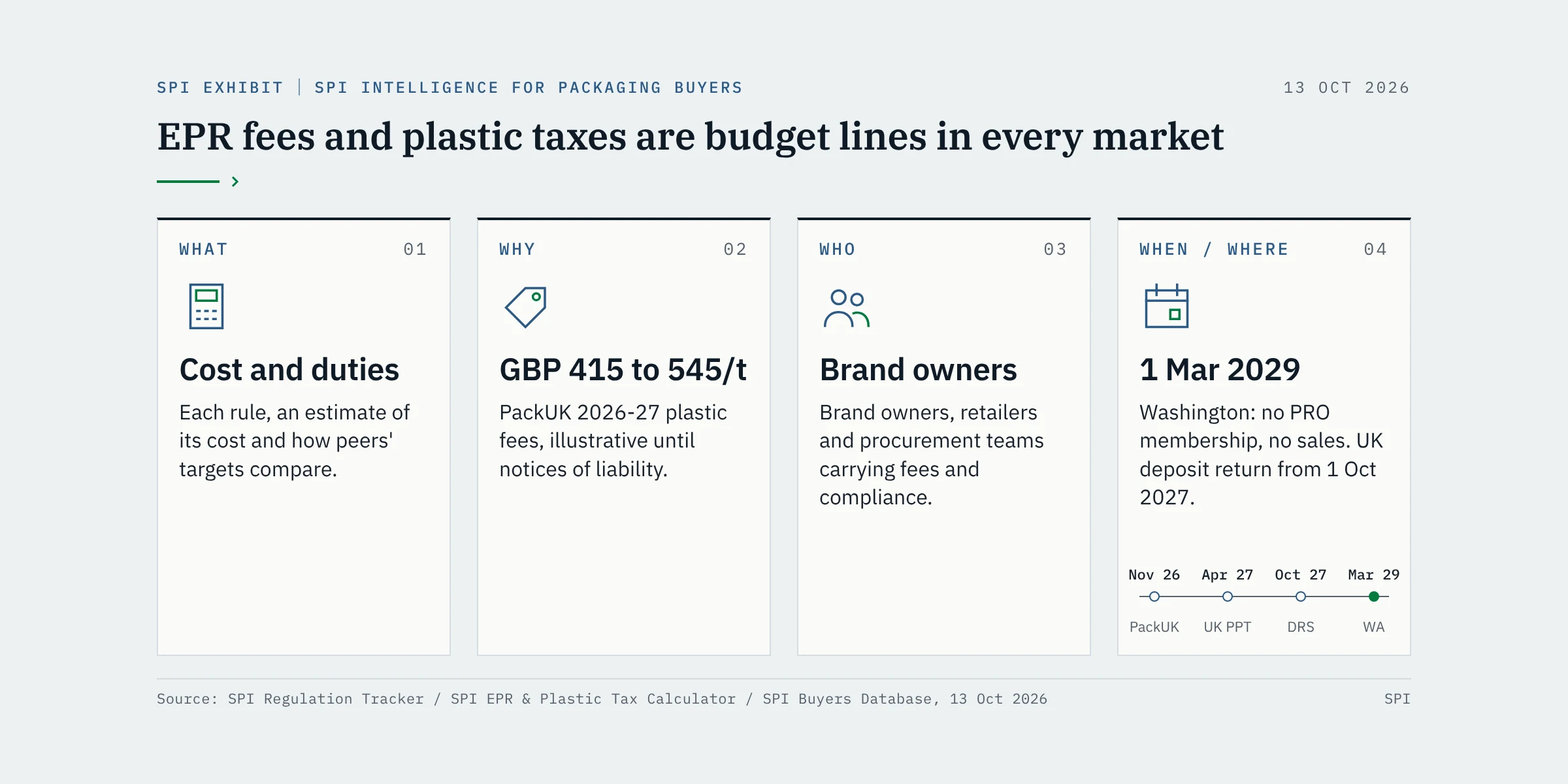
Answer: Brand owners and packaging buyers carry EPR fees, plastic taxes, registration duties and deposit return obligations in every market they sell in, and Strategic Packaging Insights (SPI) shows each rule, an estimate of its cost and how peers’ packaging targets compare, all traced to official sources.
The practical questions are what to budget for EPR and plastic tax, which registrations fall due, when deposit return starts and how your targets compare with peers’. Every fact below comes from the free SPI Regulation Tracker, SPI EPR & Plastic Tax Calculator or SPI Buyers Database, rechecked on 13 October 2026.
By the SPI team · Figures as of 13 October 2026
79
Packaging rules tracked
across 25 jurisdictions, each with its official source
SPI Regulation Tracker
216
Published fee and tax rate rows
in 14 markets
SPI EPR & Plastic Tax Calculator
179
Public packaging targets
from 42 brand owners and retailers
SPI Buyers Database
6
US states with packaging EPR duties already applying
Oregon, Colorado, California, Minnesota, Maryland, Washington
SPI Regulation Tracker
Source: SPI Regulation Tracker, SPI EPR & Plastic Tax Calculator, SPI Buyers Database, checked 14 Oct 2026.
Key facts
- The UK Plastic Packaging Tax is £228.82 per tonne from 1 April 2026 on components with less than 30% recycled plastic; from 1 April 2027 pre-consumer plastic no longer counts towards the 30% (PR-GB-001, GOV.UK, checked 13 October 2026).
- PackUK’s 2026-27 plastic fees of £415, £455 and £545 per tonne are illustrative; PackUK plans to issue year 2 notices of liability by the end of November 2026 (PR-GB-003, PackUK operational plan, updated 10 August 2026).
- Spain taxes non-reusable plastic packaging at EUR 0.45 per kg of non-recycled plastic, since 1 January 2023 (PR-ES-001, Agencia Tributaria, checked 13 October 2026).
- California SB 54 permanent regulations took effect on 1 May 2026, and producers had until 1 June 2026 to register (PR-US-004, CalRecycle).
- Since July 2025, producers not participating in Colorado’s programme may not sell covered products there, and dues have been payable since January 2026 (PR-US-003, CDPHE).
- Deposit return for PET, steel and aluminium drinks containers of 150 ml to 3 litres starts on 1 October 2027 in England, Northern Ireland and Scotland (PR-GB-004, PR-GB-005, legislation.gov.uk).
- The PPWR duty to appoint an authorised representative for direct sales in other Member States has applied since 12 August 2026; a proposal to suspend it was not adopted at 13 October 2026 (PR-EU-012, EUR-Lex COM(2025) 982).
What is changing for packaging buyers
EPR fees and plastic taxes in Europe
- UK Plastic Packaging Tax. Charged on plastic packaging components manufactured in or imported into the UK with less than 30% recycled plastic, at £228.82 per tonne from 1 April 2026 (PR-GB-001). Registration applies once a business passes a 10 tonne test. Immediate packaging of licensed human medicines and transport packaging used to import goods are exempt. No 2027 rate had been published at 13 October 2026.
- UK packaging EPR. Under SI 2024/1332, in force since 1 January 2025, UK producers supplying more than 25 tonnes of packaging with turnover of £1 million or more register and report data; large producers (over £2 million and more than 50 tonnes) also pay household packaging disposal fees (PR-GB-002). For 2026-27 PackUK’s fees are eco-modulated: eco-modulation varies fees by recyclability, here as green, amber and red ratings under the recyclability assessment methodology. Red-rated packaging pays about 20% above the amber base and green gets a provisional discount of about 9% (PR-GB-003).
- Spain. EUR 0.45 per kg of non-recycled plastic in non-reusable packaging, under Law 7/2022 (PR-ES-001). Recycled content is excluded only when certified by an accredited entity, and imports with no more than 5 kg of non-recycled plastic are exempt. Royal Decree 1055/2022 extends EPR to commercial and industrial packaging and sets a 20% reuse target for it in 2030 (PR-ES-002).
- EU plastic own resource. Member States, not companies, pay EUR 0.80 per kg of non-recycled plastic packaging waste to the EU budget (PR-EU-017). Proposal COM(2025) 574 would raise it to EUR 1 per kg from 2028; it is proposed, not adopted (PR-EU-018).
Registration and representation
- PPWR authorised representative. Regulation (EU) 2025/40 has applied since 12 August 2026 (PR-EU-001). A producer selling directly to end users in another Member State must appoint an authorised representative for EPR there. Proposal COM(2025) 982 would suspend Article 45(3) until 1 January 2035 for EU-established producers; Parliament’s ENVI committee voted on 5 October 2026, but it is not adopted (PR-EU-012). Producers established outside the EU would not be covered by the suspension.
- Germany. The VerpackDG replaced the Packaging Act on 12 August 2026: producers register in LUCID and join a system for packaging that reaches private final consumers, and foreign sellers shipping directly to German end users need an authorised representative (PR-DE-001).
- Canada. The Federal Plastics Registry requires producers placing 1,000 kg or more of plastic on the market to report quantities for 2024, 2025 and 2026 data (PR-CA-002).
SPI analysis
Registration now precedes payment in several markets. Not taking part can block sales before any fee is due: in Colorado since July 2025, and in Washington from 1 March 2029. A compliance calendar built only around fee invoices will miss these dates.
US state packaging EPR
Seven state packaging EPR laws are in the SPI Regulation Tracker. Producer duties already apply in six of them; Maine has no stewardship organisation under contract. The tracker statuses of the Minnesota, Maryland and Washington records are being updated in the 13 October check to reflect duties that now apply. A producer responsibility organisation (PRO) is the body producers join to meet EPR duties; Circular Action Alliance (CAA) is the PRO in each state where one is named.
- Oregon
- Minnesota
- Colorado
- Washington
- Other
- Oregon: CAA may charge producer feesOregon
- Minnesota: PRO membership requiredMinnesota
- Colorado: non-participating producers may not sell covered productsColorado
- Colorado: dues payableColorado
- Washington: producers appoint a PROWashington
- Maryland: CAA producer registration and reportingMaryland
- California: SB 54 producer registration deadlineCalifornia
- Washington: membership of a registered PROWashington
- Oregon: first life cycle impact disclosure for 25 largest producersOregon
- Maryland: first producer responsibility plan dueMaryland
- Minnesota: first stewardship plan dueMinnesota
- Minnesota: producer-funded reimbursement starts at 50%Minnesota
- Washington: non-members may not sell covered productsWashington
Source: SPI Regulation Tracker and SPI rule notes, checked 14 Oct 2026.
Maine dates not set: no stewardship organisation under contract at 13 October 2026.
Show the data
| Date | Label | Category | Link |
|---|---|---|---|
| 2025-07-01 | Oregon: CAA may charge producer fees | Oregon | /data/packaging-regulation-tracker/united-states/ |
| 2025-07-01 | Minnesota: PRO membership required | Minnesota | /data/packaging-regulation-tracker/united-states/ |
| 2025-07 | Colorado: non-participating producers may not sell covered products | Colorado | /data/packaging-regulation-tracker/united-states/ |
| 2026-01 | Colorado: dues payable | Colorado | /data/packaging-regulation-tracker/united-states/ |
| 2026-01-01 | Washington: producers appoint a PRO | Washington | /data/packaging-regulation-tracker/united-states/ |
| 2026-05-31 | Maryland: CAA producer registration and reporting | Maryland | /data/packaging-regulation-tracker/united-states/ |
| 2026-06-01 | California: SB 54 producer registration deadline | California | /data/packaging-regulation-tracker/united-states/ |
| 2026-07-01 | Washington: membership of a registered PRO | Washington | /data/packaging-regulation-tracker/united-states/ |
| 2026-12-31 | Oregon: first life cycle impact disclosure for 25 largest producers | Oregon | /data/packaging-regulation-tracker/united-states/ |
| 2028-07-01 | Maryland: first producer responsibility plan due | Maryland | /data/packaging-regulation-tracker/united-states/ |
| 2028-10-01 | Minnesota: first stewardship plan due | Minnesota | /data/packaging-regulation-tracker/united-states/ |
| 2029-02 | Minnesota: producer-funded reimbursement starts at 50% | Minnesota | /data/packaging-regulation-tracker/united-states/ |
| 2029-03-01 | Washington: non-members may not sell covered products | Washington | /data/packaging-regulation-tracker/united-states/ |
- Oregon (PR-US-002): producers of packaging, paper products and food serviceware register with CAA, report supply data and pay fees, which CAA could charge from 1 July 2025. The 25 largest producers by weight owe a first life cycle impact disclosure by 31 December 2026.
- Colorado (PR-US-003): CAA’s plan was approved in December 2025, dues have been payable since January 2026, and non-participating producers have been barred from selling covered products since July 2025.
- California SB 54 (PR-US-004): permanent regulations took effect on 1 May 2026, and by 1 June 2026 producers had to join CAA, register as an independent producer or apply for the small producer exemption (under USD 1 million gross annual sales). CAA submitted its PRO plan to the Advisory Board on 15 June 2026; fee start dates were not published at 13 October 2026.
- Minnesota (PR-US-006): PRO membership required since 1 July 2025; the first stewardship plan is due 1 October 2028, and producer funding of service costs phases in from 50% in February 2029 to at least 90% in 2031.
- Maryland (PR-US-007): the Act has been in effect since 1 June 2025; CAA set 31 May 2026 for producers to register and report, and the first plan is due 1 July 2028. Producers face a target to cut packaging waste by at least 25% within five years of first plan approval.
- Washington (PR-US-008): producers had to appoint a PRO by 1 January 2026 and be members of a registered PRO from 1 July 2026; from 1 March 2029 non-members may not introduce covered materials. De minimis producers (under one ton and under USD 5 million revenue) are exempt.
- Maine (PR-US-001): a 2026 request for proposals drew no bids, and on 11 September 2026 DEP announced it will revise it, so first payment dates are not set.
- Labelling. California SB 343 restricts recyclability claims on packaging made after 4 October 2026; a federal court injunction of 14 July 2026 blocks enforcement, and its tracker status is being updated in the 13 October check (PR-US-011).
SPI analysis
A single US budget line hides very different timing. Membership and data duties already apply in six states, while fees range from live (Oregon, Colorado) to undetermined (California, Maryland) and 2029 or later (Minnesota). Budget each state separately and treat supply data quality as a cost driver: Oregon sets fees on reported supply.
Canada, India and Viet Nam
Producers became fully responsible for Ontario’s Blue Box programme on 1 January 2026, with best-efforts obligations for 2026 and 2027 and 2032 targets including 60% for rigid plastics (PR-CA-003). Quebec’s modernised system, run through Éco Entreprises Québec, took effect on 1 January 2025 (PR-CA-006), and British Columbia’s Recycle BC programme has run since 2014 (PR-CA-004). In India, producers, importers and brand owners register and file returns on CPCB’s EPR portal (PR-IN-001), and Category I plastic packaging carries recycled-content obligations of 30%, 40%, 50% and 60% from 2025-26 to 2028-29 onwards (PR-IN-002). Viet Nam’s Decree 110/2026, effective 25 May 2026, sets mandatory recycling rates such as 22% for rigid PET and 10% for flexible plastic, for producers above 30 billion VND revenue (PR-VN-001).
Deposit return
A deposit return system is a refundable charge on a drinks container, repaid when it is returned. Member States must separately collect 90% by weight of single-use plastic and metal beverage containers up to three litres by 1 January 2029, in principle through deposit systems (PR-EU-007).
| Market | Start | Deposit | Scope | Rule |
|---|---|---|---|---|
| Ireland | 1 February 2024 | EUR 0.15 (150 to 500 ml); EUR 0.25 (500 ml to 3 litres) | PET bottles, aluminium and steel cans | PR-IE-001 |
| Austria | 1 January 2025 | EUR 0.25 | Single-use plastic and metal, 0.1 to 3 litres | PR-AT-001 |
| Poland | October 2025 | PLN 0.50; PLN 1 reusable glass | Plastic bottles to 3 litres, cans to 1 litre, reusable glass to 1.5 litres | PR-PL-001 |
| Portugal | 10 April 2026 | EUR 0.10 | Non-reusable plastic, ferrous metal and aluminium | PR-PT-001 |
| England, Northern Ireland, Scotland | 1 October 2027 | Not yet set | PET, steel and aluminium, 150 ml to 3 litres; glass excluded | PR-GB-004, PR-GB-005 |
In the UK, drinks producers register with the deposit management organisation, pay a fee and an amount equal to the deposit on each item, and print the scheme logo and return code. Scotland’s scheme administrator has collection targets of 70% for 2028, 80% for 2029 and 90% from 2030.
Key dates for packaging buyers
| Date | Jurisdiction | Rule | What it means for buyers |
|---|---|---|---|
| 13 November 2026 | Minnesota | Needs assessment comment closes (PR-US-006) | Input on future collection lists |
| End of November 2026 | United Kingdom | PackUK year 2 notice of liability (PR-GB-003) | Illustrative budget becomes an invoice |
| 31 December 2026 | Oregon | Life cycle impact disclosure (PR-US-002) | Applies to the 25 largest producers |
| 1 April 2027 | United Kingdom | PPT changes (PR-GB-001) | Recycled-content evidence must exclude pre-consumer plastic |
| 1 October 2027 | UK | Deposit return (PR-GB-004, PR-GB-005) | Registration, deposits and new artwork |
| 12 August 2028 at the earliest | EU | Harmonised sorting label (PR-EU-003) | EU artwork change; 24 months after the implementing act if later |
| 1 March 2029 | Washington | Market access condition (PR-US-008) | No PRO membership, no sales |
A worked illustration: budgeting EPR and plastic tax
An illustration, not an estimate for any real company. Using calculator rates, assume a brand places 100 tonnes of household plastic packaging on each market in one year: 60 tonnes of PET drinks bottles and 40 tonnes of flexible film.
| Line | United Kingdom 2026-27 (GBP) | Spain 2026 (EUR) |
|---|---|---|
| EPR fee, 60 t PET bottles | 27300 (amber 455 per t) | 16260 (271 per t) |
| EPR fee, 40 t film | 18200 (amber 455 per t) | 49720 (1243 per t) |
| Plastic tax | 9152.80 (40 t film below 30% recycled, 228.82 per t) | 33750 (75 t non-recycled, 0.45 per kg) |
| Total | 54652.80 | 99730 |
Source: SPI EPR & Plastic Tax Calculator (FEE-GB-014, FEE-GB-025, FEE-ES-103, FEE-ES-109, FEE-ES-001), checked 13 Oct 2026.
Illustration only. Currencies not converted. Assumes household packaging, a large UK producer and stated recycled-content shares.
United Kingdom (2026-27). At the illustrative amber rate of £455 per tonne (FEE-GB-014), the PackUK fee on 100 tonnes is £45,500. If the bottles reach 30% recycled plastic and the film does not, Plastic Packaging Tax at £228.82 per tonne (FEE-GB-025) is £9,152.80 on the film; if no component reached 30%, it would be £22,882. Total at amber: £54,652.80.
Spain (2026). Ecoembes fees are EUR 16,260 on the bottles at EUR 271 per tonne (FEE-ES-103) and EUR 49,720 on the film at EUR 1,243 per tonne (FEE-ES-109). With 25% recycled content overall, 75 tonnes is non-recycled, so plastic tax at EUR 0.45 per kg (FEE-ES-001) is EUR 33,750. Total: EUR 99,730.
Not included: Spanish per-unit charges and eco-modulation, confirmed PackUK fees, and supplier pass-through.
SPI analysis
Budget UK fees as a range, not a point, until PackUK confirms them. The 30% Plastic Packaging Tax threshold applies per component, while most peer targets below are portfolio averages, several of them under 30%, so buyers need component-level recycled-content data from suppliers. Material choice and recycled content are budget levers, not only sustainability metrics.
How your peers' targets compare
The SPI Buyers Database holds 179 public targets from 42 brand owners and retailers, each with the company’s own report behind it. Recycled content in plastic packaging, as reported by each company:
- Target
- Latest
Source: Company reports via SPI Buyers Database, checked 13 Oct 2026.
Company-reported; SPI does not audit. Coca-Cola target is 30 to 35% recycled plastic, lower bound shown, against 30% recycled material in primary packaging. Reckitt reports a year in arrears (2024).
Show the data
| Company, target year | Target | Latest |
|---|---|---|
| L'Oréal (by 2030, not reported) | 100 | 50 |
| HEINEKEN (by 2030, in progress) | 50 | 48 |
| Diageo (by 2030, in progress) | 50 | 47 |
| Diageo (by 2025, met) | 35 | 44 |
| L'Oréal (by 2030, in progress) | 50 | 44 |
| ITC Limited (by 2030, on track) | 60 | 35.5 |
| Marico (by 2030, in progress) | 60 | 32.2 |
| The Coca-Cola Company (by 2035, in progress) | 35 | 30 |
| Henkel (by 2030, in progress) | 35 | 28 |
| Colgate-Palmolive (by 2025, met) | 25 | 27 |
| Lidl (by 2025, met) | 25 | 26 |
| Starbucks (by 2030, in progress) | 25 | 25 |
| Unilever (by 2025, met) | 25 | 25 |
| Carrefour (by 2025, missed) | 30 | 24 |
| Nestlé (no year, not reported) | no data | 20.6 |
| The Coca-Cola Company (by 2035, in progress) | 30 | 20 |
| The Estée Lauder Companies (by 2025, missed) | 25 | 20 |
| The Estée Lauder Companies (by 2030, in progress) | 25 | 20 |
| Kimberly-Clark (by 2025, missed) | 20 | 18 |
| PepsiCo (by 2035, in progress) | 40 | 18 |
| Keurig Dr Pepper (by 2035, in progress) | 25 | 16 |
| Keurig Dr Pepper (by 2025, not reported) | 25 | 16 |
| Ahold Delhaize (by 2025, not reported) | 25 | 15.7 |
| Target (by 2025, not reported) | 20 | 13 |
| Henkel (by 2028, in progress) | 45 | 12 |
| Reckitt (by 2025, not reported) | 25 | 12 |
| Walmart (by 2025, missed) | 20 | 12 |
| Walmart (by 2025, missed) | 17 | 10.7 |
| Mars (no year, in progress) | 30 | 9.2 |
| Mars (by 2025, not reported) | 30 | 9.2 |
| ITC Limited (by 2030, on track) | 20 | 4.5 |
| Mondelēz International (by 2030, in progress) | 5 | 3.7 |
| Dabur India (by 2026, not reported) | 30 | 2 |
- Unilever, Colgate-Palmolive and Lidl report meeting 25% recycled-content goals for 2025.
- Kimberly-Clark (18% against 20%), Carrefour (24.0% against 30%) and Walmart (10.7% against 17% globally) missed theirs.
- Reckitt reports 12% for 2024 against 25% by 2025 and expects to report slightly behind the 2025 target.
- Henkel reports 28% against 35% or more by 2030, PepsiCo 18% against 40% or more by 2035, and The Coca-Cola Company 30% recycled material in primary packaging against 35% to 40% by 2035.
Which markets the tracker covers
By jurisdiction, ranked
Source: SPI Regulation Tracker, checked 14 Oct 2026.
Shown by jurisdiction as a ranked list.
Show the data
| ISO2 | Value | Label |
|---|---|---|
| EU | 18 | European Union |
| US | 13 | United States |
| GB | 7 | United Kingdom |
| CA | 6 | Canada |
| IN | 4 | India |
| CN | 3 | China |
| FR | 3 | France |
| AU | 2 | Australia |
| CO | 2 | Colombia |
| DE | 2 | Germany |
| ES | 2 | Spain |
| JP | 2 | Japan |
| KE | 2 | Kenya |
| NZ | 2 | New Zealand |
| AE | 1 | United Arab Emirates |
| AT | 1 | Austria |
| BR | 1 | Brazil |
| CL | 1 | Chile |
| ID | 1 | Indonesia |
| IE | 1 | Ireland |
| PH | 1 | Philippines |
| PL | 1 | Poland |
| PT | 1 | Portugal |
| VN | 1 | Vietnam |
| ZA | 1 | South Africa |
Questions you ask, and where SPI answers them
- Which packaging rules apply in our markets? Filter the SPI Regulation Tracker by jurisdiction, material and status. It shows rules we track, not every rule that may apply.
- What deadlines are coming? Use the tracker’s upcoming-deadlines table, alerts sign-up or CSV export. It does not tell you which deadlines bind your company.
- What could EPR and plastic tax cost us? The SPI EPR & Plastic Tax Calculator applies published rates to your tonnages, with each source shown. It is not a tax determination.
- How do our targets compare? The SPI Buyers Database lists each peer target with year, progress and source.
- How do fees differ by material? See EPR fees per tonne in 2026 and plastic packaging taxes in 2026.
- Who could supply recycled-content packaging? No free SPI tool answers this today; the SPI Converter & Supplier Directory is not yet available, so supplier mapping is done as consulting work from public sources.
How SPI builds this
Each of the 79 tracker records in 25 jurisdictions carries its official source, dates, status and last-checked date, plus its own page with an SPI note on scope, actions and open points. On 13 October 2026 the SPI team re-read 56 tracker records against their official sources and updated 46. The calculator applies 216 published rate rows in 14 markets, and every peer target links to the company’s own statement. See the SPI Methodology.
| Stage | Buyer question | SPI tool | Next step if needed |
|---|---|---|---|
| Understand | Which rules and deadlines apply in our markets? | SPI Regulation Tracker | Regulatory Intelligence monitoring |
| Evaluate | What will EPR and plastic tax cost, by material? | SPI EPR & Plastic Tax Calculator | Exposure assessment |
| Discover | How do peers’ targets compare? Who else could supply? | SPI Buyers Database | Procurement & Supplier Intelligence |
| Decide | Which redesign or sourcing change to fund? | SPI Briefing | Sustainable Packaging Strategy |
| Implement | Deliver and monitor | Sprint, Programme or Retainer | Custom research |
Limitations and what SPI does not do
The tracker’s 79 rules are not every packaging rule. The Buyers Database covers 42 large brand owners and retailers, uses company reports SPI does not audit, and holds no contacts, purchase volumes, supplier relationships or specifications. The calculator covers 14 markets; UK PackUK fees are illustrative, and Germany and Ontario are not included because no public fee table exists. SPI does not give legal, tax or financial advice, carry out testing or certification, or file with regulators. Where you need these, we can point you to a qualified provider. See our corrections log.
When you need more than the data
- Packaging Regulatory Intelligence: maps EPR, tax, ban, labelling and deposit rules to your materials and markets, with an obligation map, exposure scenarios with sourced rates, a deadline calendar and optional monitoring.
- Packaging Procurement & Supplier Intelligence: supplier long-list and short-list with public capability evidence, a comparison matrix and a diversification memo. Supplier claims are reported as claimed, not audited.
- Sustainable Packaging Strategy: an options matrix, peer benchmark and redesign roadmap for alternatives that meet targets and rules.
Formats are Briefing, Sprint, Programme or Retainer, and pricing is on request. To discuss one, send an enquiry. Related: SPI Intelligence for Packaging Manufacturers and SPI Intelligence for Converters.
Frequently asked questions
How much is UK Plastic Packaging Tax in 2026?
From 1 April 2026 the rate is £228.82 per tonne on plastic packaging components manufactured in or imported into the UK with less than 30% recycled plastic (PR-GB-001). Components at or above 30% are not taxed. From 1 April 2027 pre-consumer plastic no longer counts towards the 30%.
What is PackUK and are its 2026-27 fees final?
PackUK is the scheme administrator for UK packaging EPR. As of 13 October 2026 its plastic fees of £415, £455 and £545 per tonne are illustrative, and its operational plan targets year 2 notices of liability by the end of November 2026 (PR-GB-003).
What is California SB 54?
SB 54 is California’s packaging EPR law. It requires producers of single-use packaging and plastic food service ware to join a PRO (Circular Action Alliance) or comply individually, and to meet 2032 source reduction, recycling and recyclability goals; permanent regulations took effect on 1 May 2026 and registration applied by 1 June 2026 (PR-US-004).
Which US states have packaging EPR?
The SPI Regulation Tracker records seven: Oregon, Colorado, California, Minnesota, Maryland and Washington, where producer duties already apply, and Maine, where no stewardship organisation is yet under contract. See the United States page.
How does Oregon EPR work?
Producers of packaging, paper products and food serviceware sold into Oregon register with Circular Action Alliance, report supply data and pay fees, which CAA could charge from 1 July 2025 (PR-US-002). Fees are set on reported supply, and the 25 largest producers owe a life cycle impact disclosure by 31 December 2026.
When does the UK deposit return scheme start?
Do companies pay the EU plastic own resource?
Do we still need a PPWR authorised representative?
The duty has applied since 12 August 2026 for producers selling directly to end users in another Member State. Proposal COM(2025) 982 would suspend it for EU-established producers until 2035, but it was not adopted at 13 October 2026 (PR-EU-012). Confirm your position with counsel.
Sources
- GOV.UK, Plastic Packaging Tax: steps to take (PR-GB-001). https://www.gov.uk/guidance/check-if-you-need-to-register-for-plastic-packaging-tax (checked 13 October 2026)
- legislation.gov.uk, Finance Act 2021 section 45 (FEE-GB-025). https://www.legislation.gov.uk/ukpga/2021/26/section/45
- legislation.gov.uk, SI 2024/1332 (PR-GB-002); GOV.UK, EPR for packaging: check if your business is affected. https://www.legislation.gov.uk/uksi/2024/1332/introduction/made ; https://www.gov.uk/guidance/check-if-you-must-comply-with-epr-for-packaging–2 (checked 13 October 2026)
- GOV.UK (PackUK), Year 2 illustrative waste disposal fees (PR-GB-003, FEE-GB-013 to 015). https://www.gov.uk/government/publications/illustrative-waste-disposal-fees-2026-extended-producer-responsibility-for-packaging/year-2-illustrative-waste-disposal-fees-extended-producer-responsibility-for-packaging (checked 13 October 2026)
- GOV.UK, PackUK operational plan 2026 to 2027. https://www.gov.uk/government/publications/packuk-operational-plan/packuk-operational-plan-2026-to-2027 (checked 13 October 2026)
- legislation.gov.uk, SI 2025/67 (PR-GB-004) and SSI 2025/188 (PR-GB-005). https://www.legislation.gov.uk/uksi/2025/67/made ; https://www.legislation.gov.uk/ssi/2025/188/made (checked 13 October 2026)
- Agencia Tributaria, Spanish plastic packaging tax (PR-ES-001); BOE, Ley 7/2022 (FEE-ES-001); BOE, Real Decreto 1055/2022 (PR-ES-002). https://sede.agenciatributaria.gob.es/Sede/impuestos-especiales-medioambientales/impuesto-especial-sobre-envases-plastico-reutilizables/base-imponible-tipo-impositivo-cuota-tributaria.html ; https://www.boe.es/buscar/act.php?id=BOE-A-2022-5809 ; https://www.boe.es/buscar/act.php?id=BOE-A-2022-22690
- Ecoembes, Precios 2026 (FEE-ES-103, FEE-ES-109). https://ecoembesempresas.com/app/uploads/2025/06/Ecoembes_Precios2026.pdf
- European Parliament Legislative Observatory, Regulation (EU) 2025/40 summary (PR-EU-001, PR-EU-003, PR-EU-007). https://oeil.europarl.europa.eu/oeil/en/document-summary?id=1802233 (checked 13 October 2026)
- EUR-Lex, Commission proposal COM(2025) 982 (PR-EU-012). https://eur-lex.europa.eu/legal-content/EN/TXT/HTML/?uri=CELEX:52025PC0982 (checked 13 October 2026)
- EUR-Lex, Council Decision (EU, Euratom) 2020/2053 (PR-EU-017); Legislative Observatory, 2025/0574(CNS) (PR-EU-018). https://eur-lex.europa.eu/legal-content/EN/TXT/HTML/?uri=CELEX:32020D2053 ; https://oeil.europarl.europa.eu/oeil/en/document-summary?id=1830552
- Bundesgesetzblatt, BGBl. 2026 I Nr. 207 (PR-DE-001). https://www.recht.bund.de/bgbl/1/2026/207/VO.html
- Oregon DEQ (PR-US-002). https://oregon.gov/deq/recycling/Pages/Producers-of-Covered-Products.aspx
- CDPHE (PR-US-003). https://cdphe.colorado.gov/hm/epr-program
- CalRecycle, SB 54 regulations (PR-US-004) and SB 343 (PR-US-011). https://content.govdelivery.com/accounts/CALRECYCLE/bulletins/4157d91 ; https://calrecycle.ca.gov/wcs/recyclinglabels/
- MPCA fact sheet (PR-US-006). https://www.pca.state.mn.us/sites/default/files/w-ps1-05b%20.pdf
- Maryland General Assembly, Chapter 431 (PR-US-007). https://mgaleg.maryland.gov/2025RS/chapters_noln/Ch_431_sb0901E.pdf
- Washington Legislature, RCW 70A.208.040 (PR-US-008). https://app.leg.wa.gov/RCW/default.aspx?cite=70A.208.040
- Maine DEP (PR-US-001). https://www.maine.gov/dep/waste/recycle/epr.html
- RPRA (PR-CA-003); Gouvernement du Québec (PR-CA-006); B.C. Government, Recycle BC plan and approval 2025 (PR-CA-004); Canada.ca, Federal Plastics Registry (PR-CA-002). https://rpra.ca/2026/01/ontario-completes-transition-to-producer-run-blue-box-program/ ; https://www.environnement.gouv.qc.ca/matieres/consigne-collecte/collecte-selective-modernisee-en.htm ; https://www2.gov.bc.ca/assets/gov/environment/waste-management/recycling/recycle/residential-packaging-and-paper-recyclebc/recyclebc_plan_and_approval_2025.pdf ; https://www.canada.ca/en/environment-climate-change/services/managing-reducing-waste/reduce-plastic-waste/federal-plastics-registry.html
- NGT, CPCB reply in OA 1179 of 2024 (PR-IN-001); MoEFCC Gazette G.S.R. 237(E) (PR-IN-002). https://www.greentribunal.gov.in/sites/default/files/news_updates/REPLY%20BY%20R-2%20CPCB%20IN%20OA%20NO.%201179%20of%202024%20HARIYALI%20WELFARE%20SOCIETY%20VS%20UNION%20OF%20INDIA.pdf ; https://www.mpcb.gov.in/sites/default/files/standing_orders/Plastic_Waste_Management_2026.pdf
- Official Gazette of Viet Nam, Decree 110/2026/NĐ-CP (PR-VN-001). https://congbaocdn.chinhphu.vn/180507251028987904/2026/4/20/469301-1776647243_v1_1776647876_signed.pdf
- Deposit return: RIS, BGBl. II Nr. 283/2023 (PR-AT-001); gov.ie (PR-IE-001); APA FAQ (PR-PT-001); gov.pl (PR-PL-001). https://www.ris.bka.gv.at/Dokumente/BgblAuth/BGBLA_2023_II_283/BGBLA_2023_II_283.html ; https://www.gov.ie/en/press-release/8526d-irelands-deposit-return-scheme-is-now-live ; https://apambiente.pt/sites/default/files/_Residuos/FluxosEspecificosResiduos/ERE/SDR/perguntas-frequentes-sdr.pdf ; https://www.gov.pl/web/klimat/system-kaucyjny
- Company sources for the peer comparison, as linked on each SPI Buyers Database profile (rechecked 13 October 2026).
Ask the SPI team
What changes for your packaging next quarter?
Tell us your markets and materials. The SPI team walks you through the rules and buyer commitments that affect them.
Prefer email? Write to sales@strategicpackaginginsights.com.
- Q1
Which packaging rules apply to us in each market we sell in?
We map each market's EPR, tax, ban, recycled-content, labelling and deposit rules against your materials and formats, and show which are in force, adopted or only proposed.
- Q2
What could EPR fees and plastic taxes cost us next year?
We apply published fee tables and tax rates to your tonnages and recycled content, and show the result as scenarios with every rate sourced.
- Q3
Can you tell us when a rule changes?
Yes. The free tracker alerts cover rule changes by country; a monitoring retainer adds monthly notes on what the changes mean for your portfolio.