
SPI Ledger: Packaging Regulation, EPR Fee and Brand Target Analysis from SPI Data
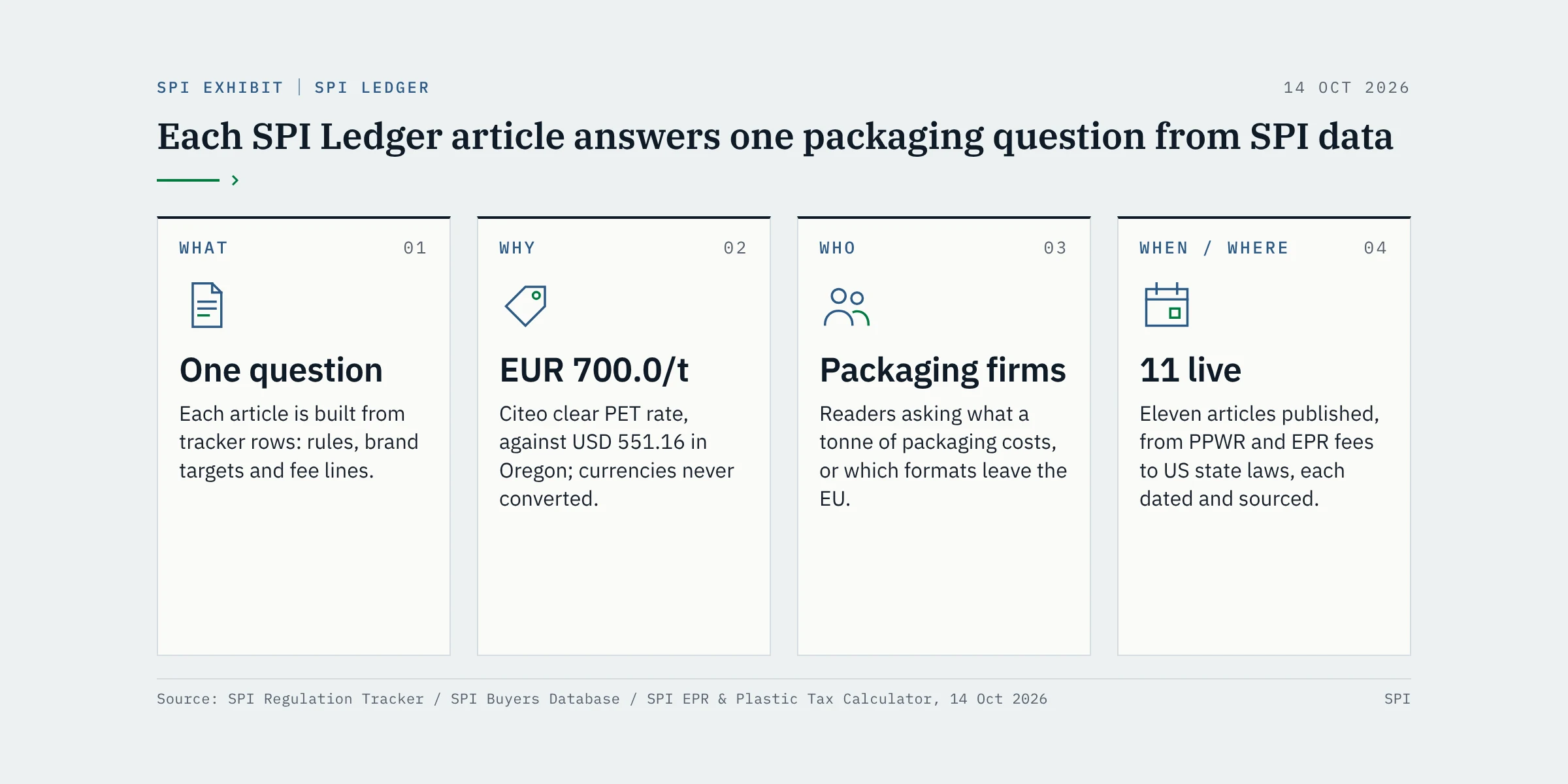
SPI Ledger is where Strategic Packaging SPI Ledger (SPI) answers one packaging question per article, using its own sourced datasets on packaging rules, brand owner targets and EPR fees, with every figure traced to an official or company source and dated.
Each article starts from rows in the SPI Trackers: 79 packaging rules in 25 jurisdictions, 179 public packaging targets from 42 brand owners and retailers, and 216 published fee and tax rates from 14 markets. Figures are re-checked against the trackers on the day an article is published, and SPI’s own reading is labelled “SPI analysis”.
By the SPI team · Figures as of 13 October 2026
79
Packaging rules behind the analysis
in 25 jurisdictions, each with an SPI rule note
SPI Regulation Tracker, 13 Oct 2026
179
Brand owner packaging targets
from 42 brand owners and retailers
SPI Buyers Database, 13 Oct 2026
216
Published EPR fee and plastic tax rates
from 14 markets, in their own currency
SPI EPR & Plastic Tax Calculator, 13 Oct 2026
19
Targets due by 2025 reported missed
company-reported results
SPI Buyers Database, 13 Oct 2026
Source: SPI Trackers, checked 14 Oct 2026.
News analysis
EPR notice of liability for year 2: a missed PackUK instalment can cost more than the whole bill
PackUK intends to send the UK EPR notice of liability for year 2 (2026 to 2027) by the end of November 2026; it is the invoice for each large producer's disposal fee and administration fee, payable on the instalment dates it states, and an instalment still unpaid 50 days after its due date exposes the producer to a penalty equal…
20 min read
News analysis
Modelo 592: Spain’s plastic tax return falls due 20 days after each quarter, the stock ledger a month after
Modelo 592 is the self-assessment return for Spain's special tax on non-reusable plastic packaging, charged at EUR 0.45 per kilogram of non-recycled plastic; manufacturers and intra-EU acquirers file it electronically within the…
19 min read
News analysis
CPCB EPR portal registration costs INR 10,000 to INR 50,000, but the annual return keeps it alive
CPCB EPR portal registration is mandatory for every producer, importer and brand owner of plastic packaging in India before it trades: the application fee is INR 10,000, INR 20,000 or INR 50,000…
19 min read
News analysis
AB 793 recycled content: California’s 25% bottle floor holds, and 2025 data show who faces the 50% step
AB 793 recycled content rules, in Public Resources Code section 14547, require every beverage manufacturer that sells CRV plastic beverage containers in California to use on average at least 25% postconsumer recycled…
19 min read
News analysis
Valorlux tarifs 2026: coloured PET up 60.3%, steel 46.1% and HDPE 27.0%, plus a new PET tray line
The Valorlux tarifs 2026 for Luxembourg household packaging, approved at its October 2025 general assembly, charge EUR 0.2498 per kg for a clear PET bottle, EUR 0.4857 for other-coloured PET (up 60.3%…
19 min read
News analysis
Henkel Sustainable Impact Report 2025: 28% recycled plastic, 88% designed for recycling, and the rules ahead
The Henkel Sustainable Impact Report 2025, published on 14 April 2026, gives 28% recycled plastic in consumer goods packaging against a 2025 goal of more than 30%, and 88% of packaging designed…
20 min read
News analysis
LUCID Verpackungsregister after the VerpackDG: who registers and how foreign sellers name a representative
The LUCID Verpackungsregister is Germany's packaging producer register, run by the Zentrale Stelle Verpackungsregister (ZSVR); since 12 August 2026, section 6 of the VerpackDG requires every producer under the EU PPWR to…
19 min read
News analysis
Register for plastic packaging tax: two 10 tonne tests, 30 days to notify HMRC, then four returns a year
To register for plastic packaging tax, a UK manufacturer or importer of finished plastic packaging components has to tell HMRC within 30 days of meeting either of two 10 tonne tests in…
20 min read
News analysis
California SB 343: the chasing arrows cutoff passed on 4 October 2026, but an injunction holds enforcement
California SB 343, now Public Resources Code section 42355.51, treats the chasing arrows or any recyclable claim as deceptive on products and packaging manufactured after 4 October 2026 unless the material type…
19 min read
News analysis
Recycle BC fee schedule 2026: a 17.6% average rise, a CAD 7.5 million drawdown and flat fees to CAD 13,900
The Recycle BC fee schedule 2026 prices 23 material lines from 29 cents per kg for magazines to 407 cents per kg for expanded polystyrene; Recycle BC puts the average rise at…
20 min read
News analysis
Nestlé packaging sustainability strategy: a 12% to 17% virgin plastic cut by 2030 after 28.0% in 2025
The Nestlé packaging sustainability strategy, published in September 2026, replaces its 2025 goal of one third less virgin plastic, which ended at 28.0% against 2018, with a new aim of 12% to…
20 min read
News analysis
Citeo tarifs 2026: weight rates rose 12% to 31% and five maluses climbed ahead of the 2027 declaration
The Citeo tarifs 2026 for French household packaging charge 70.00 euro cents per kg for a clear PET bottle (EUR 700 per tonne, up 30.8% on 2025), 25.81 cents for paper and…
20 min read
News analysis
Ecoembes tarifas 2027: plastics and glass rise up to 7%, metals and wood hold, HDPE and UNE bags fall
The Ecoembes tarifas 2027 for household packaging (Precios 2027) are published: flexible film rises from EUR 1.243 to EUR 1.269 per kg, PET trays from EUR 0.659 to EUR 0.682, other rigid…
19 min read
News analysis
Fost Plus tarifs 2027: steel rises 77.6% and EPS 57.2% while glass, paper, clear PET and the penalty hold
Fost Plus has published its 2027 Packaging EPR rates (the former Green Dot rates) in euro per kilogram excluding VAT: of 30 lines on its rates page, 13 rise, 9 fall and…
19 min read
News analysis
Contributo ambientale CONAI 2027: glass and wood rise 20% and the importer tare rate is up 21% in a year
The contributo ambientale CONAI 2027 changes on 1 January 2027 for glass (EUR 40 to EUR 48 per tonne) and wood (EUR 10 to EUR 12), and the flat import rate on…
21 min read
News analysis
Verpact tariefdifferentiatie 2027: design steps stay at EUR 0.10 a kilo while recycled content splits off
Under the Verpact tariefdifferentiatie 2027, the Dutch plastic discount splits in two from 1 January 2027: a Design for Recycling scheme of four EUR 0.10 steps per kg, capped at EUR 0.40,…
21 min read
News analysis
Vietnam EPR Decree 110/2026: paying the Fund costs 297,000 to 1,070,000 VND a tonne, and film pays most
Vietnam EPR Decree 110/2026/ND-CP, signed on 1 April 2026 and in force since 25 May 2026, requires producers and importers of packaged food, cosmetics, medicines, fertilisers and feed, cleaning products and cement…
21 min read
News analysis
Kraft Heinz sustainability report packaging: 86% recyclable, no new targets, and the EPR and PFAS dates ahead
The latest Kraft Heinz sustainability report packaging data are still in its 2025 ESG Report, covering fiscal 2024: 86% of packaging was recyclable, reusable or compostable against a goal of 100% by…
19 min read
News analysis
China express packaging regulations bind couriers in 47 articles and reach sellers through one clause
China express packaging regulations start with the Ministry of Transport's Administrative Measures for Postal and Express Packaging (Order No. 1 of 2021), in force since 12 March 2021: their 47 articles bind…
19 min read
News analysis
Permen LHK P.75 tahun 2019: Indonesia’s 30% producer roadmap, sector tables and 2030 phase-outs
Permen LHK P.75 tahun 2019, Regulation of the Minister of Environment and Forestry No. P.75/MENLHK/SETJEN/KUM.1/10/2019 on the Roadmap for Waste Reduction by Producers, in force since 5 December 2019, requires manufacturers of…
21 min read
News analysis
New Jersey recycled content law: rigid plastic hits 20% on 18 Jan 2027, food packs reportedly wait to 2030
The New Jersey recycled content law, P.L.2021, c.391 (N.J.S.A. 13:1E-99.135 et seq.), requires manufacturers selling in the state to meet average postconsumer recycled content minimums in rigid plastic containers, plastic beverage containers,…
20 min read
News analysis
Walmart packaging goals 2025: all four fell short in FY2026, and Oregon and California set the next dates
The Walmart packaging goals 2025 deadline covered four aims: 100% of global private-brand packaging recyclable, reusable or industrially compostable, 20% post-consumer recycled content in North America private-brand plastic packaging and 17% globally,…
19 min read
News analysis
Tesco packaging targets: 99% recyclable, 87% at kerbside, and UK EPR and deposits now set the pace
Tesco missed its 2025 packaging targets narrowly: its Sustainability Report 2026 puts 99% of UK Own Brand packaging by weight as recyclable against a 100% goal, with 87% recyclable at kerbside, and…
21 min read
News analysis
Hindustan Unilever annual report plastic: footprint up 33% since 2019 while EPR credits reach 203% of use
Hindustan Unilever annual report plastic disclosures for FY2025-26 set out the goals, while the BRSR and plastics page give the numbers: a plastic packaging footprint of about 128,000 tonnes for 2025, up…
19 min read
News analysis
EPR exemption threshold: eight of 14 packaging laws set a money floor and a tonnage floor, and two set none
An EPR exemption threshold is the size line below which a business escapes packaging EPR duties, and it differs by law: the UK exempts producers that do not exceed both GBP 1,000,000…
19 min read
News analysis
UK EPR fees 2027 to 2028: year 3 is locked to a 1.6 red factor on 2026 data, while the base fee is still open
PackUK has not published UK EPR fees for 2027 to 2028 (year 3); what is fixed is that red-rated household packaging will pay 1.6 times the amber fee, charged on packaging supplied…
20 min read
News analysis
Décret 3R emballages plastique: France fell far behind its 20% test, and the 2026 to 2030 targets are unset
France's 3R decree, Décret n° 2021-517 of 29 April 2021, set a 20% cut in single-use plastic packaging by 31 December 2025 against 2018 tonnage, at least half of it through reuse,…
19 min read
News analysis
Deposit return scheme UK 2027: SI 2025/67 duties for drinks producers and retailers, and where Scotland fits
The deposit return scheme in the UK starts on 1 October 2027: under SI 2025/67 in England and Northern Ireland, every UK-established drinks producer must register with the deposit management organisation, label…
22 min read
News analysis
Ley REP envases y embalajes: Chile’s DS 12 targets climb every year to 2034, and plastic starts lowest
Under Chile's Ley REP for envases y embalajes, Decreto Supremo 12 of 2020 makes every producer above 300 kg a year meet yearly recovery targets through a management system: household plastic is…
22 min read
News analysis
EPR penalties compared: daily fines in US states, turnover fines in the UK, prison in Kenya and South Africa
EPR penalties for packaging range, in each market's own currency, from a GBP 1,000 fixed penalty in the UK and fines of up to EUR 200,000 in Germany to USD 50,000 a…
19 min read
News analysis
Colorado HB22-1355: a brand-first producer cascade, a 14-part needs assessment and a 27-item plan for CAA
Colorado HB22-1355, the Producer Responsibility Program for Statewide Recycling Act in C.R.S. 25-17-701 to 25-17-716, makes the first party in a statutory producer cascade fund a statewide recycling system through one nonprofit,…
21 min read
News analysis
Plastic packaging tax 2027: GBP 236.56 a tonne, and pre-consumer scrap stops counting towards the 30% line
The plastic packaging tax 2027 rate is GBP 236.56 per tonne from 1 April 2027, charged on UK plastic packaging components with less than 30% recycled plastic, and on the same day…
19 min read
News analysis
PPWR deposit return system: Article 50 sets a 90% test for 2029 and a narrow 80% exit
Under Article 50 of the PPWR, Regulation (EU) 2025/40, every Member State must separately collect at least 90% by weight of single-use plastic drinks bottles and metal drinks containers up to 3…
20 min read
News analysis
Ireland packaging regulations: S.I. 282/2014 sets the producer test, while the PPWR redraws who is a producer
Ireland packaging regulations rest on the European Union (Packaging) Regulations 2014, S.I. No. 282 of 2014, as amended: every business that supplies packaging must handle its packaging waste under regulations 5 to…
19 min read
News analysis
EPR legislation by country: 18 of 23 markets have a packaging EPR law, five still rely on bans or roadmaps
EPR legislation for packaging is in force in 18 of the 23 markets SPI tracks at country level, from Japan's Act No. 112 of 1995 to Germany's VerpackDG of 12 August 2026…
20 min read
News analysis
Oregon Recycling Modernization Act: 25 large producers owe first life cycle reports by 31 December 2026
The Oregon Recycling Modernization Act is SB 582 of 2021 (Oregon Laws 2021, chapter 681), codified at ORS 459A.860 to 459A.975 and signed on 6 August 2021: since 1 July 2025 every…
19 min read
News analysis
Kenya EPR regulations 2024: Legal Notice 176 makes every producer register, certify imports and fund a scheme
The Kenya EPR regulations are the Sustainable Waste Management (Extended Producer Responsibility) Regulations, 2024, Legal Notice 176 of 2024, made under section 13 of the Sustainable Waste Management Act, 2022 and in…
19 min read
News analysis
Resolución 1407 de 2018: Colombia’s packaging EPR target hits 30% in 2030, and plastics have their own table
Resolución 1407 de 2018 is the Colombian Ministry of Environment's packaging EPR rule: every producer of paper, board, plastic, glass and metal packaging, with no minimum volume, must file or join a…
19 min read
News analysis
EPR reporting deadlines in 2027: 50 filings, invoices and payments across 14 markets, 19 of them by 31 March
EPR reporting deadlines for 2026 packaging cluster in early 2027: Fost Plus and Valorlux want the annual declaration by 28 February, Citeo by the end of February, Spain's producer registry and Portugal's…
20 min read
News analysis
Plastic to paper packaging: four big buyers’ fibre switches, and the fee and PFAS tests each one must pass
Plastic to paper packaging is now routine at Nestlé, McDonald's, Mondelēz and Tesco, and the fee rules mostly reward it: in France a paper pack can weigh up to 3.25 times the…
20 min read
News analysis
Danone packaging under EU rules: water bottles carry three duties at once, dairy drinks depend on the country
Danone packaging totalled 1.39 million tonnes in 2025, 0.68 million of it plastic, and 87% was designed for recycling on the company's own count; in Europe its water bottles now sit under…
20 min read
News analysis
Snack packaging recyclability rules now test the wrapper, and Mondelēz, Nestlé and ITC report it least
Snack packaging recyclability rules reach the wrapper in two ways: in the EU, Article 6 of the Packaging and Packaging Waste Regulation (PPWR) has required all packaging to be recyclable since 12…
19 min read
News analysis
UK packaging regulations 2026: three charges in all four nations, and drinks deposits from 1 October 2027
UK packaging regulations rest on three money flows: Plastic Packaging Tax at GBP 228.82 a tonne (GBP 236.56 from 1 April 2027) on plastic components under 30% recycled content, packaging EPR under…
19 min read
News analysis
Reusable packaging EPR fees: zero in three euro schemes, EUR 0.015 a kg once at Verpact, a bonus in Oregon
Reusable packaging EPR fees in 2026 are close to zero in Europe, but only for packs declared the right way: Valorlux (PV00), Fost Plus and Valipac charge EUR 0, Austria exempts deposit…
20 min read
News analysis
How are EPR fees calculated? Schemes set rates in 12 of 14 markets, and regulators mostly approve the method
EPR fees are calculated by taking the net cost of collecting, sorting and recycling each packaging material, after material sales revenue, adding administration and other required costs, and dividing by the tonnes…
20 min read
News analysis
EPR fee schedule design: Oregon runs on a reserve return, B.C. and Colorado price cost and recyclability
EPR fee schedule design differs sharply across the three North American programmes with published 2027 rates. Recycle BC prints one rate for each of 23 lines in Canadian cents per kilogram; Circular…
21 min read
News analysis
EPR online marketplace obligations: platforms now check, pay or act as producer for third-party sellers
EPR online marketplace obligations depend on the market: since 12 August 2026, EU platforms must collect each seller's packaging registration number and a self-certification before letting it sell (PPWR Article 45(4)); in…
19 min read
News analysis
South Africa EPR regulations 2020: the 10-tonne producer test, PRO duties and a 15-year maximum penalty
South Africa's EPR regulations are the Extended Producer Responsibility Regulations, 2020 (GN R1184, Government Gazette 43879, 5 November 2020) and the paper and packaging scheme notice (GN 1187, Gazette 43882), in force…
20 min read
News analysis
Colombia Law 2232 single-use plastics: 8 products banned since July 2024, 13 more go on 7 July 2030
Colombia Law 2232 of 2022 bans single-use plastics in 14 numbered groups, in two waves: 6 groups, which the Ministry of Environment counts as 8 products such as checkout bags, straws and…
21 min read
News analysis
Brazil Decree 11.413 reverse logistics: three certificates packaging producers can use to prove targets
Brazil Decree 11.413 reverse logistics rules, in force since 14 April 2023, do not set targets: they give manufacturers, importers, distributors and traders three voluntary certificates (the CCRLR recycling credit, the CERE…
22 min read
News analysis
The EU plastic levy would rise 38% in 2028 under the Commission plan, and by up to 82.5% where rebates end
The EU plastic levy is a charge of EUR 0.80 per kilogram of plastic packaging waste that each Member State generates but does not recycle, paid by national governments into the EU…
21 min read
News analysis
Single-use plastics directive by country: France adds 13 measures beyond the EU ban list, Ireland adds 1
The single-use plastics directive by country is one EU floor plus national extras: Directive (EU) 2019/904 makes every Member State ban the same nine Part B items and all oxo-degradable plastic from…
19 min read
News analysis
EPR producer definition: the US states and UK follow the brand, the EU the first sale, India all three
The EPR producer definition decides which company registers, reports and pays for a pack, and the six definitions SPI compared answer it differently: the EU's PPWR, applied since 12 August 2026, makes…
20 min read
News analysis
Composite packaging EPR fees: one laminate pouch is charged EUR 616 to EUR 4,419 a tonne in 2026
Composite packaging EPR fees in 2026 depend less on the materials in a pack than on the rule each scheme uses to classify it: the same PET, aluminium and PE coffee pouch…
20 min read
News analysis
Eight provinces now bill packaging producers, and no two set the fee on the same base
As of 20 October 2026, producers fund packaging and paper recycling in eight Canadian provinces, with full producer responsibility in British Columbia, Ontario, Québec, Alberta, New Brunswick and Nova Scotia and shared…
23 min read
News analysis
A shipper case that is 68% empty fails the PPWR’s 50% cap at every counting basis, while a standard box that passes at case level can sit at 47% once the whole pallet is measured
From 1 January 2030, Article 10 of Regulation (EU) 2025/40 requires every pack, including shipper cases, trays, shrink packs and pallet wrap, to be cut to the minimum weight and volume its…
19 min read
News analysis
The EU PFAS limit for food-contact paper and board is as much a paperwork test as a chemistry test, and the name on the pack signs for it
Since 12 August 2026, food-contact packaging may not be placed on the EU market with PFAS at or above 25 ppb for any single PFAS, 250 ppb for their sum or 50…
21 min read
News analysis
China’s packaging duties moved into a new Code in August 2026, but the standards that decide a pack’s fate did not change
Since 15 August 2026, China's packaging duties sit in the Ecological Environment Code, which repealed the 2020 Solid Waste Law; the Code restates the excessive packaging, e-commerce and single-use plastics duties, while…
19 min read
News analysis
Vietnam sets recycling rates per material with a pay-instead route, the Philippines fines missed plastic recovery targets, and Indonesia is replacing its producer roadmap for 2028
Vietnam's Decree 110/2026/ND-CP, in force since 25 May 2026, requires producers and importers to recycle 10% to 22% of their packaging by material or pay F = R x V x Fs…
20 min read
News analysis
Packaging deadlines from 2026 to 2030 cluster in 2026 and on 1 January 2030
Between 2026 and 2030, 21 of the 79 rules in the SPI Regulation Tracker take effect, and adding the staged steps inside rules gives 70 dated packaging milestones, with 8 of them…
22 min read
News analysis
Seven US states have packaging EPR laws, but only Oregon and Colorado charge producers fees in 2026
As of 14 October 2026, Oregon (since 1 July 2025) and Colorado (dues from January 2026) are the two US states where producers pay packaging EPR fees under a published schedule; California,…
20 min read
News analysis
Four deposit return schemes now run in the tracked EU markets, and the UK’s four nations start together in October 2027
Ireland (February 2024), Austria (January 2025), Poland (October 2025) and Portugal (April 2026) now charge deposits on drinks containers; England, Northern Ireland, Scotland and Wales follow on 1 October 2027 under one…
19 min read
News analysis
German packaging law in 2026: VerpackDG in force, a plastic levy per kg and a tax still only reported
The German packaging law is now the Verpackungsrecht-Durchführungsgesetz (VerpackDG), which replaced the Verpackungsgesetz (VerpackG) on 12 August 2026, the day the EU PPWR began to apply. In 2026 producers must register in…
22 min read
News analysis
Maine EPR pays towns the median cost of similar towns, and every producer date still waits on one contract
Maine EPR, the Stewardship Program for Packaging in 38 M.R.S. section 2146 and DEP rule Chapter 428, makes producers pay a stewardship organisation that reimburses participating towns at the median per-ton cost…
20 min read
News analysis
Federal Plastics Registry: residential packaging only until 2027, with 2026 data due 29 September 2027
The Federal Plastics Registry requires every producer that places 1,000 kg or more of plastic packaging, electronics or single-use plastic products on the Canadian market in a year to report resin, source…
19 min read
News analysis
Canada single-use plastics ban vs B.C. regulation: 10 formats overlap, and B.C. alone reaches 13 more
The Canada single-use plastics ban (SOR/2022-138) has barred the sale of plastic checkout bags, cutlery, stir sticks, straws and certain foam, PVC, black-pigment and oxo-degradable foodservice ware since 20 December 2023, and…
20 min read
News analysis
The Philippines EPR Act asks for 60% plastic recovery by 31 December 2026, and volumes must rise again
The Philippines EPR Act, Republic Act No. 11898 of 2022, requires every large enterprise selling plastic-packaged goods to register an EPR program with DENR and to recover or offset 60% of its…
19 min read
News analysis
GB 23350-2021: all 38 packs failing Shanghai checks since 2023 broke the void ratio limit, none the cost cap
GB 23350-2021, China's mandatory standard on excessive packaging for food and cosmetics, has applied since 1 September 2023 to sales packs made, sold or imported in mainland China; a pack fails if…
19 min read
News analysis
Washington packaging EPR: producers must already be in a PRO, but the 2029 Legislature sees the plan first
Washington packaging EPR, set by SB 5284 (Chapter 316, Laws of 2025) in Chapter 70A.208 RCW, already requires every producer above the de minimis line to be a member of a registered…
21 min read
News analysis
Omnibus VIII leaves the representative duty for non-EU sellers intact, but changes the arithmetic of selling through an EU hub
Neither the European Parliament's position of 20 October 2026 nor the Council's mandate of 21 October 2026 relaxes the PPWR authorised representative duty for producers established outside the EU, so a non-EU…
19 min read
News analysis
The PPWR moved packaging duties off Member States and onto one named company per pack
Directive 94/62/EC told Member States what packaging had to achieve and left them to decide who in the chain carried it; Regulation (EU) 2025/40 applies directly, splits the old essential requirements into…
19 min read
News analysis
India, New Zealand and Dubai draw a bag line in microns, Kenya bans the carrier bag at any thickness, and only Kenya has pulled all thin film into licensing
India requires plastic carry bags to be at least 120 microns thick and non-woven bags at least 60 GSM; New Zealand has banned plastic shopping bags with handles under 70 microns since…
19 min read
News analysis
The UK and the EU count chemically recycled plastic alike at the plant, but differently at the pack
HMRC's draft Plastic Packaging Tax regulations of 6 October 2026 and the EU's Implementing Decision (EU) 2026/1425 both use a three-month, fuel-excluded mass balance for chemically recycled plastic, but the UK lets…
22 min read
News analysis
California’s SB 54 rules are in force, but CalRecycle’s own data put every plastic packaging category far below the 65% recycling target
California's SB 54 permanent regulations have been in effect since 1 May 2026, and the programme now turns on Circular Action Alliance's revised plan, which CalRecycle received on 13 October 2026 and…
19 min read
News analysis
Minnesota’s draft needs assessment puts the first numbers on its packaging targets: recycling from 48% to as much as 65% in ten years, and a recycling system that costs about USD 320 million a year
Minnesota's Packaging Waste and Cost Reduction Act writes no reduction or recycling percentages into statute; the draft 2026 Needs Assessment, open for comment until 13 November 2026, proposes them for the Minnesota…
19 min read
News analysis
Maryland’s producer plan is due on 1 July 2028, and the date that bars unplanned sales is simply the end of MDE’s 120-day review
Maryland's packaging law (SB 901, Chapter 431 of 2025) and its rules, COMAR 26.04.14, in effect since 25 May 2026, set four steps in order: a needs assessment that is already done,…
19 min read
News analysis
Compostable packaging is mandatory for three EU formats from 2028, but most national rules treat compostable plastic as plastic
From 12 February 2028 the PPWR requires permeable tea and coffee bags, soft single-serve pods and sticky labels on fruit and vegetables to be compostable, and lets Member States add non-metal pods…
20 min read
News analysis
The PPWR grades a pack by how much of it recycles, and the fee link waits for a second Commission act
Under Article 6 and Annex II of Regulation (EU) 2025/40, every pack gets a design-for-recycling score and a grade of A (at least 95%), B (at least 80%) or C (at least…
19 min read
News analysis
The EU produced 4.2% more packaging waste per person in 2024 than in 2018, so the PPWR’s “5% less by 2030” is a cut of almost 9% from where Europe stands, and of 20% or more in eight Member States
Article 43 of Regulation (EU) 2025/40 requires each Member State to cut packaging waste generated per person by at least 5% by 2030, 10% by 2035 and 15% by 2040 against its…
20 min read
News analysis
The reuse duties that reach Henkel, Colgate-Palmolive and Marico sit mostly outside their refill programmes
The EU's binding reuse targets fall from 1 January 2030 on transport packaging (40%) and grouped packaging (10%), not on the detergent, soap and toothpaste packs these companies refill, while India's reuse…
20 min read
News analysis
The first PPWR marking date is a digital one in February 2027, and the EU sorting label now waits on an act planned for the end of 2026
Under Articles 12 and 13 of Regulation (EU) 2025/40, the EU symbol for extended producer responsibility (EPR) can appear only in a QR code or other digital carrier from 12 February 2027,…
21 min read
News analysis
From 2030 the PPWR asks for 40% reusable transport packaging, but on own-site and domestic routes it asks for all of it, and cardboard boxes sit outside every target
Article 29 of Regulation (EU) 2025/40 requires operators that use pallets, crates, boxes, trays, drums, intermediate bulk containers and similar transport packaging to make at least 40% of it reusable within a…
19 min read
News analysis
Film, colour and tubes, not tonnage, decide what state EPR charges Kraft Heinz, General Mills, Colgate-Palmolive, Kimberly-Clark and Walmart
On the 2027 schedules published on 1 October 2026, the same 1,000 tonnes of a company's typical US packaging would cost from about USD 175,000 to USD 577,000 in Oregon, USD 313,000…
20 min read
News analysis
Five UK-based groups face the same three packaging charges, but each one’s own disclosures point to a different lever
In the UK a tonne of plastic packaging can carry up to three charges: Plastic Packaging Tax at GBP 228.82 a tonne below 30% recycled plastic, a PackUK disposal fee of GBP…
19 min read
News analysis
Two years after tethered caps became law, neither Nestlé nor Tesco reports on them in its 2026 packaging reporting, and the EU collects no data on whether they work
Since 3 July 2024, plastic caps and lids on single-use beverage containers of up to 3 litres must stay attached in every EU Member State, with glass and metal containers and liquid…
21 min read
News analysis
Six euro schemes send six different price signals on rigid plastic, and a full sleeve on a clear PET bottle costs 10% more in Spain but 12 times more in Belgium
In 2026 a clear PET bottle pays between EUR 249.8 per tonne (Valorlux, Luxembourg) and EUR 1,220.0 before discounts (Verpact, the Netherlands), but the bigger difference is how each scheme reacts to…
24 min read
News analysis
Six euro schemes treat a small brand in three different ways, and a 1,200 kg seller pays nothing in two markets but about EUR 400 in two others
A small brand placing 1,200 kg of household packaging a year owes no fee in the Netherlands, where Verpact charges only above 50,000 kg, or in Ireland, where Repak membership starts above…
23 min read
News analysis
In Austria, Portugal and Spain a kilogram of commercial packaging pays a fraction of the household rate, so the split decides most of the bill
For the same plastic film, the 2026 household rate is 5.8 times the commercial rate at ARA in Austria, about 7 times at Ecoembes in Spain and 106.5 times the non-urban rate…
22 min read
News analysis
Euro EPR fees did not move together from 2025 to 2026: the same basket rose 27% in Ireland and 26% in France and fell 6% in Spain
From 2025 to 2026, France, Portugal and Ireland raised almost every material line, most by 16% to 47%, Spain cut most of its household lines, Italy cut paper and raised plastic, and…
20 min read
News analysis
Steel pays EUR 5 to EUR 522 a tonne across nine euro EPR tables, and a wood pallet can cost nothing, a tenth of the rate or the full rate
In 2026 the household steel line runs from EUR 5 per tonne at CONAI to EUR 521.90 at Sociedade Ponto Verde, wood runs from EUR 10 at CONAI to EUR 4,419 at…
22 min read
News analysis
Three rulebooks, the EU, the US states and the UK, reach 13 of 24 big packaging buyers at once
Of the 24 brand owners and retailers profiled in depth in the SPI Packaging Buyers Database, EU packaging rules reach 18, US state packaging EPR reaches 17, the UK rules reach 15…
20 min read
News analysis
Germany’s single-use plastic levy falls on whoever first sells nine item types, and cups, wrappers and cartons decide most brands’ bills
The Einwegkunststofffonds levy is owed by the company that first places a listed single-use plastic item on the German market, as maker, filler, seller or importer, or by a foreign seller shipping…
19 min read
News analysis
India’s single-use plastic ban names three packaging films and every carry bag under 120 microns, and leaves the rest of the pack to EPR
Since 1 July 2022, rule 4(2) of India's Plastic Waste Management Rules has banned the manufacture, import, stocking, distribution, sale and use of a fixed list of single-use plastic items, of which…
21 min read
News analysis
The dearest household glass fee in the euro area is 5.6 times the cheapest, and the gap is about scheme design, not glass
In 2026 the nine euro schemes Strategic Packaging Insights (SPI) priced charge household glass between EUR 19.14 per tonne (Repak, brand holder share) and EUR 108 per tonne (ARA, Austria) on weight,…
20 min read
News analysis
Aluminium pays EUR 5 to EUR 480 a tonne across nine euro EPR tables, and thin foil, laminates and deposit cans cost several times more
In 2026 the standard household aluminium line runs from EUR 5.14 per tonne at Repak to EUR 480 at ARA, with Spain, Portugal, Luxembourg, Italy and Belgium all at or below EUR…
22 min read
News analysis
A plain paper carton pays up to 18 times more in one euro scheme than another, and a coating can multiply it again
In 2026 the household rate for plain paper and board runs from EUR 17 per tonne at Verpact in the Netherlands to EUR 310.40 at Sociedade Ponto Verde in Portugal, so 1,000…
21 min read
News analysis
Five euro schemes price a beverage carton close to rigid plastic, not paper, and two of them raise the carton line by a fifth or more in 2027
In 2026 a beverage or liquid food carton pays EUR 1.020 per kg at ARA in Austria, EUR 0.920 at Verpact in the Netherlands, EUR 0.808 at Fost Plus in Belgium, EUR…
23 min read
News analysis
Chile sets recovery targets by material, Colombia runs producer plans, and Brazil now prices plastic packaging recovery by region
Chile's Decree 12 of 2020 sets yearly household targets that take plastic from 11% in 2026 to 45% from 2034, Colombia makes every producer file a recovery plan with ANLA under Resolution…
20 min read
News analysis
Three West Coast foam laws reach the same clamshell through three different doors: a failed recycling rate, a fixed list and a vendor ban
Expanded polystyrene (EPS) cups, plates, bowls and clamshells can no longer be supplied into California, Washington or Oregon, but California bars only producers because the statewide 25% recycling rate was not met…
21 min read
News analysis
In France, Citeo’s eco-modulation adds 30% to one brand basket while the Triman label is being written out of the law
By 2027 a brand owner selling household packaging in France must reach a 10% reuse share, keep printing Triman and Info-tri until French law or an EU label replaces them, keep "recyclable"…
22 min read
Key facts
- SPI Ledger articles draw on the SPI Regulation Tracker (79 rules), the SPI Buyers Database (179 targets) and the SPI EPR & Plastic Tax Calculator (216 rate rows), all as of 13 October 2026.
- All 11 SPI Ledger articles are now published, covering brand targets, deadlines, recycled content, EPR fees, US state EPR, flexible packaging, the PPWR, India, deposit return and plastic packaging taxes (SPI Ledger, 14 October 2026).
- Of the 60 brand targets due by 2025, 16 are reported met, 19 missed and 24 not yet reported (SPI Buyers Database, 13 October 2026).
- Adding the staged steps in SPI’s rule notes to rule start dates gives 60 dated packaging milestones between 2026 and 2030, 8 of them on 1 January 2030 (SPI Regulation Tracker and rule notes, 13 October 2026).
- On one 100-tonne household packaging basket, 2026 EPR fees come to about EUR 61 to EUR 375 per tonne across the euro schemes SPI priced, each scheme kept in its own currency (SPI EPR & Plastic Tax Calculator, 13 October 2026).
- The UK Plastic Packaging Tax is GBP 228.82 per tonne from 1 April 2026 on components with less than 30% recycled plastic, and Spain taxes non-recycled plastic at EUR 0.45 per kg (PR-GB-001, PR-ES-001; GOV.UK and Agencia Tributaria).
- From 1 January 2030, Article 25 of the PPWR bars the six packaging formats and uses listed in Annex V (PR-EU-008; EUR-Lex, consulted 13 October 2026).
What SPI Ledger is
SPI Ledger articles take one question a packaging business is actually asking, such as “what will a tonne of flexible packaging cost us in EPR fees?” or “which single-use formats leave the EU market in 2030?”, and answer it from SPI’s own data. They are written by the SPI team and carry the byline “By the SPI team”.
Three things set them apart from general packaging news. First, every number comes from a row a reader can open: a tracker rule with its official source, a brand target with the company’s own report, or a fee line with the scheme’s published table. Second, nothing is published for the sake of publishing; an article appears when SPI’s data can say something specific. Third, interpretation is labelled: paragraphs that begin “SPI analysis” are SPI’s reading, and everything else is sourced fact.
Every article follows the same shape: an “Answer:” standfirst, numbered key findings, a section on what the findings mean for manufacturers, converters, brand owners and retailers, a dated “What to watch” list, a methodology box, an FAQ and numbered sources.
SPI Ledger is not legal advice, and no article is a substitute for confirming an obligation against the legal text or with qualified counsel.
The 11 SPI Ledger articles
| Article | Question it answers | Built on | Link |
|---|---|---|---|
| Who met their 2025 packaging targets? A scorecard of brand owner and retailer goals | How many brand targets due by 2025 were reported met, missed or not reported? | Every 2025 target in the SPI Buyers Database, with company reports | /insights/2025-packaging-targets-scorecard/ |
| Every packaging deadline from 2026 to 2030 on one calendar | Which packaging obligations start in each year to 2030? | Tracker rule start dates plus staged steps from the SPI rule notes | /insights/packaging-deadlines-2026-2030/ |
| The pledge gap: brand recycled-content targets against the legal minimums | Do brand recycled-content goals keep pace with the law? | Recycled-content targets set against EU, California, New Jersey, India and Colombia rules | /insights/recycled-content-pledge-gap/ |
| What packaging EPR fees cost per tonne in 2026, across 14 markets | What does a tonne of packaging cost in each EPR scheme? | All calculator rate rows and a 100-tonne basket priced scheme by scheme | /insights/epr-fees-per-tonne-2026/ |
| US packaging EPR, state by state | Where do US producers pay EPR fees today, and what comes next? | Seven US state rules, their SPI notes and CAA fee rows | /insights/us-state-packaging-epr/ |
| The flexible packaging problem: recyclability gaps and fee premiums | How far is flexible plastic from recyclable, and what does film cost in fees? | Brand recyclability results, film and rigid fee lines, PR-EU-010 | /insights/flexible-packaging-recyclability-gap/ |
| PPWR after 12 August 2026: what applies now, in 2028 and in 2030 | Which PPWR duties apply today and which wait? | The 18 EU tracker rules and pending implementing acts | /insights/ppwr-after-august-2026/ |
| India's 2026 plastic packaging rules: recycled content, reuse and certificates | What did G.S.R. 237(E) change for Indian packaging? | PR-IN-001 to PR-IN-004 and Indian brand targets | /insights/india-plastic-packaging-rules-2026/ |
| Deposit return across Europe and the UK, 2024 to 2029 | Which deposit schemes run now, at what deposit, and what starts next? | PR-EU-007 and six national deposit rules | /insights/deposit-return-europe-uk/ |
| Plastic packaging taxes in force today: rates, thresholds, worked examples and who pays | Which plastic packaging taxes apply, at what rate, and who pays? | PR-GB-001, PR-ES-001, PR-EU-017, PR-EU-018 and calculator tax rows | /insights/plastic-packaging-taxes-2026/ |
| PPWR 2030 format restrictions: the six Annex V entries, who they hit and what is exempt | Which formats does Annex V take off the EU market in 2030? | PR-EU-008 and Annex V checked on EUR-Lex, with PR-FR-002 and PR-EU-014 | /insights/ppwr-2030-format-restrictions/ |
Source: SPI Ledger, SPI team, checked 11 Nov 2026.
Who met their 2025 packaging targets?
2025 was the year many first-generation brand owner packaging pledges fell due. The scorecard counts every target in the SPI Buyers Database with a deadline of 2025 or earlier, using one counting rule throughout, and groups the results by type and company.
Only one of the 16 recyclability goals due by 2025 is reported met, and no company reported reaching 100% recyclable packaging. Tesco reported 99% recyclable own-brand packaging by weight in the UK and Colgate-Palmolive about 96%, both just short of their goals. The article shows each company’s figure against its target on the company’s own basis, because recycled content measured across all packaging is not comparable with recycled content measured across plastic alone.
SPI analysis
9 of the 19 reported misses came within 5 percentage points of the goal, so a “missed” label often hides a near miss.
Every packaging deadline from 2026 to 2030
The calendar puts every dated obligation in the tracker on one timeline. Only 21 of the 79 rules have an effective date between 2026 and 2030, but adding the staged steps recorded in SPI’s rule notes gives 60 dated milestones in 41 rules, so a calendar built on start dates alone would miss 39 of them. The 2026 rules range from Ontario’s full producer responsibility for the Blue Box (PR-CA-003) and California’s SB 54 permanent regulations from 1 May 2026 (PR-US-004) to the PPWR’s general application and PFAS limits from 12 August 2026 (PR-EU-001, PR-EU-002). Eight milestones fall on 1 January 2030, among them PPWR recyclability, recycled content, the Annex V formats and California’s 50% postconsumer content for plastic beverage containers.
SPI analysis
14 of the 24 milestones in 2026 belong to EPR rules, against 2 of the 16 in 2030. The near-term dates are about registration, data and fees; the 2030 dates are about the pack itself.
The pledge gap on recycled content
The pledge gap sets the 36 recycled-content targets in the SPI Buyers Database against the legal minimums in the EU, California, New Jersey, India and Colombia, and compares them only where a target and a law measure the same thing. Dabur India, for example, reports 2%, 6% and 1% recycled plastic in its Category I, II and III non-food packaging for FY 2025-26, against India’s levels of 30%, 10% and 5% for that year (PR-IN-002).
SPI analysis
The legal ladders in the tracker rise by 1 to 10 percentage points a year to 2030, while most brand goals with a later deadline need only 0.3 to 2.2 points a year. A company-wide average can never show compliance with a market rule, because the laws measure per market and per category.
What packaging EPR fees cost per tonne in 2026, across 14 markets
This article began as a side-by-side of four schemes and now covers all 14 markets in the calculator. It prices one 100-tonne household packaging basket, scheme by scheme: about EUR 61 to EUR 375 per tonne across the euro schemes, GBP 240 to GBP 316 under PackUK’s illustrative rates, USD 229 in Colorado, USD 304 in Oregon and CAD 688 in British Columbia. Across the euro schemes, published plastic lines run from EUR 51 per tonne to EUR 4,419 per tonne. Currencies are never converted.
SPI analysis
Plastic is 20 of the basket’s 100 tonnes but more than half its fee in 8 of the 11 schemes priced in full or near full, and pricing the basket’s film at the same scheme’s rigid line would cut the bill by 30.7% in Spain.
US packaging EPR, state by state
The state-by-state article compares Oregon, Colorado, California, Minnesota, Maryland, Washington and Maine. As of 13 October 2026, only Oregon (since 1 July 2025) and Colorado (dues from January 2026) charge producers fees under a published schedule (PR-US-002, PR-US-003). It also covers California’s SB 54 permanent regulations from 1 May 2026 (PR-US-004) and Washington’s bar on selling covered materials outside a PRO from 1 March 2029 (PR-US-008), and works two baskets through both CAA fee schedules.
The flexible packaging problem
The flexible packaging article starts from Unilever’s 2025 result: 57% of its plastic packaging reusable, recyclable or compostable, made up of 75% of rigids and 15% of flexibles (Unilever Annual Report and Accounts 2025). It then shows that in 8 of 12 fee tables compared, a PE or general film line costs more per tonne than the nearest rigid line of the same scheme, and sets both against the PPWR recyclability rule for 2030 (PR-EU-010).
PPWR after 12 August 2026
This article maps all 18 EU rules in the tracker against the PPWR’s calendar. Since 12 August 2026 the regulation applies directly, but only the PFAS limit for food-contact packaging (PR-EU-002) and the registration and authorised representative duties bite today; the harmonised label follows in 2028 (PR-EU-003), 90% separate collection of beverage containers by 1 January 2029 (PR-EU-007), and six rules on 1 January 2030. It also tracks the implementing acts the Commission has not yet adopted.
India’s 2026 plastic packaging rules
The India article reads G.S.R. 237(E) of 31 March 2026. The amendment keeps the recycled-content shares set in 2022, rising to 60% for Category I rigid plastic from 2028-29 (PR-IN-002), and adds carry-forward of food-contact shortfalls, exemptions where recycled plastic is not allowed and certificates for importers. It sets the Indian brand owners in the SPI Buyers Database against those levels.
Deposit return across Europe and the UK
The deposit return article compares the schemes running in Ireland (EUR 0.15 and 0.25 deposits since 1 February 2024), Austria (EUR 0.25 since 1 January 2025), Poland (PLN 0.50 since October 2025) and Portugal (EUR 0.10 since April 2026) with the UK schemes starting on 1 October 2027 (PR-IE-001, PR-AT-001, PR-PL-001, PR-PT-001, PR-GB-004, PR-GB-005), and with the PPWR’s 90% collection duty for 2029.
Plastic packaging taxes in force today
The plastic taxes article separates plastic packaging taxes from EPR fees and now adds rate history, worked examples and the 2027 UK changes. The UK tax is GBP 228.82 per tonne from 1 April 2026 on components below 30% recycled plastic, with the Isle of Man at the same rate (PR-GB-001). Spain taxes non-reusable packaging at EUR 0.45 per kg of non-recycled plastic under Law 7/2022 (PR-ES-001). EU Member States, not companies, pay EUR 0.80 per kg of non-recycled plastic packaging waste to the EU budget (PR-EU-017), and a Commission proposal would raise that to EUR 1 per kg in 2028 (PR-EU-018).
SPI analysis
The UK threshold works as a cliff edge: a component at 29% recycled content is taxed on its full weight and one at 30% is not taxed at all. Spain has no such edge, so every point of recycled content lowers the bill.
PPWR 2030 format restrictions
This article reads Article 25 of Regulation (EU) 2025/40, which from 1 January 2030 bars packaging “in the formats and for the uses listed in Annex V” (EUR-Lex, consulted 13 October 2026), and goes through the six entries one by one: grouped packaging, fresh produce packs under 1.5 kg, dine-in food and drink, single-portion condiments, hotel toiletries and very lightweight carrier bags. It sets out the exemptions, who each entry reaches, and how France’s national rules (PR-FR-002) and the Single-Use Plastics Directive bans in force since 3 July 2021 (PR-EU-014) already cover part of the ground.
Find the article for your question
| If your question is about | Start with | Data behind it |
|---|---|---|
| Whether brands are meeting packaging goals | /insights/2025-packaging-targets-scorecard/, /insights/recycled-content-pledge-gap/ | SPI Buyers Database |
| When obligations start | /insights/packaging-deadlines-2026-2030/, /insights/ppwr-after-august-2026/ | SPI Regulation Tracker |
| What EPR fees cost | /insights/epr-fees-per-tonne-2026/, /insights/us-state-packaging-epr/, /insights/flexible-packaging-recyclability-gap/ | SPI EPR & Plastic Tax Calculator |
| Plastic packaging taxes | /insights/plastic-packaging-taxes-2026/ | SPI EPR & Plastic Tax Calculator |
| Bans and format rules | /insights/ppwr-2030-format-restrictions/ | SPI Regulation Tracker |
| Deposit return | /insights/deposit-return-europe-uk/ | SPI Regulation Tracker |
| India | /insights/india-plastic-packaging-rules-2026/ | SPI Regulation Tracker, SPI Buyers Database |
Source: SPI Ledger, SPI team, checked 11 Nov 2026.
How SPI Ledger articles are made
| Element | What it means in practice |
|---|---|
| Built on SPI data | Every chart and table is drawn from tracker, database or calculator rows, with the rule ID, company or fee line named |
| Official sources opened and dated | Any fact beyond SPI's own rows comes from an official or company source opened for the piece, with its URL and consulted date |
| Checked on the day | Every figure is re-checked against the trackers on the day of publication, because the weekly source check can change a rule |
| Interpretation labelled | SPI's own reading appears in paragraphs that begin "SPI analysis" |
| Currencies kept apart | Fees are compared within one currency only and never converted |
| Corrections logged | Errors are corrected and dated under the corrections policy |
Source: SPI Methodology, checked 11 Nov 2026.
The method is the same as for the trackers themselves, set out on the SPI Methodology page. Articles carry the publication date and, where a figure has since changed, an “Updated” date. Each ends with its numbered sources.
Topics SPI Ledger covers
- Packaging regulation: the PPWR, US state EPR laws such as California SB 54, India’s plastic waste rules, single-use plastic bans and deposit return schemes. See the SPI Regulation Tracker.
- EPR fees and plastic taxes: what producer responsibility costs per tonne and per material, how eco-modulation moves it, and how plastic packaging taxes differ from fees. See the SPI EPR & Plastic Tax Calculator.
- Brand owner commitments: recycled content, virgin plastic reduction, recyclability and reuse targets, and what companies report against them. See the SPI Buyers Database.
From article to decision
SPI Ledger sits at the Decide stage of SPI’s model: Discover in the SPI Buyers Database, Understand in the SPI Regulation Tracker, Evaluate in the calculator, then Decide with the analysis in hand. An article can say that PPWR format restrictions start on 1 January 2030; it cannot say which of your SKUs they hit. That is the work of SPI Packaging Regulatory Intelligence and Sustainable Packaging Strategy, scoped to your materials and markets, with prices available on request. To suggest a topic or discuss a question, use the enquiry form.
Frequently asked questions
What is SPI Ledger on the SPI website?
SPI Ledger is the analysis section of Strategic Packaging SPI Ledger (SPI). Each of its 11 articles answers one packaging question from SPI’s own sourced data on 79 tracked rules, 179 brand targets and 216 fee rates, with every figure dated and SPI’s interpretation labelled.
Who writes SPI Ledger articles?
The SPI team writes and checks every article, and each carries the byline “By the SPI team”. Figures are re-checked against the SPI Trackers on the day of publication.
How much are packaging EPR fees per tonne in 2026?
It depends on the scheme and material. Clear PET bottles cost EUR 700 per tonne with Citeo in France and USD 551.16 per tonne with Circular Action Alliance in Oregon, and one 100-tonne household basket costs about EUR 61 to EUR 375 per tonne across the euro schemes SPI priced. The SPI EPR & Plastic Tax Calculator applies the published rates of 14 markets to your own tonnes.
Which countries have a plastic packaging tax?
Among the rules SPI tracks, the UK (GBP 228.82 per tonne from 1 April 2026, below 30% recycled content), the Isle of Man (same rate) and Spain (EUR 0.45 per kg of non-recycled plastic) tax plastic packaging. The EU plastic own resource of EUR 0.80 per kg is paid by Member States, not companies.
What does the PPWR ban in 2030?
From 1 January 2030, Article 25 of Regulation (EU) 2025/40 bars packaging in the six formats and uses listed in Annex V, such as single-use plastic packaging for less than 1.5 kg of pre-packed fresh fruit and vegetables. The restriction applies to a format and use together, not to a material.
Did brand owners meet their 2025 packaging targets?
Many did not, on their own reported figures. In the SPI Buyers Database, of the targets due by 2025, 16 are reported met, 19 missed and 24 not yet reported. The SPI Ledger scorecard sets out every one by company and type.
How often are new SPI Ledger articles published?
Articles appear when SPI’s data can answer a question specifically; nothing is published just to fill a calendar. The first 11 are published, and existing articles are updated and re-dated when the underlying tracker rows change. Dated news events appear in SPI News.
Can I cite SPI Ledger articles?
Yes. Please cite Strategic Packaging SPI Ledger, the article title and the date you accessed it. Each article lists its sources, so you can also cite the underlying law, company report or fee table directly.
Sources
- SPI Regulation Tracker and SPI rule notes, data as of 13 October 2026. /data/packaging-regulation-tracker/
- SPI Buyers Database, data as of 13 October 2026. /data/packaging-buyers-database/
- SPI EPR & Plastic Tax Calculator, data as of 13 October 2026. /data/epr-plastic-tax-calculator/
- Citeo, Guide du tarif des emballages ménagers 2026. https://clients-cms.citeo.com/uploads/guide_du_tarif_des_emballages_menagers_2026_f9e4c5b4e6.pdf (as given in SPI EPR & Plastic Tax Calculator, consulted 13 October 2026)
- Circular Action Alliance, 2026 Oregon Producer Fee Schedule. https://static1.squarespace.com/static/64260ed078c36925b1cf3385/t/693b2c9103be112d168e1b19/1765485713621/OR+2026+Fee+Schedule+Public.pdf (as given in SPI EPR & Plastic Tax Calculator, consulted 13 October 2026)
- GOV.UK, Plastic Packaging Tax: steps to take (PR-GB-001). https://www.gov.uk/guidance/check-if-you-need-to-register-for-plastic-packaging-tax (as given in SPI Regulation Tracker, checked 13 October 2026)
- Agencia Tributaria, Impuesto especial sobre envases de plástico no reutilizables (PR-ES-001). https://sede.agenciatributaria.gob.es/Sede/impuestos-especiales-medioambientales/impuesto-especial-sobre-envases-plastico-reutilizables/base-imponible-tipo-impositivo-cuota-tributaria.html (as given in SPI Regulation Tracker, checked 13 October 2026)
- EUR-Lex, Regulation (EU) 2025/40, Article 25 and Annex V (PR-EU-008). https://eur-lex.europa.eu/eli/reg/2025/40/oj/eng (consulted 13 October 2026 for the SPI Ledger article)
- European Parliament Legislative Observatory, Regulation (EU) 2025/40 summary (PR-EU-001, PR-EU-003, PR-EU-004, PR-EU-006, PR-EU-007, PR-EU-009). https://oeil.europarl.europa.eu/oeil/en/document-summary?id=1802233 (as given in SPI Regulation Tracker, checked 13 October 2026)
- EUR-Lex, Directive (EU) 2019/904 (PR-EU-014, PR-EU-016). https://eur-lex.europa.eu/legal-content/EN/TXT/HTML/?uri=CELEX:32019L0904 (as given in SPI Regulation Tracker, checked 13 October 2026)
- CalRecycle, Plastic Minimum Content Standards and Reporting, AB 793 (PR-US-009). https://calrecycle.ca.gov/bevcontainer/bevdistman/plasticcontent/ (as given in SPI Regulation Tracker, checked 13 October 2026)
- NJDEP, Recycled Content Law FAQ (PR-US-010). https://www.nj.gov/dep/dshw/recycled-content/recycled_content_faqs.pdf (as given in SPI Regulation Tracker, checked 13 October 2026)
- MoEFCC, Gazette G.S.R. 237(E), Plastic Waste Management Amendment Rules 2026 (PR-IN-002). https://www.mpcb.gov.in/sites/default/files/standing_orders/Plastic_Waste_Management_2026.pdf (as given in SPI Regulation Tracker, checked 13 October 2026)
- Unilever, Annual Report and Accounts 2025. https://www.unilever.com/files/unilever-annual-report-and-accounts-2025.pdf (as given in SPI Buyers Database, consulted 13 October 2026)
- SPI Ledger articles 01 to 11, SPI team, 13 and 14 October 2026, for the figures each article section above summarises. /insights/
Ask the SPI team
What changes for your packaging next quarter?
Tell us your markets and materials. The SPI team walks you through the rules and buyer commitments that affect them.
Prefer email? Write to sales@strategicpackaginginsights.com.
- Q1
Which packaging rules apply to us in each market we sell in?
We map each market's EPR, tax, ban, recycled-content, labelling and deposit rules against your materials and formats, and show which are in force, adopted or only proposed.
- Q2
What could EPR fees and plastic taxes cost us next year?
We apply published fee tables and tax rates to your tonnages and recycled content, and show the result as scenarios with every rate sourced.
- Q3
Can you tell us when a rule changes?
Yes. The free tracker alerts cover rule changes by country; a monitoring retainer adds monthly notes on what the changes mean for your portfolio.