
SPI Packaging Regulatory Intelligence: EPR, PPWR, Plastic Tax and Deadline Mapping for Your Markets
SPI Packaging Regulatory Intelligence tells you which packaging rules apply to your materials and formats in each market you sell in, what EPR fees and plastic taxes could cost at published rates, and when each obligation starts, with every rule traced to its official source.
Packaging rules now differ by country, by US state and by pack format, and many of the figures that drive cost are still illustrative or pending. Strategic Packaging Insights (SPI) builds this work on the SPI Regulation Tracker and the SPI EPR & Plastic Tax Calculator, and keeps enacted rules, proposals and SPI interpretation in separate columns so you can see what is certain.
By the SPI team · Figures as of 13 October 2026
79
Packaging rules tracked
across 25 jurisdictions
SPI Regulation Tracker
60
Rules in force
obligations that apply today
SPI Regulation Tracker
13
Rules adopted, not yet started
obligations with a start date ahead
SPI Regulation Tracker
216
Published fee and tax rate rows
across 14 markets
SPI EPR & Plastic Tax Calculator
Source: SPI Regulation Tracker; SPI EPR & Plastic Tax Calculator, checked 14 Oct 2026.
Key facts
- The SPI Regulation Tracker holds 79 packaging rules in 25 jurisdictions on 13 October 2026, of which 25 are extended producer responsibility (EPR) rules, the largest type (SPI Regulation Tracker).
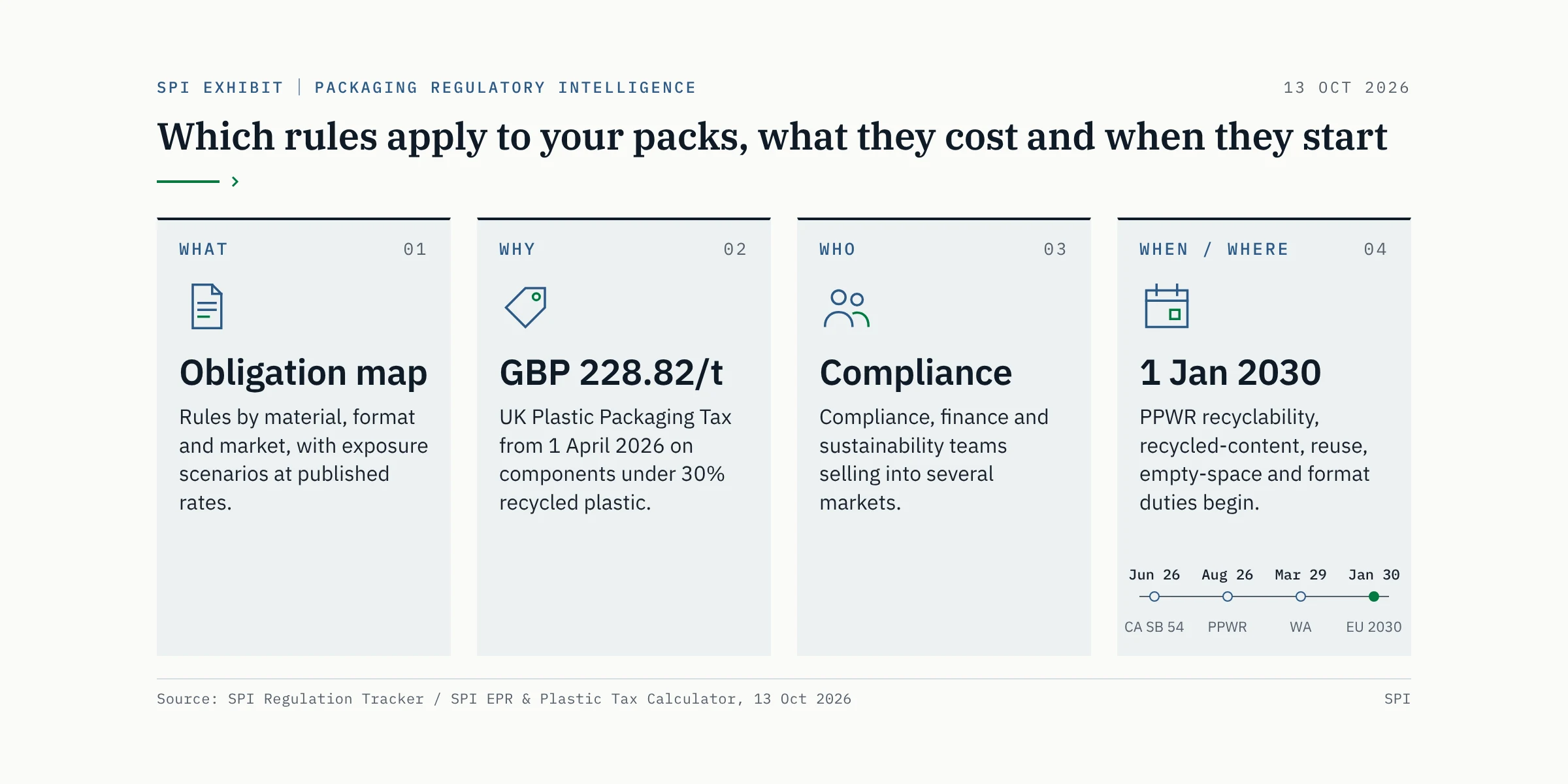
- Regulation (EU) 2025/40, the Packaging and Packaging Waste Regulation (PPWR), has applied since 12 August 2026; recyclability, recycled-content, reuse, empty-space and format obligations follow on 1 January 2030 (PR-EU-001, PR-EU-004, PR-EU-006, PR-EU-008, PR-EU-009, PR-EU-010).
- California SB 54 permanent regulations took effect on 1 May 2026 and producer registration was due by 1 June 2026 (PR-US-004, CalRecycle).
- Washington producers had to be members of a registered PRO by 1 July 2026, and from 1 March 2029 producers outside a PRO in good standing may not introduce covered materials into the state (PR-US-008, Chapter 70A.208 RCW).
- California SB 343 limits recyclability claims on products made after 4 October 2026, but a federal court has blocked enforcement since 14 July 2026 (PR-US-011, CalRecycle).
- The UK Plastic Packaging Tax is £228.82 per tonne from 1 April 2026 on components with less than 30% recycled plastic; Spain taxes non-recycled plastic in non-reusable packaging at EUR 0.45 per kg (PR-GB-001, PR-ES-001).
- PackUK’s 2026-27 plastic fees are illustrative only, at £415, £455 and £545 per tonne for green, amber and red ratings, and PackUK targets the year 2 notice of liability for the end of November 2026 (PR-GB-003).
The problem: rules that differ by market, format and date
A brand owner selling one product range in Europe and North America now faces a different set of packaging obligations in almost every market. The SPI Regulation Tracker counts 25 EPR rules, 17 bans, 7 deposit return schemes, 6 recycled-content rules, 6 design rules, 4 taxes and 3 labelling rules. Each has its own scope, its own threshold and its own start date. Three features make the problem real now rather than in some later planning cycle.
EPR moved from policy to invoices
In the United States, Oregon’s Circular Action Alliance (CAA) could charge producer fees from 1 July 2025 (PR-US-002). Colorado producers paid dues on covered materials from January 2026, and non-participating producers may not sell covered products there since July 2025 (PR-US-003). California’s SB 54 permanent regulations took effect on 1 May 2026 (PR-US-004). Minnesota required PRO membership from 1 July 2025 (PR-US-006), Maryland’s PRO files the annual producer registration from 1 July 2026 (PR-US-007), and Washington required membership of a registered PRO by 1 July 2026 (PR-US-008). Maine’s law is adopted, but no stewardship organisation is under contract: a 2026 request for proposals received none, and on 11 September 2026 Maine DEP said it would revise it (PR-US-001).
| State | Law | Status | What already applies | Next date |
|---|---|---|---|---|
| Oregon | SB 582, Plastic Pollution and Recycling Modernization Act | In force | CAA member fees since 1 July 2025 | 2026 fee schedule in force |
| Colorado | HB22-1355 | In force | Dues payable from January 2026; no sales by non-participating producers since July 2025 | CAA plan approved December 2025 |
| California | SB 54 and permanent regulations | In force | Regulations effective 1 May 2026; registration by 1 June 2026 | 2032 source reduction and recycling goals |
| Minnesota | Packaging Waste and Cost Reduction Act | Adopted; producer obligations started (status being updated in the 13 October check) | PRO membership from 1 July 2025 | First stewardship plan due 1 October 2028 |
| Maryland | SB 901, Chapter 431 | Adopted; producer obligations started (status being updated in the 13 October check) | PRO annual registration filing from 1 July 2026 | First plan due 1 July 2028 |
| Washington | SB 5284, Recycling Reform Act | Adopted; producer obligations started (status being updated in the 13 October check) | Registered PRO membership by 1 July 2026 | Market access restriction from 1 March 2029 |
| Maine | 38 M.R.S. §2146 | Adopted | Program rule adopted; no stewardship organisation contracted | First payment dates not set |
Source: SPI Regulation Tracker and SPI rule notes, checked 14 Oct 2026.
In Europe the PPWR now applies across the EU, and national schemes have already moved to format-level fees. In the UK, PackUK issued its first notices of liability in October 2025 and has published only illustrative 2026-27 fees (PR-GB-003).
Fees are set per format, not per material
The same “plastic” line can cost very different amounts within a single scheme. In the SPI EPR & Plastic Tax Calculator, CONAI’s 2026 contribution in Italy runs from EUR 51 per tonne for Band A1.1 plastic to EUR 922 for Band C. Fost Plus in Belgium charges EUR 360.4 per tonne for clear colourless PET bottles and EUR 4,419 per tonne for other plastics including aluminium laminates and PVC. CAA’s 2026 Oregon schedule runs from USD 198.42 per tonne for natural HDPE bottles to USD 3,042.38 for expanded polystyrene containers, cups and trays.
SPI analysis
A portfolio-level EPR estimate that uses one average plastic rate per country can be wrong by a large margin, because the fee depends on polymer, format, colour and recyclability rating. Exposure has to be built from your own format list, which is why SPI asks for tonnage by format and not only by material.
Many key numbers are provisional
Several figures that drive budgets were not final on 13 October 2026. PackUK’s 2026-27 fees are illustrative (PR-GB-003). The SB 343 labelling restriction is on the books but its enforcement is enjoined (PR-US-011). The EU’s proposed suspension of the PPWR authorised-representative obligation is still before the European Parliament and the Council, so the obligation applies from 12 August 2026 (PR-EU-012). Some PPWR start dates depend on Commission implementing acts, such as the harmonised sorting label, due from 12 August 2028 or 24 months after its implementing act if that is later (PR-EU-003). HMRC has announced that from 1 April 2027 pre-consumer plastic will no longer count towards the UK Plastic Packaging Tax 30% threshold (PR-GB-001, SPI rule note).
Deadlines cluster
- EPR
- Tax
- Deposit return
- Labelling
- Other
- UK: PackUK targets the year 2 notice of liability (PR-GB-003)EPR
- UK: pre-consumer plastic no longer counts towards the Plastic Packaging Tax threshold (PR-GB-001)Tax
- England, Northern Ireland and Scotland: drinks deposit return starts (PR-GB-004, PR-GB-005)Deposit return
- Maryland: first producer responsibility plan due (PR-US-007)EPR
- EU: harmonised sorting label, or later if the implementing act is late (PR-EU-003)Labelling
- Minnesota: first stewardship plan due (PR-US-006)EPR
- EU: 90% separate collection of plastic bottles and metal cans up to 3 litres (PR-EU-007)Deposit return
- Washington: no sales by producers outside a PRO in good standing (PR-US-008)EPR
- EU: PPWR recyclability, 30% recycled content in plastic drinks bottles, reuse, empty space and Annex V formats (PR-EU-004 to PR-EU-010)Design rule
- California: 50% recycled content in plastic beverage containers (PR-US-009)Recycled content
Source: SPI Regulation Tracker and SPI rule notes, checked 14 Oct 2026.
Includes milestones from SPI rule notes as well as tracker effective dates, so it is kept as a static snapshot.
Show the data
| Date | Label | Category | Link |
|---|---|---|---|
| 2026-11 | UK: PackUK targets the year 2 notice of liability (PR-GB-003) | EPR | /data/packaging-regulation-tracker/united-kingdom/#pr-gb-003 |
| 2027-04-01 | UK: pre-consumer plastic no longer counts towards the Plastic Packaging Tax threshold (PR-GB-001) | Tax | /data/packaging-regulation-tracker/united-kingdom/#pr-gb-001 |
| 2027-10-01 | England, Northern Ireland and Scotland: drinks deposit return starts (PR-GB-004, PR-GB-005) | Deposit return | /data/packaging-regulation-tracker/united-kingdom/#pr-gb-004 |
| 2028-07-01 | Maryland: first producer responsibility plan due (PR-US-007) | EPR | /data/packaging-regulation-tracker/united-states/#pr-us-007 |
| 2028-08-12 | EU: harmonised sorting label, or later if the implementing act is late (PR-EU-003) | Labelling | /data/packaging-regulation-tracker/european-union/#pr-eu-003 |
| 2028-10-01 | Minnesota: first stewardship plan due (PR-US-006) | EPR | /data/packaging-regulation-tracker/united-states/#pr-us-006 |
| 2029-01-01 | EU: 90% separate collection of plastic bottles and metal cans up to 3 litres (PR-EU-007) | Deposit return | /data/packaging-regulation-tracker/european-union/#pr-eu-007 |
| 2029-03-01 | Washington: no sales by producers outside a PRO in good standing (PR-US-008) | EPR | /data/packaging-regulation-tracker/united-states/#pr-us-008 |
| 2030-01-01 | EU: PPWR recyclability, 30% recycled content in plastic drinks bottles, reuse, empty space and Annex V formats (PR-EU-004 to PR-EU-010) | Design rule | /data/packaging-regulation-tracker/european-union/#pr-eu-010 |
| 2030-01-01 | California: 50% recycled content in plastic beverage containers (PR-US-009) | Recycled content | /data/packaging-regulation-tracker/united-states/#pr-us-009 |
Who this service is for
- Compliance and regulatory affairs teams at brand owners, retailers and importers who must know which rules apply to which SKUs, and from when.
- Finance teams who need EPR fee and plastic tax lines for the 2027 budget, with sources they can show to auditors and the board.
- Sustainability teams who need to see how recycled content, recyclability ratings and format choices change regulatory cost.
- Converters and packaging manufacturers whose customers ask them for recycled-content evidence, recyclability data or Plastic Packaging Tax pass-through.
It suits companies selling packaged goods into several markets. If you sell into one market and your question is “what is the fee for this material”, the free calculator usually answers it.
Scope: what SPI covers
- Regulatory landscape mapping by market, material and format: EPR, plastic taxes, bans, recycled-content rules, labelling, deposit return and design rules such as empty space and recyclability.
- EPR exposure assessment from your tonnages and the published fee tables, by scheme and format.
- Plastic packaging tax scenarios, including what moving components across the UK 30% recycled-content threshold would change.
- Compliance deadline mapping across all the markets you sell in, with dependencies such as pending implementing acts.
- Ongoing monitoring of new and changed rules, with monthly change notes for your portfolio.
Deliverables
| Deliverable | What it contains | Format |
|---|---|---|
| Obligation map | Each market and material, the rules that apply, their status, thresholds and start dates; enacted rules, proposals and SPI interpretation in separate columns | Spreadsheet and summary in the report |
| Exposure scenarios | EPR fees and plastic taxes at published rates applied to your tonnages, with the rate, source and date on every line and low, central and high cases where rates are illustrative | Model with assumptions register |
| Deadline calendar | Every dated obligation for your markets, with what must be done by when and what each date depends on | Calendar file and table |
| Monitoring retainer (optional) | Monthly change notes on new and amended rules, fee publications and court decisions that affect your portfolio | Monthly note and quarterly read-out |
Source: SPI Consulting service definitions, checked 12 Nov 2026.
Methodology: the SPI 6-step spine, applied to regulation
| Step | Common to every SPI engagement | Specific to Regulatory Intelligence |
|---|---|---|
| 1 Scope | Scoping call and written brief | Markets, materials, formats, SKUs in scope; which year's fees |
| 2 Source plan | Sources named with date, scope and licence | Official gazettes, regulators and scheme fee tables for each market |
| 3 Evidence | Desk research and SPI datasets | SPI Regulation Tracker records and rule notes, fee rows from the calculator, new rules researched to the same standard |
| 4 Analysis | Facts separate from SPI estimates | Enacted, adopted and proposed shown apart; your tonnages applied to sourced rates |
| 5 Check | Second-person check of numbers and sources | Every rate and date re-opened on its official source |
| 6 Deliver | Report, data annex, read-out call | Obligation map, exposure model, deadline calendar |
Source: SPI Methodology; SPI Consulting service definitions, checked 12 Nov 2026.
Every rule SPI relies on is traced to its official source and shows the date it was consulted. Where the public record is pending or contested, as with the SB 343 injunction or illustrative PackUK fees, the deliverable says so in the row and does not present an estimate as a confirmed rate. More detail is on the SPI Methodology page.
Sample deliverable outline (illustration only)
The outline below illustrates the format of an SPI exposure assessment. It is not a past project. It names no company and reports no results; where your data would go, it says so.
| Section | What it shows | Illustrative row |
|---|---|---|
| 1 Decision and scope | The decision, markets, formats and fee year agreed in the brief | Budget 2027 EPR and tax lines for UK, France and Oregon |
| 2 Obligation map | Rules by market and format, status and start date | UK, rigid plastic: PR-GB-002 in force; PR-GB-001 in force; PR-GB-004 adopted, starts 1 October 2027 |
| 3 Rate table | Published rate, unit, year, source, date consulted | Citeo 2026, clear PET bottle, EUR 700 per tonne |
| 4 Exposure scenarios | Your tonnage times rate, by format; low, central, high | [your tonnage] x GBP 415 / 455 / 545 per tonne (PackUK illustrative) |
| 5 Sensitivities | What changes if a format moves rating or recycled content | Component above 30% recycled plastic: no UK Plastic Packaging Tax |
| 6 Deadline calendar | Dated actions for the next 36 months | 2029-03-01: Washington PRO membership in good standing |
| 7 Open points | What is pending or contested, and when it may resolve | SB 343 enforcement enjoined since 14 July 2026 |
| Annex | Sources, assumptions register, corrections log | Source list with consulted dates |
Source: SPI Consulting format illustration, checked 12 Nov 2026.
Rates shown are public rows from the SPI EPR & Plastic Tax Calculator; tonnages and results are placeholders.
Formats, timelines and pricing
| Format | Typical use for this service | Typical timeline | Pricing |
|---|---|---|---|
| Briefing | One question on one rule or market, answered from tracker data | 60-minute call and short memo | On request |
| Sprint | Obligation map and exposure scenarios for one region | 2 to 4 weeks | On request |
| Programme | Several regions, full SKU list, deadline calendar and handover | 6 to 12 weeks | On request |
| Retainer | Monitoring with monthly change notes and quarterly read-outs | Ongoing | On request |
Prices are quoted after a scoping call and fixed in a written proposal.
What SPI needs from you
- The list of markets you sell into, and whether you are the producer under each scheme (brand owner, importer or first distributor).
- Packaging tonnages by market, material and format for the fee year in scope, ideally from your existing EPR declarations.
- Recycled-content and recyclability data you already hold, such as UK recyclability assessment ratings or supplier recycled-content certificates.
- Any compliance scheme or PRO memberships, and the notices or invoices you have received.
- Your decision deadline and the person on your side who owns the decision.
Where data is missing, SPI shows the gap and the assumption used in its place.
Limitations: what SPI does not do
- This is decision support, not legal advice or legal representation. Confirm obligations with qualified counsel and your compliance scheme.
- Exposure figures are estimates from your inputs and published rates. Where a rate is illustrative, the estimate is shown as a range.
- SPI does not file declarations, register with schemes or regulators, or deal with authorities on your behalf.
- SPI does not test packaging, certify recyclability or give audit opinions on your data.
- Coverage is limited to the markets and sources named in the source plan.
SPI Trackers this service draws on
- SPI Regulation Tracker: 79 rules in 25 jurisdictions, each with its official source, dates and SPI rule note.
- SPI EPR & Plastic Tax Calculator: 216 published rate rows in 14 markets. Germany and Ontario are not included because no public fee table exists.
- SPI Buyers Database: peer recycled-content and recyclability targets, used when a regulatory decision depends on what competitors have committed to.
Related analysis: what EPR fees cost per tonne in 2026, plastic packaging taxes in 2026 and the PPWR 2030 format restrictions. For material and redesign choices, see SPI Sustainable Packaging Strategy.
How to enquire
Start with the free tracker and calculator if you have not used them. When your question is specific to your portfolio, send the enquiry form or write to sales@strategicpackaginginsights.com with your markets, materials and decision deadline. The SPI team aims to reply within two business days, then holds a scoping call and sends a written proposal with a fixed price.
Frequently asked questions
What is packaging regulatory intelligence?
It is a structured view of the packaging rules that apply to your packs: EPR, plastic taxes, bans, recycled-content targets, labelling and deposit return, by market, material and format, with their dates and costs. SPI builds it from official sources, tracked in the SPI Regulation Tracker, and keeps enacted rules, proposals and interpretation separate.
What are the PPWR requirements for 2030?
From 1 January 2030, Regulation (EU) 2025/40 requires packaging to be recyclable under design-for-recycling criteria, sets 30% minimum recycled content for single-use plastic beverage bottles, sets 40% reuse for transport packaging and 10% for grouped packaging, caps empty space at 50% in grouped, transport and e-commerce packaging, and restricts the single-use plastic formats in Annex V. Some start dates depend on implementing acts.
How do you estimate EPR fees for our packaging?
SPI applies each scheme’s published fee table to your tonnages by format, records the rate, source and date on every line, and shows low, central and high cases where rates are illustrative, as with PackUK for 2026-27. Results are estimates, not invoices.
Which US states have packaging EPR laws?
The SPI Regulation Tracker records packaging EPR laws in seven states. Oregon, Colorado and California are in force; Minnesota, Maryland and Washington have producer obligations that have already started, and their tracker status is being updated in the 13 October check; Maine’s law is adopted, but no stewardship organisation was under contract on 13 October 2026. Each state has its own registration, fee and plan dates.
Is California SB 343 in effect?
SB 343 restricts recyclability claims and the chasing-arrows symbol on products and packaging made after 4 October 2026. A federal court issued a preliminary injunction on 14 July 2026 that blocks enforcement, so the rule is on the books but cannot currently be enforced. Brand owners should keep label changes ready in case the injunction is lifted.
Is this legal advice?
No. SPI provides decision support built on official sources. It does not give legal advice or file with regulators, and recommends that you confirm obligations with qualified counsel and your compliance scheme.
Can SPI monitor rule changes for us?
Yes. The free SPI Regulation Tracker alerts cover rule changes by country. A monitoring retainer adds monthly notes on what the changes mean for your markets and formats, with quarterly read-outs.
Sources
- SPI Regulation Tracker and SPI rule notes, /data/packaging-regulation-tracker/, data as of 13 October 2026.
- SPI EPR & Plastic Tax Calculator, /data/epr-plastic-tax-calculator/, data as of 13 October 2026; each fee row links to its scheme’s published 2026 table.
- European Parliament Legislative Observatory: Regulation (EU) 2025/40 summary, https://oeil.europarl.europa.eu/oeil/en/document-summary?id=1802233, as given in the SPI Regulation Tracker, checked 13 October 2026.
- European Commission (DG ENV): Packaging waste, https://environment.ec.europa.eu/topics/waste-and-recycling/packaging-waste_en, as given in the SPI Regulation Tracker, checked 13 October 2026.
- CalRecycle: SB 54 Permanent Regulations approved and in effect, https://content.govdelivery.com/accounts/CALRECYCLE/bulletins/4157d91, checked 13 October 2026.
- CalRecycle: SB 343 Accurate Recycling Labels, https://calrecycle.ca.gov/wcs/recyclinglabels/, checked 13 October 2026.
- Oregon DEQ: Producers of Covered Products, https://oregon.gov/deq/recycling/Pages/Producers-of-Covered-Products.aspx, checked 13 October 2026.
- CDPHE: Producer Responsibility Program, https://cdphe.colorado.gov/hm/epr-program, checked 13 October 2026.
- Maine DEP: Stewardship Program for Packaging, https://www.maine.gov/dep/waste/recycle/epr.html, checked 13 October 2026.
- MPCA fact sheet: Packaging waste and cost reduction act, https://www.pca.state.mn.us/sites/default/files/w-ps1-05b%20.pdf, checked 13 October 2026.
- Maryland General Assembly: Chapter 431 (SB 901), https://mgaleg.maryland.gov/2025RS/chapters_noln/Ch_431_sb0901E.pdf, checked 13 October 2026.
- Washington Ecology: Recycling Reform Act, https://ecology.wa.gov/waste-toxics/reducing-recycling-waste/our-recycling-programs/recycling-reform-act, checked 13 October 2026.
- GOV.UK: Year 2 illustrative waste disposal fees, EPR for packaging, https://www.gov.uk/government/publications/illustrative-waste-disposal-fees-2026-extended-producer-responsibility-for-packaging/year-2-illustrative-waste-disposal-fees-extended-producer-responsibility-for-packaging, checked 13 October 2026.
- GOV.UK: Plastic Packaging Tax: steps to take, https://www.gov.uk/guidance/check-if-you-need-to-register-for-plastic-packaging-tax, checked 13 October 2026.
- Agencia Tributaria: Impuesto especial sobre envases de plástico no reutilizables, https://sede.agenciatributaria.gob.es/Sede/impuestos-especiales-medioambientales/impuesto-especial-sobre-envases-plastico-reutilizables/base-imponible-tipo-impositivo-cuota-tributaria.html, checked 13 October 2026.
- legislation.gov.uk: SI 2025/67 Deposit Scheme for Drinks Containers (England and Northern Ireland) Regulations 2025, https://www.legislation.gov.uk/uksi/2025/67/made, checked 13 October 2026.
Ask the SPI team
What changes for your packaging next quarter?
Tell us your markets and materials. The SPI team walks you through the rules and buyer commitments that affect them.
Prefer email? Write to sales@strategicpackaginginsights.com.
- Q1
Which packaging rules apply to us in each market we sell in?
We map each market's EPR, tax, ban, recycled-content, labelling and deposit rules against your materials and formats, and show which are in force, adopted or only proposed.
- Q2
What could EPR fees and plastic taxes cost us next year?
We apply published fee tables and tax rates to your tonnages and recycled content, and show the result as scenarios with every rate sourced.
- Q3
Can you tell us when a rule changes?
Yes. The free tracker alerts cover rule changes by country; a monitoring retainer adds monthly notes on what the changes mean for your portfolio.