
SPI Intelligence for Packaging Manufacturers
Answer: Packaging manufacturers face legal recycled-content minimums, material-specific EPR fees, plastic taxes and format bans that are moving demand between materials between now and 2030, and Strategic Packaging Insights (SPI) tracks each one with its official source, status and date.
New lines and plants run for a decade or more, while the rules and brand-owner commitments that decide what customers buy change within two or three years. This page sets out what is confirmed, what is only proposed, and what each shift means for resin, film, glass, metal, paper and board producers.
By the SPI team · Figures as of 13 October 2026
79
Packaging rules tracked
across 25 jurisdictions, each with its official source
SPI Regulation Tracker
6
Recycled-content rules with legal minimums
EU, California, New Jersey and India
SPI Regulation Tracker
179
Public packaging targets
set by 42 brand owners and retailers
SPI Buyers Database
2,100.1
Citeo 2026 fee for PVC-containing packaging, EUR per tonne
against 20.1 for glass
SPI EPR & Plastic Tax Calculator, FEE-FR-115 and FEE-FR-105
Source: SPI Regulation Tracker, SPI Buyers Database, SPI EPR & Plastic Tax Calculator, checked 14 Oct 2026.
Key facts
- Regulation (EU) 2025/40, the Packaging and Packaging Waste Regulation (PPWR), has applied since 12 August 2026 (PR-EU-001, European Parliament Legislative Observatory, checked 13 October 2026).
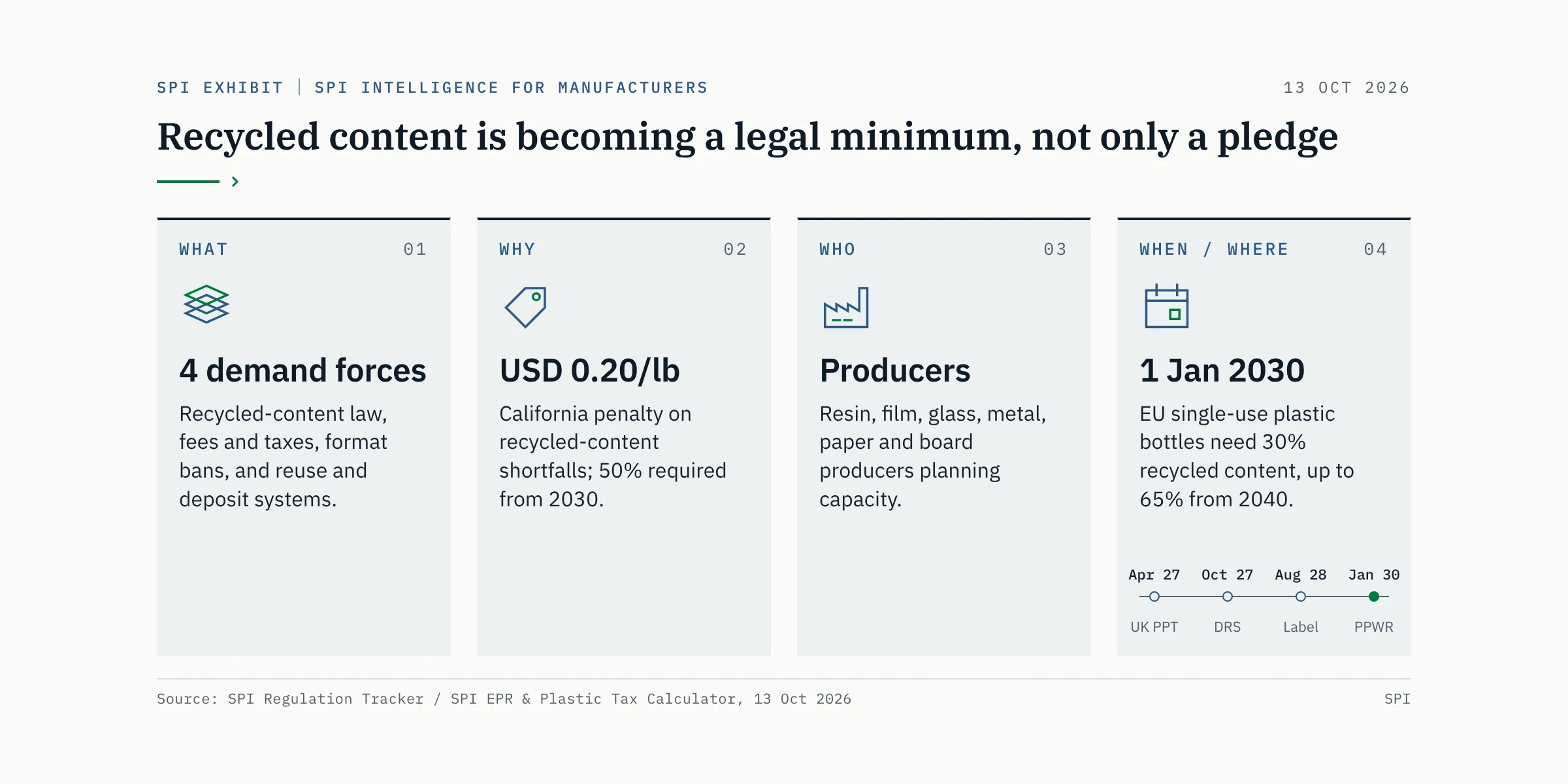
- Single-use plastic beverage bottles in the EU need 30% recycled content from 2030 and up to 65% from 2040 under the PPWR (PR-EU-004, PR-EU-005, checked 13 October 2026).
- The UK Plastic Packaging Tax is £228.82 per tonne from 1 April 2026 on components with less than 30% recycled plastic (PR-GB-001, GOV.UK, checked 13 October 2026).
- India’s Category I rigid plastic packaging must contain 40% recycled plastic in 2026-27 and 60% from 2028-29 (PR-IN-002, G.S.R. 237(E) of 31 March 2026).
- California’s redemption-value plastic beverage containers need 25% postconsumer recycled plastic now and 50% from 1 January 2030, with a USD 0.20 per pound shortfall penalty (PR-US-009, CalRecycle, checked 13 October 2026).
- Citeo’s 2026 French household fee for complex or multi-resin plastic is EUR 1,400.1 per tonne, twice the EUR 700.0 charged for clear PET bottles (calculator rows FEE-FR-114 and FEE-FR-106).
What is changing for packaging manufacturers
Four forces now set demand for packaging materials: recycled-content law, taxes and fees that price each material, restrictions on specific formats, and reuse and deposit systems that change the container mix. Each is covered below, with the rule ID so you can open the record.
Recycled content becomes a legal minimum
Post-consumer recycled (PCR) content means material recycled from packaging that consumers have used and discarded, as opposed to factory scrap. Several rules now set it as a legal floor.
- European Union (adopted). The PPWR sets minimum shares of post-consumer recycled plastic in plastic packaging from 1 January 2030, including 30% for single-use plastic beverage bottles; other categories have their own percentages (PR-EU-004). How recycled content is calculated and verified depends on a Commission implementing act that the Commission timeline lists as due by 31 December 2026. The bottle figure rises to up to 65% in 2040 (PR-EU-005). Pharmaceutical packaging, infant-food packaging, medical devices, transport of hazardous goods and compostable plastic packaging are listed as exceptions in the EUR-Lex summary.
- European Union (in force). Under Directive (EU) 2019/904, PET beverage bottles up to three litres must contain at least 25% recycled plastic from 2025, and all single-use plastic beverage bottles 30% from 2030, as a Member State average. Glass and metal bottles with plastic caps are outside it (PR-EU-016).
- California (in force). AB 793 requires plastic beverage containers carrying the California Redemption Value to contain 25% postconsumer recycled plastic from 1 January 2025 and 50% from 1 January 2030, measured as an annual average per manufacturer, with a USD 0.20 per pound penalty on shortfalls (PR-US-009). Post-industrial material does not count.
- New Jersey (in force). The Recycled Content Law requires 15% PCR in plastic beverage containers from 2024, 20% from 2027 and 50% in 2044; rigid plastic containers rise from 10% to 50% by 2036, and carryout and trash bags have their own steps. Pyrolysis and gasification outputs do not count as PCR (PR-US-010).
- India (in force). Schedule II of the Plastic Waste Management Rules first set category-wise recycled content in 2022, and G.S.R. 237(E) of 31 March 2026 restates it: Category I (rigid) 30%, 40%, 50% and 60% for 2025-26 to 2028-29 onwards; Category II 10%, 10%, 20% and 20%; Category III (multilayer) 5%, 5%, 10% and 10%, counted on the plastic layers. Recycled packaging must meet IS 14534:2023, and importers meet their share by buying certificates (PR-IN-002).
SPI analysis
Recycled-content rules in the EU, California, New Jersey and India turn post-consumer resin into a compliance input with fixed dates. Suppliers that can document recycled content to the required standard, such as IS 14534:2023 in India or PCR-only counting in California and New Jersey, are likely to be easier to buy from than those that cannot. Documentation is becoming part of the product.
Taxes and fees now price material choices
- UK Plastic Packaging Tax. £228.82 per tonne from 1 April 2026 on plastic packaging components manufactured in or imported into the UK with less than 30% recycled plastic (PR-GB-001). UK manufacturers are directly liable for components they make once they pass the 10 tonne test. HMRC has announced that from 1 April 2027 pre-consumer plastic will no longer count towards the 30% threshold and a certified mass balance approach will apply to chemically recycled plastic. No 2027 rate had been published on GOV.UK at 13 October 2026.
- Spain. Non-reusable plastic packaging is taxed at EUR 0.45 per kg of non-recycled plastic under Law 7/2022, since 1 January 2023. Semi-finished products such as preforms, thermoplastic sheets and closures are also taxed, and recycled plastic is excluded only when certified by an accredited entity (PR-ES-001).
- EU plastic own resource. Member States, not companies, pay EUR 0.80 per kg of non-recycled plastic packaging waste (PR-EU-017); a proposal to raise it to EUR 1 from 2028 is not adopted (PR-EU-018).
- EPR fees. Extended producer responsibility (EPR) makes producers pay for the collection and recycling of their packaging, usually as fees per tonne collected by a producer responsibility organisation (PRO). Fees differ sharply by material. Citeo’s 2026 household rates in France run from EUR 20.1 per tonne for glass to EUR 2,100.1 for packaging containing PVC (calculator rows FEE-FR-101 to 117).
The UK takes a different route. Eco-modulation means fees that vary with a pack’s recyclability or design. PackUK’s illustrative 2026-27 disposal fees are set by material and by red, amber or green rating under the recyclability assessment methodology (RAM). For plastic they are £415, £455 and £545 per tonne (PR-GB-003). These are estimates published in December 2025, not confirmed fees: PackUK’s operational plan targets calculation of year 2 fees in November 2026 and the year 2 notice of liability by the end of November 2026.
- Green
- Amber
- Red
Source: GOV.UK (PackUK), Year 2 illustrative waste disposal fees, via SPI EPR & Plastic Tax Calculator, checked 13 Oct 2026.
Illustrative 2026-27 fees published December 2025; confirmed fees not yet published.
Show the data
| Material | Green | Amber | Red |
|---|---|---|---|
| Fibre-based composite | 475 | 525 | 630 |
| Plastic | 415 | 455 | 545 |
| Wood | 410 | 450 | 540 |
| Steel | 260 | 290 | 345 |
| Aluminium | 245 | 270 | 325 |
| Other materials | 205 | 225 | 270 |
| Paper and board | 190 | 210 | 250 |
| Glass | 185 | 205 | 245 |
SPI analysis
Fee tables already price format choices before any design rule bites. In France a tonne of complex or multi-resin plastic costs twice the fee of a tonne of clear PET bottles, and in the UK the red-to-green gap on plastic is £130 per tonne in the illustrative table. Manufacturers that can show customers a lower fee line, with the rate and source, have a commercial argument that does not depend on a sustainability budget.
Formats are being restricted or redesigned
- Annex V formats. From 1 January 2030, Article 25 and Annex V of the PPWR bar specified single-use packaging formats, mostly plastic, including packaging for pre-packed fresh fruit and vegetables under 1.5 kg, packaging for food and drinks consumed on hospitality premises, and single-use hotel toiletry packaging for individual bookings (PR-EU-008). Member States may set some exemptions, and the Commission timeline lists Annex V guidelines by 12 February 2027. Our Annex V article lists each format.
- Recyclability. EU packaging must be recyclable in an economically viable way by 2030, graded A, B or C against design-for-recycling criteria; it must be recycled at scale from 2035, and grade B becomes the minimum from 2038 (PR-EU-010). The grades are linked to EPR fee modulation.
- Empty space. Grouped, transport and e-commerce packaging may have no more than 50% empty space from 2030; the measurement method is an implementing act due by 12 February 2028 (PR-EU-009).
- PFAS. Since 12 August 2026, food-contact packaging with per- and polyfluoroalkyl substances at or above the PPWR limits may not be placed on the EU market (PR-EU-002). This mainly touches paper, board and moulded-fibre grades that used fluorinated treatments for grease and water resistance. Oregon has banned foodware containers with intentionally added PFAS since 1 January 2025 (PR-US-013).
- Expanded polystyrene (EPS). EPS food service ware is restricted for producers in California, where EPS missed its 25% recycling rate (PR-US-005), and banned in Washington since 1 June 2024 (PR-US-012) and Oregon (PR-US-013).
- British Columbia. Food service ware of polystyrene foam, PVC, PVDC, biodegradable or oxo-degradable plastic has been barred since 15 July 2024; PVC film wrap is exempt until 1 July 2028 and foam meat trays until 1 July 2030 (PR-CA-005).
Reuse and deposit systems change the container mix
The PPWR sets 2030 reuse targets of 40% for transport packaging, including sales packaging used for transport, and 10% for grouped packaging (PR-EU-006). Member States must separately collect 90% by weight of single-use plastic and metal beverage containers up to three litres by 1 January 2029, in principle through deposit return systems (PR-EU-007). A deposit return system is a refundable charge on a drinks container, paid back when it is returned. In the UK, deposit return for PET, steel and aluminium drinks containers of 150 ml to 3 litres starts on 1 October 2027 in England, Northern Ireland and Scotland; glass is excluded (PR-GB-004, PR-GB-005). India requires brand owners to reuse 70% of drinking-water rigid containers of 4.9 litres or more in 2025-26, rising to 85% from 2028-29 (PR-IN-003).
SPI analysis
UK deposit return from October 2027 and the EU’s 90% collection requirement for 2029 should increase separately collected PET and cans, a cleaner feedstock for food-grade recycled resin. Makers of durable crates, pallets and refillable containers gain a regulatory driver; single-use transport packaging loses one.
Key dates for manufacturers
- United Kingdom
- EU
- India
- United States
- Canada
- PackUK year 2 notice of liability (planned by end of November)United Kingdom
- Implementing act on recycled-content calculation dueEU
- 2027New Jersey plastic beverage containers 20% PCRUnited States
- Annex V guidelines dueEU
- Pre-consumer plastic stops counting towards the 30% PPT thresholdUnited Kingdom
- India Category I recycled content 50% (2027-28)India
- Deposit return starts in England, Northern Ireland and ScotlandUnited Kingdom
- Empty space methodology dueEU
- India Category I recycled content 60%India
- B.C. PVC film wrap exemption endsCanada
- Harmonised material-composition label, at the earliestEU
- Minnesota first stewardship plan dueUnited States
- 90% separate collection of beverage containersEU
- Recyclability, recycled content, reuse, empty space and Annex V rulesEU
- California 50% PCR in redemption-value plastic beverage containersUnited States
Source: SPI Regulation Tracker and SPI rule notes, checked 14 Oct 2026.
Includes Commission act deadlines and staged steps taken from SPI rule notes.
Show the data
| Date | Label | Category | Link |
|---|---|---|---|
| 2026-11 | PackUK year 2 notice of liability (planned by end of November) | United Kingdom | /data/packaging-regulation-tracker/united-kingdom/ |
| 2026-12-31 | Implementing act on recycled-content calculation due | EU | /data/packaging-regulation-tracker/european-union/ |
| 2027-02-12 | Annex V guidelines due | EU | /data/packaging-regulation-tracker/european-union/ |
| 2027-04-01 | Pre-consumer plastic stops counting towards the 30% PPT threshold | United Kingdom | /data/packaging-regulation-tracker/united-kingdom/ |
| 2027-04-01 | India Category I recycled content 50% (2027-28) | India | /data/packaging-regulation-tracker/india/ |
| 2027 | New Jersey plastic beverage containers 20% PCR | United States | /data/packaging-regulation-tracker/united-states/ |
| 2027-10-01 | Deposit return starts in England, Northern Ireland and Scotland | United Kingdom | /data/packaging-regulation-tracker/united-kingdom/ |
| 2028-02-12 | Empty space methodology due | EU | /data/packaging-regulation-tracker/european-union/ |
| 2028-04-01 | India Category I recycled content 60% | India | /data/packaging-regulation-tracker/india/ |
| 2028-07-01 | B.C. PVC film wrap exemption ends | Canada | /data/packaging-regulation-tracker/canada/ |
| 2028-08-12 | Harmonised material-composition label, at the earliest | EU | /data/packaging-regulation-tracker/european-union/ |
| 2028-10-01 | Minnesota first stewardship plan due | United States | /data/packaging-regulation-tracker/united-states/ |
| 2029-01-01 | 90% separate collection of beverage containers | EU | /data/packaging-regulation-tracker/european-union/ |
| 2030-01-01 | Recyclability, recycled content, reuse, empty space and Annex V rules | EU | /data/packaging-regulation-tracker/european-union/ |
| 2030-01-01 | California 50% PCR in redemption-value plastic beverage containers | United States | /data/packaging-regulation-tracker/united-states/ |
| Date | Rule | What it means for manufacturers |
|---|---|---|
| End of November 2026 | PackUK year 2 fees (PR-GB-003) | Customers’ UK fee per material and rating becomes final |
| 1 April 2027 | UK PPT changes (PR-GB-001) | Pre-consumer plastic stops counting towards 30% |
| 1 October 2027 | UK deposit return (PR-GB-004, PR-GB-005) | Cleaner PET and can feedstock |
| 12 August 2028 at the earliest | EU harmonised label (PR-EU-003) | Artwork changes; 24 months after the implementing act if later |
| 1 January 2030 | PPWR design cluster (PR-EU-004 to 010) | Recyclability, recycled content, reuse and format rules together |
What your customers have committed to
The SPI Buyers Database holds 179 public packaging targets from 42 brand owners and retailers, covering recycled content, virgin plastic reduction, recyclability and reuse. For targets due in 2025 or earlier, 16 were reported met and 19 missed, with 24 still without a reported outcome. The recycled-content targets are the most direct signal of future resin demand.
- Target
- Latest
Source: Company reports via SPI Buyers Database, checked 13 Oct 2026.
Company-reported; SPI does not audit. Metrics and baselines differ. Keurig Dr Pepper target is 25 to 35; lower bound shown.
Show the data
| Company and target | Target | Latest |
|---|---|---|
| L'Oréal (by 2030, not reported) | 100 | 50 |
| HEINEKEN (by 2030, in progress) | 50 | 48 |
| Diageo (by 2030, in progress) | 50 | 47 |
| Diageo (by 2025, met) | 35 | 44 |
| L'Oréal (by 2030, in progress) | 50 | 44 |
| ITC Limited (by 2030, on track) | 60 | 35.5 |
| Marico (by 2030, in progress) | 60 | 32.2 |
| The Coca-Cola Company (by 2035, in progress) | 35 | 30 |
| Henkel (by 2030, in progress) | 35 | 28 |
| Colgate-Palmolive (by 2025, met) | 25 | 27 |
| Lidl (by 2025, met) | 25 | 26 |
| Starbucks (by 2030, in progress) | 25 | 25 |
| Unilever (by 2025, met) | 25 | 25 |
| Carrefour (by 2025, missed) | 30 | 24 |
| Nestlé (no year, not reported) | no data | 20.6 |
| The Coca-Cola Company (by 2035, in progress) | 30 | 20 |
| The Estée Lauder Companies (by 2025, missed) | 25 | 20 |
| The Estée Lauder Companies (by 2030, in progress) | 25 | 20 |
| Kimberly-Clark (by 2025, missed) | 20 | 18 |
| PepsiCo (by 2035, in progress) | 40 | 18 |
| Keurig Dr Pepper (by 2035, in progress) | 25 | 16 |
| Keurig Dr Pepper (by 2025, not reported) | 25 | 16 |
| Ahold Delhaize (by 2025, not reported) | 25 | 15.7 |
| Target (by 2025, not reported) | 20 | 13 |
| Henkel (by 2028, in progress) | 45 | 12 |
| Reckitt (by 2025, not reported) | 25 | 12 |
| Walmart (by 2025, missed) | 20 | 12 |
| Walmart (by 2025, missed) | 17 | 10.7 |
| Mars (no year, in progress) | 30 | 9.2 |
| Mars (by 2025, not reported) | 30 | 9.2 |
| ITC Limited (by 2030, on track) | 20 | 4.5 |
| Mondelēz International (by 2030, in progress) | 5 | 3.7 |
| Dabur India (by 2026, not reported) | 30 | 2 |
- Diageo beat its 35% PET bottle target and reports 47% recycled input across about 1.35 million tonnes of packaging in fiscal 2026. HEINEKEN also reports 39% of volume in reusable formats against 43% by 2030.
- The Coca-Cola Company targets 35% to 40% recycled material in primary packaging by 2035 and reports 30% in 2025. PepsiCo targets 40% or more recycled content in plastic packaging by 2035 and reports 18% in 2025, from 2.0 million metric tons of plastic in its key markets.
- AB InBev reports 89.7% of products in returnable or majority-recycled packaging in 2025 against a 100% goal, and its report names limited recycled PET supply as the main reason.
- Unilever reports 57% of its plastic packaging reusable, recyclable or compostable in 2025: 75% of rigids but 15% of flexibles.
- Walmart also missed a 15% virgin plastic cut, reporting 4.12% above baseline; Kimberly-Clark and The Estée Lauder Companies missed their 2025 recycled-content goals.
SPI analysis
Missed 2025 targets and legal minimums arriving from 2027 to 2030 point the same way: continued demand for documented recycled content. AB InBev’s explanation suggests the constraint is feedstock, not intent. Plan capacity against adopted dates and treat proposals as scenarios.
Which rule types touch manufacturers most
The rule type tells you which team should own it: recycled content and tax sit with purchasing and costing, design rules and bans with product development. EPR and deposit rules mostly bind your customers, but arrive as specification changes and fee-driven requests to switch material.
Questions you ask, and where SPI answers them
Which of my materials face a legal recycled-content minimum, where and from when? Filter the SPI Regulation Tracker by type “recycled content” and your material. It will not tell you how a rule applies to a specific product; check scope with counsel.
Is a rule in force, adopted or only proposed? Every rule shows its status, official source and last-checked date, so proposals such as PR-EU-018 never read as law.
Which brand owners have committed to recycled content, and are they on track? Filter the SPI Buyers Database by target type. Each target shows the year due, latest reported progress and the quote behind it, not volumes or suppliers.
How much more does one material cost a customer in EPR fees? Run the SPI EPR & Plastic Tax Calculator with the same tonnage under two materials. UK figures are illustrative until PackUK confirms its fees, and Germany and Ontario are not included because they publish no public fee table.
What does the 30% recycled-content threshold save in UK tax? Components at or above 30% recycled plastic pay no Plastic Packaging Tax; below it they pay £228.82 per tonne (PR-GB-001). Our plastic packaging taxes article compares the UK, Isle of Man and Spain.
When do deadlines fall in my customers’ markets? Use the tracker’s upcoming-deadlines table and alerts sign-up, or export the records as CSV.
How SPI builds this
Each of the 79 tracker records carries its official source, dates, status and last-checked date, plus its own page with an SPI note on scope, actions and open points. On 13 October 2026 the SPI team re-read 56 tracker records against their official sources and updated 46. The Buyers Database links every target to the company’s statement, and the calculator applies 216 published rate rows across 14 markets. The SPI Methodology page explains sourcing, checks and corrections.
Where this fits in your decision
| Stage | Question | SPI tool | When you need more |
|---|---|---|---|
| Discover | Which customers are committed to recycled content, recyclability or reuse? | SPI Buyers Database | Market & Competitive Intelligence |
| Understand | Which bans, minimums and design rules touch my materials, where? | SPI Regulation Tracker | Regulatory Intelligence monitoring |
| Evaluate | How do fees and taxes change the cost of each material for customers? | SPI EPR & Plastic Tax Calculator | Regulatory exposure scenarios |
| Decide | Which segments, formats or plants to prioritise? | SPI Briefing | Strategy & Growth |
| Implement | Plan and track the change | Sprint, Programme or Retainer | Custom research |
Limitations and what SPI does not do
The tracker’s 79 rules are a selection of significant packaging rules, not every rule in every market. The Buyers Database uses company reports that SPI does not audit, and holds no contacts, purchase volumes, supplier relationships or specifications. The calculator applies published rates and excludes bonuses, maluses and per-unit charges.
SPI does not give legal advice, carry out laboratory or certified testing, issue certifications or audit opinions, or file with regulators. Where you need those, we can point you to a qualified provider. Report an error through corrections.
When you need more than the data
The SPI Trackers and calculator are free. Three SPI Consulting services fit manufacturers:
- Packaging Strategy & Growth: where to grow next and which segments or formats to prioritise. Deliverables include an opportunity map with scoring, growth options with benefits and risks, and a 12 to 24 month go-to-market plan.
- Packaging Market & Competitive Intelligence: competitor profiles from public information, benchmark tables, demand-driver analysis and a geography ranking.
- Packaging Regulatory Intelligence: an obligation map for your materials and markets, exposure scenarios with stated rates, and a deadline calendar.
Work runs as a Briefing, Sprint, Programme or Retainer, and pricing is on request. To start, send an enquiry with your markets, materials and decision date. Related pages: SPI Intelligence for Converters and SPI Intelligence for Brand Owners and Packaging Buyers.
Frequently asked questions
What is the PPWR?
The PPWR is Regulation (EU) 2025/40 on packaging and packaging waste. It entered into force on 11 February 2025, has generally applied since 12 August 2026 and replaces Directive 94/62/EC (PR-EU-001). Its main design obligations on recyclability, recycled content, reuse, empty space and Annex V formats apply from 1 January 2030.
When do EU recycled-content rules for plastic packaging start?
The PPWR minimums apply from 1 January 2030, with 30% for single-use plastic beverage bottles and up to 65% from 2040 (PR-EU-004, PR-EU-005). The calculation and verification method depends on a Commission implementing act listed as due by 31 December 2026. Separately, PET beverage bottles have needed 25% recycled content as a Member State average since 2025 (PR-EU-016).
Does the UK Plastic Packaging Tax apply to packaging manufacturers?
Yes. It applies to plastic packaging components manufactured in or imported into the UK with less than 30% recycled plastic, at £228.82 per tonne from 1 April 2026 (PR-GB-001). Businesses register once they pass a 10 tonne test, and from 1 April 2027 pre-consumer plastic no longer counts as recycled.
Which packaging formats does the EU ban from 2030?
Annex V of the PPWR lists them, including packaging for pre-packed fresh fruit and vegetables under 1.5 kg, packaging for food and drink consumed on hospitality premises and single-use hotel toiletry packaging (PR-EU-008). Member States may set some exemptions. See our Annex V article.
What recycled content does India require in plastic packaging?
Category I (rigid) plastic packaging needs 30% recycled plastic in 2025-26, 40% in 2026-27, 50% in 2027-28 and 60% from 2028-29 (PR-IN-002). Category II rises from 10% to 20% and Category III from 5% to 10%. Recycled packaging must meet IS 14534:2023.
How do EPR fees differ by packaging material?
In France, Citeo’s 2026 household fees run from EUR 20.1 per tonne for glass and EUR 258.1 for paper and board to EUR 1,400.1 for complex plastic and EUR 2,100.1 for PVC-containing packaging (calculator rows FEE-FR-101 to 117). In the UK, illustrative 2026-27 fees range from £185 per tonne for green-rated glass to £630 for red-rated fibre-based composite. See EPR fees per tonne in 2026.
Is SPI's regulation data legal advice?
No. It is decision support built from official sources, with each record’s source and last-checked date shown. Confirm how a rule applies to your products with qualified counsel.
Sources
- European Parliament Legislative Observatory, Regulation (EU) 2025/40 summary. https://oeil.europarl.europa.eu/oeil/en/document-summary?id=1802233 (checked 13 October 2026)
- EUR-Lex, Regulation (EU) 2025/40, Article 25 and Annex V, OJ L 22.1.2025. https://eur-lex.europa.eu/eli/reg/2025/40/oj/eng (checked 13 October 2026)
- European Commission (DG ENV), Packaging waste. https://environment.ec.europa.eu/topics/waste-and-recycling/packaging-waste_en (checked 13 October 2026)
- European Commission Green Forum, PPWR implementation timeline. https://green-forum.ec.europa.eu/packaging-and-packaging-waste-regulation-implementation_en (checked 13 October 2026)
- EUR-Lex, Directive (EU) 2019/904. https://eur-lex.europa.eu/legal-content/EN/TXT/HTML/?uri=CELEX:32019L0904 (checked 13 October 2026)
- European Parliament Legislative Observatory, 2025/0574(CNS). https://oeil.europarl.europa.eu/oeil/en/document-summary?id=1830552 (checked 13 October 2026)
- GOV.UK, Plastic Packaging Tax: steps to take. https://www.gov.uk/guidance/check-if-you-need-to-register-for-plastic-packaging-tax (checked 13 October 2026)
- GOV.UK (HMRC), Plastic Packaging Tax: mass balance approach and removal of pre-consumer plastic, 26 November 2025. https://www.gov.uk/government/publications/plastic-packaging-tax-mass-balance-approach-and-removal-of-pre-consumer-plastic/plastic-packaging-tax-mass-balance-approach-and-removal-of-pre-consumer-plastic (checked 13 October 2026)
- GOV.UK (PackUK), Year 2 illustrative waste disposal fees (updated 19 December 2025). https://www.gov.uk/government/publications/illustrative-waste-disposal-fees-2026-extended-producer-responsibility-for-packaging/year-2-illustrative-waste-disposal-fees-extended-producer-responsibility-for-packaging (checked 13 October 2026)
- GOV.UK, PackUK operational plan 2026 to 2027. https://www.gov.uk/government/publications/packuk-operational-plan/packuk-operational-plan-2026-to-2027 (checked 13 October 2026)
- legislation.gov.uk, SI 2025/67 and SSI 2025/188. https://www.legislation.gov.uk/uksi/2025/67/made ; https://www.legislation.gov.uk/ssi/2025/188/made (checked 13 October 2026)
- Agencia Tributaria, plastic packaging tax base and rate. https://sede.agenciatributaria.gob.es/Sede/impuestos-especiales-medioambientales/impuesto-especial-sobre-envases-plastico-reutilizables/base-imponible-tipo-impositivo-cuota-tributaria.html (checked 13 October 2026)
- Citeo, Guide du tarif des emballages ménagers 2026 (updated 22 June 2026). https://clients-cms.citeo.com/uploads/guide_du_tarif_des_emballages_menagers_2026_f9e4c5b4e6.pdf (checked 13 October 2026)
- CalRecycle, AB 793 plastic minimum content and EPS food service ware. https://calrecycle.ca.gov/bevcontainer/bevdistman/plasticcontent/ ; https://calrecycle.ca.gov/packaging/packaging-epr/eps/ (checked 13 October 2026)
- NJDEP, Recycled Content Law FAQ. https://www.nj.gov/dep/dshw/recycled-content/recycled_content_faqs.pdf (checked 13 October 2026)
- Oregon DEQ, Foodware containers and polystyrene foam; Washington Ecology, EPS ban, 29 May 2024. https://www.oregon.gov/deq/mm/production/pages/polystyrene.aspx ; https://ecology.wa.gov/about-us/who-we-are/news/2024/may-29-eps-foam-clamshell-containers-plates-bowls-cups-trays-and-coolers-are-banned-for-sale (checked 13 October 2026)
- MoEFCC Gazette G.S.R. 237(E), 31 March 2026. https://www.mpcb.gov.in/sites/default/files/standing_orders/Plastic_Waste_Management_2026.pdf (checked 13 October 2026)
- B.C. Government, food service ware regulation factsheet. https://www2.gov.bc.ca/assets/gov/environment/waste-management/recycling/recycle/food_service_ware_regulation_factsheet.pdf (checked 13 October 2026)
- MPCA, Packaging Waste and Cost Reduction Act fact sheet. https://www.pca.state.mn.us/sites/default/files/w-ps1-05b%20.pdf (checked 13 October 2026)
- Company reports for each buyer, linked from its profile in the SPI Buyers Database (rechecked 13 October 2026).
Ask the SPI team
What changes for your packaging next quarter?
Tell us your markets and materials. The SPI team walks you through the rules and buyer commitments that affect them.
Prefer email? Write to sales@strategicpackaginginsights.com.
- Q1
Which packaging rules apply to us in each market we sell in?
We map each market's EPR, tax, ban, recycled-content, labelling and deposit rules against your materials and formats, and show which are in force, adopted or only proposed.
- Q2
What could EPR fees and plastic taxes cost us next year?
We apply published fee tables and tax rates to your tonnages and recycled content, and show the result as scenarios with every rate sourced.
- Q3
Can you tell us when a rule changes?
Yes. The free tracker alerts cover rule changes by country; a monitoring retainer adds monthly notes on what the changes mean for your portfolio.