
SPI Intelligence for Personal and Home Care Packaging
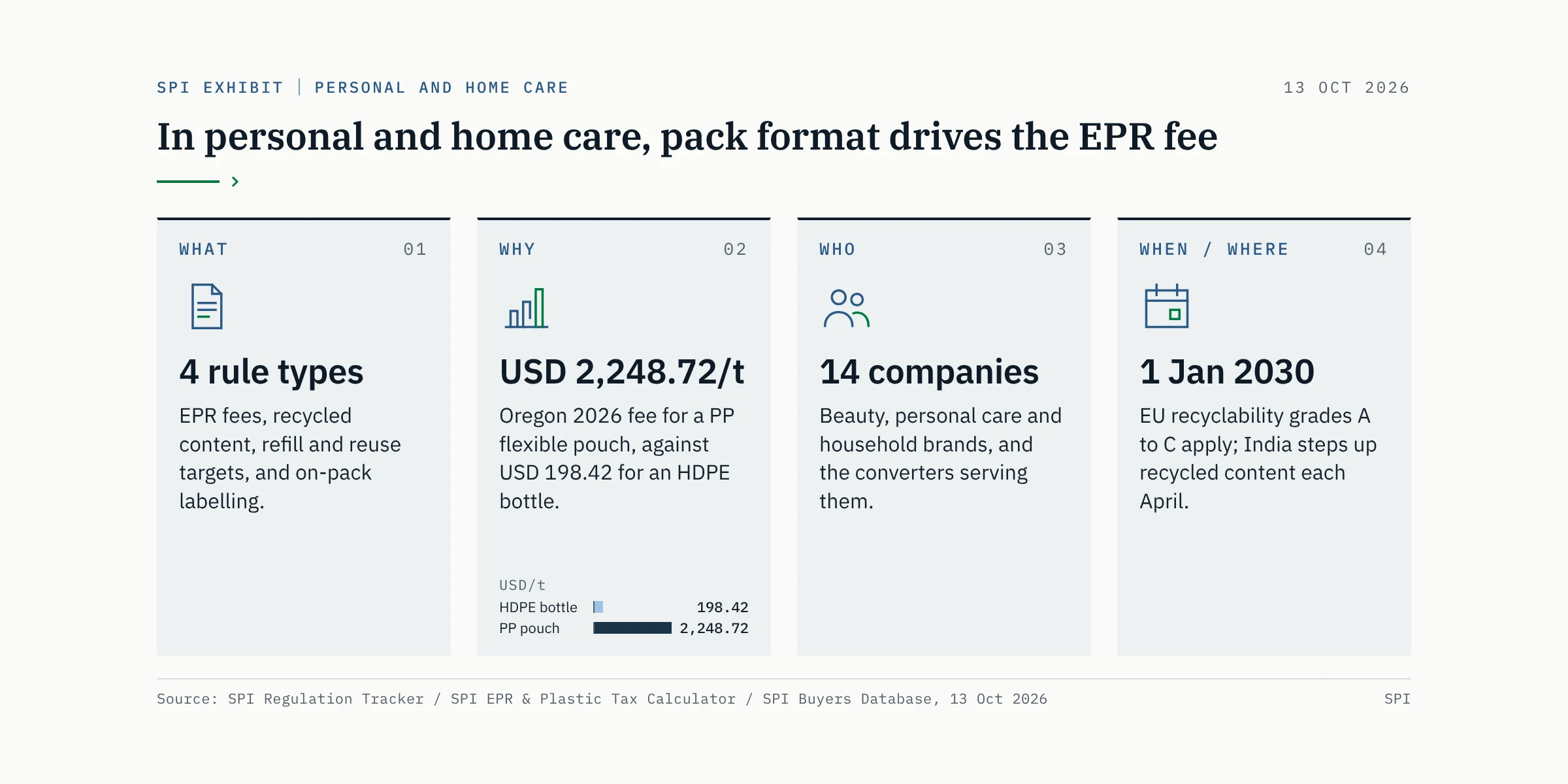
Personal and home care packs are mostly rigid and flexible plastics, so the rules that weigh most are EPR fees modulated by format and recyclability, minimum recycled content, refill and reuse targets, and on-pack labelling; the SPI Regulation Tracker holds 25 EPR, 6 recycled-content, 3 reuse and 3 labelling rules.
Strategic Packaging Insights (SPI) traces each rule to its official source and sets it beside the public targets of 14 beauty, personal care and household brands. The sharpest cost signal is format: in Oregon’s 2026 schedule a PP flexible pouch pays USD 2,248.72 per tonne against USD 198.42 for a natural HDPE bottle.
By the SPI team · Figures as of 13 October 2026
25
EPR rules tracked
Producers pay per tonne in each market they sell into
SPI Regulation Tracker, 13 Oct 2026
11.3
Oregon PP flexible versus natural HDPE bottle, fee ratio
USD 2248.72 against USD 198.42 per tonne, 2026
FEE-US-106, FEE-US-102
15
Unilever flexibles reusable, recyclable or compostable (%)
Against 75 for rigids, 2025
SPI Buyers Database
14
Personal and home care companies profiled
Each with public packaging targets and sources
SPI Buyers Database, 13 Oct 2026
Source: SPI Regulation Tracker; SPI EPR & Plastic Tax Calculator; SPI Buyers Database, checked 14 Oct 2026.
Key facts
- From 1 January 2030, packaging placed on the EU market must be recyclable in an economically viable way, graded A, B or C under design-for-recycling criteria; from 1 January 2038 the minimum is grade B (Regulation (EU) 2025/40; PR-EU-010).
- India’s Plastic Waste Management Rules set recycled content for Category I rigid plastic packaging at 30% in 2025-26 rising to 60% from 2028-29; Category II (flexible) rises from 10% to 20% and Category III (multilayer) from 5% to 10% (G.S.R. 237(E); PR-IN-002).
- New Jersey requires rigid plastic containers to contain 10% post-consumer recycled content from 2024, rising to 50% by 2036 (P.L.2021, c.391; PR-US-010).
- In 2026 rates held by SPI, Belgium’s Fost Plus charges EUR 4.419 per kg for other plastics including aluminium laminates, against EUR 0.8019 for rigid PE (FEE-BE-019, FEE-BE-015).
- California’s SB 343 restricts recyclability claims on products made after 4 October 2026, but a federal court blocked enforcement by preliminary injunction on 14 July 2026 (PR-US-011).
- The UK Plastic Packaging Tax is £228.82 per tonne from 1 April 2026 on components with less than 30% recycled plastic (PR-GB-001).
Who this page is for
Brand owners in beauty, personal care, oral care and household cleaning, and the converters and resin suppliers who make their bottles, tubes, jars, pouches, sachets and refills. Four questions drive their packaging decisions. Will this format be recyclable under EU rules from 2030? How much recycled plastic must it hold in India or New Jersey? What does moving from a rigid bottle to a flexible refill do to EPR fees? And when does the label have to change?
The SPI Regulation Tracker classes its 79 rules by type. Four types carry most of the weight for personal and home care.
EPR fees: why format matters more than material
Definition. Extended producer responsibility (EPR) makes the brand owner or importer pay for collecting and recycling the packaging it places on a market, usually through a producer responsibility organisation (PRO) that charges a fee per tonne. Eco-modulation means the fee varies with recyclability or design.
EPR now applies in most markets where personal and home care brands sell. In Europe the national schemes run under Regulation (EU) 2025/40, which has applied since 12 August 2026 (PR-EU-001). In the UK, SI 2024/1332 requires UK-established producers supplying more than 25 tonnes of packaging with turnover of £1 million or more to register and report; large producers (over 50 tonnes and over £2 million) also pay disposal fees (PR-GB-002). In the United States, Oregon’s Circular Action Alliance (CAA) has charged fees since 1 July 2025 (PR-US-002), Colorado dues have been payable since January 2026 (PR-US-003), and California producers had until 1 June 2026 to join CAA, register as independent producers or apply for the small-producer exemption under the SB 54 permanent regulations (PR-US-004). Minnesota, Maryland and Washington have also passed their laws’ effective dates, with fees phasing in from 2028 to 2030; their tracker status is being updated in the 13 October check (PR-US-006, PR-US-007, PR-US-008).
For personal and home care the striking pattern is how much a flexible or complex pack pays compared with a rigid one, within the same scheme.
| Scheme | Currency | Rigid PE or HDPE bottle | Rigid PP | PE flexible | PP flexible | Laminate or complex |
|---|---|---|---|---|---|---|
| France, Citeo | EUR | 770.1 | 770.1 | 770.1 | 840.1 | 1400.1 |
| Belgium, Fost Plus | EUR | 801.9 | 1016.1 | 1080.4 | 2209.5 | 4419 |
| Spain, Ecoembes | EUR | 285 | 748 | 1243 | 1243 | no data |
| Netherlands, Verpact | EUR | 1220 | 1220 | 1320 | 1320 | no data |
| Oregon, CAA | USD | 198.42 | 837.76 | 947.99 | 2248.72 | 2248.72 |
| Colorado, CAA | USD | 308.65 | 440.92 | 1058.22 | 1410.96 | 1631.42 |
Source: SPI EPR & Plastic Tax Calculator, checked 13 Oct 2026.
2026 rates per tonne in each scheme's own currency; Belgium and Netherlands published per kg, multiplied by 1000. Compare along a row only; never compare or rank across currencies. Spain and Netherlands do not split PE and PP flexibles; Spain's other rigid plastics line is shown under rigid PP.
France is the exception: Citeo charges the same EUR 770.1 per tonne for a PE bottle and a PE flexible, and steps up only for PP flexibles, complex packs and PVC (EUR 2,100.1). Italy’s CONAI plastic bands run from EUR 51 per tonne (Band A1.1) to EUR 922 (Band C), but SPI data does not tie bands to formats. In the UK, PackUK’s illustrative 2026-27 plastic fees are modulated by recyclability rating rather than format: £415 green, £455 amber and £545 red per tonne (PR-GB-003). These are illustrative; PackUK’s operational plan targets the year 2 notice of liability by the end of November 2026.
SPI analysis
A refill pouch is not automatically cheaper in fees. Oregon charges USD 2,248.72 per tonne for PP flexibles against USD 198.42 for natural HDPE bottles, so a pouch must be about eleven times lighter per unit of product just to break even on fees. The answer depends on the pack and the market, so model it per SKU rather than assume it. A mono-PE pouch is usually the safer choice: it pays less than PP film in every scheme above except Spain and the Netherlands, where flexibles share one rate.
Recyclability and recycled content
Definitions. Recyclable packaging is designed so it can be collected, sorted and recycled at scale. Post-consumer recycled (PCR) content is plastic recovered from used consumer packaging.
EU recyclability from 2030. Regulation (EU) 2025/40 requires packaging placed on the EU market to be recyclable from 1 January 2030, assessed against design-for-recycling criteria and graded A, B or C (PR-EU-010, recital 28). Packaging below grade C is treated as technically non-recyclable, and from 1 January 2038 the minimum is grade B. The grades will also feed the modulation of national EPR fees (recital 35). The delegated acts setting the criteria were not shown as adopted on the Commission pages consulted on 13 October 2026, so no format can yet be graded with certainty.
EU recycled content. Plastic packaging must contain minimum shares of post-consumer recycled plastic from 2030, with higher shares in 2040 (PR-EU-004, PR-EU-005). The 30% figure in the tracker is for single-use plastic beverage bottles; other categories, including most personal and home care packs, have their own percentages in Article 7 of the Regulation, which the SPI Regulation Tracker does not yet record. The implementing act on calculation and verification is due by 31 December 2026, and the EUR-Lex summary lists exceptions for pharmaceutical packaging and medical devices, which matters for consumer health brands.
India. Producers, importers and brand owners face category-wise recycled-content obligations under G.S.R. 237(E) of 2026 (PR-IN-002). Category III multilayer obligations count the plastic layers only. Recycled packaging must meet IS 14534:2023, and importers meet their share by buying certificates. India’s plastic packaging EPR runs through Schedule II of the Plastic Waste Management Rules and the CPCB portal, where brand owners file annual returns (PR-IN-001); the next return, for 2026-27, is due by 30 June 2027.
| Obligation (rule) | 2025-26 | 2026-27 | 2027-28 | 2028-29 onwards |
|---|---|---|---|---|
| Recycled content, Category I rigid (PR-IN-002) | 30 | 40 | 50 | 60 |
| Recycled content, Category II flexible (PR-IN-002) | 10 | 10 | 20 | 20 |
| Recycled content, Category III multilayer (PR-IN-002) | 5 | 5 | 10 | 10 |
| Reuse, Category I rigid 0.9 to under 4.9 l or kg (PR-IN-003) | 10 | 15 | 20 | 25 |
Source: SPI Regulation Tracker, checked 14 Oct 2026.
Category I rigid, II flexible, III multilayer (plastic layers only). Reuse shares apply to brand owners using Category I rigid packs of 0.9 to under 4.9 litres or kg; drinking-water and other larger packs have separate shares.
New Jersey. Brand owners of products in rigid plastic containers sold in New Jersey register annually with NJDEP (window 1 September to 31 December) and meet rising PCR levels: 10% from 2024, reaching 50% by 2036 (PR-US-010). Rigid containers for FDCA-regulated drugs, supplements, devices and cosmetics, and for FIFRA-registered products, are exempt, so many cosmetics packs fall outside while most other household products do not.
China. GB 23350-2021, in force since 1 September 2023, limits excessive packaging of food and cosmetics sold in China: no more than four layers for cosmetics, void ratios capped by net content, and packaging cost excluding the contact layer at no more than 20% of the sales price (PR-CN-003).
SPI analysis
Recycled-content gaps become compliance gaps as rules arrive. Dabur reports 2%, 6% and 1% recycled content in its non-food Category I, II and III plastics in FY 2025-26, against 30%, 10% and 5% levels that match India’s first-year obligations. Food-grade recycled PET and HDPE are contested by beverage and food brands, so personal and home care buyers that rely on the same grades should secure volume early or qualify non-food-contact recycled streams.
Refill and reuse targets
The PPWR sets binding 2030 reuse targets of 40% for transport and sales packaging used for transport and 10% for grouped packaging, and large retailers must endeavour to devote 10% of sales area to refill stations from 2030, according to the EUR-Lex summary (PR-EU-006). Spain’s Royal Decree 1055/2022 adds national targets of 20% reusable commercial and industrial packaging by weight in 2030 and 30% in 2035, and household packaging targets of 5% in 2030 and 10% in 2035 (PR-ES-002). India requires brand owners to reuse a rising share of Category I rigid plastic packaging, shown in the table above (PR-IN-003).
None of the 14 personal and home care companies in the SPI Buyers Database has a stand-alone refill target; refill appears inside combined goals such as Estée Lauder’s “recyclable, refillable, reusable, recycled or recoverable” target. The retail refill-station duty is the most direct route by which reuse will reach shampoo, detergent and household cleaner ranges in Europe.
Labelling: two waves of artwork change
- France (PR-FR-003, in force). The Triman logo with Info-tri sorting instructions has been required on household packaging since a phased roll-out from summer 2022, across 15 EPR categories.
- California (PR-US-011; status being updated in the 13 October check). SB 343 limits the chasing-arrows symbol and recyclability claims to items meeting CalRecycle’s criteria, such as collection by programmes serving at least 60% of the population, for products made after 4 October 2026. A preliminary injunction of 14 July 2026 in California League of Food Producers v. Bonta blocks enforcement; CalRecycle’s study work continues.
- EU (PR-EU-003, adopted). A harmonised material-composition label is due on packaging placed on the EU market by 12 August 2028 at the earliest. The label design depends on a Commission implementing act that was still in preparation in October 2026.
SPI analysis
Plan artwork once for both waves. National marks such as Info-tri are likely to give way to the PPWR label, and SB 343 may or may not bite depending on the court case. A single artwork cycle timed to the EU implementing act, with California alternatives ready, avoids paying for plates twice.
Key dates for personal and home care packaging
Personal and home care brands face a rolling calendar rather than one big date: EPR fee and reporting cycles every year in each market, India’s steps every April, and the EU recyclability and recycled-content tests on 1 January 2030.
- EPR
- Design rule
- Recycled content
- Other
- Other
- Spain Royal Decree 1055/2022 extends EPR to all packaging (PR-ES-002)EPR
- China GB 23350-2021 limits on cosmetics packaging (PR-CN-003)Design rule
- New Jersey recycled content law in force (PR-US-010)Recycled content
- UK packaging EPR regulations in force (PR-GB-002)EPR
- Oregon CAA fees chargeable; Minnesota PRO membership required (PR-US-002, PR-US-006)EPR
- Colorado EPR dues payable (PR-US-003)EPR
- India Plastic Waste Management Amendment Rules 2026 in force (PR-IN-002, PR-IN-003)Recycled content
- California SB 54 producer registration deadline (PR-US-004)EPR
- PPWR applies across the EU (PR-EU-001)Other
- California SB 343 date for products made after it; enforcement enjoined (PR-US-011)Labelling
- PackUK year 2 notice of liability targeted (PR-GB-003)EPR
- EU implementing act on recycled-content calculation due (PR-EU-004)Recycled content
- India 2026-27 annual EPR return due (PR-IN-001)EPR
- India Category I 60% recycled content and 25% reuse from 2028-29 (PR-IN-002, PR-IN-003)Recycled content
- EU harmonised sorting label, earliest date (PR-EU-003)Labelling
- Minnesota first stewardship plan due (PR-US-006)EPR
- Washington market access restriction for producers outside a PRO (PR-US-008)EPR
- PPWR recyclability, recycled content and reuse targets; Spain 20% reuse (PR-EU-010, PR-EU-004, PR-EU-006, PR-ES-002)Several
- 2036New Jersey rigid plastic containers 50% PCR (PR-US-010)Recycled content
- PPWR minimum recyclability grade B (PR-EU-010)Design rule
Source: SPI Regulation Tracker; SPI rule notes, checked 14 Oct 2026.
India steps follow the April to March financial year.
Show the data
| Date | Label | Category | Link |
|---|---|---|---|
| 2022-12-29 | Spain Royal Decree 1055/2022 extends EPR to all packaging (PR-ES-002) | EPR | /data/packaging-regulation-tracker/spain/ |
| 2023-09-01 | China GB 23350-2021 limits on cosmetics packaging (PR-CN-003) | Design rule | /data/packaging-regulation-tracker/china/ |
| 2024-01-18 | New Jersey recycled content law in force (PR-US-010) | Recycled content | /data/packaging-regulation-tracker/united-states/ |
| 2025-01-01 | UK packaging EPR regulations in force (PR-GB-002) | EPR | /data/packaging-regulation-tracker/united-kingdom/ |
| 2025-07-01 | Oregon CAA fees chargeable; Minnesota PRO membership required (PR-US-002, PR-US-006) | EPR | /data/packaging-regulation-tracker/united-states/ |
| 2026-01 | Colorado EPR dues payable (PR-US-003) | EPR | /data/packaging-regulation-tracker/united-states/ |
| 2026-03-31 | India Plastic Waste Management Amendment Rules 2026 in force (PR-IN-002, PR-IN-003) | Recycled content | /data/packaging-regulation-tracker/india/ |
| 2026-06-01 | California SB 54 producer registration deadline (PR-US-004) | EPR | /data/packaging-regulation-tracker/united-states/ |
| 2026-08-12 | PPWR applies across the EU (PR-EU-001) | Other | /data/packaging-regulation-tracker/european-union/ |
| 2026-10-04 | California SB 343 date for products made after it; enforcement enjoined (PR-US-011) | Labelling | /data/packaging-regulation-tracker/united-states/ |
| 2026-11 | PackUK year 2 notice of liability targeted (PR-GB-003) | EPR | /data/packaging-regulation-tracker/united-kingdom/ |
| 2026-12-31 | EU implementing act on recycled-content calculation due (PR-EU-004) | Recycled content | /data/packaging-regulation-tracker/european-union/ |
| 2027-06-30 | India 2026-27 annual EPR return due (PR-IN-001) | EPR | /data/packaging-regulation-tracker/india/ |
| 2028-04 | India Category I 60% recycled content and 25% reuse from 2028-29 (PR-IN-002, PR-IN-003) | Recycled content | /data/packaging-regulation-tracker/india/ |
| 2028-08-12 | EU harmonised sorting label, earliest date (PR-EU-003) | Labelling | /data/packaging-regulation-tracker/european-union/ |
| 2028-10-01 | Minnesota first stewardship plan due (PR-US-006) | EPR | /data/packaging-regulation-tracker/united-states/ |
| 2029-03-01 | Washington market access restriction for producers outside a PRO (PR-US-008) | EPR | /data/packaging-regulation-tracker/united-states/ |
| 2030-01-01 | PPWR recyclability, recycled content and reuse targets; Spain 20% reuse (PR-EU-010, PR-EU-004, PR-EU-006, PR-ES-002) | Several | /data/packaging-regulation-tracker/european-union/ |
| 2036 | New Jersey rigid plastic containers 50% PCR (PR-US-010) | Recycled content | /data/packaging-regulation-tracker/united-states/ |
| 2038-01-01 | PPWR minimum recyclability grade B (PR-EU-010) | Design rule | /data/packaging-regulation-tracker/european-union/ |
What 14 personal and home care companies have committed to
The SPI Buyers Database lists 14 personal and home care companies among its 42 brand owners and retailers, which together publish 179 packaging targets. Each target is quoted from the company’s own report; status is SPI’s reading of the reported figure against the company’s own goal. SPI does not audit these figures.
- Latest
- Target
Source: SPI Buyers Database, checked 13 Oct 2026.
Latest reported year shown in each company's report: 2025 or fiscal 2025, except Reckitt (2024) and Henkel (April 2026). Henkel's goal is for 2030; the others were due in 2025.
Show the data
| Company | Latest | Target |
|---|---|---|
| L'Oréal (by 2030, not reported) | 50 | 100 |
| L'Oréal (by 2030, in progress) | 44 | 50 |
| ITC Limited (by 2030, on track) | 35.5 | 60 |
| Marico (by 2030, in progress) | 32.2 | 60 |
| Henkel (by 2030, in progress) | 28 | 35 |
| Colgate-Palmolive (by 2025, met) | 27 | 25 |
| Unilever (by 2025, met) | 25 | 25 |
| The Estée Lauder Companies (by 2025, missed) | 20 | 25 |
| The Estée Lauder Companies (by 2030, in progress) | 20 | 25 |
| Kimberly-Clark (by 2025, missed) | 18 | 20 |
| Henkel (by 2028, in progress) | 12 | 45 |
| Reckitt (by 2025, not reported) | 12 | 25 |
| ITC Limited (by 2030, on track) | 4.5 | 20 |
| Dabur India (by 2026, not reported) | 2 | 30 |
Recycled content. Colgate-Palmolive reports 27% post-consumer recycled plastic against a 25% goal for 2025, and Unilever met its 25% target in 2025. Kimberly-Clark reports 18% against 20% by 2025, and Estée Lauder 20% against 25%, now moved to 2030. Reckitt reports 12% (2024) against 25% by 2025 and says it expects to report slightly behind. Henkel targets 35% or more by 2030 and reports 28%. L’Oréal reports half of the plastics in its packaging recycled or biobased in 2025, and has replaced that goal with 50% of all packaging materials by 2030.
Recyclability. Colgate-Palmolive reports about 96% of packaging recyclable, reusable or compostable at the end of 2025, missing 100%, and about 98% of its toothpaste SKUs in its recyclable tube. Reckitt reports 81% (2024) and says it will not reach 100% by 2025. Procter & Gamble reports 80% designed to be recyclable or reusable (fiscal 2024/25) against 100% by 2030, Henkel 88% against 100% by 2030, and Marico 95%, missing 100% by 2025. Unilever reports 57% overall, 75% of rigids and 15% of flexibles, against 2030 for rigids and 2035 for flexibles.
Virgin plastic. Kenvue reports a 33% cut from 2020, beating its 25% goal. Colgate-Palmolive reports 32% against one-third, so missed narrowly. Procter & Gamble reports 24% per unit against 50% by 2030, Reckitt 18% against 50% by 2030, and Unilever 29% against 30% by 2026. Kimberly-Clark reports its plastics footprint down 16% from 2019 against 50% by 2030.
- Latest
- Target
Source: SPI Buyers Database, checked 13 Oct 2026.
Definitions differ: some count recyclable, reusable or compostable; P&G counts designed to be recyclable or reusable; Unilever counts plastic packaging only. Reckitt figure is 2024.
Show the data
| Company | Latest | Target |
|---|---|---|
| Colgate-Palmolive (by 2025, missed) | 96 | 100 |
| Colgate-Palmolive (by 2030, in progress) | 96 | 100 |
| Marico (by 2025, missed) | 95 | 100 |
| Marico (by 2030, in progress) | 95 | 100 |
| Dabur India (by 2028, met) | 90 | 80 |
| Dabur India (by 2035, in progress) | 90 | 100 |
| Henkel (by 2030, in progress) | 88 | 100 |
| Reckitt (by 2025, missed) | 81 | 100 |
| Haleon (by 2025, met) | 80 | 100 |
| Haleon (by 2030, in progress) | 80 | 100 |
| Procter & Gamble (by 2030, in progress) | 80 | 100 |
| Unilever (by 2030, in progress) | 75 | 100 |
| The Estée Lauder Companies (by 2025, missed) | 72 | 75 |
| Unilever (by 2035, in progress) | 57 | 100 |
SPI analysis
Flexibles are where fee, recyclability and target risk meet. Unilever’s 15% figure for flexibles against 75% for rigids, Belgium’s EUR 4.419 per kg for laminates and the PPWR grade C floor from 2030 all point at the same formats: sachets, multilayer pouches and laminated tubes. Mono-material PE and PP flexibles, paper-based sachets and recyclable tube designs are where converters can win specifications in the next two years.
How SPI builds this page
SPI Regulation Tracker. Each of the 79 rules has its official source, dates, last-checked date and its own page with an SPI note on scope, actions and open points. The 13 October 2026 check re-read 56 tracker records against their official sources and updated 46. SPI EPR & Plastic Tax Calculator. 216 published rate rows in 14 markets, each copied from the scheme’s own table; UK PackUK year 2 fees are illustrative, and Germany and Ontario are not included because no public fee table exists. Per-unit charges and bonus-malus adjustments in France, Spain and US states are not in the default result. SPI Buyers Database. Company-reported targets with links; no contacts, volumes, suppliers or specifications.
Limitations. The tracker does not yet record the PPWR recycled-content percentages for non-beverage categories, and it does not assess whether a specific pack is recyclable. SPI does not give legal or tax advice, test or certify packaging, certify life-cycle assessments or file on your behalf; we can point you to a qualified provider. See methodology and corrections.
Where this fits in your decision
- Discover: compare peers’ targets in the SPI Buyers Database.
- Understand: follow EPR, recycled-content, reuse and labelling rules in the SPI Regulation Tracker, with alerts.
- Evaluate: model fees for a rigid-to-flexible switch in the SPI EPR & Plastic Tax Calculator, and read plastic packaging taxes in 2026.
- Decide and implement: SPI Consulting applies the same data to your formats and markets.
Related pages: Food and beverage, Pharma and healthcare for consumer health ranges, and the Industries overview.
When you need more than the data
The SPI Trackers are free. Three SPI Consulting services fit personal and home care work:
- Sustainable Packaging Strategy: material alternatives, desk-based recyclability reviews against published guidance, refill options and peer benchmarks, delivered as an options matrix and redesign roadmap.
- Packaging Regulatory Intelligence: EPR, plastic tax, recycled-content and labelling rules mapped to your formats and markets, with exposure scenarios and a deadline calendar.
- Packaging Procurement & Supplier Intelligence: supplier mapping for recycled-content and mono-material packs, using public capability evidence.
Work is scoped as a Briefing, Sprint, Programme or Retainer, with pricing on request. To discuss a format or market question, send an enquiry.
Frequently asked questions
Are flexible plastics charged more than rigid plastics in EPR schemes?
Usually, in the 2026 rates held by SPI. Oregon charges USD 2,248.72 per tonne for PP flexibles against USD 198.42 for natural HDPE bottles, and Spain’s Ecoembes EUR 1,243 for film and flexibles against EUR 285 for rigid HDPE. France’s Citeo is the exception, charging EUR 770.1 per tonne for both PE bottles and PE flexibles.
Must cosmetics and personal care packaging be recyclable in the EU by 2030?
Yes. Under Regulation (EU) 2025/40, packaging placed on the EU market must be recyclable from 1 January 2030, graded A, B or C against design-for-recycling criteria, with grade B the minimum from 2038 (PR-EU-010). The delegated acts with the detailed criteria were not yet adopted on 13 October 2026.
What recycled content will the PPWR require for cosmetics and detergent bottles?
The PPWR sets minimum post-consumer recycled content for plastic packaging from 2030, with category-specific percentages in Article 7 (PR-EU-004). The 30% figure published widely is for single-use plastic beverage bottles. The calculation method depends on an implementing act due by 31 December 2026.
What recycled content does India require for plastic packaging?
Under G.S.R. 237(E), Category I rigid plastic packaging rises from 30% recycled content in 2025-26 to 60% from 2028-29, Category II flexible from 10% to 20%, and Category III multilayer from 5% to 10% on its plastic layers (PR-IN-002). Recycled packaging must meet IS 14534:2023.
Is California's SB 343 labelling law being enforced?
No, not at present. SB 343 applies to products made after 4 October 2026, but a federal court issued a preliminary injunction on 14 July 2026 blocking enforcement (PR-US-011). Keep alternative artwork ready in case the injunction is lifted.
Does a refill pouch reduce EPR fees?
Not automatically. Flexible formats often pay a higher rate per tonne, so the pouch must be light enough to offset the higher rate; in Oregon a PP flexible pays about eleven times a natural HDPE bottle per tonne. Model each SKU with the SPI EPR & Plastic Tax Calculator before switching.
Which UK businesses pay packaging EPR fees?
UK-established producers supplying more than 25 tonnes of packaging with turnover of £1 million or more must register and report; large producers, over 50 tonnes and over £2 million, also pay disposal fees to PackUK (PR-GB-002). PackUK’s 2026-27 plastic fees are illustrative at £415 to £545 per tonne by recyclability rating (PR-GB-003).
Do the EU reuse targets apply to shampoo and detergent bottles?
The PPWR’s binding 2030 reuse targets cover transport packaging and grouped packaging rather than individual sales packs (PR-EU-006). Large retailers must, however, endeavour to devote 10% of sales area to refill stations from 2030, which is how refill is most likely to reach personal and home care ranges.
Sources
- SPI Regulation Tracker, /data/packaging-regulation-tracker/, data as of 13 October 2026; each rule cited by ID with its official source.
- SPI Buyers Database, /data/packaging-buyers-database/, data as of 13 October 2026; company figures from each company’s own report as linked on its profile.
- SPI EPR & Plastic Tax Calculator, /data/epr-plastic-tax-calculator/, data as of 13 October 2026.
- European Parliament Legislative Observatory: Regulation (EU) 2025/40 summary, https://oeil.europarl.europa.eu/oeil/en/document-summary?id=1802233, consulted 13 October 2026 (PR-EU-001, PR-EU-003 to PR-EU-006).
- European Commission (DG ENV): Packaging waste, https://environment.ec.europa.eu/topics/waste-and-recycling/packaging-waste_en, consulted 13 October 2026 (PR-EU-010).
- EUR-Lex: Regulation (EU) 2025/40, OJ L 22.1.2025, recitals, https://eur-lex.europa.eu/legal-content/EN/TXT/HTML/?uri=OJ:L_202500040, and EUR-Lex summary, https://eur-lex.europa.eu/legal-content/EN/TXT/HTML/?uri=LEGISSUM:4806724, consulted 13 October 2026 (PR-EU-004, PR-EU-006, PR-EU-010).
- European Commission Green Forum: PPWR implementation timeline, https://green-forum.ec.europa.eu/packaging-and-packaging-waste-regulation-implementation_en, consulted 13 October 2026.
- French Ministry of Ecological Transition: Info-tri, https://www.ecologie.gouv.fr/info-tri, consulted 13 October 2026 (PR-FR-003).
- CalRecycle: SB 343 Accurate Recycling Labels, https://calrecycle.ca.gov/wcs/recyclinglabels/, consulted 13 October 2026 (PR-US-011).
- CalRecycle: SB 54 permanent regulations bulletin, https://content.govdelivery.com/accounts/CALRECYCLE/bulletins/4157d91, consulted 13 October 2026 (PR-US-004).
- Oregon DEQ: Producers of Covered Products, https://oregon.gov/deq/recycling/Pages/Producers-of-Covered-Products.aspx; CDPHE: Producer Responsibility Program, https://cdphe.colorado.gov/hm/epr-program; MPCA fact sheet, https://www.pca.state.mn.us/sites/default/files/w-ps1-05b%20.pdf; Maryland General Assembly: Chapter 431, https://mgaleg.maryland.gov/2025RS/chapters_noln/Ch_431_sb0901E.pdf; Washington Ecology: Recycling Reform Act, https://ecology.wa.gov/waste-toxics/reducing-recycling-waste/our-recycling-programs/recycling-reform-act; all consulted 13 October 2026 (PR-US-002, PR-US-003, PR-US-006, PR-US-007, PR-US-008).
- BOE: Real Decreto 1055/2022, https://www.boe.es/buscar/act.php?id=BOE-A-2022-22690, consulted 13 October 2026 (PR-ES-002).
- MoEFCC Gazette G.S.R. 237(E), hosted by Maharashtra Pollution Control Board, https://www.mpcb.gov.in/sites/default/files/standing_orders/Plastic_Waste_Management_2026.pdf, and NGT: CPCB reply affidavit annexing G.S.R. 133(E), https://www.greentribunal.gov.in/sites/default/files/news_updates/2222_0.pdf, consulted 13 October 2026 (PR-IN-001, PR-IN-002, PR-IN-003).
- NJDEP: Recycled Content Law FAQ, https://www.nj.gov/dep/dshw/recycled-content/recycled_content_faqs.pdf, consulted 13 October 2026 (PR-US-010).
- Hong Kong Trade and Industry Department: circular reproducing GB 23350-2021, https://www.tid.gov.hk/english/aboutus/tradecircular/cic/asia/2023/files/ci2023318a.pdf, consulted 13 October 2026 (PR-CN-003).
- legislation.gov.uk: SI 2024/1332, https://www.legislation.gov.uk/uksi/2024/1332/introduction/made, consulted 13 October 2026 (PR-GB-002); GOV.UK: Year 2 illustrative waste disposal fees, https://www.gov.uk/government/publications/illustrative-waste-disposal-fees-2026-extended-producer-responsibility-for-packaging/year-2-illustrative-waste-disposal-fees-extended-producer-responsibility-for-packaging, consulted 13 October 2026 (PR-GB-003).
- GOV.UK: Plastic Packaging Tax: steps to take, https://www.gov.uk/guidance/check-if-you-need-to-register-for-plastic-packaging-tax, consulted 13 October 2026 (PR-GB-001).
- Citeo: Guide du tarif des emballages ménagers 2026, https://clients-cms.citeo.com/uploads/guide_du_tarif_des_emballages_menagers_2026_f9e4c5b4e6.pdf (FEE-FR-107, 108, 112 to 115); Fost Plus: 2026 Green Dot tariffs, https://www.fostplus.be/en/media/1930/download (FEE-BE-012, 015 to 017, 019); Ecoembes: Precios 2026, https://ecoembesempresas.com/app/uploads/2025/06/Ecoembes_Precios2026.pdf (FEE-ES-107 to 109); Verpact: tarieven, https://www.verpact.nl/nl/tarieven (FEE-NL-003, 004); CONAI: EPR fee, https://www.conai.org/en/companies/services-for-managing-consortium-obligations-and-business-opportunities/epr-fee/ (FEE-IT-012, 020); all consulted 13 October 2026.
- Circular Action Alliance: 2026 Oregon Producer Fee Schedule, https://static1.squarespace.com/static/64260ed078c36925b1cf3385/t/693b2c9103be112d168e1b19/1765485713621/OR+2026+Fee+Schedule+Public.pdf, and 2026 Colorado Producer Dues Schedule, https://static1.squarespace.com/static/64260ed078c36925b1cf3385/t/693b45923163e42ba98d634f/1765492118120/CO+2026+Dues+Schedule+Public.pdf, consulted 13 October 2026 (FEE-US-102, 103, 105 to 107, 132, 133, 135 to 137).
- Company reports as linked on each SPI Buyers Database profile, rechecked 13 October 2026: Colgate-Palmolive 2025 Sustainability & Social Impact Report; Dabur BRSR FY 2025-26; Henkel press release, 14 April 2026; Kenvue 2025 packaging announcement; Kimberly-Clark 2025 Sustainability Report; L’Oréal 2025 Universal Registration Document; Marico Integrated Annual Report 2025-26; Procter & Gamble ESG Waste; Reckitt Sustainability Report 2025; The Estée Lauder Companies Fiscal 2025 Social Impact & Sustainability Report; Unilever Annual Report and Accounts 2025.
Ask the SPI team
What changes for your packaging next quarter?
Tell us your markets and materials. The SPI team walks you through the rules and buyer commitments that affect them.
Prefer email? Write to sales@strategicpackaginginsights.com.
- Q1
Which packaging rules apply to us in each market we sell in?
We map each market's EPR, tax, ban, recycled-content, labelling and deposit rules against your materials and formats, and show which are in force, adopted or only proposed.
- Q2
What could EPR fees and plastic taxes cost us next year?
We apply published fee tables and tax rates to your tonnages and recycled content, and show the result as scenarios with every rate sourced.
- Q3
Can you tell us when a rule changes?
Yes. The free tracker alerts cover rule changes by country; a monitoring retainer adds monthly notes on what the changes mean for your portfolio.