
SPI Custom Packaging Research
Answer: Custom packaging research is a study, dataset, company profile or forecast built for one specific packaging question that off-the-shelf reports and free tools do not answer; Strategic Packaging Insights (SPI) builds it on the same sourced rules, fees and buyer targets behind its SPI Trackers, with every source and assumption stated.
SPI’s free products cover 79 packaging rules, 216 published fee rows and 179 public buyer targets, and they still leave gaps: markets without a public fee table, targets with no reported outcome, and rules that wait on implementing acts. Custom research fills the gap that matters to your decision, and says plainly what remains unknown.
By the SPI team · Figures as of 13 October 2026
79
Packaging rules
across 25 jurisdictions, each with its official source
SPI Regulation Tracker
42
Brand owners and retailers
with public packaging targets
SPI Buyers Database
179
Public packaging targets
with reported progress where published
SPI Buyers Database
216
Published fee and tax rows
in 14 markets
SPI EPR & Plastic Tax Calculator
Source: SPI Trackers, checked 14 Oct 2026.
Key facts
- The SPI Regulation Tracker holds 79 rules in 25 jurisdictions, each with its official source, dates and last-checked date (13 October 2026).
- The SPI Buyers Database records 179 public packaging targets from 42 companies; for 46 the company has not reported a clear outcome or progress against the target (13 October 2026).
- The SPI EPR & Plastic Tax Calculator holds 216 published rate rows in 14 markets, in four currencies: EUR, USD, GBP and CAD.
- Germany and Ontario are not in the calculator because no public fee table is available; UK PackUK Year 2 (2026-27) fees are illustrative (PR-GB-003, GOV.UK).
- The EU harmonised sorting label under Regulation (EU) 2025/40 applies from 12 August 2028 at the earliest and depends on a Commission implementing act still pending in October 2026 (PR-EU-003).
- India’s 2026 amendment rules set recycled-content obligations by plastic packaging category from 2025-26 to 2028-29 (PR-IN-002, G.S.R. 237(E), 31 March 2026).
The problem: when off-the-shelf research does not answer the question
Most packaging decisions start with a specific question: a pack, a market, a customer, a date. Syndicated market reports are written for a broad audience, and free tools such as the SPI Trackers cover what can be sourced publicly. Between the two sits a gap that is often exactly where the decision lies.
Public data has dated, visible gaps
SPI publishes its own gaps rather than hiding them. Three examples from 13 October 2026:
- Fees. The SPI EPR & Plastic Tax Calculator has no rows for Germany or Ontario, because neither publishes a fee table SPI can cite. Germany’s packaging law was replaced by the VerpackDG from 12 August 2026, which requires producers to register in the LUCID register and finance recycling through system participation (PR-DE-001), but no public fee table is available. PackUK Year 2 plastic fees of £415, £455 and £545 per tonne by recyclability rating are illustrative, not confirmed (PR-GB-003).
- Targets. In the SPI Buyers Database, 46 targets have an unknown status, often because the company stopped reporting the metric, changed its baseline or replaced the target. Of the targets due in 2025 or earlier, 24 have no clear reported outcome.
- Rules. Adopted rules can wait on secondary acts. The PPWR sorting label depends on an implementing act (PR-EU-003), the calculation method for 2030 recycled content on an act due by 31 December 2026 (PR-EU-004), and Maine’s EPR has no stewardship organisation under contract and no first payment date (PR-US-001). Australia’s national packaging EPR bill was referred to a Senate committee on 14 May 2026 and had not passed at the last check (PR-AU-003).
SPI analysis
An unknown status is itself a finding. When a buyer stops reporting a recycled-content figure, or replaces a target before its deadline, a converter or investor needs to know why. That is a question for structured desk research and, where scoped, interviews, not for a database field.
Decisions need definitions that match the business
Off-the-shelf studies use their own segment definitions. A custom dataset can follow yours: your material families, your formats, your customer list, your sales regions. For example, India’s 2026 recycled-content rules split plastic packaging into Category I, II and III with different obligations for 2025-26 to 2028-29 (PR-IN-002), and Dabur reports 2%, 6% and 1% recycled content against its own 30%, 10% and 5% targets for FY 2025-26. A brand owner or resin supplier planning for India needs those categories mapped to its own product list, which no general report does.
| Question | What the SPI Trackers hold | What they do not hold | What custom research adds |
|---|---|---|---|
| Which rules apply to our packs? | Rules by jurisdiction, type, material and status, with sources | Mapping to your SKUs | Obligation map built on your product list |
| What will EPR cost us? | Published rates in 14 markets | Germany, Ontario, confirmed PackUK Year 2 fees, your tonnages | Scenario model with your tonnages and stated assumptions |
| What have our customers committed to? | Public targets and progress for 42 companies | Companies outside the database, volumes, suppliers | Profiles of the companies you name, from public sources |
| How big is this segment, and where is it going? | Rules and targets that drive demand | Market sizes and forecasts | Sizing and scenarios with base year, drivers and ranges |
| What happened to a missed or dropped target? | Reported figures and status | The reasons behind them | Desk research and, if scoped, interviews |
Source: SPI, checked 12 Nov 2026.
By jurisdiction, ranked
Source: SPI Regulation Tracker, checked 14 Oct 2026.
Shown by jurisdiction as a ranked list.
Show the data
| ISO2 | Value | Label |
|---|---|---|
| EU | 18 | European Union |
| US | 13 | United States |
| GB | 7 | United Kingdom |
| CA | 6 | Canada |
| IN | 4 | India |
| CN | 3 | China |
| FR | 3 | France |
| AU | 2 | Australia |
| CO | 2 | Colombia |
| DE | 2 | Germany |
| ES | 2 | Spain |
| JP | 2 | Japan |
| KE | 2 | Kenya |
| NZ | 2 | New Zealand |
| AE | 1 | United Arab Emirates |
| AT | 1 | Austria |
| BR | 1 | Brazil |
| CL | 1 | Chile |
| ID | 1 | Indonesia |
| IE | 1 | Ireland |
| PH | 1 | Philippines |
| PL | 1 | Poland |
| PT | 1 | Portugal |
| VN | 1 | Vietnam |
| ZA | 1 | South Africa |
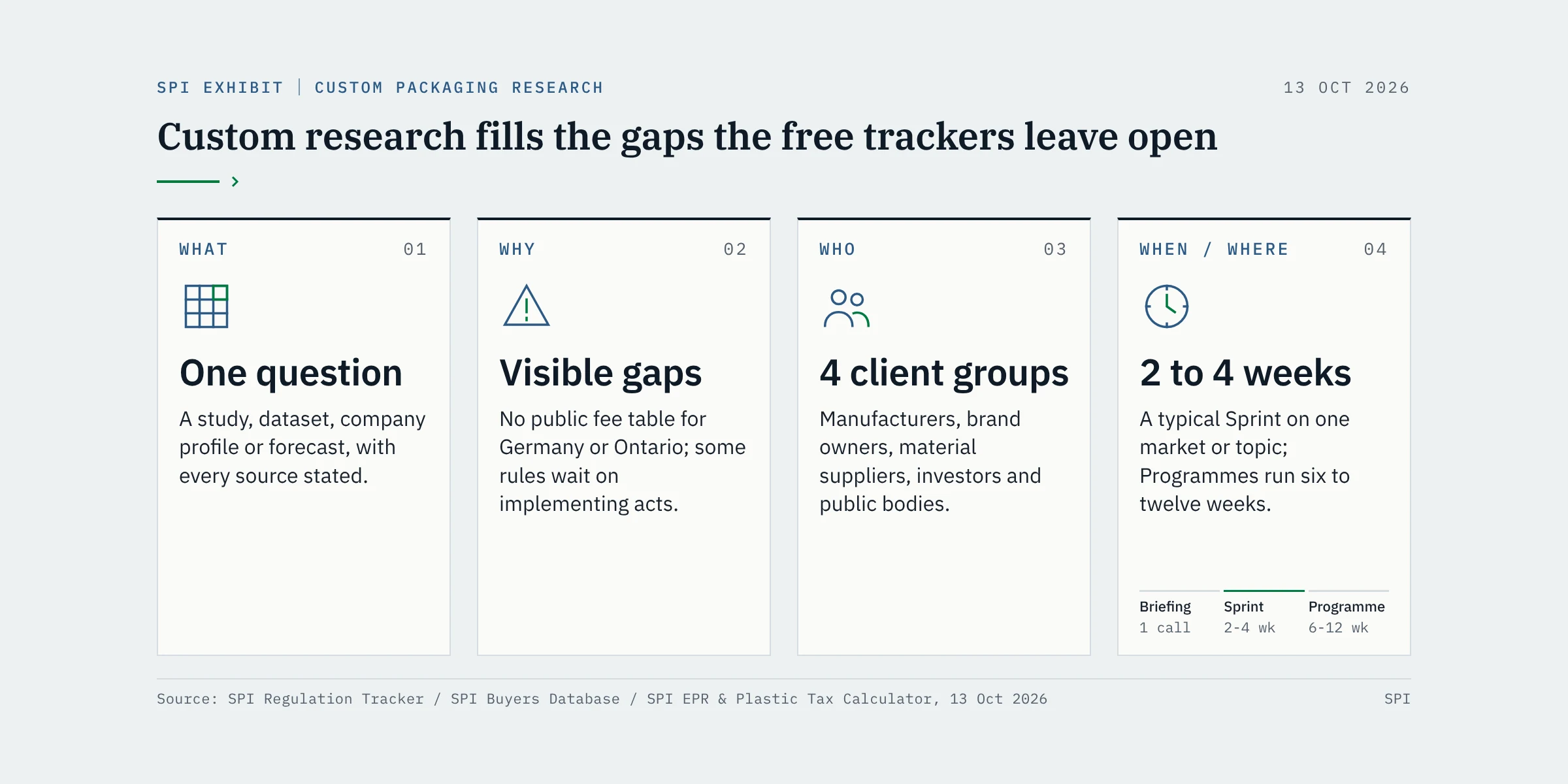
Who this service is for
- Packaging manufacturers and converters who need a market study, customer profile set or segment forecast on their own definitions.
- Brand owners and retailers who need a dataset that the free tools do not hold, such as an obligation map for a product range or a peer benchmark of companies outside the SPI Buyers Database.
- Material suppliers and recyclers who need a demand scenario for a material or a market linked to dated rules.
- Investors, associations and public bodies who need a sourced dataset or study for a specific question.
Scope: what SPI covers
- Client-specific market studies: a market, segment, material or format studied on your definitions, with sources for every figure.
- Company profiles: structured profiles of the companies you name, built only from public and licensed information.
- Forecasts and scenarios: demand or cost scenarios that state their base year, drivers, assumptions and ranges.
- Customised datasets: for example, rule, fee or target data extended to markets, companies or fields beyond the SPI Trackers, delivered with source and licence notes.
- Decision-support analysis: a written answer to one defined question, with the evidence and the uncertainty shown.
Deliverables
| Deliverable | What it contains | Format |
|---|---|---|
| Research report | Findings, method, sourced data and SPI analysis kept visibly separate | Report or deck |
| Dataset | Rows and fields to your definition, with a source, date and licence note for every row | CSV or spreadsheet with data dictionary |
| Company profiles | A fixed template per company, every fact sourced and dated | Spreadsheet and profile pages |
| Forecast or scenario model | Base year, drivers, scenarios and ranges, with an assumptions register | Spreadsheet model and summary |
| Data annex and read-out | Sources, assumptions, corrections log and a read-out call with one round of clarifications | Spreadsheet, call |
Methodology: the SPI 6-step spine
Custom research follows the same six steps as all SPI consulting, set out in the SPI Methodology. For forecasts and datasets, two rules are added: every forecast states its base year, drivers, scenarios and ranges, and every dataset row carries its source and licence terms.
| Step | What happens | Custom research output |
|---|---|---|
| 1. Scope | Scoping call and written brief: the question, definitions, geography, time horizon | Agreed question, definitions and deliverable list |
| 2. Source plan | Public, licensed and your sources listed; licence terms checked for every dataset | Approved source plan with licence notes |
| 3. Evidence | Desk research, SPI datasets, and interviews only when scoped and agreed | Evidence base and, for datasets, raw rows |
| 4. Analysis | Sourced data kept separate from SPI estimates; assumptions listed; forecasts as scenarios with ranges | Draft findings, model or dataset |
| 5. Check | Second SPI team member checks numbers, sources and model logic; corrections logged | QA record |
| 6. Deliver | Report, dataset or model, data annex and read-out call, one round of clarifications | Final deliverable and read-out |
Source: SPI Methodology, checked 12 Nov 2026.
Sample deliverable outline (illustration only)
The outline below illustrates the format of a typical forecast deliverable. It is not a past project and contains no real company names, figures or results.
| Driver | Base year value | Source and date | Low scenario | Central scenario | High scenario | Rule or target link |
|---|---|---|---|---|---|---|
| Driver 1, for example demand volume | Value with unit | Named source, date consulted | Stated range | Stated value | Stated range | Rule ID or none |
| Driver 2, for example recycled-content share | Value with unit | Named source, date consulted | Stated range | Stated value | Stated range | Rule ID |
| Driver 3, for example fee per tonne | Value in own currency | Fee table row, date | Stated range | Stated value | Stated range | Rule ID |
Source: SPI illustration, not a past project, checked 12 Nov 2026.
Entries are placeholders showing the format only.
- Question and definitions. What the forecast answers, and the segment, material and geography definitions used.
- Base year. The starting values, each with its source and date.
- Drivers. The rules, buyer targets, fees and other factors that move the forecast, each linked to its source.
- Scenarios. Low, central and high cases with the assumptions that separate them.
- Results. Ranges by year and segment, never a single point without its range.
- Sensitivities and gaps. Which assumptions matter most and what could not be sourced.
- Annex. Assumptions register, sources, licence notes and corrections log.
Engagement formats and typical timelines
| Format | Typical scope | Typical timeline | Pricing |
|---|---|---|---|
| Briefing | One question answered from existing SPI data, with a call and short memo | One 60-minute call plus a short memo; timing agreed at scoping | On request, fixed fee |
| Sprint | One study, profile set or dataset for one market or topic | Two to four weeks | On request, fixed fee per scope |
| Programme | Multi-market studies, larger datasets or forecast models, in phases | Six to twelve weeks | On request, fixed fee by phase |
| Retainer | Dataset or profile updates on a schedule, with quarterly read-outs | Ongoing | On request, monthly fee |
What SPI needs from you
- The question and the decision it supports, with your deadline.
- Your definitions: segments, materials, formats, regions and companies.
- Any data you want included, such as tonnages or product lists, shared under confidentiality.
- How you will use the output, so licence terms for underlying sources can be checked.
- A named contact for clarifications during the work.
Limitations: what this service does not do
- Forecasts are scenarios, not predictions. They depend on the stated assumptions and are shown as ranges.
- Datasets carry the licence terms of their sources. Some public or licensed data cannot be redistributed; the licence note says what you can do with each row.
- No invented data. SPI does not invent contacts, purchase volumes, supplier relationships or specifications. Gaps are reported as gaps.
- Not legal, financial or tax advice. Regulatory content is decision support; confirm obligations with qualified counsel.
- No testing, certification or audit opinions. Where you need these, we say so and can point you to a qualified provider.
- Public, licensed and your own sources only. SPI does not seek non-public information about other companies.
- Some SPI data products are not yet available, including the SPI Converter & Supplier Directory, SPI Innovation & Launch Tracker and SPI Patent Tracker. Custom research builds what is needed for your question from public sources.
SPI Trackers and tools this service draws on
- SPI Regulation Tracker: 79 rules in 25 jurisdictions, with CSV export.
- SPI Buyers Database: 179 public packaging targets from 42 brand owners and retailers.
- SPI EPR & Plastic Tax Calculator: 216 published rate rows in 14 markets.
Related reading: EPR fees per tonne in 2026 and plastic packaging taxes in 2026.
Where this fits in your decision
Custom research can sit at any stage of SPI’s Discover, Understand, Evaluate, Decide and Implement model, but most often at Implement, when a decision needs a dataset or forecast built to its own terms. If your question matches one of SPI’s other services, that service is usually faster: Packaging Regulatory Intelligence, Sustainable Packaging Strategy, Market & Competitive Intelligence, Strategy & Growth, Procurement & Supplier Intelligence, Innovation & Technology or Investment & Transaction Intelligence.
How to enquire
Send an enquiry through the contact form with your question, definitions and deadline, or write to sales@strategicpackaginginsights.com. The SPI team aims to reply within two business days with a first view or a few questions. If the work fits, we hold a scoping call and send a written proposal with a fixed fee.
Frequently asked questions
What is custom packaging research?
It is a study, dataset, company profile set or forecast built for one specific packaging question, on your definitions. SPI builds it from public, licensed and your own sources, with every fact sourced and dated and every assumption stated.
How is custom research different from a market report?
A syndicated report answers broad questions for many readers using its own definitions. Custom research answers your question, uses your segments and companies, and shows the sources and gaps behind each figure.
Can SPI build a dataset we can use internally?
Yes. Datasets come with a source, date and licence note per row and a data dictionary. What you can do with each row depends on the licence of its underlying source, which SPI checks during the source plan.
Does SPI produce packaging market forecasts?
Yes, as scenarios. Every SPI forecast states its base year, drivers, assumptions and ranges, and is not presented as a prediction.
Why is there no German EPR fee in SPI's calculator?
No public German fee table is available for SPI to cite, so the SPI EPR & Plastic Tax Calculator leaves it out; Ontario is also absent for the same reason. Custom research can build a scenario from the information you hold and any public evidence, with the assumptions stated.
How long does custom research take?
A single study, profile set or dataset usually runs as a Sprint of two to four weeks. Larger or multi-market work runs as a Programme of six to twelve weeks. Pricing is on request after scoping.
Will SPI share our research with others?
No. Custom work is confidential and for your use. SPI may publish its own free data and analysis on related topics, but never your inputs or deliverables.
Sources
- SPI Regulation Tracker, SPI Buyers Database and SPI EPR & Plastic Tax Calculator, data as of 13 October 2026. /data/packaging-regulation-tracker/ ; /data/packaging-buyers-database/ ; /data/epr-plastic-tax-calculator/
- European Parliament Legislative Observatory, Regulation (EU) 2025/40 summary. https://oeil.europarl.europa.eu/oeil/en/document-summary?id=1802233 (PR-EU-003, PR-EU-004; checked 13 October 2026)
- GOV.UK (PackUK), Year 2 illustrative waste disposal fees. https://www.gov.uk/government/publications/illustrative-waste-disposal-fees-2026-extended-producer-responsibility-for-packaging/year-2-illustrative-waste-disposal-fees-extended-producer-responsibility-for-packaging (PR-GB-003; checked 13 October 2026)
- Bundesgesetzblatt, BGBl. 2026 I Nr. 207. https://www.recht.bund.de/bgbl/1/2026/207/VO.html (PR-DE-001; checked 13 October 2026)
- Maine DEP, Stewardship Program for Packaging. https://www.maine.gov/dep/waste/recycle/epr.html (PR-US-001; checked 13 October 2026)
- Parliament of Australia, Senate inquiry page. https://www.aph.gov.au/search/url/Inquiry/27382_16_ (PR-AU-003; checked 13 October 2026)
- MoEFCC Gazette G.S.R. 237(E), 31 March 2026. https://www.mpcb.gov.in/sites/default/files/standing_orders/Plastic_Waste_Management_2026.pdf (PR-IN-002; checked 13 October 2026)
- Dabur India, Business Responsibility and Sustainability Report FY 2025-26. https://nsearchives.nseindia.com/corporate/BRSR_500096_06072026182932.pdf (rechecked 13 October 2026)
Ask the SPI team
What changes for your packaging next quarter?
Tell us your markets and materials. The SPI team walks you through the rules and buyer commitments that affect them.
Prefer email? Write to sales@strategicpackaginginsights.com.
- Q1
Which packaging rules apply to us in each market we sell in?
We map each market's EPR, tax, ban, recycled-content, labelling and deposit rules against your materials and formats, and show which are in force, adopted or only proposed.
- Q2
What could EPR fees and plastic taxes cost us next year?
We apply published fee tables and tax rates to your tonnages and recycled content, and show the result as scenarios with every rate sourced.
- Q3
Can you tell us when a rule changes?
Yes. The free tracker alerts cover rule changes by country; a monitoring retainer adds monthly notes on what the changes mean for your portfolio.