
SPI Intelligence for Pharma and Healthcare Packaging
Pharma and healthcare packaging is partly carved out of the new packaging rules: the EU PPWR recyclability and recycled-content duties, the UK and Spanish plastic taxes and three US state EPR laws exclude some medicinal or medical packaging, but EPR fees, registration and labelling still apply to most of a pharma company’s packaging footprint.
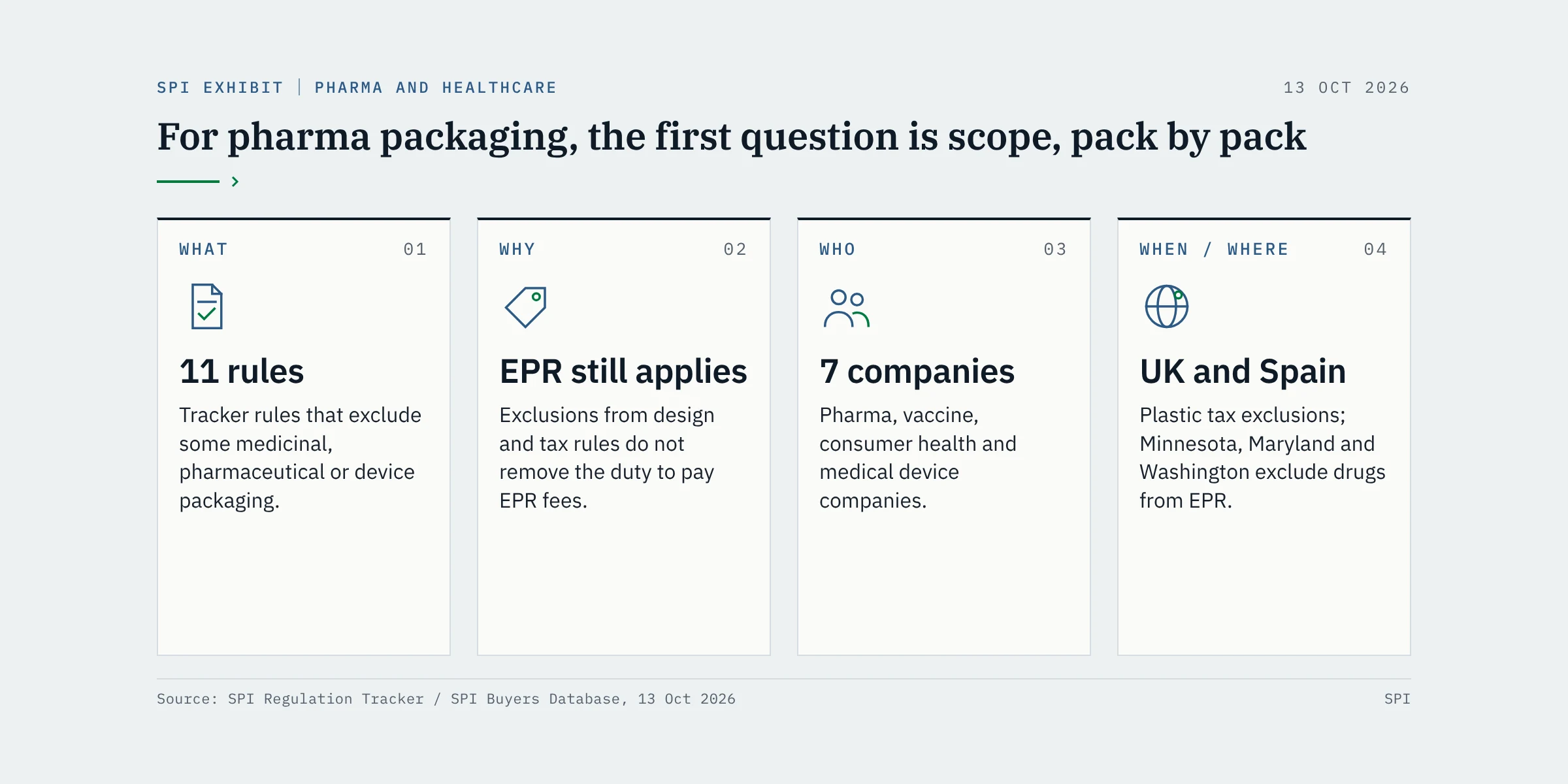
Strategic Packaging Insights (SPI) has read the scope of every rule in the SPI Regulation Tracker and found 11 that exclude some medicinal, pharmaceutical or medical-device packaging, against 25 EPR rules that mostly do not. The first decision for a pharma or consumer health team is therefore scope, pack by pack and market by market.
By the SPI team · Figures as of 13 October 2026
11
Tracked rules that exclude some medicinal or medical packaging
EU, UK, Spain, Colombia, Quebec and four US states
SPI rule notes, 13 Oct 2026
25
EPR rules tracked
Most carry no sector carve-out
SPI Regulation Tracker, 13 Oct 2026
228.82
UK Plastic Packaging Tax, GBP per tonne from 1 Apr 2026
Immediate packaging of licensed human medicines is exempt
PR-GB-001
7
Pharma and consumer health companies profiled
Public packaging targets with sources
SPI Buyers Database, 13 Oct 2026
Source: SPI Regulation Tracker; SPI rule notes; SPI Buyers Database, checked 14 Oct 2026.
Key facts
- Recital 34 of Regulation (EU) 2025/40 says the PPWR recyclability requirement should not be mandatory for immediate packaging of medicinal products and contact-sensitive plastic packaging of medical devices, and that this does not remove the duty to pay EPR fees (PR-EU-010).
- The EUR-Lex summary of the PPWR lists pharmaceutical packaging and medical devices among the exceptions to the 2030 and 2040 minimum recycled-content targets for plastic packaging (PR-EU-004, PR-EU-005).
- The UK Plastic Packaging Tax of £228.82 per tonne from 1 April 2026 does not apply to immediate packaging of licensed human medicines (GOV.UK; PR-GB-001).
- Spain’s EUR 0.45 per kg tax on non-recycled plastic in non-reusable packaging excludes packaging for medicines, medical devices and special medical foods (Ley 7/2022; PR-ES-001).
- Minnesota, Maryland and Washington exclude packaging for FDA-regulated drugs and medical devices from their packaging EPR laws (PR-US-006, PR-US-007, PR-US-008).
- Viet Nam’s Decree 110/2026/ND-CP, effective 25 May 2026, explicitly covers the commercial packaging of medicines, with mandatory recycling rates from 10% (flexible plastic) to 22% (aluminium and rigid PET) (PR-VN-001).
Who this page is for
Regulatory, packaging and sustainability teams at pharmaceutical, vaccine, consumer health and medical device companies, and the converters, glass, aluminium and plastic suppliers who serve them. Safety and product rules come first in this sector: a material change must protect stability, sterility and dosing, and often needs a regulatory variation. That makes it important to know which packaging rules actually apply before planning any redesign.
Three of the tracker’s rule types weigh most here: EPR, recycled content and labelling. Most EPR rules apply across all products; most exemptions sit in design and tax rules.
Scope first: which rules exclude medicinal and medical packaging
Definitions. Immediate packaging is packaging in direct contact with a medicinal product, as used in Directive 2001/83/EC. Contact-sensitive packaging is a PPWR term for certain plastic packaging of sensitive products such as medical devices and infant food; check the Regulation’s own definition before relying on it. Outer or secondary packaging, such as the carton around a blister, is usually not immediate packaging.
The table sets out, rule by rule, what the official source excludes and what still applies. It is drawn from the SPI rule notes, which read each rule’s scope against its official source.
| Rule | Jurisdiction | Type | What is excluded | What still applies |
|---|---|---|---|---|
| PR-EU-010 | EU | Design rule | Immediate packaging of medicinal products; contact-sensitive plastic packaging of medical devices (recital 34) | EPR fees (recital 34); outer packaging |
| PR-EU-004, PR-EU-005 | EU | Recycled content | Pharmaceutical packaging and medical devices (EUR-Lex summary; recital 38) | Other plastic packaging in the range |
| PR-EU-008 | EU | Ban | Single-use packaging needed for public health or medical purposes remains allowed (Commission facts page) | Annex V formats used for non-medical purposes |
| PR-GB-001 | UK | Tax | Immediate packaging of licensed human medicines | Outer cartons, wraps and other plastic components below 30% recycled content |
| PR-ES-001 | Spain | Tax | Packaging for medicines, medical devices, special medical foods, hospital infant formula and healthcare hazardous waste | Other non-reusable plastic packaging |
| PR-CO-001 | Colombia | EPR | Packaging for medicines and pharmaceuticals | Other packaging placed on the market |
| PR-CA-006 | Quebec | EPR | Syringes and certain medical bags such as IV solution bags | Other containers, packaging and printed matter |
| PR-US-006 | Minnesota | EPR | Packaging for FDA-regulated drugs and medical devices, medical food and infant formula | Other packaging and paper products |
| PR-US-007 | Maryland | EPR | Packaging for FDA-regulated drugs and devices, medical food and infant formula | Other packaging and paper products |
| PR-US-008 | Washington | EPR | Packaging for FDA-regulated drugs and devices and infant formula | Other packaging and paper products |
| PR-US-010 | New Jersey | Recycled content | Rigid plastic containers for FDCA-regulated drugs, supplements, devices and cosmetics | Other regulated containers and bags |
Source: SPI Regulation Tracker; SPI rule notes, checked 14 Oct 2026.
Exclusions as stated on the official sources consulted on 13 October 2026. PPWR detail rests on recitals and the EUR-Lex summary because the operative articles did not load; confirm with counsel.
Several rules point the other way. Viet Nam’s Decree 110/2026/ND-CP names medicines among the goods whose primary and outer commercial packaging carries mandatory recycling rates (PR-VN-001). The UK packaging EPR regulations, the Oregon, Colorado and California programmes, Germany’s VerpackDG and India’s plastic packaging EPR show no medicines carve-out on the official pages SPI consulted (PR-GB-002, PR-US-002, PR-US-003, PR-US-004, PR-DE-001, PR-IN-001). India’s recycled-content rules exempt uses where a central law or body such as CDSCO does not permit recycled plastic, provided the basis is declared in the annual return (PR-IN-002).
SPI analysis
Exemptions from design rules do not remove cost. The PPWR’s own recital says the recyclability exemption does not cover EPR contributions, and the UK, Oregon, Colorado, California and German schemes record no medicines carve-out. Budget fees on the full packaging footprint, including immediate packaging, until scope is confirmed for each market. Outer cartons, leaflets, shippers and plastic wraps are where the design rules most clearly bite.
EPR fees and registration
Definition. Extended producer responsibility (EPR) makes the brand owner or importer pay for collecting and recycling the packaging it places on a market, usually through a producer responsibility organisation (PRO).
- EU and Germany. The PPWR has applied since 12 August 2026 (PR-EU-001). In Germany the VerpackDG replaced the Verpackungsgesetz on the same date; companies register in LUCID and join a dual system for packaging that reaches private final consumers, and foreign sellers shipping direct to German end users need an authorised representative (PR-DE-001). A Commission proposal would suspend the PPWR authorised-representative duty for EU-established producers until 1 January 2035, but it is not adopted (PR-EU-012).
- UK. SI 2024/1332 requires UK-established producers supplying more than 25 tonnes of packaging with turnover of £1 million or more to register and report; large producers (over 50 tonnes, over £2 million) also pay disposal fees (PR-GB-002). PackUK’s illustrative 2026-27 fees are modulated by recyclability rating, and its operational plan targets the year 2 notice of liability by the end of November 2026 (PR-GB-003).
- United States. Oregon fees have been chargeable since 1 July 2025 (PR-US-002), Colorado dues since January 2026 (PR-US-003), and California producers had until 1 June 2026 to join Circular Action Alliance, register as independent producers or claim the small-producer exemption (PR-US-004). Minnesota, Maryland and Washington have passed their laws’ effective dates, with the drug and device exclusions noted above; their tracker status is being updated in the 13 October check.
- India and Viet Nam. Indian producers, importers and brand owners register on the CPCB EPR portal and file annual returns, the next by 30 June 2027 (PR-IN-001). Vietnamese producers above VND 30 billion annual revenue from covered products register a recycling plan or pay a Fund contribution before 1 April each year (PR-VN-001).
Viet Nam shows how a medicines-inclusive EPR law sets obligations by material rather than by product.
Recyclability and recycled content
EU recyclability. From 1 January 2030, packaging placed on the EU market must be recyclable, graded A, B or C against design-for-recycling criteria, with grade B the minimum from 1 January 2038 (PR-EU-010). Immediate medicinal packaging and contact-sensitive device packaging sit outside this duty according to recital 34, and the PPWR allows innovative packaging additional time (recital 33). Secondary cartons, leaflets and transport packaging do not benefit from the medicinal exclusion.
EU recycled content. Minimum post-consumer recycled content applies to plastic packaging from 2030 and rises in 2040 (PR-EU-004, PR-EU-005). The EUR-Lex summary lists pharmaceutical packaging and medical devices among the exceptions. The Commission timeline lists a delegated act on evaluating derogations by 1 January 2028 and a review of the 2030 targets by 12 February 2032, either of which could change scope.
India. G.S.R. 237(E) sets recycled content for Category I rigid plastic packaging at 30% in 2025-26, rising to 60% from 2028-29; Category II at 10% to 20%; Category III at 5% to 10% (PR-IN-002). Uses where recycled plastic is not permitted by a central body such as CDSCO are exempt if the basis is declared in the annual return.
SPI analysis
For prescription medicines, regulatory approval, not packaging law, sets the pace of material change. A recycled-content or recyclability switch in immediate packaging can trigger stability studies and a marketing-authorisation variation, so the realistic levers in the next three years are outer packaging, leaflets and transport packs. Consumer health ranges sold through retail sit much closer to personal care and should expect the same EU and India pressures.
Plastic taxes and labelling
Plastic taxes. The UK Plastic Packaging Tax charges £228.82 per tonne from 1 April 2026 on finished plastic packaging components with less than 30% recycled plastic, with immediate packaging of licensed human medicines exempt (PR-GB-001). HMRC has announced that from 1 April 2027 pre-consumer plastic will no longer count towards the 30% threshold. Spain charges EUR 0.45 per kg of non-recycled plastic in non-reusable packaging, excluding packaging for medicines, medical devices and special medical foods (PR-ES-001). See plastic packaging taxes in 2026.
Labelling. The PPWR harmonised material-composition label is due by 12 August 2028 at the earliest, depending on a Commission implementing act still in preparation in October 2026 (PR-EU-003). France requires the Triman logo with Info-tri sorting instructions on household packaging (PR-FR-003). California’s SB 343 restricts recyclability claims on products made after 4 October 2026, but enforcement has been blocked by preliminary injunction since 14 July 2026 (PR-US-011). In pharma, pack graphics also carry regulated product information, so sorting-label changes should be planned with regulatory affairs.
What to do now: a scope-first checklist
These steps come from the actions in the SPI rule notes, ordered for a pharma or consumer health portfolio.
- Split the portfolio by packaging level. Record for each SKU which components are immediate packaging, which are outer packaging and which are transport packaging, because the PPWR, UK and Spanish exclusions depend on it.
- Map the exclusion to each market. Use the scope matrix above: an exclusion in Spain or Minnesota does not carry over to Oregon, Germany or Viet Nam.
- Register everywhere EPR applies. Check LUCID in Germany, UK registration against the 25-tonne and £1 million tests, Circular Action Alliance in Oregon, Colorado and California, and the CPCB portal in India.
- Price the outer packaging. Cartons, leaflets, shrink wraps and shippers carry the fees and taxes the exclusions do not remove. Model them in the SPI EPR & Plastic Tax Calculator.
- Plan artwork with regulatory affairs. Book the EU harmonised label change into the next labelling variation cycle, and watch the SB 343 court case before changing US recyclability claims.
Key dates for pharma and healthcare packaging
Most pharma deadlines are fee and reporting cycles rather than design dates. The table shows the dates SPI tracks that apply to medicinal and consumer health packs in at least part of their range.
- Tax
- EPR
- Recycled content
- Labelling
- Design rule
- Spain plastic packaging tax applies, medicines packaging excluded (PR-ES-001)Tax
- UK packaging EPR regulations in force (PR-GB-002)EPR
- Oregon EPR fees chargeable (PR-US-002)EPR
- Colorado EPR dues payable (PR-US-003)EPR
- UK Plastic Packaging Tax rises to 228.82 GBP per tonne (PR-GB-001)Tax
- Viet Nam Decree 110/2026 in force, medicines packaging covered (PR-VN-001)EPR
- California SB 54 producer registration deadline (PR-US-004)EPR
- PPWR applies; Germany VerpackDG replaces VerpackG (PR-EU-001, PR-DE-001)EPR
- PackUK year 2 notice of liability targeted (PR-GB-003)EPR
- UK pre-consumer plastic stops counting towards 30% threshold; Viet Nam annual registration due (PR-GB-001, PR-VN-001)Tax
- India 2026-27 annual EPR return due (PR-IN-001)EPR
- EU delegated act on recycled-content derogations due (PR-EU-004)Recycled content
- Maryland first producer responsibility plan due (PR-US-007)EPR
- EU harmonised sorting label, earliest date (PR-EU-003)Labelling
- Minnesota first stewardship plan due (PR-US-006)EPR
- Viet Nam recycling rates can rise by up to 10 points (PR-VN-001)EPR
- PPWR recyclability and recycled content apply, with medicinal exclusions (PR-EU-010, PR-EU-004)Design rule
- PPWR minimum recyclability grade B (PR-EU-010)Design rule
Source: SPI Regulation Tracker; SPI rule notes, checked 14 Oct 2026.
Show the data
| Date | Label | Category | Link |
|---|---|---|---|
| 2023-01-01 | Spain plastic packaging tax applies, medicines packaging excluded (PR-ES-001) | Tax | /data/packaging-regulation-tracker/spain/ |
| 2025-01-01 | UK packaging EPR regulations in force (PR-GB-002) | EPR | /data/packaging-regulation-tracker/united-kingdom/ |
| 2025-07-01 | Oregon EPR fees chargeable (PR-US-002) | EPR | /data/packaging-regulation-tracker/united-states/ |
| 2026-01 | Colorado EPR dues payable (PR-US-003) | EPR | /data/packaging-regulation-tracker/united-states/ |
| 2026-04-01 | UK Plastic Packaging Tax rises to 228.82 GBP per tonne (PR-GB-001) | Tax | /data/packaging-regulation-tracker/united-kingdom/ |
| 2026-05-25 | Viet Nam Decree 110/2026 in force, medicines packaging covered (PR-VN-001) | EPR | /data/packaging-regulation-tracker/vietnam/ |
| 2026-06-01 | California SB 54 producer registration deadline (PR-US-004) | EPR | /data/packaging-regulation-tracker/united-states/ |
| 2026-08-12 | PPWR applies; Germany VerpackDG replaces VerpackG (PR-EU-001, PR-DE-001) | EPR | /data/packaging-regulation-tracker/european-union/ |
| 2026-11 | PackUK year 2 notice of liability targeted (PR-GB-003) | EPR | /data/packaging-regulation-tracker/united-kingdom/ |
| 2027-04-01 | UK pre-consumer plastic stops counting towards 30% threshold; Viet Nam annual registration due (PR-GB-001, PR-VN-001) | Tax | /data/packaging-regulation-tracker/united-kingdom/ |
| 2027-06-30 | India 2026-27 annual EPR return due (PR-IN-001) | EPR | /data/packaging-regulation-tracker/india/ |
| 2028-01-01 | EU delegated act on recycled-content derogations due (PR-EU-004) | Recycled content | /data/packaging-regulation-tracker/european-union/ |
| 2028-07-01 | Maryland first producer responsibility plan due (PR-US-007) | EPR | /data/packaging-regulation-tracker/united-states/ |
| 2028-08-12 | EU harmonised sorting label, earliest date (PR-EU-003) | Labelling | /data/packaging-regulation-tracker/european-union/ |
| 2028-10-01 | Minnesota first stewardship plan due (PR-US-006) | EPR | /data/packaging-regulation-tracker/united-states/ |
| 2029-01-01 | Viet Nam recycling rates can rise by up to 10 points (PR-VN-001) | EPR | /data/packaging-regulation-tracker/vietnam/ |
| 2030-01-01 | PPWR recyclability and recycled content apply, with medicinal exclusions (PR-EU-010, PR-EU-004) | Design rule | /data/packaging-regulation-tracker/european-union/ |
| 2038-01-01 | PPWR minimum recyclability grade B (PR-EU-010) | Design rule | /data/packaging-regulation-tracker/european-union/ |
What seven pharma and health companies have committed to
The SPI Buyers Database lists seven pharma and consumer health companies among its 42 brand owners and retailers, which together publish 179 packaging targets. Figures are as each company reports them; SPI does not audit them.
| Company | Target | Latest reported | Status |
|---|---|---|---|
| Haleon | All packaging recycle-ready by 2025 | 80% recycle-ready (to 30 Jun 2025); company says 2025 goal met | Met |
| Haleon | Virgin petroleum-based plastic down 10% by 2025 vs 2022 | 9% (to 30 Jun 2025); company says results to 30 Sep 2025 pass 10% | Met |
| Kenvue | Virgin plastic down 25% by 2025 vs 2020 | 33% | Met |
| Reckitt | 100% of plastic packaging recyclable or reusable by 2025 | 81% (2024) | Missed |
| Reckitt | 25% recycled content in plastic packaging by 2025 | 12% (2024); expects to report slightly behind | Behind; under review |
| Dabur India | 80% reusable, recyclable or compostable by FY 2028 | 90% (FY 2025-26) | Met |
| Sanofi | 100% of syringe vaccines blister-free by 2030 | 61.5% (2025) | In progress |
| GSK | 25% environmental impact reduction for product and packaging by 2030 | 42% of in-scope products have reduction plans | In progress |
| Pfizer | Eliminate and reduce packaging materials (no number or year) | Not reported | Unknown |
Source: SPI Buyers Database, checked 13 Oct 2026.
Status is SPI's reading of each company's reported figure against its own target.
Sanofi moved its blister-free target from 2027 to 2030 and reports that all new medicines and vaccines have followed an eco-design approach since 2025. GSK finalised the scope and method of its 2030 product and packaging goal in 2025 and plans reduction plans for all in-scope products by the end of 2026; it also uses recycled card in packaging and e-leaflets for vaccines. Reckitt reports an 18% cut in virgin plastic packaging (2024) against 50% by 2030.
SPI analysis
Two patterns are visible. Consumer health companies (Haleon, Kenvue, Reckitt) set targets in the same terms as personal care and report similar gaps, especially on recycled content. Prescription medicine companies (Sanofi, GSK, Pfizer) target formats and process, such as blister removal and eco-design, rather than portfolio-wide percentages. Converters should expect consumer health briefs to track PR-EU-004 and PR-IN-002, and prescription briefs to focus on secondary packaging and cold-chain shippers.
How SPI builds this page
SPI Regulation Tracker. Each of the 79 rules in 25 jurisdictions has its official source, dates, last-checked date and an SPI note on scope, actions and open points. The 13 October 2026 check re-read 56 tracker records against their official sources and updated 46. The exclusion matrix above comes from those notes. SPI EPR & Plastic Tax Calculator. 216 published rate rows in 14 markets; it applies rates to your tonnages and does not apply sector exemptions. SPI Buyers Database. Company-reported targets with links; no contacts, volumes, suppliers or specifications.
Limitations. The PPWR exclusions rest on recitals and the EUR-Lex summary because the operative articles did not load during SPI’s checks; confirm them with counsel. SPI does not give legal advice, file regulatory submissions or variations, or carry out stability, compatibility or laboratory testing or certification; where you need these, we can point you to a qualified provider. See methodology and corrections.
Where this fits in your decision
- Understand: filter the SPI Regulation Tracker by jurisdiction and type, and read each rule’s scope note.
- Evaluate: estimate EPR fees and plastic tax on your tonnages in the SPI EPR & Plastic Tax Calculator, then remove exempt items yourself.
- Discover: compare health companies’ targets in the SPI Buyers Database.
- Decide and implement: SPI Consulting maps scope and exposure across your markets.
Related pages: Personal and home care for consumer health ranges sold in retail, and the Industries overview.
When you need more than the data
The SPI Trackers are free. Three SPI Consulting services fit pharma and healthcare work:
- Packaging Regulatory Intelligence: a jurisdiction-by-material obligation map showing enacted rules, exclusions and SPI interpretation in separate columns, with exposure scenarios and a deadline calendar.
- Sustainable Packaging Strategy: options for outer packaging, leaflets and shippers, benchmarked against peers’ public commitments.
- Packaging Procurement & Supplier Intelligence: supplier mapping when a material change is planned, using public capability evidence.
Work is scoped as a Briefing, Sprint, Programme or Retainer, with pricing on request. To discuss a scope question, send an enquiry.
Frequently asked questions
Are medicines exempt from the EU PPWR recyclability requirement?
Recital 34 of Regulation (EU) 2025/40 says the recyclability requirement should not be mandatory for immediate packaging of medicinal products under Directive 2001/83/EC or for contact-sensitive plastic packaging of medical devices (PR-EU-010). Outer packaging is not covered by that exclusion. Confirm the operative article wording with counsel.
Do pharmaceutical companies still pay packaging EPR fees?
In most markets, yes. PPWR recital 34 says the recyclability exemption does not cover EPR contributions, and the UK, Oregon, Colorado, California and German schemes show no medicines carve-out on the official pages SPI consulted. Minnesota, Maryland and Washington exclude packaging for FDA-regulated drugs and devices (PR-US-006, PR-US-007, PR-US-008).
Does the UK Plastic Packaging Tax apply to medicine packaging?
Immediate packaging of licensed human medicines is exempt from the UK Plastic Packaging Tax, according to GOV.UK guidance (PR-GB-001). Other plastic components, such as outer wraps and transport packaging made in or imported into the UK with less than 30% recycled plastic, are taxed at £228.82 per tonne from 1 April 2026.
Is pharmaceutical packaging exempt from EU recycled-content targets?
The EUR-Lex summary of the PPWR lists pharmaceutical packaging and medical devices among the exceptions to the minimum recycled-content targets for plastic packaging that start in 2030 (PR-EU-004). Recital 38 also refers to certain contact-sensitive medical packaging being excluded. A delegated act on derogations is due by 1 January 2028.
Does Spain's plastic packaging tax apply to medicines?
No. Spain’s tax of EUR 0.45 per kg of non-recycled plastic in non-reusable packaging excludes packaging for medicines, medical devices, special medical foods, hospital infant formula and healthcare hazardous waste (Ley 7/2022; PR-ES-001).
Which EPR laws explicitly cover medicines packaging?
Viet Nam’s Decree 110/2026/ND-CP, effective 25 May 2026, names medicines among the goods whose commercial packaging carries mandatory recycling rates, from 10% for flexible plastic to 22% for aluminium and rigid PET (PR-VN-001). Producers below VND 30 billion annual revenue from covered products are outside it.
What are India's recycled-content rules for pharmaceutical packaging?
India’s G.S.R. 237(E) sets category-wise recycled content, 30% to 60% for rigid plastic by 2028-29 (PR-IN-002). Uses where a central law or body such as CDSCO does not permit recycled plastic are exempt, provided the basis is declared in the annual return on the CPCB portal.
When does the EU harmonised packaging label apply?
The PPWR harmonised material-composition label is due by 12 August 2028 at the earliest (PR-EU-003). The label design depends on a Commission implementing act that was still in preparation in October 2026.
Sources
- SPI Regulation Tracker and SPI rule notes, /data/packaging-regulation-tracker/, data as of 13 October 2026; each rule cited by ID with its official source.
- SPI Buyers Database, /data/packaging-buyers-database/, data as of 13 October 2026; company figures from each company’s own report as linked on its profile.
- SPI EPR & Plastic Tax Calculator, /data/epr-plastic-tax-calculator/, data as of 13 October 2026 (FEE-GB-002, 005, 008, 011, 014, 017, 020, 023).
- EUR-Lex: Regulation (EU) 2025/40, OJ L 22.1.2025, recitals 33, 34 and 38, https://eur-lex.europa.eu/legal-content/EN/TXT/HTML/?uri=OJ:L_202500040, consulted 13 October 2026 (PR-EU-004, PR-EU-010).
- EUR-Lex: Summaries of EU legislation, Packaging and packaging waste (from 2026), https://eur-lex.europa.eu/legal-content/EN/TXT/HTML/?uri=LEGISSUM:4806724, consulted 13 October 2026 (PR-EU-004, PR-EU-005).
- European Parliament Legislative Observatory: Regulation (EU) 2025/40 summary, https://oeil.europarl.europa.eu/oeil/en/document-summary?id=1802233, consulted 13 October 2026 (PR-EU-001, PR-EU-003).
- European Commission (DG ENV): Packaging waste, https://environment.ec.europa.eu/topics/waste-and-recycling/packaging-waste_en, and Facts about the new EU rules on packaging, https://environment.ec.europa.eu/topics/waste-and-recycling/packaging-waste/facts-about-new-eu-rules-packaging-and-packaging-waste_en, consulted 13 October 2026 (PR-EU-008, PR-EU-010, PR-EU-012).
- European Commission Green Forum: PPWR implementation timeline, https://green-forum.ec.europa.eu/packaging-and-packaging-waste-regulation-implementation_en, consulted 13 October 2026.
- GOV.UK: Plastic Packaging Tax: steps to take, https://www.gov.uk/guidance/check-if-you-need-to-register-for-plastic-packaging-tax; Check which plastic packaging is exempt from Plastic Packaging Tax, https://www.gov.uk/guidance/check-which-plastic-packaging-is-exempt-from-plastic-packaging-tax; HMRC policy paper on mass balance and pre-consumer plastic, https://www.gov.uk/government/publications/plastic-packaging-tax-mass-balance-approach-and-removal-of-pre-consumer-plastic/plastic-packaging-tax-mass-balance-approach-and-removal-of-pre-consumer-plastic; all consulted 13 October 2026 (PR-GB-001).
- legislation.gov.uk: SI 2024/1332, https://www.legislation.gov.uk/uksi/2024/1332/introduction/made, and GOV.UK: Year 2 illustrative waste disposal fees, https://www.gov.uk/government/publications/illustrative-waste-disposal-fees-2026-extended-producer-responsibility-for-packaging/year-2-illustrative-waste-disposal-fees-extended-producer-responsibility-for-packaging, consulted 13 October 2026 (PR-GB-002, PR-GB-003).
- Agencia Tributaria: Impuesto especial sobre envases de plástico no reutilizables, https://sede.agenciatributaria.gob.es/Sede/impuestos-especiales-medioambientales/impuesto-especial-sobre-envases-plastico-reutilizables/base-imponible-tipo-impositivo-cuota-tributaria.html, and BOE: Ley 7/2022, https://www.boe.es/buscar/act.php?id=BOE-A-2022-5809, consulted 13 October 2026 (PR-ES-001).
- Cancillería normograma: Resolución 1407 de 2018, https://cancilleria.gov.co/sites/default/files/Normograma/docs/resolucion_minambienteds_1407_2018.htm, consulted 13 October 2026 (PR-CO-001).
- Gouvernement du Québec: feuillet synthèse collecte sélective, https://www.environnement.gouv.qc.ca/matieres/consigne-collecte/feuillet-synthese-collecte-selective.pdf, and Modernized Selective Collection, https://www.environnement.gouv.qc.ca/matieres/consigne-collecte/collecte-selective-modernisee-en.htm, consulted 13 October 2026 (PR-CA-006).
- MPCA fact sheet, https://www.pca.state.mn.us/sites/default/files/w-ps1-05b%20.pdf; Maryland General Assembly: Chapter 431 (SB 901), https://mgaleg.maryland.gov/2025RS/chapters_noln/Ch_431_sb0901E.pdf; Washington Ecology: Recycling Reform Act, https://ecology.wa.gov/waste-toxics/reducing-recycling-waste/our-recycling-programs/recycling-reform-act; all consulted 13 October 2026 (PR-US-006, PR-US-007, PR-US-008).
- NJDEP: Recycled Content Law FAQ, https://www.nj.gov/dep/dshw/recycled-content/recycled_content_faqs.pdf, consulted 13 October 2026 (PR-US-010).
- Oregon DEQ: Producers of Covered Products, https://oregon.gov/deq/recycling/Pages/Producers-of-Covered-Products.aspx; CDPHE: Producer Responsibility Program, https://cdphe.colorado.gov/hm/epr-program; CalRecycle: SB 54 permanent regulations, https://content.govdelivery.com/accounts/CALRECYCLE/bulletins/4157d91; all consulted 13 October 2026 (PR-US-002, PR-US-003, PR-US-004).
- Bundesgesetzblatt: BGBl. 2026 I Nr. 207, https://www.recht.bund.de/bgbl/1/2026/207/VO.html, and Zentrale Stelle Verpackungsregister: what changes from 12 August, https://www.verpackungsregister.org/en/i-want-to-know-what-will-change-from-12-august, consulted 13 October 2026 (PR-DE-001).
- MoEFCC Gazette G.S.R. 237(E), hosted by Maharashtra Pollution Control Board, https://www.mpcb.gov.in/sites/default/files/standing_orders/Plastic_Waste_Management_2026.pdf, and NGT: CPCB reply in OA 1179 of 2024, https://www.greentribunal.gov.in/sites/default/files/news_updates/REPLY%20BY%20R-2%20CPCB%20IN%20OA%20NO.%201179%20of%202024%20HARIYALI%20WELFARE%20SOCIETY%20VS%20UNION%20OF%20INDIA.pdf, consulted 13 October 2026 (PR-IN-001, PR-IN-002).
- Official Gazette of Viet Nam: Decree 110/2026/NĐ-CP, https://congbaocdn.chinhphu.vn/180507251028987904/2026/4/20/469301-1776647243_v1_1776647876_signed.pdf, consulted 13 October 2026 (PR-VN-001).
- French Ministry of Ecological Transition: Info-tri, https://www.ecologie.gouv.fr/info-tri, and CalRecycle: SB 343 Accurate Recycling Labels, https://calrecycle.ca.gov/wcs/recyclinglabels/, consulted 13 October 2026 (PR-FR-003, PR-US-011).
- Company reports as linked on each SPI Buyers Database profile, rechecked 13 October 2026: Haleon Health, Inclusivity and Sustainability Report 2025; Kenvue 2025 Healthy Lives Mission Report announcement; Reckitt Sustainability Report 2025; Dabur BRSR FY 2025-26; Sanofi Eco-design Factsheet (July 2026); GSK Responsible Business 2025; Pfizer Packaging.
Ask the SPI team
What changes for your packaging next quarter?
Tell us your markets and materials. The SPI team walks you through the rules and buyer commitments that affect them.
Prefer email? Write to sales@strategicpackaginginsights.com.
- Q1
Which packaging rules apply to us in each market we sell in?
We map each market's EPR, tax, ban, recycled-content, labelling and deposit rules against your materials and formats, and show which are in force, adopted or only proposed.
- Q2
What could EPR fees and plastic taxes cost us next year?
We apply published fee tables and tax rates to your tonnages and recycled content, and show the result as scenarios with every rate sourced.
- Q3
Can you tell us when a rule changes?
Yes. The free tracker alerts cover rule changes by country; a monitoring retainer adds monthly notes on what the changes mean for your portfolio.