
SPI Consulting: Packaging Consulting Built on Sourced Regulation, Fee and Buyer Data
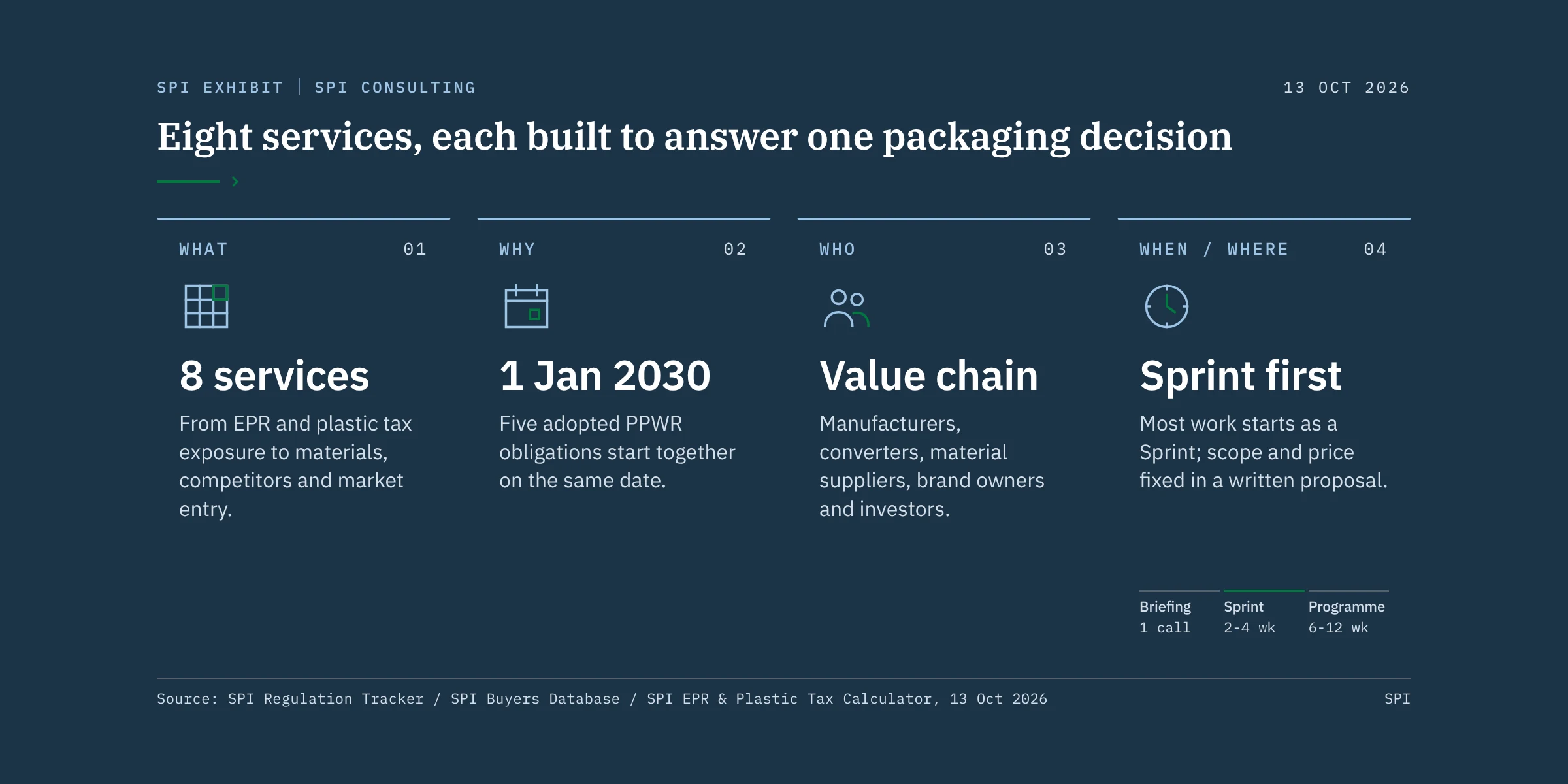
SPI Consulting is the packaging consulting practice of Strategic Packaging Insights (SPI): eight services that each answer one packaging decision, from EPR and plastic tax exposure to material choices, competitors and market entry, built on the same sourced data as the SPI Trackers.
Each service starts with the decision you have to make and a written brief, uses public, licensed and supplied sources named in a source plan, and keeps sourced facts visibly apart from SPI judgement. Prices are given on request after a short scoping call, and every proposal states what SPI will not do.
By the SPI team · Figures as of 13 October 2026
79
Packaging rules tracked
across 25 jurisdictions, each with its official source
SPI Regulation Tracker
42
Brand owners and retailers
with their public packaging targets and reported progress
SPI Buyers Database
179
Public packaging targets
each quoted from the company's own report
SPI Buyers Database
216
Published fee and tax rate rows
across 14 markets
SPI EPR & Plastic Tax Calculator
Source: SPI Regulation Tracker, SPI Buyers Database, SPI EPR & Plastic Tax Calculator, checked 14 Oct 2026.
Key facts
- The SPI Regulation Tracker holds 79 packaging rules in 25 jurisdictions on 13 October 2026: 60 in force, 13 adopted and 4 proposed, with the rest expired or withdrawn (SPI Regulation Tracker).
- Regulation (EU) 2025/40, the Packaging and Packaging Waste Regulation (PPWR), has applied since 12 August 2026, and five of its adopted obligations start together on 1 January 2030 (PR-EU-001, PR-EU-004, PR-EU-006, PR-EU-008, PR-EU-009, PR-EU-010).
- California SB 54 permanent regulations took effect on 1 May 2026, with producer registration due by 1 June 2026 (PR-US-004, CalRecycle).
- Of 60 public packaging targets due in 2025 or earlier in the SPI Buyers Database, companies report 16 as met and 19 as missed; 24 have no reported outcome yet (SPI Buyers Database, 13 October 2026).
- Within one fee schedule, plastic rates can differ by a factor of three: Citeo’s 2026 tariff charges EUR 700 per tonne for clear PET bottles and EUR 2,100.1 per tonne for packaging containing PVC (SPI EPR & Plastic Tax Calculator, Citeo 2026).
- PackUK’s 2026-27 plastic fees are published only as illustrative figures: £415, £455 and £545 per tonne for green, amber and red recyclability ratings (PR-GB-003, GOV.UK).
- SPI does not give legal advice, test or certify packaging, give audit opinions or file with regulators on anyone’s behalf (SPI Consulting service definitions, 13 October 2026).
What SPI Consulting is
SPI Consulting is decision support for companies in the packaging value chain: packaging manufacturers and converters, material suppliers, brand owners and retailers, sustainability teams and investors. A packaging consultant, in SPI’s sense, does five things: desk research, data analysis, structured interviews where they are agreed, modelling, and written recommendations. The output is a document you can act on, with every external fact traced to its source and every assumption listed.
The SPI team delivers every engagement. The same team builds and checks the SPI Trackers: the SPI Regulation Tracker, the SPI Buyers Database and the SPI EPR & Plastic Tax Calculator. That matters because the data a project starts from has already been traced to official sources, so analyst time goes into your question rather than into finding the basic facts.
SPI is a focused specialist. It covers packaging only: materials, formats, end uses, the rules that govern them and the companies that buy them. It does not claim the scale of a general management consultancy, and it does not take work outside packaging.
Why packaging decisions are harder now
Three things changed in 2025 and 2026, and all three show up in SPI’s own data.
Rules arrived in a cluster. More rules in the SPI Regulation Tracker took effect in 2025 and in 2026 than in any earlier year, with EPR the largest single type in both. They include the PPWR applying from 12 August 2026 (PR-EU-001), the PFAS limits for food-contact packaging on the same day (PR-EU-002), California SB 54 permanent regulations from 1 May 2026 (PR-US-004), Ontario’s full producer responsibility for the Blue Box from 1 January 2026 (PR-CA-003), Portugal’s Volta deposit system from April 2026 (PR-PT-001) and Viet Nam’s Decree 110/2026/ND-CP from 25 May 2026 (PR-VN-001).
Costs became itemised by format. EPR fees are no longer one rate per material. In the SPI EPR & Plastic Tax Calculator, Circular Action Alliance’s 2026 Oregon schedule charges USD 198.42 per tonne for natural HDPE bottles and USD 2,248.72 per tonne for plastic laminates and other flexible plastic packaging. PackUK’s 2026-27 illustrative plastic fees step from £415 (green) to £545 (red) per tonne by recyclability rating (PR-GB-003). The UK Plastic Packaging Tax adds £228.82 per tonne from 1 April 2026 on plastic components with less than 30% recycled plastic (PR-GB-001).
Public targets came due. Many brand-owner packaging targets were set for 2025. In the SPI Buyers Database, companies report 19 of the 60 targets due in 2025 or earlier as missed, against 16 reported as met. Suppliers who plan around those targets, and brand owners who must restate them, now need evidence rather than ambition.
SPI analysis
Each of these changes turns a general question (“are we exposed?”) into a specific one (“which of our formats pay the red-rate fee in which three markets, and what does a redesign save?”). Specific questions are where structured consulting earns its cost. General questions are often answered for free by the SPI Trackers, and SPI says so when that is the case.
Find the service for your problem
The matrix routes the questions SPI is asked most often to the service that leads on them and the services that support. Start from the row that sounds like your question.
| Your question | Regulatory Intelligence | Sustainable Packaging Strategy | Market & Competitive Intelligence | Strategy & Growth | Procurement & Supplier Intelligence | Innovation & Technology | Investment & Transaction Intelligence | Custom Research |
|---|---|---|---|---|---|---|---|---|
| Which packaging rules apply to us, in which markets, and from when? | Lead | Supports | no data | no data | no data | no data | Supports | no data |
| What will EPR fees and plastic taxes cost us next year? | Lead | Supports | no data | no data | no data | no data | no data | no data |
| Which material or redesign meets our targets and the rules without breaking cost? | Supports | Lead | no data | no data | no data | Supports | no data | no data |
| Are our packaging targets credible next to our peers? | no data | Lead | Supports | no data | no data | no data | no data | no data |
| Who are our real competitors in a segment, and how do we compare? | no data | no data | Lead | Supports | no data | no data | no data | no data |
| Which segment, format or country should we grow into next? | Supports | no data | Supports | Lead | no data | no data | no data | no data |
| How should we price and take a new format to market? | no data | no data | Supports | Lead | no data | no data | no data | no data |
| Our supply base is concentrated: who else could supply this pack? | no data | no data | Supports | no data | Lead | no data | no data | no data |
| Is this material or technology ready to scale? | no data | Supports | no data | no data | no data | Lead | no data | no data |
| How exposed is an acquisition target to packaging rules and buyer targets? | Supports | no data | Supports | no data | no data | no data | Lead | no data |
| We need a dataset, profile or forecast nobody publishes | no data | no data | no data | no data | no data | no data | no data | Lead |
Source: SPI Consulting service definitions, checked 12 Nov 2026.
The eight services in one line each
- Packaging Regulatory Intelligence: EPR, plastic taxes, bans, recycled-content, labelling and deposit rules mapped to your materials, markets and deadlines, with exposure scenarios at published rates.
- Sustainable Packaging Strategy: material alternatives, desk-based recyclability reviews against published design-for-recycling guidance, reuse options and a prioritised redesign roadmap.
- Packaging Market & Competitive Intelligence: market assessments, competitor benchmarks from public information, demand drivers and a geography ranking.
- Packaging Strategy & Growth: market entry, segment priorities, pricing intelligence and a 12 to 24 month go-to-market plan.
- Packaging Procurement & Supplier Intelligence: supplier long lists and short lists from public capability evidence, comparison matrices and diversification options.
- Packaging Innovation & Technology: technology landscapes, patent activity from public patent databases and readiness assessments for emerging materials.
- Packaging Investment & Transaction Intelligence: target screening, the market and competitive sections of commercial due diligence, and red-flag memos on regulatory and demand risk.
- Custom Packaging Research: a study, dataset, company profile or forecast built for one question that the other services do not cover.
Packaging Regulatory Intelligence is the first service SPI publishes in full, because it sits directly on the SPI Regulation Tracker and the SPI EPR & Plastic Tax Calculator.
Where consulting fits: Discover, Understand, Evaluate, Decide, Implement
SPI organises its products and services in the order packaging decisions are usually made. The free SPI Trackers cover the first three stages for most readers. Consulting is the optional next step when your question is specific to your portfolio, your markets or your deadline.
| Stage | Question | Free SPI product | SPI Consulting next step |
|---|---|---|---|
| Discover | Who buys what, and what have they promised? | SPI Buyers Database | Market & Competitive Intelligence; Procurement & Supplier Intelligence |
| Understand | Which rules apply, and when? | SPI Regulation Tracker | Regulatory Intelligence (monitoring); Innovation & Technology |
| Evaluate | What will it cost, and what are the options? | SPI EPR & Plastic Tax Calculator | Regulatory Intelligence (exposure assessment); Sustainable Packaging Strategy |
| Decide | Which option, which market, which asset? | SPI Briefing | Strategy & Growth; Investment & Transaction Intelligence |
| Implement | How do we deliver and keep track? | Sprint, Programme or Retainer | Custom Research |
Source: SPI Consulting service definitions, checked 12 Nov 2026.
A typical path: a packaging buyer reads in the SPI Regulation Tracker that Washington’s Recycling Reform Act bars producers outside a producer responsibility organisation (PRO) in good standing from introducing covered materials from 1 March 2029 (PR-US-008), checks its Oregon and Colorado fee lines in the calculator, and then asks SPI for an exposure assessment across all its US states. Each step before the enquiry is free and needs no sign-up.
If you are not sure where to start, the SPI Intelligence pages filter the data by reader: SPI Intelligence for Packaging manufacturers, Converters, Brand owners and packaging buyers, Sustainability teams and Investors.
How every SPI engagement runs
Every service uses the same six-step SPI Methodology. Each service page adds the work that is specific to that service.
| Step | What happens | What you see |
|---|---|---|
| 1 Scope | Scoping call and written brief: the decision to support, geographies, materials and formats, time horizon | Written brief to confirm |
| 2 Source plan | The public, licensed and supplied sources to be used; each external fact keeps its original source, date, scope and licence | Source plan in the proposal |
| 3 Evidence | Desk research, SPI datasets (Regulation Tracker, Buyers Database, fee tables), interviews only when scoped and agreed | Interim check-in on Sprints and Programmes |
| 4 Analysis | Sourced data kept visibly separate from SPI estimates and interpretation; assumptions listed | Assumptions register |
| 5 Check | A second SPI team member checks numbers and sources; corrections logged for the engagement | Corrections log on request |
| 6 Deliver | Report or deck, data annex and read-out call; one round of clarifications included | Final report, annex and call |
Source: SPI Methodology; SPI Consulting service definitions, checked 12 Nov 2026.
The separation in step 4 is the rule that most shapes an SPI deliverable. A published fee rate, a statutory date or a company’s reported progress is shown as a sourced fact with its source and date. A tonnage you supply is shown as your input. A scenario, a ranking or a recommendation is labelled as SPI analysis. You can always see which is which, so you can challenge the judgement without having to re-check the facts. The same principles are set out on the SPI Methodology page, and public corrections to SPI data are listed on the corrections page.
Engagement formats
Most work starts as a Sprint. The format sets the depth and the timeline; the service sets the subject.
| Format | Typical scope | Typical timeline | Pricing |
|---|---|---|---|
| Briefing | One question answered from existing SPI data | A 60-minute call and a short memo | On request, fixed fee |
| Sprint | One market or topic | 2 to 4 weeks | On request, fixed fee per scope |
| Programme | Several markets or workstreams, delivered in phases, with a named sponsor on your side | 6 to 12 weeks | On request, fixed fee by phase |
| Retainer | Ongoing monitoring with change notes and quarterly read-outs | Ongoing, monthly | On request, monthly fee |
Source: SPI Consulting service definitions, checked 12 Nov 2026.
SPI does not publish prices. Each quote is built from the scope agreed in the brief and fixed in a written proposal before work starts, so the price you accept is the price for that scope.
The rules that apply to every service
| SPI does | SPI does not |
|---|---|
| Desk research | Give legal advice or legal representation |
| Data analysis on SPI datasets and named sources | Carry out certified or laboratory testing |
| Structured interviews, where scoped and agreed | Issue certifications or audit opinions |
| Modelling, with assumptions listed | File with regulators on your behalf |
| Written recommendations, labelled as SPI analysis | Seek non-public or improperly obtained competitor information |
| Point you to a qualified provider for legal, testing or certification work | Invent contacts, purchase volumes, supplier relationships or specifications |
Source: SPI Consulting service definitions, checked 12 Nov 2026.
Four limitations are printed in every SPI proposal and deliverable:
- Estimates are not guarantees. Scenario results depend on the assumptions stated with them.
- Regulatory content is decision support, not legal advice. Confirm obligations with qualified counsel and your compliance scheme.
- SPI does not invent contacts, purchase volumes, supplier relationships or packaging specifications. Gaps are reported as gaps.
- Coverage is limited to the sources named in the source plan.
SPI declines requests for legal opinions, certification, laboratory testing, collection of personal contact data, or anything that needs non-public competitor information. Where one of these is the real need, SPI says so early and can point you to a qualified provider. It names a partner only once a written partner arrangement exists, and none is in place today.
How to start an enquiry
You never have to enquire to use SPI data: the SPI Trackers stay free and usable without a form. When you do want to talk, the path is short.
- Send the enquiry form or write to sales@strategicpackaginginsights.com. Useful details are your company, role, country, the service you think fits and your decision deadline; a budget range is optional.
- The SPI team aims to reply within two business days with a first view or a few questions.
- A scoping call agrees the decision, markets, materials and timing.
- SPI sends a written proposal with the scope, source plan, format, timeline and fixed price.
- Work starts when the engagement is signed.
Investment and transaction work adds a non-disclosure agreement and a conflict check before scoping. The enquiries that move fastest name a decision and a date: “we must decide by March whether to move our UK range from red-rated to green-rated plastic” gives SPI far more to work with than “we would like to understand EPR”.
Frequently asked questions
What does a packaging consultant do?
A packaging consultant helps a company make a packaging decision with better evidence. At SPI that means desk research, data analysis, agreed interviews, modelling and written recommendations on rules, costs, materials, markets, competitors or suppliers. SPI does not test packaging, certify it or give legal opinions.
How much does SPI packaging consulting cost?
SPI gives prices on request. After a short scoping call, SPI sends a written proposal with a fixed fee for the agreed scope: a fixed fee for a Briefing or Sprint, a fee per phase for a Programme, or a monthly fee for a Retainer.
Which SPI Consulting service do I need?
Start from your question. Rules, deadlines and EPR or plastic tax costs go to Packaging Regulatory Intelligence; material and redesign choices to Sustainable Packaging Strategy; competitors and demand to Packaging Market & Competitive Intelligence; where to grow and how to price to Packaging Strategy & Growth. The problem-by-service matrix on this page routes the other questions.
How long does a packaging consulting project take?
A Briefing is a 60-minute call and a short memo. A Sprint on one market or topic typically takes two to four weeks, and a Programme across several markets or workstreams six to twelve weeks. Retainers run monthly with quarterly read-outs.
Does SPI give legal advice on packaging compliance?
No. SPI’s regulatory work is decision support built on official sources, not legal advice or legal representation. Every proposal says this, and SPI recommends confirming obligations with qualified counsel and your compliance scheme.
Can I use SPI data without hiring SPI?
Yes. The SPI Regulation Tracker, the SPI Buyers Database and the SPI EPR & Plastic Tax Calculator are free to use without an enquiry. Consulting is for questions that need your own portfolio, markets or deadlines applied to that data.
Who delivers SPI Consulting work?
The SPI team delivers every engagement, and a second team member checks numbers and sources before delivery. SPI does not pass work to unnamed partners.
What does SPI need from us to start?
A named decision and deadline, the markets and materials in scope, and the internal data the question depends on, such as packaging tonnages by material and market for an EPR exposure assessment. Each service page lists its specific inputs.
Sources
- SPI Regulation Tracker, /data/packaging-regulation-tracker/, data as of 13 October 2026.
- SPI Buyers Database, /data/packaging-buyers-database/, data as of 13 October 2026.
- SPI EPR & Plastic Tax Calculator, /data/epr-plastic-tax-calculator/, data as of 13 October 2026.
- SPI Consulting service definitions, draft v0.2, 13 October 2026 (internal).
- European Parliament Legislative Observatory: Regulation (EU) 2025/40 summary, https://oeil.europarl.europa.eu/oeil/en/document-summary?id=1802233, as given in the SPI Regulation Tracker, checked 13 October 2026.
- CalRecycle: SB 54 Permanent Regulations approved and in effect, https://content.govdelivery.com/accounts/CALRECYCLE/bulletins/4157d91, as given in the SPI Regulation Tracker, checked 13 October 2026.
- Washington Ecology: Recycling Reform Act, https://ecology.wa.gov/waste-toxics/reducing-recycling-waste/our-recycling-programs/recycling-reform-act, as given in the SPI Regulation Tracker, checked 13 October 2026.
- GOV.UK: Year 2 illustrative waste disposal fees, EPR for packaging, https://www.gov.uk/government/publications/illustrative-waste-disposal-fees-2026-extended-producer-responsibility-for-packaging/year-2-illustrative-waste-disposal-fees-extended-producer-responsibility-for-packaging, as given in the SPI EPR & Plastic Tax Calculator, checked 13 October 2026.
- GOV.UK: Plastic Packaging Tax: steps to take, https://www.gov.uk/guidance/check-if-you-need-to-register-for-plastic-packaging-tax, as given in the SPI Regulation Tracker, checked 13 October 2026.
- Citeo: Guide du tarif des emballages ménagers 2026, https://clients-cms.citeo.com/uploads/guide_du_tarif_des_emballages_menagers_2026_f9e4c5b4e6.pdf, as given in the SPI EPR & Plastic Tax Calculator, checked 13 October 2026.
- Circular Action Alliance: 2026 Oregon Producer Fee Schedule, https://static1.squarespace.com/static/64260ed078c36925b1cf3385/t/693b2c9103be112d168e1b19/1765485713621/OR+2026+Fee+Schedule+Public.pdf, as given in the SPI EPR & Plastic Tax Calculator, checked 13 October 2026.
Ask the SPI team
What changes for your packaging next quarter?
Tell us your markets and materials. The SPI team walks you through the rules and buyer commitments that affect them.
Prefer email? Write to sales@strategicpackaginginsights.com.
- Q1
Which packaging rules apply to us in each market we sell in?
We map each market's EPR, tax, ban, recycled-content, labelling and deposit rules against your materials and formats, and show which are in force, adopted or only proposed.
- Q2
What could EPR fees and plastic taxes cost us next year?
We apply published fee tables and tax rates to your tonnages and recycled content, and show the result as scenarios with every rate sourced.
- Q3
Can you tell us when a rule changes?
Yes. The free tracker alerts cover rule changes by country; a monitoring retainer adds monthly notes on what the changes mean for your portfolio.