
SPI Intelligence for Packaging Industries
Each SPI industry page takes the 79 rules in the SPI Regulation Tracker, picks the three or four rule types that weigh most on that industry’s packs, and pairs them with the brand owners and retailers in the SPI Buyers Database that sell in it.
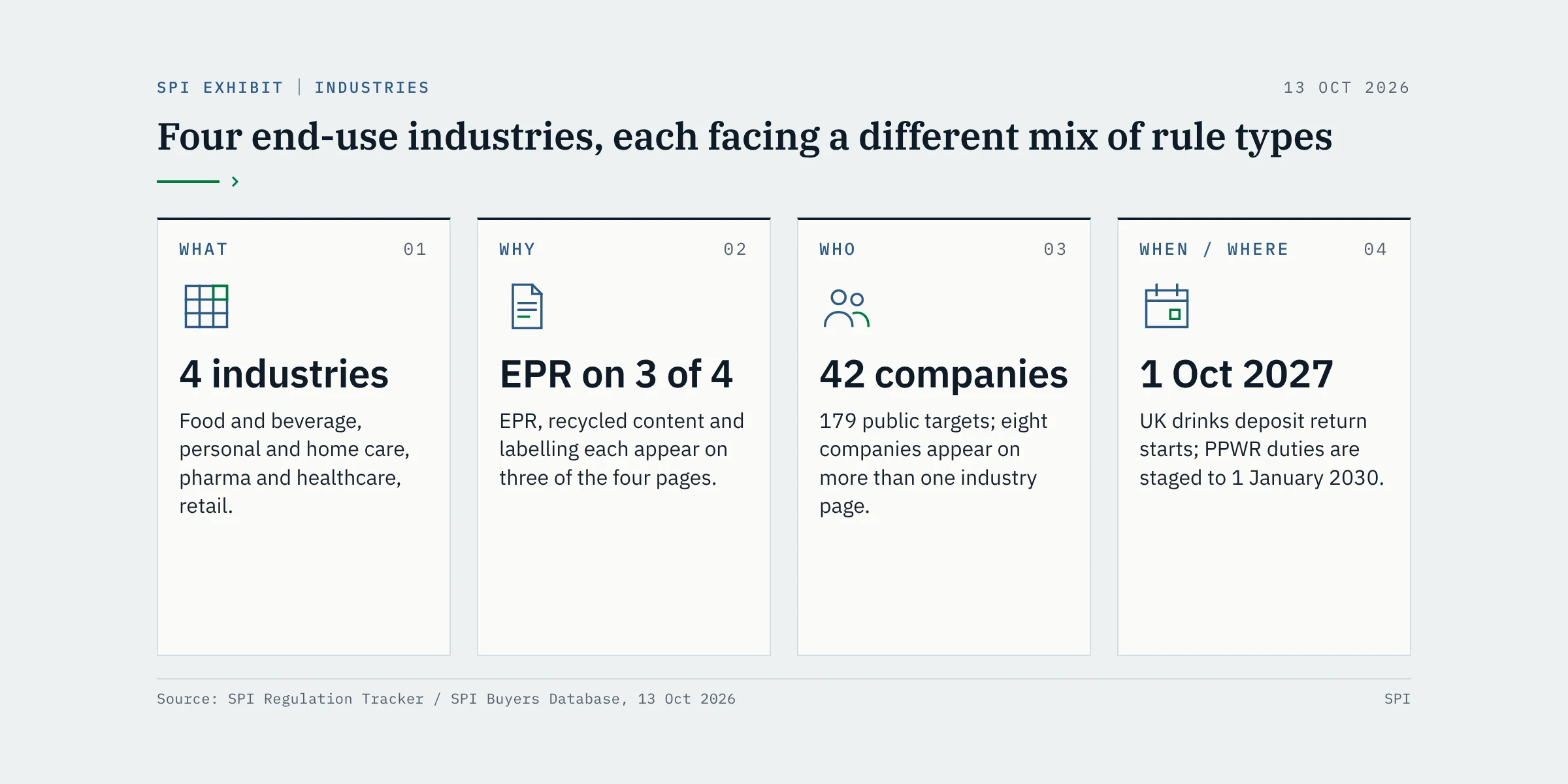
Strategic Packaging Insights (SPI) covers four end-use industries: food and beverage, personal and home care, pharma and healthcare, and retail and e-commerce. EPR, recycled content and labelling each appear on three of the four pages, while deposit return and single-use bans sit only on the food and drink page.
By the SPI team · Figures as of 13 October 2026
79
Rules in the SPI Regulation Tracker
In 25 jurisdictions, each with an official source
SPI Regulation Tracker, 13 Oct 2026
11
Rule types
7 appear on at least one industry page
SPI Regulation Tracker, 13 Oct 2026
42
Brand owners and retailers profiled
Each listed on at least one industry page
SPI Buyers Database, 13 Oct 2026
179
Public packaging targets
Quoted from each company's own reports
SPI Buyers Database, 13 Oct 2026
Source: SPI Regulation Tracker; SPI Buyers Database, checked 14 Oct 2026.
Key facts
- On 13 October 2026 the SPI Regulation Tracker held 79 rules in 25 jurisdictions: 60 in force, 13 adopted and 4 proposed, 2 expired and 0 withdrawn (SPI Regulation Tracker).
- EPR is the largest rule type, with 25 rules, and it is on the watch list of three industry pages: personal and home care, pharma and healthcare, and retail and e-commerce (SPI Regulation Tracker, 13 October 2026).
- Since 12 August 2026 the Packaging and Packaging Waste Regulation (EU) 2025/40 has applied directly in every EU Member State, with recyclability, recycled content, reuse and empty space duties staged to 1 January 2030 (PR-EU-001; EUR-Lex summary).
- Since 1 April 2026 the UK Plastic Packaging Tax is GBP 228.82 per tonne on finished plastic components with less than 30% recycled plastic; immediate packaging of licensed human medicines is exempt (PR-GB-001; GOV.UK).
- England, Northern Ireland and Scotland start drinks deposit return on 1 October 2027, with retailers that sell in-scope drinks charging the deposit (SI 2025/67; GOV.UK; PR-GB-004, PR-GB-005).
- On 13 October 2026 the SPI Buyers Database profiled 42 companies with 179 public packaging targets; eight of them appear on more than one industry page (SPI Buyers Database).
How the industry pages are built
Definition. In SPI data an industry is a group of end uses. Each company in the SPI Buyers Database carries one or more end-use tags, assigned by SPI from its public reporting, such as food, beverage, personal care, pharma or e-commerce. An industry page lists every company with at least one matching tag. Food and beverage takes food, beverage and foodservice. Personal and home care takes personal care and home care. Pharma and healthcare takes pharma. Retail and e-commerce takes retail and e-commerce.
Rules work differently. Very few packaging rules are written for one industry; most apply by material, format or role. So each page names the rule types to watch, the three or four types where the obligations bite hardest for that industry’s packs, and draws on every tracker rule of those types. The matrix below shows the result.
LowerHigher(shade by fifths of all values in the table)
| Industry | EPR | Ban | Deposit return | Design rule | Recycled content | Labelling | Reuse target |
|---|---|---|---|---|---|---|---|
| Food and beverage | no data | 17 | 7 | 6 | 6 | no data | no data |
| Personal and home care | 25 | no data | no data | no data | 6 | 3 | 3 |
| Pharma and healthcare | 25 | no data | no data | no data | 6 | 3 | no data |
| Retail and e-commerce | 25 | no data | no data | 6 | no data | 3 | 3 |
Source: SPI Regulation Tracker; SPI industry definitions, checked 14 Oct 2026.
A cell shows the number of tracker rules of that type when the type is on the industry's watch list; an empty cell means the type is not on that page's list. Plan, tax, reporting and other rules (12 in all) sit on no watch list and are covered in the text.
SPI analysis
The matrix shows where the industries share work and where they do not. A personal care brand and a pharma company watch almost the same rule types, so a single EPR and recycled-content programme can serve both. Food and drink is the outlier: its pages are built around deposit return and bans, which barely touch the other three. Retailers share EPR with personal care and pharma, but design rules on empty space and transport packaging make their exposure distinct.
| Industry page | Rule types to watch | Rules | Jurisdictions | Companies | Next date on the page |
|---|---|---|---|---|---|
| Food and beverage | Deposit return, recycled content, ban, design rule | 36 | 15 | 21 | 2027-10-01 UK deposit return |
| Personal and home care | EPR, recycled content, reuse target, labelling | 37 | 17 | 14 | 2026-11 PackUK year 2 notice targeted |
| Pharma and healthcare | EPR, recycled content, labelling | 34 | 16 | 7 | 2026-11 PackUK year 2 notice targeted |
| Retail and e-commerce | EPR, reuse target, design rule, labelling | 37 | 18 | 9 | 2026-11 PackUK year 2 notice targeted |
Source: SPI Regulation Tracker; SPI Buyers Database, checked 14 Oct 2026.
Rule and jurisdiction counts are the tracker rules of the page's watched types. Companies are those with a matching end-use tag; one company can appear on several pages.
The four industries
Food and beverage
Food and beverage packaging carries many of the single-use rules: deposit return for drinks containers, tethered caps, recycled content in bottles, food-contact limits such as PFAS, and bans on some single-use plastic formats. Four national drinks deposit systems already run in Austria, Ireland, Portugal and Poland, and the UK schemes start on 1 October 2027 (PR-AT-001, PR-IE-001, PR-PT-001, PR-PL-001, PR-GB-004). From 2030 the PPWR sets 30% recycled content for single-use plastic beverage bottles (PR-EU-004). The page profiles 21 food, drink and foodservice companies. Read the food and beverage page.
Personal and home care
Personal and home care packs are mostly rigid and flexible plastics, so recycled-content targets, recyclability rules, refill and reuse, and EPR fee modulation weigh heavily on design choices. The page compares EPR fees by format across euro and US schemes, sets out India’s recycled-content and reuse steps under the Plastic Waste Management Amendment Rules 2026 (PR-IN-002, PR-IN-003) and tracks the public targets of 14 companies. Read the personal and home care page.
Pharma and healthcare
Pharma and healthcare packaging must meet safety and product rules first, which limits material changes. Some packaging rules carve out exemptions for medicinal products, so it matters which obligations actually apply. The page sets out which tracker rules exclude some or all medicinal packaging, among them the PPWR recyclability and recycled-content articles, the UK Plastic Packaging Tax and Spain’s plastic packaging tax (PR-EU-010, PR-EU-004, PR-GB-001, PR-ES-001), and profiles 7 companies. Read the pharma and healthcare page.
Retail and e-commerce
Retailers carry own-brand packaging targets, and e-commerce packaging faces new rules on empty space, reuse and transport packaging, alongside EPR in every market shipped to. From 1 January 2030 the PPWR sets a maximum 50% empty space ratio for grouped, transport and e-commerce packaging and 40% reuse for transport packaging (PR-EU-009, PR-EU-006). The page profiles 9 retailers and marketplaces. Read the retail and e-commerce page.
Rule types across all industries
The tracker sorts every rule into one of 11 types. Seven of them appear on at least one industry watch list. The chart shows how far each type has progressed.
Definitions. EPR (extended producer responsibility) makes the producer pay for collecting and recycling its packaging, usually through fees to a producer responsibility organisation. Ban covers rules that prohibit a format or material. Deposit return adds a refundable deposit to drinks containers. Design rule covers requirements on the pack itself, such as tethered caps, PFAS limits or empty space. Recycled content sets a minimum share of recycled material. Labelling covers sorting and recyclability marks and claims. Reuse target sets a share of packaging that must be reusable or reused. Tax covers plastic packaging taxes and charges. Plan covers national targets and roadmaps. Reporting covers data duties. Other holds framework laws such as the PPWR itself.
Rules that sit on no watch list
4 plan, 4 tax, 3 other and 1 reporting rules are not on any industry watch list. That does not mean they can be ignored.
The UK Plastic Packaging Tax charges GBP 228.82 per tonne from 1 April 2026 on finished plastic components with less than 30% recycled plastic. From 1 April 2027, pre-consumer plastic will no longer count towards the 30% threshold (PR-GB-001). Spain charges EUR 0.45 per kg of non-recycled plastic in non-reusable packaging and has done so since 1 January 2023 (PR-ES-001). Both taxes fall on manufacturers and importers, and both exempt medicines packaging, which is why the pharma page covers them in full. The EU plastic own resource charges Member States EUR 0.80 per kg of non-recycled plastic packaging waste, not companies directly. A Commission proposal to raise it to EUR 1 per kg from 2028 is still under consultation (PR-EU-017, PR-EU-018). Canada’s Federal Plastics Registry asks producers placing plastic packaging on the Canadian market to report quantities each year (PR-CA-002).
SPI analysis
We keep plastic taxes off the watch lists because they apply by material, not by industry. Any business that makes or imports plastic packaging into the UK or Spain should model them, whatever its sector. The SPI EPR & Plastic Tax Calculator holds both taxes beside the EPR fee schedules.
Who the industry pages cover
The SPI Buyers Database tags each company with the end uses it reports. Personal care and food are the most common tags. Because a company can carry several tags, the industry company counts add up to more than the 42 companies in the database.
Eight companies appear on more than one industry page. Most are Indian or global consumer goods groups that sell food and personal care, or consumer health groups that sell both medicines and personal care.
| Company | Food and beverage | Personal and home care | Pharma and healthcare | Retail and e-commerce |
|---|---|---|---|---|
| Dabur India | Yes | Yes | Yes | no data |
| Hindustan Unilever | Yes | Yes | no data | no data |
| ITC Limited | Yes | Yes | no data | no data |
| Marico | Yes | Yes | no data | no data |
| Unilever | Yes | Yes | no data | no data |
| Haleon | no data | Yes | Yes | no data |
| Kenvue | no data | Yes | Yes | no data |
| Reckitt | no data | Yes | Yes | no data |
Source: SPI Buyers Database, checked 13 Oct 2026.
SPI analysis
For a company on two pages, the obligations add up, but they do not double. Dabur India’s food and personal care packs fall under the same Indian EPR registration and recycled-content steps (PR-IN-001, PR-IN-002). Its medicines may fall under exclusions that its shampoo does not. Start with the page that matches your largest packaging tonnage, then check the pharma page for any exclusions that apply to part of your range.
Across the database, companies report 179 public packaging targets. Of those due by 2025, 16 are recorded as met, 19 as missed and 24 as unknown, where the company has not yet published a result. Each industry page compares named companies on recyclable design and recycled content, using figures quoted from their own reports.
Key dates across industries
The dates below affect more than one industry page. Each page holds the full list for its sector.
- Tax
- EPR
- Recycled content
- Other
- Other
- Spain plastic packaging tax applies (PR-ES-001)Tax
- UK packaging EPR regulations in force (PR-GB-002)EPR
- Oregon EPR fees chargeable (PR-US-002)EPR
- India Plastic Waste Management Amendment Rules 2026 in force (PR-IN-002, PR-IN-003)Recycled content
- UK Plastic Packaging Tax rises to 228.82 GBP per tonne (PR-GB-001)Tax
- California SB 54 producer registration deadline (PR-US-004)EPR
- PPWR applies across the EU; PFAS limits in food-contact packaging (PR-EU-001, PR-EU-002)Other
- PackUK year 2 notice of liability targeted (PR-GB-003)EPR
- EU implementing act on recycled-content calculation due (PR-EU-004)Recycled content
- UK pre-consumer plastic stops counting towards the 30% tax threshold (PR-GB-001)Tax
- England, Northern Ireland and Scotland drinks deposit return starts (PR-GB-004, PR-GB-005)Deposit return
- EU harmonised sorting label, earliest date (PR-EU-003)Labelling
- EU 90% separate collection of beverage containers (PR-EU-007)Deposit return
- PPWR recyclability, recycled content, reuse and empty space duties; Annex V format restrictions (PR-EU-010, PR-EU-004, PR-EU-006, PR-EU-009, PR-EU-008)Several
- PPWR minimum recyclability grade B (PR-EU-010)Design rule
Source: SPI Regulation Tracker; European Commission Green Forum PPWR implementation timeline, checked 14 Oct 2026.
India steps follow the April to March financial year. The PackUK notice date is a target, not a fixed deadline.
Show the data
| Date | Label | Category | Link |
|---|---|---|---|
| 2023-01-01 | Spain plastic packaging tax applies (PR-ES-001) | Tax | /data/packaging-regulation-tracker/spain/ |
| 2025-01-01 | UK packaging EPR regulations in force (PR-GB-002) | EPR | /data/packaging-regulation-tracker/united-kingdom/ |
| 2025-07-01 | Oregon EPR fees chargeable (PR-US-002) | EPR | /data/packaging-regulation-tracker/united-states/ |
| 2026-03-31 | India Plastic Waste Management Amendment Rules 2026 in force (PR-IN-002, PR-IN-003) | Recycled content | /data/packaging-regulation-tracker/india/ |
| 2026-04-01 | UK Plastic Packaging Tax rises to 228.82 GBP per tonne (PR-GB-001) | Tax | /data/packaging-regulation-tracker/united-kingdom/ |
| 2026-06-01 | California SB 54 producer registration deadline (PR-US-004) | EPR | /data/packaging-regulation-tracker/united-states/ |
| 2026-08-12 | PPWR applies across the EU; PFAS limits in food-contact packaging (PR-EU-001, PR-EU-002) | Other | /data/packaging-regulation-tracker/european-union/ |
| 2026-11 | PackUK year 2 notice of liability targeted (PR-GB-003) | EPR | /data/packaging-regulation-tracker/united-kingdom/ |
| 2026-12-31 | EU implementing act on recycled-content calculation due (PR-EU-004) | Recycled content | /data/packaging-regulation-tracker/european-union/ |
| 2027-04-01 | UK pre-consumer plastic stops counting towards the 30% tax threshold (PR-GB-001) | Tax | /data/packaging-regulation-tracker/united-kingdom/ |
| 2027-10-01 | England, Northern Ireland and Scotland drinks deposit return starts (PR-GB-004, PR-GB-005) | Deposit return | /data/packaging-regulation-tracker/united-kingdom/ |
| 2028-08-12 | EU harmonised sorting label, earliest date (PR-EU-003) | Labelling | /data/packaging-regulation-tracker/european-union/ |
| 2029-01-01 | EU 90% separate collection of beverage containers (PR-EU-007) | Deposit return | /data/packaging-regulation-tracker/european-union/ |
| 2030-01-01 | PPWR recyclability, recycled content, reuse and empty space duties; Annex V format restrictions (PR-EU-010, PR-EU-004, PR-EU-006, PR-EU-009, PR-EU-008) | Several | /data/packaging-regulation-tracker/european-union/ |
| 2038-01-01 | PPWR minimum recyclability grade B (PR-EU-010) | Design rule | /data/packaging-regulation-tracker/european-union/ |
How SPI builds these pages
SPI Regulation Tracker. Each of the 79 rules has an official source, its key dates, a last-checked date and its own page with an SPI note on scope, actions and open points. The 13 October 2026 check re-read 56 tracker records against their official sources and updated 46. Rules are grouped by type, and the industry pages draw on every rule of the types they watch.
SPI Buyers Database. 42 brand owners and retailers with 179 public packaging targets, each quoted from the company’s own report with a link. It holds no contacts, volumes, suppliers or specifications.
Limitations. The rule-type method is a starting point, not a scope check. A rule of a watched type may not apply to your packs, and a rule outside the watch list, such as a plastic tax, may apply. The four pages do not cover every end use: tobacco, industrial and automotive packaging have no page of their own. Company end-use tags come from public reporting and may not reflect every product line. SPI does not give legal advice, test or certify packaging, or file with regulators; where you need that, we can point you to a qualified provider. See our methodology and corrections pages.
Where this fits in your decision
- Discover: find your industry in the matrix above and open its page.
- Understand: filter the SPI Regulation Tracker by rule type and country, and sign up for alerts.
- Evaluate: estimate EPR fees and plastic tax in the SPI EPR & Plastic Tax Calculator, and compare peers’ targets in the SPI Buyers Database.
- Decide and implement: SPI Consulting applies the same data to your own packs, markets and suppliers.
When you need more than the data
The SPI Trackers are free. Three SPI Consulting services work across industries:
- Packaging Regulatory Intelligence: the rules above mapped to your materials, formats and markets, with an obligation map and a deadline calendar.
- Sustainable Packaging Strategy: redesign, recycled-content and reuse options tested against the rules, with a peer benchmark of public commitments.
- Packaging Procurement & Supplier Intelligence: fee and tax exposure built into supplier and material choices.
Work is scoped as a Briefing, Sprint, Programme or Retainer, with pricing on request. If your sector is not listed, or spans several pages, send an enquiry. SPI aims to reply within two business days, and we tell you plainly what our data covers and what it does not.
Frequently asked questions
Which packaging regulations apply to my industry?
It depends on your materials, formats and markets more than your sector. As a starting point, each SPI industry page lists the rule types that weigh most: deposit return, recycled content, bans and design rules for food and beverage; EPR, recycled content, reuse and labelling for personal and home care; EPR, recycled content and labelling for pharma; and EPR, reuse, design rules and labelling for retail and e-commerce.
Is EPR relevant to food and beverage companies?
Yes. EPR is not on the food and beverage watch list because deposit return, bans and recycled content drive more of its design decisions, but food and drink packaging pays EPR fees in every market with a scheme. The food and beverage page covers fees for its main formats, and the SPI EPR & Plastic Tax Calculator holds 216 fee rows in 14 markets.
Do plastic packaging taxes apply to every industry?
They apply by material and role, not by industry. The UK Plastic Packaging Tax and Spain’s tax on non-reusable plastic packaging fall on manufacturers and importers of plastic packaging in any sector (PR-GB-001, PR-ES-001). Both exempt medicines packaging: in the UK, the immediate packaging of licensed human medicines.
Are medicines exempt from packaging rules?
Partly. Several rules exclude some or all medicinal packaging, including the PPWR recyclability and recycled-content requirements and the UK and Spanish plastic taxes. EPR registration and fees still apply to most of a pharma company’s packaging: the UK, Oregon, Colorado and California programmes show no medicines carve-out on the official pages SPI consulted, while Minnesota, Maryland and Washington exclude FDA-regulated drugs and devices. The pharma and healthcare page sets out each exclusion with its source.
How does SPI decide which companies appear on each page?
Each company in the SPI Buyers Database carries end-use tags, assigned by SPI from its public reporting. A company appears on every industry page whose end uses it shares, so eight companies appear on more than one page. The database profiles 42 companies in all.
My sector is not listed. Can SPI help?
The four pages cover the end uses with the most companies in the SPI Buyers Database. The SPI Regulation Tracker itself is organised by rule type and country, so you can filter it for any packaging. For other sectors, send an enquiry and we will tell you what our data covers.
Can SPI tell me whether my packaging complies?
No. SPI provides regulatory and market intelligence: what each rule says, who it covers and when it applies, with the official source. SPI does not give legal advice, test or certify packaging, or file with regulators.
Sources
- SPI Regulation Tracker, /data/packaging-regulation-tracker/, data as of 13 October 2026; each rule cited by ID with its official source.
- SPI Buyers Database, /data/packaging-buyers-database/, data as of 13 October 2026; company end-use tags and targets from each company’s own report as linked on its profile.
- SPI EPR & Plastic Tax Calculator, /data/epr-plastic-tax-calculator/, data as of 13 October 2026.
- EUR-Lex: Summaries of EU legislation, Packaging and packaging waste (from 2026), https://eur-lex.europa.eu/legal-content/EN/TXT/HTML/?uri=LEGISSUM:4806724, consulted 13 October 2026 (PR-EU-001).
- European Commission Green Forum: PPWR implementation timeline, https://green-forum.ec.europa.eu/packaging-and-packaging-waste-regulation-implementation_en, consulted 13 October 2026 (implementing-act dates).
- GOV.UK: Check which plastic packaging is exempt from Plastic Packaging Tax, https://www.gov.uk/guidance/check-which-plastic-packaging-is-exempt-from-plastic-packaging-tax, consulted 13 October 2026 (PR-GB-001).
- GOV.UK (HMRC policy paper, 26 November 2025): Plastic Packaging Tax: mass balance approach and removal of pre-consumer plastic, https://www.gov.uk/government/publications/plastic-packaging-tax-mass-balance-approach-and-removal-of-pre-consumer-plastic, consulted 13 October 2026 (PR-GB-001).
- BOE: Ley 7/2022, de 8 de abril, de residuos y suelos contaminados para una economía circular (BOE-A-2022-5809), https://www.boe.es/buscar/act.php?id=BOE-A-2022-5809, consulted 13 October 2026 (PR-ES-001).
- EUR-Lex: Council Decision (EU, Euratom) 2020/2053, https://eur-lex.europa.eu/legal-content/EN/TXT/HTML/?uri=CELEX:32020D2053, consulted 13 October 2026 (PR-EU-017).
- European Parliament Legislative Observatory: procedure file 2025/0574(CNS), https://oeil.europarl.europa.eu/oeil/en/procedure-file?reference=2025/0574(CNS), consulted 13 October 2026 (PR-EU-018).
- legislation.gov.uk: SI 2025/67, https://www.legislation.gov.uk/uksi/2025/67/made, and SSI 2025/188, https://www.legislation.gov.uk/ssi/2025/188/made, consulted 13 October 2026 (PR-GB-004, PR-GB-005).
- GOV.UK: Year 2 illustrative waste disposal fees, EPR for packaging, https://www.gov.uk/government/publications/illustrative-waste-disposal-fees-2026-extended-producer-responsibility-for-packaging/year-2-illustrative-waste-disposal-fees-extended-producer-responsibility-for-packaging, consulted 13 October 2026 (PR-GB-003).
Ask the SPI team
What changes for your packaging next quarter?
Tell us your markets and materials. The SPI team walks you through the rules and buyer commitments that affect them.
Prefer email? Write to sales@strategicpackaginginsights.com.
- Q1
Which packaging rules apply to us in each market we sell in?
We map each market's EPR, tax, ban, recycled-content, labelling and deposit rules against your materials and formats, and show which are in force, adopted or only proposed.
- Q2
What could EPR fees and plastic taxes cost us next year?
We apply published fee tables and tax rates to your tonnages and recycled content, and show the result as scenarios with every rate sourced.
- Q3
Can you tell us when a rule changes?
Yes. The free tracker alerts cover rule changes by country; a monitoring retainer adds monthly notes on what the changes mean for your portfolio.