
SPI Regulation Tracker: Packaging Laws, EPR, PPWR and Deadlines by Country
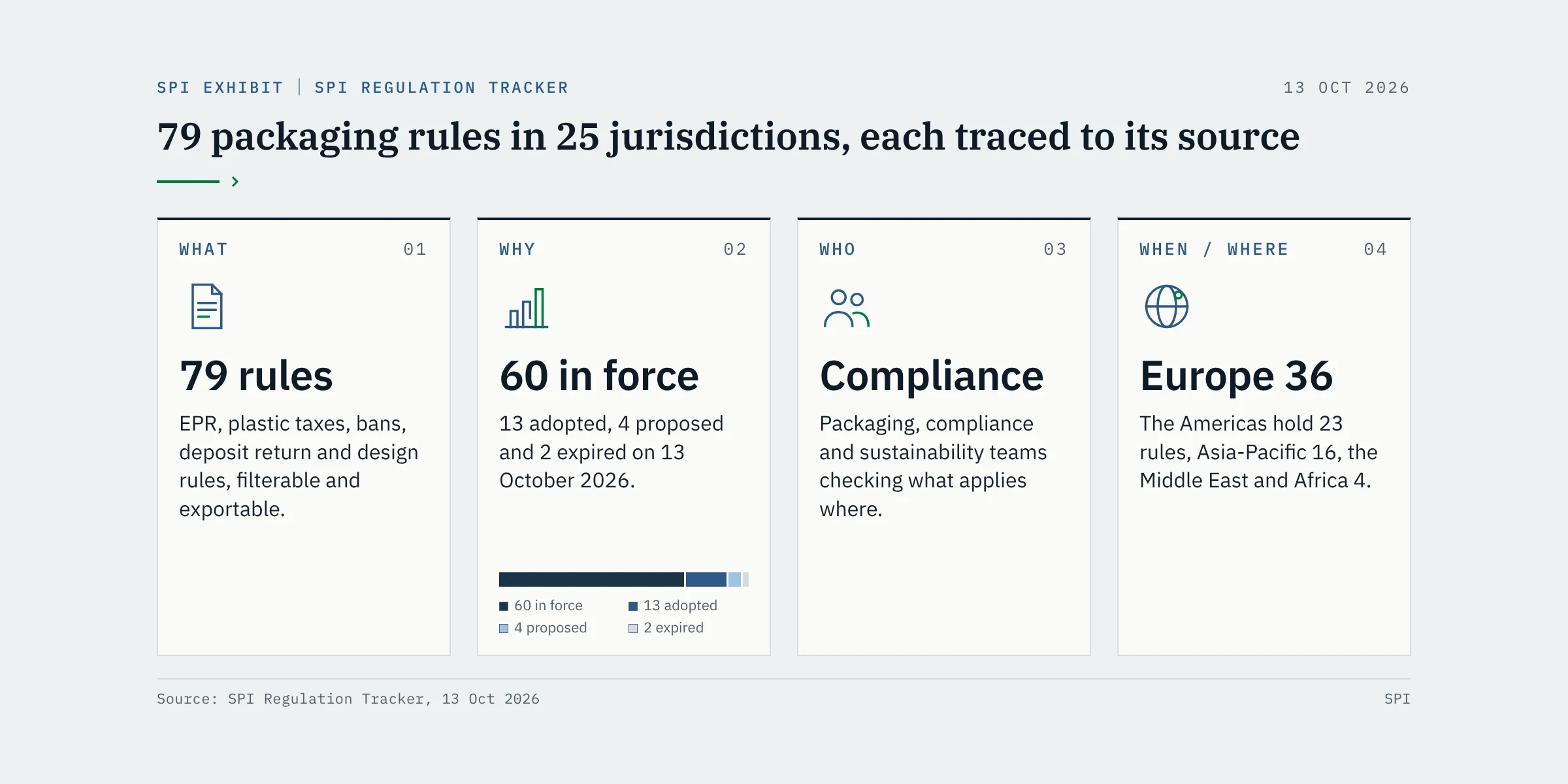
The SPI Regulation Tracker is a free, filterable database of 79 packaging rules in 25 jurisdictions, from the EU Packaging and Packaging Waste Regulation (PPWR) to California SB 54, each linked to its official source with its dates and last-checked date.
Strategic Packaging Insights (SPI) built it so packaging, compliance and sustainability teams can see which extended producer responsibility (EPR) schemes, plastic taxes, bans, deposit return schemes and design rules apply where, and from when. Every rule names its official source, and can be filtered, exported as CSV or followed by e-mail alert.
By the SPI team · Figures as of 13 October 2026
79
Packaging rules tracked
Each linked to its official source
SPI Regulation Tracker, 13 Oct 2026
25
Jurisdictions
Countries, the EU, and US states and Canadian provinces within their countries
SPI Regulation Tracker, 13 Oct 2026
60
Rules in force
Obligations that apply today
SPI Regulation Tracker, 13 Oct 2026
13
Adopted, still to start
Passed into law, obligations start later
SPI Regulation Tracker, 13 Oct 2026
Source: SPI Regulation Tracker, checked 13 Oct 2026.
1 matching rules
Reuse targets for rigid plastic packaging (PWM Rules Schedule II, revised 2026)
SPI summary Brand owners must reuse a minimum share of Category I rigid plastic packaging, an obligation first set in Schedule II in 2022. The 2026 amendment keeps 70% to 85% for drinking-water containers of 4.9 litres or more and 10% to 25% for 0.9 to 4.9 litre packs, adds a 10% to 15% target for other large packs and allows carry-forward.
85 % reuse (drinking-water rigid packaging >=4.9 L/kg, 2028-29 onwards) 0.9-4.9 L/kg: 10/15/20/25%; >=4.9 L/kg drinking water: 70/75/80/85%; >=4.9 L/kg other: 10/10/15/15% (2025-26 to 2028-29+). The 2022 Schedule II (G.S.R. 133(E)) set 10-25% and 70-85% without the drinking-water split.
From the source “shall have minimum obligation to reuse such packaging as per the table given below”
Materials: Plastic
Ministry of Environment, Forest and Climate Change · Applies from 31 Mar 2026 · MoEFCC Gazette G.S.R. 237(E), hosted by Maharashtra Pollution Control Board
Source consulted 13 Oct 2026 · History (4)
- Changed: title, SPI summary, rate note
- Verified
- Changed: unit
- Added
Reuse targetIn forceEnactedSourced
SPI Change Log
Rules added, changed, verified or removed, newest first. Each rule keeps its full history.
E-mail alerts
SPI Rule Alerts: get an e-mail when rules change
Free. One e-mail a week, only in weeks when rules in your chosen jurisdictions are added or changed. Confirm by e-mail first; unsubscribe in one click.
Key facts
- The SPI Regulation Tracker holds 79 packaging rules in 25 jurisdictions as of 13 October 2026: 60 in force, 13 adopted, 4 proposed, 2 expired and 0 withdrawn (SPI Regulation Tracker).
- Regulation (EU) 2025/40, the Packaging and Packaging Waste Regulation (PPWR), has applied since 12 August 2026 and replaces Directive 94/62/EC (PR-EU-001, European Parliament Legislative Observatory).
- From 1 January 2030 the PPWR requires all packaging on the EU market to be recyclable, sets 30% minimum recycled content for single-use plastic beverage bottles and bars listed single-use plastic formats in Annex V (PR-EU-010, PR-EU-004, PR-EU-008).
- California SB 54 permanent regulations took effect on 1 May 2026, with producer registration due by 1 June 2026 (PR-US-004, CalRecycle).
- California SB 343 restricts recyclability claims on products made after 4 October 2026, but a federal court has enjoined enforcement since 14 July 2026 (PR-US-011, CalRecycle).
- Seven US states have packaging EPR laws in the tracker: Oregon, Colorado and California are in force, Maine is adopted, and the SPI team’s 13 October 2026 check found Washington, Minnesota and Maryland in force, with those records being updated (PR-US-001 to PR-US-004, PR-US-006 to PR-US-008).
- England, Northern Ireland and Scotland start drinks deposit return schemes on 1 October 2027 (PR-GB-004, PR-GB-005, legislation.gov.uk).
What the SPI Regulation Tracker covers
The tracker records packaging rules made by public authorities: laws, regulations, decrees and the official schemes under them. A “rule” is one obligation, or a closely linked set, with its own dates, so a large law can produce several rows: the PPWR appears as 11 EU rows because its obligations start on different dates.
Each rule carries a type, status, materials, authority, dates, any rate or target, the official source with a short quote, the date that source was consulted and an SPI summary. Each rule also has its own page with an SPI note: what it means in practice, who is in scope, what to do by when, related rules and open questions.
Rules by jurisdiction
Europe accounts for 36 of the 79 rules, the Americas 23, Asia-Pacific 16, and the Middle East and Africa 4. The European Union is the largest single jurisdiction with 18 rules, followed by the United States with 13 (across seven states), the United Kingdom with 7 and Canada with 6.
SPI analysis
The row count shows where packaging law is most fragmented, not the size of a market. The United States has 13 rows because each state writes its own EPR law. A one-row jurisdiction can still carry a heavy obligation: Vietnam’s Decree 110/2026/ND-CP sets mandatory recycling rates for packaging materials from 25 May 2026 (PR-VN-001).
Rules by status
A status says where a rule stands in law today. In force means the obligation applies now. Adopted means the rule has passed but its obligations start later, or cannot yet be enforced. Proposed means a formal proposal, bill or planned measure that is not yet law. Expired means the rule has been repealed or its target date has passed. Withdrawn means a proposed or planned measure has been dropped or put on hold.
The 4 proposed rules include the EU Environmental Omnibus suspension of the PPWR authorised-representative duty (PR-EU-012), the proposed EUR 1 per kg EU plastic own resource from 2028 (PR-EU-018) and Australia’s packaging EPR bill of 2026 (PR-AU-003). New Zealand’s stage 3 plastic phase-out, whose 2025 deadline was removed on 18 December 2024 with no new date set, is shown as withdrawn and is being updated to proposed in the SPI team’s 13 October 2026 check (PR-NZ-002). The 2 expired rows are the repealed Directive 94/62/EC (PR-EU-013) and Australia’s 2025 National Packaging Targets (PR-AU-001).
Rules by type
The tracker uses 11 rule types. EPR (extended producer responsibility) makes producers fund or run the collection and recycling of their packaging; it is the largest type with 25 rules. A ban prohibits a format or material (17 rules). Deposit return schemes put a refundable deposit on drinks containers (7). Design rules cover recyclability, PFAS limits or empty space (6); recycled content (6) and reuse (3) rules set minimum shares; taxes charge a rate per weight (4); labelling (3), plans (4) and reporting (1) cover sorting marks, national targets and market data.
SPI analysis
EPR in force is now the norm across the jurisdictions tracked: packaging EPR applies today in 13 of the 25 jurisdictions, from Germany and the UK to India, Vietnam, Chile, Brazil and Kenya. The question has moved from “will we pay?” to “how much per tonne and per material?”, which the SPI EPR & Plastic Tax Calculator answers for 14 markets.
How to use the tracker
The tracker is free to read with no sign-in. It answers three questions: what applies in a market, what is coming and when, and what the official text says.
Filter the rules
The rules table on this page can be filtered by search term (for example “plastic tax”, “PPWR” or “deposit”), type, material (plastic, single-use plastic, paper and board, metal, glass, wood or all packaging), status, jurisdiction, enacted or proposed, and checking (verified or sourced). The left-hand rail shows live counts and applies the same filters. Filters combine, so “type: deposit return, status: adopted” returns the schemes that have passed but not yet started.
Open a jurisdiction page
Each jurisdiction has its own page at /data/packaging-regulation-tracker//, for example European Union, United States, United Kingdom or India. Each opens with a short answer (rules, rules in force, next deadline), then lists deadlines, rules in force, adopted and proposed rules, a timeline and a peer comparison.
Read a rule
Every rule shows its authority, effective date, rate or target where there is one, the materials covered, the official source with a quoted extract, the SPI summary and the SPI note. The “Source consulted” line gives the date the official text was last opened, and the history lists each time the rule was added, changed, verified or corrected.
Export to CSV
Any filtered view downloads as a CSV file with one row per rule, ready for a compliance register. Filter to “United States, EPR” and the file holds those rules only.
Get e-mail alerts
Alerts are free. Choose your jurisdictions (or none for all), confirm by e-mail, and receive at most one e-mail a week, only in weeks when a rule there is added or changed. Unsubscribe in one click; the address is used for nothing else.
Key packaging regulations explained
This section gives the short version of the rules that most often decide packaging budgets and redesign plans. Rule IDs link to the rule on its jurisdiction page.
EU Packaging and Packaging Waste Regulation (PPWR)
Regulation (EU) 2025/40 entered into force on 11 February 2025 and has generally applied since 12 August 2026, replacing the 1994 Packaging and Packaging Waste Directive (PR-EU-001). It applies directly in every Member State; Germany replaced its Packaging Act with the VerpackDG from the same date (PR-DE-001).
PPWR requirements arrive in stages. Since 12 August 2026, food-contact packaging with PFAS at or above the PPWR limit values may not be placed on the EU market (PR-EU-002). The harmonised sorting label follows from 12 August 2028, or 24 months after its implementing act if later; that act was still pending in October 2026 (PR-EU-003). By 1 January 2029 Member States must separately collect at least 90% by weight of single-use plastic and metal beverage containers up to three litres (PR-EU-007).
The heaviest step is 1 January 2030. On that date all packaging must be recyclable in an economically viable way (PR-EU-010); plastic packaging must meet minimum recycled-content shares, including 30% for single-use plastic beverage bottles, rising to up to 65% in 2040 (PR-EU-004, PR-EU-005); binding reuse targets of 40% for transport packaging and 10% for grouped packaging apply (PR-EU-006); grouped, transport and e-commerce packaging must keep empty space at or below 50% (PR-EU-009); and Article 25 and Annex V bar listed formats, including plastic packaging for pre-packed fresh fruit and vegetables under 1.5 kg and packaging for food and drink filled and consumed on HORECA premises (PR-EU-008).
The authorised-representative duty for cross-border sellers could be suspended by the Environmental Omnibus proposal COM(2025) 982, but until it is adopted the duty applies (PR-EU-012). Read the EU jurisdiction page for all 18 EU rules and the SPI Insights article on PPWR 2030 format restrictions for Annex V entry by entry.
SPI analysis
For most brand owners 2030 is a design and sourcing deadline now, because formats, recycled-resin contracts and line changes take several product cycles. Many details depend on implementing acts still in preparation, so map which obligations touch each format and role, and watch the act timetable, starting with labelling and recycled-content methodology.
Tethered caps
Since 3 July 2024, single-use beverage containers up to three litres with plastic caps or lids may only be placed on the EU market if the caps and lids stay attached during intended use, under Article 6(1) of Directive (EU) 2019/904 (PR-EU-015). Composite beverage packaging such as cartons is covered as well as bottles. The same Directive has required PET beverage bottles to contain at least 25% recycled plastic since 2025, and all single-use plastic beverage bottles 30% from 2030, as a national average (PR-EU-016).
California SB 54
SB 54 is California’s packaging EPR law. Producers of single-use packaging and plastic food service ware must join a producer responsibility organisation (Circular Action Alliance) or take another compliance path, and the law sets 2032 goals for source reduction, recycling and recyclability (PR-US-004). Permanent regulations took effect on 1 May 2026, and producers had until 1 June 2026 to join Circular Action Alliance, register as an independent producer or apply for the small producer exemption. Circular Action Alliance submitted its PRO plan to the Advisory Board on 15 June 2026.
Because expanded polystyrene (EPS) missed the 25% recycling rate required by 1 January 2025, producers may not sell or distribute EPS food service ware in California; the restriction applies to producers, not to retailers or restaurants that are not producers (PR-US-005).
SPI analysis
Fee start dates were not published on the CalRecycle pages SPI consulted, so 2026-27 budgets need a range. Mapping SKUs to CalRecycle’s covered material categories list is the step that cannot wait.
California SB 343
SB 343 limits the chasing-arrows symbol and other recyclability claims on products and packaging manufactured after 4 October 2026 to materials that meet CalRecycle’s criteria, such as collection by programmes serving at least 60% of the population (PR-US-011). On 14 July 2026 a federal court issued a preliminary injunction in California League of Food Producers v. Bonta blocking enforcement of SB 343; according to CalRecycle, its study obligations continue. In the SPI team’s 13 October 2026 check, SB 343 is being updated to adopted, with the injunction stated on the rule, because the law stands but cannot currently be enforced.
SPI analysis
The safest position is compliant artwork ready but not yet printed, so labels can change quickly if the injunction is lifted.
Packaging EPR in US states
The tracker holds packaging EPR laws in seven US states. Oregon, Colorado and California are in force. The SPI team’s 13 October 2026 check found the Washington, Minnesota and Maryland laws in force too, with producers already registering with or joining a PRO, and those three records are being updated from adopted. Maine is adopted but has no stewardship organisation under contract.
| State | Law and rule ID | Status | What already applies | Next dated step |
|---|---|---|---|---|
| Oregon | Plastic Pollution and Recycling Modernization Act (SB 582), PR-US-002 | In force | CAA membership fees chargeable since 1 Jul 2025 | First life cycle impact disclosure by the 25 largest producers, 31 Dec 2026 |
| Colorado | HB22-1355, PR-US-003 | In force | Non-participants barred from sale since Jul 2025; dues from Jan 2026 | Annual dues each January |
| California | SB 54, PR-US-004 | In force | Regulations effective 1 May 2026; registration by 1 Jun 2026 | 2032 statutory goals |
| Washington | Recycling Reform Act (SB 5284), PR-US-008 | In force (13 Oct 2026 check; record being updated) | PRO appointment by 1 Jan 2026; PRO membership by 1 Jul 2026 | Market access restriction for non-members from 1 Mar 2029 |
| Minnesota | Packaging Waste and Cost Reduction Act, PR-US-006 | In force (13 Oct 2026 check; record being updated) | PRO membership from 1 Jul 2025 | Stewardship plan due 1 Oct 2028; 50% reimbursement from Feb 2029 |
| Maryland | SB 901 (Chapter 431), PR-US-007 | In force (13 Oct 2026 check; record being updated) | PRO registration filing from 1 Jul 2026 | First plan due 1 Jul 2028 |
| Maine | 38 M.R.S. §2146, PR-US-001 | Adopted | Program rule (Chapter 428) adopted | No stewardship organisation under contract; DEP revising the RFP (11 Sep 2026) |
Source: SPI Regulation Tracker and SPI rule notes, checked 13 Oct 2026.
CAA is Circular Action Alliance. Next dated steps come from official state agency sources cited on each rule. Status for Washington, Minnesota and Maryland is as found in the SPI team's 13 October 2026 check; their tracker records are being updated from adopted.
Oregon EPR fees are set on the supply data producers report to Circular Action Alliance, so packaging weight and material data drive cost directly (PR-US-002). Colorado EPR has barred non-participating producers from selling covered products since July 2025, under a Circular Action Alliance plan approved in December 2025 (PR-US-003). In Washington, producers outside a PRO in good standing may not introduce covered materials from 1 March 2029 (PR-US-008). Maine’s 2026 request for proposals drew no bids, so its first payment dates are not set (PR-US-001). The United States page lists all 13 US rules, and EPR fees per tonne in 2026 compares Oregon and Colorado rates.
SPI analysis
The US map is converging on one PRO but not on one rulebook. Circular Action Alliance is named in Oregon, Colorado, California, Minnesota and Maryland, yet each state sets its own covered materials, exemptions, reporting dates and fee basis, so a single national packaging data set has to be cut seven ways.
UK packaging EPR and Plastic Packaging Tax
SI 2024/1332 requires UK packaging producers to register and report data, and large producers to pay disposal fees (PR-GB-002). For 2026-27, PackUK’s illustrative plastic fees are £415 (green), £455 (amber) and £545 (red) per tonne; confirmed fees are still to follow (PR-GB-003). The UK Plastic Packaging Tax is £228.82 per tonne from 1 April 2026 for components with less than 30% recycled plastic (PR-GB-001); Spain taxes non-reusable plastic packaging at EUR 0.45 per kg of non-recycled plastic (PR-ES-001). See plastic packaging taxes in force today.
Deposit return schemes
A deposit return scheme (DRS) adds a refundable deposit to a drink, paid back when the empty container is returned; producers join the operator, pay fees and deposits, and print the scheme logo. The tracker holds 7 deposit return rules: four schemes running and three adopted.
| Jurisdiction | Rule | Status | Start | Containers | Deposit |
|---|---|---|---|---|---|
| Ireland | PR-IE-001 Re-turn | In force | 2024-02-01 | PET bottles and metal cans | EUR 0.15 (150 to 500 ml); EUR 0.25 (500 ml to 3 l) |
| Austria | PR-AT-001 | In force | 2025-01-01 | Single-use plastic and metal, 0.1 to 3 l | EUR 0.25 |
| Poland | PR-PL-001 | In force | 2025-10 | Plastic bottles to 3 l, metal cans to 1 l, reusable glass to 1.5 l | PLN 0.50; PLN 1 for reusable glass |
| Portugal | PR-PT-001 Volta | In force | 2026-04-10 | Plastic and metal beverage containers | EUR 0.10 |
| England and Northern Ireland | PR-GB-004 | Adopted | 2027-10-01 | PET, steel and aluminium, 150 ml to 3 l; glass excluded | Set by the deposit management organisation |
| Scotland | PR-GB-005 | Adopted | 2027-10-01 | Main start moved from 1 Oct 2025 | no data |
| European Union | PR-EU-007 | Adopted | 2029-01-01 | Single-use plastic and metal beverage containers up to 3 l | 90% separate collection target |
Source: SPI Regulation Tracker, checked 13 Oct 2026.
Deposits as stated on each official source. Poland's source gives October 2025 without a day.
SPI analysis
PR-EU-007 is the rule that will multiply national schemes, since Member States that cannot reach 90% separate collection by other means are expected to set up a deposit system. Drinks brand owners should check the scheme position in every Member State they supply and budget for fees, deposit cash flow and artwork. In England and Northern Ireland the deposit and producer fees are set by the deposit management organisation, not the regulations (PR-GB-004).
Single-use plastic bans
Bans are the second-largest rule type with 17 rules, 15 of them in force. Most target foodservice and high-litter items; the PPWR extends bans to mainstream packaging formats from 2030.
| Jurisdiction | Rule | Since | Main items |
|---|---|---|---|
| EU | SUP Directive (PR-EU-014) | 3 Jul 2021 | Cutlery, plates, straws, stirrers, EPS food and drink containers and cups, oxo-degradable plastics |
| England | SI 2023/982 (PR-GB-006) | 1 Oct 2023 | Plates, trays, bowls, cutlery, polystyrene food and drink containers |
| Canada | SOR/2022-138 (PR-CA-001) | 20 Dec 2022 | Checkout bags, cutlery, foodservice ware, ring carriers, stir sticks, straws; export ban since 20 Dec 2025 |
| India | G.S.R. 571(E) (PR-IN-004) | 1 Jul 2022 | Plates, cups, cutlery, straws, wrapping film; carry bags at least 120 microns |
| Dubai | Resolution 124 of 2023 (PR-AE-001) | 1 Jan 2026 | Plates, cutlery, cups and lids (final phase) |
| California | SB 54 EPS restriction (PR-US-005) | 1 Jan 2025 | EPS food service ware, for producers |
| EU (adopted) | PPWR Annex V (PR-EU-008) | 1 Jan 2030 | Listed single-use plastic packaging formats |
Other bans in force cover France (PR-FR-002), Wales (PR-GB-007), Washington and Oregon polystyrene (PR-US-012, PR-US-013), British Columbia (PR-CA-005), New Zealand (PR-NZ-001), China (PR-CN-001), Colombia (PR-CO-002) and Kenya (PR-KE-001).
SPI analysis
Bans often reach manufacture, import and export, not only sale, so they hit converters directly. A court challenge does not suspend them: Canada’s regulations remain in force while a Supreme Court of Canada leave application is pending (PR-CA-001).
Packaging compliance deadlines 2026 to 2030
The timeline below lists dated obligations still ahead on 13 October 2026, drawn from tracker records and the SPI notes on each rule. Proposed measures are marked.
- EPR
- Ban
- Recycled content
- Deposit return
- Other
- UK: PackUK targets the year 2 notice of liability with confirmed 2026-27 fees (PR-GB-003)EPR
- Oregon: first life cycle impact disclosure by the 25 largest producers (PR-US-002)EPR
- 2027New Jersey: plastic beverage containers need 20% postconsumer recycled content (PR-US-010)Recycled content
- EU: Commission guidelines on Annex V due (PR-EU-008)Ban
- England and Northern Ireland: drinks deposit return scheme starts (PR-GB-004)Deposit return
- Scotland: deposit return scheme main start (PR-GB-005)Deposit return
- 2028EU (proposed): plastic own resource would rise from EUR 0.80 to EUR 1 per kg (PR-EU-018)Tax
- 2028India: Category I rigid plastic packaging reaches 60% recycled content in 2028-29 (PR-IN-002)Recycled content
- Maryland: first producer responsibility plan due (PR-US-007)EPR
- EU: harmonised sorting label, or later if the implementing act is late (PR-EU-003)Labelling
- Minnesota: first stewardship plan due (PR-US-006)EPR
- EU: 90% separate collection of plastic and metal drinks containers (PR-EU-007)Deposit return
- Minnesota: producer-funded reimbursement starts at 50% (PR-US-006)EPR
- Washington: non-member producers may not introduce covered materials (PR-US-008)EPR
- 2030Spain: 20% reusable commercial and industrial packaging (PR-ES-002)Reuse target
- EU: all packaging recyclable (PR-EU-010)Design rule
- EU: 30% recycled content in single-use plastic beverage bottles (PR-EU-004)Recycled content
- EU: reuse targets of 40% for transport and 10% for grouped packaging (PR-EU-006)Reuse target
- EU: maximum 50% empty space in grouped, transport and e-commerce packaging (PR-EU-009)Design rule
- EU: Annex V single-use plastic format restrictions (PR-EU-008)Ban
- California: plastic beverage containers need 50% postconsumer recycled content (PR-US-009)Recycled content
Source: SPI Regulation Tracker and SPI rule notes, checked 13 Oct 2026.
Rows include staged milestones from SPI rule notes; the live binding adds any further tracker dates in the range.
Show the data
| Date | Label | Category | Link |
|---|---|---|---|
| 2026-11 | UK: PackUK targets the year 2 notice of liability with confirmed 2026-27 fees (PR-GB-003) | EPR | /data/packaging-regulation-tracker/united-kingdom/#pr-gb-003 |
| 2026-12-31 | Oregon: first life cycle impact disclosure by the 25 largest producers (PR-US-002) | EPR | /data/packaging-regulation-tracker/united-states/#pr-us-002 |
| 2027-02-12 | EU: Commission guidelines on Annex V due (PR-EU-008) | Ban | /data/packaging-regulation-tracker/european-union/#pr-eu-008 |
| 2027 | New Jersey: plastic beverage containers need 20% postconsumer recycled content (PR-US-010) | Recycled content | /data/packaging-regulation-tracker/united-states/#pr-us-010 |
| 2027-10-01 | England and Northern Ireland: drinks deposit return scheme starts (PR-GB-004) | Deposit return | /data/packaging-regulation-tracker/united-kingdom/#pr-gb-004 |
| 2027-10-01 | Scotland: deposit return scheme main start (PR-GB-005) | Deposit return | /data/packaging-regulation-tracker/united-kingdom/#pr-gb-005 |
| 2028 | EU (proposed): plastic own resource would rise from EUR 0.80 to EUR 1 per kg (PR-EU-018) | Tax | /data/packaging-regulation-tracker/european-union/#pr-eu-018 |
| 2028 | India: Category I rigid plastic packaging reaches 60% recycled content in 2028-29 (PR-IN-002) | Recycled content | /data/packaging-regulation-tracker/india/#pr-in-002 |
| 2028-07-01 | Maryland: first producer responsibility plan due (PR-US-007) | EPR | /data/packaging-regulation-tracker/united-states/#pr-us-007 |
| 2028-08-12 | EU: harmonised sorting label, or later if the implementing act is late (PR-EU-003) | Labelling | /data/packaging-regulation-tracker/european-union/#pr-eu-003 |
| 2028-10-01 | Minnesota: first stewardship plan due (PR-US-006) | EPR | /data/packaging-regulation-tracker/united-states/#pr-us-006 |
| 2029-01-01 | EU: 90% separate collection of plastic and metal drinks containers (PR-EU-007) | Deposit return | /data/packaging-regulation-tracker/european-union/#pr-eu-007 |
| 2029-02 | Minnesota: producer-funded reimbursement starts at 50% (PR-US-006) | EPR | /data/packaging-regulation-tracker/united-states/#pr-us-006 |
| 2029-03-01 | Washington: non-member producers may not introduce covered materials (PR-US-008) | EPR | /data/packaging-regulation-tracker/united-states/#pr-us-008 |
| 2030-01-01 | EU: all packaging recyclable (PR-EU-010) | Design rule | /data/packaging-regulation-tracker/european-union/#pr-eu-010 |
| 2030-01-01 | EU: 30% recycled content in single-use plastic beverage bottles (PR-EU-004) | Recycled content | /data/packaging-regulation-tracker/european-union/#pr-eu-004 |
| 2030-01-01 | EU: reuse targets of 40% for transport and 10% for grouped packaging (PR-EU-006) | Reuse target | /data/packaging-regulation-tracker/european-union/#pr-eu-006 |
| 2030-01-01 | EU: maximum 50% empty space in grouped, transport and e-commerce packaging (PR-EU-009) | Design rule | /data/packaging-regulation-tracker/european-union/#pr-eu-009 |
| 2030-01-01 | EU: Annex V single-use plastic format restrictions (PR-EU-008) | Ban | /data/packaging-regulation-tracker/european-union/#pr-eu-008 |
| 2030-01-01 | California: plastic beverage containers need 50% postconsumer recycled content (PR-US-009) | Recycled content | /data/packaging-regulation-tracker/united-states/#pr-us-009 |
| 2030 | Spain: 20% reusable commercial and industrial packaging (PR-ES-002) | Reuse target | /data/packaging-regulation-tracker/spain/#pr-es-002 |
SPI analysis
The near-term deadlines are about money and data; the 2029-2030 deadlines are about the pack itself. Packaging weights, materials and recyclability ratings recorded per SKU and market now feed both.
Methodology: how SPI builds and checks the tracker
The tracker follows the SPI Methodology. Every rule goes through the same six steps: an SPI analyst finds the rule in its official source and copies a short quote; records the authority, type, status, materials, dates and rate (the rule is then marked Sourced); writes the SPI summary and note; a second SPI team member re-checks the record against the source (marked Verified); the weekly source check watches open points; and reported errors are corrected and logged.
Sources. Each rule is taken from an official source: the legal text in an official journal or gazette, or the page of the ministry, regulator, legislature or scheme body that runs it. The source is named, linked and quoted on the rule.
Statuses. Statuses are set from the official record on the date the source was consulted. Enacted means law (in force, adopted or expired); proposed means not yet law; withdrawn means a proposed or planned measure has been dropped or put on hold.
Re-checks. On 13 October 2026 the SPI team re-read 56 tracker records against their official sources and updated 46. A rule is marked Verified only after a second SPI team member has checked it; until then it is marked Sourced. When a fact on a verified rule changes, the rule returns to Sourced until it is checked again.
Weekly source check. Each week the SPI team re-opens the sources behind open points in the rule notes: pending PPWR implementing acts, court cases such as the SB 343 injunction, consultations and fee announcements such as PackUK’s year 2 fees. Changes go into the rule history and that week’s alerts.
Corrections. If you find an error or a missing rule, write to sales@strategicpackaginginsights.com with the rule ID and the source. Each report is checked against the official text and every correction is logged in the rule history (Corrections).
Record and reading kept apart. The quote is copied from the official source; the SPI summary and SPI note are SPI’s own reading and are labelled as such.
Limitations
- Not legal advice. Confirm obligations against the linked legal text and with qualified counsel or your compliance scheme.
- Coverage is growing and is not complete for any jurisdiction. Guidance and local rules may not be listed. France’s packaging EPR scheme is not yet a tracker row, although Citeo’s 2026 fees appear in the SPI EPR & Plastic Tax Calculator.
- Dates move. Rates and dates can change after a source was consulted. Where a date depends on a pending implementing act, the rule note says so.
- Status is a single label. A law can stand while its enforcement is blocked (SB 343) or apply while its main funding duties start years later (Minnesota, Maryland); read the rule note for the detail.
- Values are headline figures. Where a rule has several rates, the value field holds one (for example 30% under PR-EU-004) and the summary gives the rest.
Where the tracker fits: Discover, Understand, Evaluate, Decide, Implement
The tracker is the Understand stage of SPI’s model: which rules apply, when and at what rate. Discover is the SPI Buyers Database (179 public packaging targets from 42 brand owners and retailers). Evaluate is the SPI EPR & Plastic Tax Calculator (216 rate rows, 14 markets), which turns a rule into an estimated cost. Decide and Implement are where SPI Consulting comes in.
When to talk to SPI Consulting
The tracker answers “what is the rule?”. It does not tell you which rules hit your own SKUs, materials and markets, or what they cost you. That is the scope of SPI Packaging Regulatory Intelligence: a jurisdiction-by-material obligation map for your portfolio, EPR and plastic tax exposure scenarios using published rates and your own data, a dated deadline calendar, and ongoing monitoring with monthly change notes. Enacted rules, proposals and SPI interpretation sit in separate columns, each traced to its source. SPI does not give legal advice, file with regulators or certify packaging. If that is the right next step, ask for a briefing.
FAQ
What is the SPI Regulation Tracker?
The SPI Regulation Tracker is a free database of packaging rules run by Strategic Packaging Insights (SPI). As of 13 October 2026 it holds 79 rules in 25 jurisdictions, covering EPR, plastic taxes, bans, deposit return, recycled content, reuse, labelling, design and reporting rules, each linked to its official source.
What is the PPWR and when does it apply?
The PPWR is Regulation (EU) 2025/40, the EU Packaging and Packaging Waste Regulation. It has generally applied since 12 August 2026, replacing Directive 94/62/EC. Its main design obligations, including recyclability, recycled content, reuse targets, a 50% empty space limit and Annex V format restrictions, start on 1 January 2030.
What are the PPWR recycled content requirements?
What is California SB 54?
SB 54 is California’s packaging extended producer responsibility law. Producers of single-use packaging and plastic food service ware must join a producer responsibility organisation, register as an independent producer or claim an exemption, and meet 2032 goals. Permanent regulations took effect on 1 May 2026, with registration due by 1 June 2026.
Is California SB 343 in effect?
SB 343 applies to products and packaging made after 4 October 2026 and limits the chasing-arrows symbol and recyclable claims to materials meeting CalRecycle’s criteria. A federal court has enjoined enforcement since 14 July 2026, so the law stands but cannot currently be enforced; the SPI team’s 13 October 2026 check is updating its status in the SPI Regulation Tracker to adopted.
Which US states have packaging EPR laws?
The SPI Regulation Tracker records seven. Oregon, Colorado and California are in force. Washington, Minnesota and Maryland were found in force in the SPI team’s 13 October 2026 check, with their records being updated, and producer funding there phases in between 2028 and 2031. Maine is adopted but has no stewardship organisation under contract. Each state sets its own covered materials, exemptions and dates.
Which countries have a deposit return scheme for drinks containers?
Among the jurisdictions tracked, schemes run in Ireland (since 1 February 2024), Austria (1 January 2025), Poland (October 2025) and Portugal (10 April 2026). England, Northern Ireland and Scotland start on 1 October 2027, and EU Member States must reach 90% separate collection of plastic and metal drinks containers by 1 January 2029.
Which single-use plastic items are banned?
It depends on the market. The EU has banned single-use plastic cutlery, plates, straws, stirrers and EPS food containers since 3 July 2021, and England, Canada, India, Dubai and others have their own lists. The tracker holds 17 ban rules; filter by type “Ban” to see them.
How often is the tracker updated, and can I download it?
Rules are added and changed as SPI finds them, and the SPI team runs a weekly source check on open points such as pending acts and court cases. Any filtered view downloads as CSV, and e-mail alerts send at most one message a week when rules change.
Is the SPI Regulation Tracker legal advice?
No. It summarises official texts and labels SPI’s own reading as SPI analysis. Confirm obligations against the linked legal text and with qualified counsel or your compliance scheme.
Sources
- SPI Regulation Tracker, 79 rules, data as of 13 October 2026, and SPI rule notes for PR-EU-001, PR-EU-007, PR-EU-008, PR-EU-012, PR-EU-015, PR-US-001 to PR-US-008, PR-US-011, PR-GB-003, PR-GB-004, PR-CA-001, PR-IE-001, PR-PT-001, PR-NZ-002 (SPI, 13 October 2026).
- European Parliament Legislative Observatory: Regulation (EU) 2025/40 summary. https://oeil.europarl.europa.eu/oeil/en/document-summary?id=1802233 (as given in SPI Regulation Tracker, checked 2026-10-13)
- EUR-Lex: Regulation (EU) 2025/40 (PPWR), Article 25 and Annex V. https://eur-lex.europa.eu/eli/reg/2025/40/oj/eng (as given in SPI Regulation Tracker, checked 2026-10-13)
- European Commission (DG ENV): Packaging waste. https://environment.ec.europa.eu/topics/waste-and-recycling/packaging-waste_en (as given in SPI Regulation Tracker, checked 2026-10-13)
- European Parliament Legislative Observatory: 2025/0574(CNS). https://oeil.europarl.europa.eu/oeil/en/document-summary?id=1830552 (as given in SPI Regulation Tracker, checked 2026-10-13)
- EUR-Lex: Directive (EU) 2019/904. https://eur-lex.europa.eu/legal-content/EN/TXT/HTML/?uri=CELEX:32019L0904 (as given in SPI Regulation Tracker, checked 2026-10-13)
- Bundesgesetzblatt: BGBl. 2026 I Nr. 207. https://www.recht.bund.de/bgbl/1/2026/207/VO.html (as given in SPI Regulation Tracker, checked 2026-10-13)
- CalRecycle: SB 54 Permanent Regulations approved and in effect. https://content.govdelivery.com/accounts/CALRECYCLE/bulletins/4157d91 (as given in SPI Regulation Tracker, checked 2026-10-13)
- CalRecycle: EPS Food Service Ware Requirements. https://calrecycle.ca.gov/packaging/packaging-epr/eps/ (as given in SPI Regulation Tracker, checked 2026-10-13)
- CalRecycle: SB 343 Accurate Recycling Labels. https://calrecycle.ca.gov/wcs/recyclinglabels/ (as given in SPI Regulation Tracker, checked 2026-10-13)
- CalRecycle: Plastic Minimum Content Standards and Reporting (AB 793). https://calrecycle.ca.gov/bevcontainer/bevdistman/plasticcontent/ (as given in SPI Regulation Tracker, checked 2026-10-13)
- NJDEP Recycled Content Law FAQ. https://www.nj.gov/dep/dshw/recycled-content/recycled_content_faqs.pdf (as given in SPI Regulation Tracker, checked 2026-10-13)
- Oregon DEQ: Producers of Covered Products. https://oregon.gov/deq/recycling/Pages/Producers-of-Covered-Products.aspx (as given in SPI Regulation Tracker, checked 2026-10-13)
- CDPHE: Producer Responsibility Program. https://cdphe.colorado.gov/hm/epr-program (as given in SPI Regulation Tracker, checked 2026-10-13)
- Maine DEP: Stewardship Program for Packaging. https://www.maine.gov/dep/waste/recycle/epr.html (as given in SPI Regulation Tracker, checked 2026-10-13)
- MPCA fact sheet: Packaging waste and cost reduction act. https://www.pca.state.mn.us/sites/default/files/w-ps1-05b%20.pdf (as given in SPI Regulation Tracker, checked 2026-10-13)
- Maryland General Assembly: Chapter 431 (SB 901). https://mgaleg.maryland.gov/2025RS/chapters_noln/Ch_431_sb0901E.pdf (as given in SPI Regulation Tracker, checked 2026-10-13)
- Washington Ecology: Recycling Reform Act. https://ecology.wa.gov/waste-toxics/reducing-recycling-waste/our-recycling-programs/recycling-reform-act (as given in SPI Regulation Tracker, checked 2026-10-13)
- Washington State Legislature: Chapter 70A.208 RCW. https://app.leg.wa.gov/RCW/default.aspx?cite=70A.208&full=true (as given in SPI rule note PR-US-008, consulted 2026-10-13)
- legislation.gov.uk: SI 2024/1332. https://www.legislation.gov.uk/uksi/2024/1332/introduction/made (as given in SPI Regulation Tracker, checked 2026-10-13)
- GOV.UK: Year 2 illustrative waste disposal fees, EPR for packaging. https://www.gov.uk/government/publications/illustrative-waste-disposal-fees-2026-extended-producer-responsibility-for-packaging/year-2-illustrative-waste-disposal-fees-extended-producer-responsibility-for-packaging (as given in SPI Regulation Tracker, checked 2026-10-13)
- GOV.UK: Plastic Packaging Tax: steps to take. https://www.gov.uk/guidance/check-if-you-need-to-register-for-plastic-packaging-tax (as given in SPI Regulation Tracker, checked 2026-10-13)
- legislation.gov.uk: SI 2025/67 Deposit Scheme for Drinks Containers (England and Northern Ireland) Regulations 2025. https://www.legislation.gov.uk/uksi/2025/67/made (as given in SPI Regulation Tracker, checked 2026-10-13)
- legislation.gov.uk: SSI 2025/188. https://www.legislation.gov.uk/ssi/2025/188/article/3 (as given in SPI Regulation Tracker, checked 2026-10-13)
- legislation.gov.uk: SI 2023/982. https://www.legislation.gov.uk/uksi/2023/982/made (as given in SPI Regulation Tracker, checked 2026-10-13)
- Agencia Tributaria: Impuesto especial sobre envases de plástico no reutilizables. https://sede.agenciatributaria.gob.es/Sede/impuestos-especiales-medioambientales/impuesto-especial-sobre-envases-plastico-reutilizables/base-imponible-tipo-impositivo-cuota-tributaria.html (as given in SPI Regulation Tracker, checked 2026-10-13)
- BOE: Real Decreto 1055/2022. https://www.boe.es/buscar/act.php?id=BOE-A-2022-22690 (as given in SPI Regulation Tracker, checked 2026-10-13)
- RIS: Pfandverordnung für Einweggetränkeverpackungen, BGBl. II Nr. 283/2023. https://www.ris.bka.gv.at/Dokumente/BgblAuth/BGBLA_2023_II_283/BGBLA_2023_II_283.html (as given in SPI Regulation Tracker, checked 2026-10-13)
- gov.ie: Ireland’s Deposit Return Scheme is live. https://www.gov.ie/en/press-release/8526d-irelands-deposit-return-scheme-is-now-live (as given in SPI Regulation Tracker, checked 2026-10-13)
- Government of Portugal: Volta entra em vigor. https://portugal.gov.pt/pt/gc25/comunicacao/noticias/volta-sistema-de-deposito-e-reembolso-de-embalagens-entra-em-vigor (as given in SPI Regulation Tracker, checked 2026-10-13)
- gov.pl: System kaucyjny. https://www.gov.pl/web/klimat/system-kaucyjny (as given in SPI Regulation Tracker, checked 2026-10-13)
- Canada.ca: Single-use plastics prohibition regulations overview. https://www.canada.ca/en/environment-climate-change/services/managing-reducing-waste/reduce-plastic-waste/single-use-plastic-overview.html (as given in SPI Regulation Tracker, checked 2026-10-13)
- MoEFCC Gazette G.S.R. 571(E), hosted by Maharashtra Pollution Control Board. https://www.mpcb.gov.in/sites/default/files/standing_orders/3Plastic_Waste_Management_Rules_2016_%28Second_Amendments%29_2021.pdf (as given in SPI Regulation Tracker, checked 2026-10-13)
- MoEFCC Gazette G.S.R. 237(E), hosted by Maharashtra Pollution Control Board. https://www.mpcb.gov.in/sites/default/files/standing_orders/Plastic_Waste_Management_2026.pdf (as given in SPI Regulation Tracker, checked 2026-10-13)
- Dubai Municipality: final phase of single-use plastic ban from 2026. https://www.dm.gov.ae/dubai-to-enforce-final-phase-of-single-use-plastic-ban-from-2026/ (as given in SPI Regulation Tracker, checked 2026-10-13)
- Ministry for the Environment (New Zealand): Update on waste policies. https://environment.govt.nz/news/update-on-waste-policies/ (as given in SPI Regulation Tracker, checked 2026-10-13)
- Official Gazette of Viet Nam: Decree 110/2026/NĐ-CP. https://congbaocdn.chinhphu.vn/180507251028987904/2026/4/20/469301-1776647243_v1_1776647876_signed.pdf (as given in SPI Regulation Tracker, checked 2026-10-13)
- Parliament of Australia: Senate inquiry page, No Time to Waste Bill 2026. https://www.aph.gov.au/search/url/Inquiry/27382_16_ (as given in SPI Regulation Tracker, checked 2026-10-13)
Ask the SPI team
What changes for your packaging next quarter?
Tell us your markets and materials. The SPI team walks you through the rules and buyer commitments that affect them.
Prefer email? Write to sales@strategicpackaginginsights.com.
- Q1
Which packaging rules apply to us in each market we sell in?
We map each market's EPR, tax, ban, recycled-content, labelling and deposit rules against your materials and formats, and show which are in force, adopted or only proposed.
- Q2
What could EPR fees and plastic taxes cost us next year?
We apply published fee tables and tax rates to your tonnages and recycled content, and show the result as scenarios with every rate sourced.
- Q3
Can you tell us when a rule changes?
Yes. The free tracker alerts cover rule changes by country; a monitoring retainer adds monthly notes on what the changes mean for your portfolio.