
PPWR reuse targets
High impactArticle 29 sets 40% for listed transport packaging, 100% on own-site and domestic routes, and 10% for grouped packaging and beverages from 2030.

Sustainable Packaging · Market Research Report
Answer: The reusable packaging market is now shaped by dated legal duties. From 1 January 2030, Regulation (EU) 2025/40 requires at least 40% of listed transport packaging to be reusable within a re-use system and 10% of beverages to be made available in reusable packaging, while takeaway outlets must let consumers bring their own containers by 2027. Germany’s reusable beverage share was 34.5% in 2024 against a 70% target.
This report sets out the EU reuse targets and refill duties, the German and French rules that came first, the way European packaging fee schemes price a reusable pack, the official statistics that exist, and what a pool operator’s filings report. It is written by the SPI team from regulators’ pages, scheme fee tables, Eurostat and Umweltbundesamt releases and company filings, dated 29 November 2026.
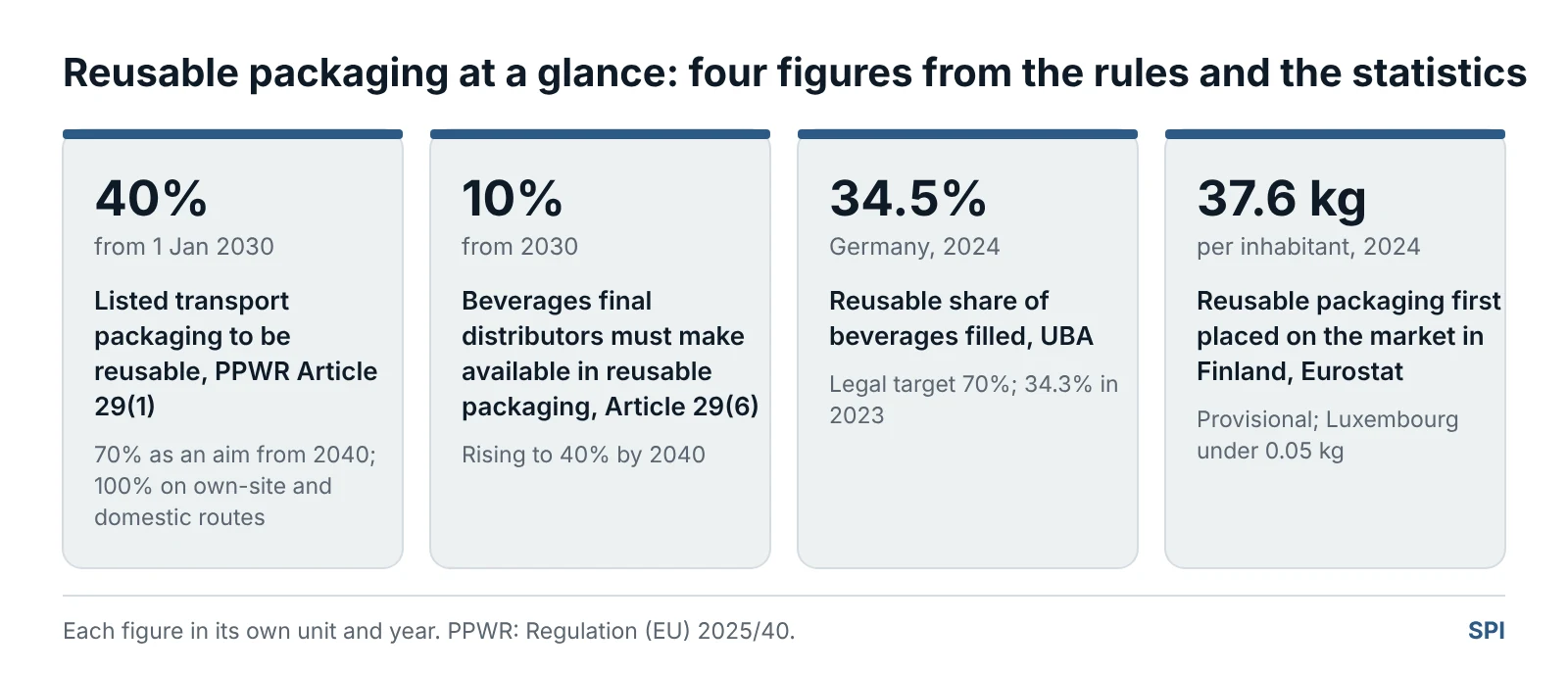
| Label | Value | Note | Source |
|---|---|---|---|
| Listed transport packaging reusable from 1 Jan 2030 | 40% | 70% aim from 2040; 100% on own-site and domestic routes | Article 29(1) to (3) |
| Beverages made available in reusable packaging from 2030 | 10% | 40% by 2040 | Article 29(6) |
| Germany, reusable share of beverages, 2024 | 34.5% | Legal target 70%; 34.3% in 2023 | Umweltbundesamt |
| Finland, reusable packaging first placed on the market, 2024 | 37.6 kg per inhabitant | Provisional; Luxembourg under 0.05 kg | Eurostat |
Note: Each tile is in its own unit and year.
Eurostat defines reusable packaging as packaging conceived, designed and placed on the market to accomplish multiple trips or rotations within its lifecycle (Eurostat reference metadata for packaging waste statistics). The PPWR adds a second condition for its targets: the packaging must be reusable within a re-use system (Commission Notice C/2026/3084, section 18). A refillable bottle sold once and thrown away does not help an operator meet Article 29.
That condition is why the market splits into two parts. The first is business to business: pallets, crates, trays, drums, intermediate bulk containers (IBCs) and foldable boxes that move goods between plants, warehouses and shops. The second is business to consumer: refillable bottles, reusable cups and takeaway containers that return to a shop or a collection point. Pool operators sit in both, renting the packaging and running the cleaning and repair.
Each of the regimes in this report draws the line in its own words. Article 29(1) lists the transport formats by name. Germany’s rule covers takeaway sellers that fill food into single-use plastic food packaging or drinks into single-use cups. France counts reused units and lets refilling at the point of sale count as reuse. Fee schemes then add their own test: Valorlux limits its zero rate to closed-loop packaging whose ownership is kept through collection (Valorlux FAQ), and Verpact asks the producer to show that a reuse system exists (SPI’s reusable packaging EPR fee analysis).
The PPWR has applied since 12 August 2026, but its reuse targets start on 1 January 2030 and fall on economic operators, not on Member States. Exhibit 2 shows the binding levels and the 2040 aims.
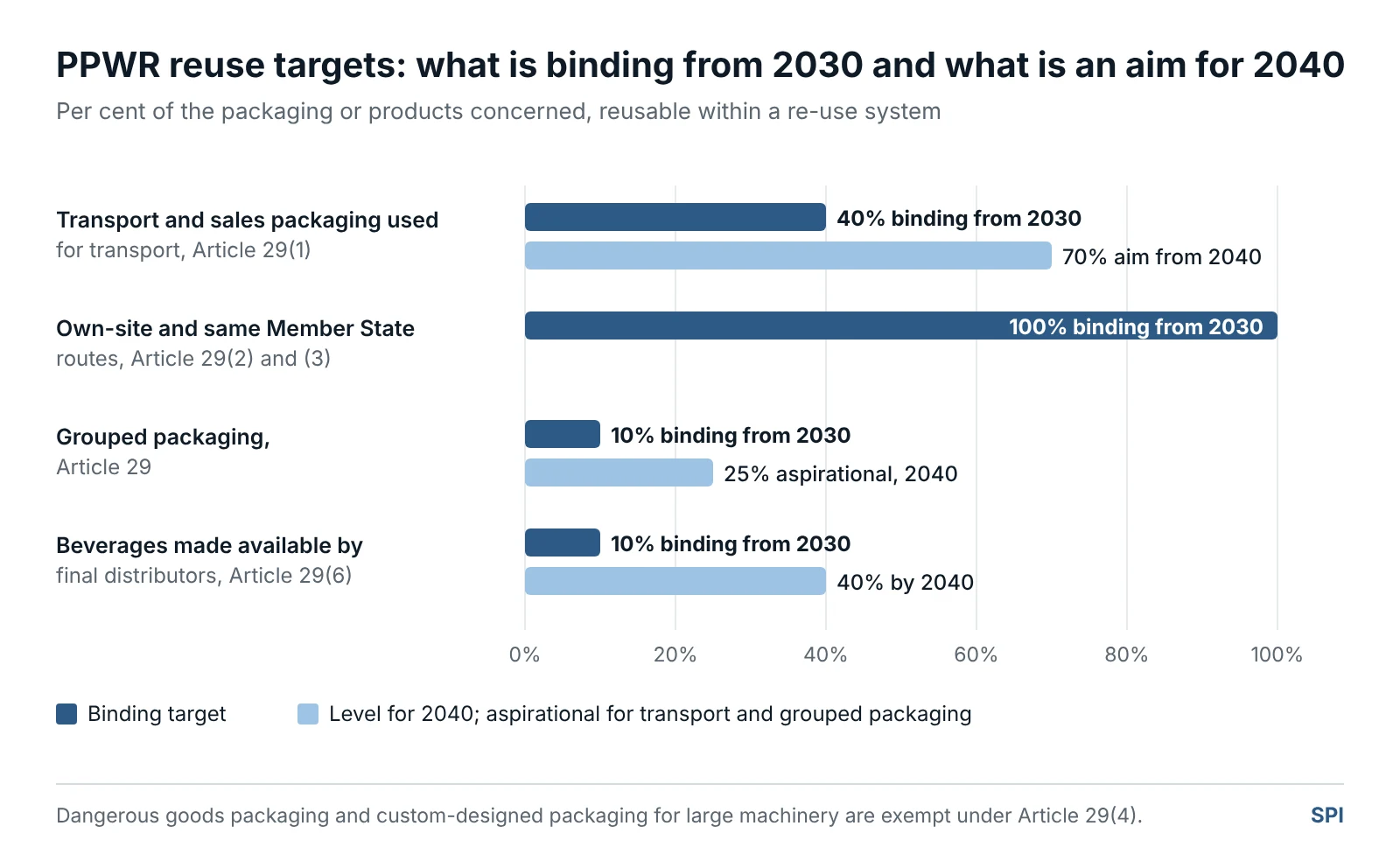
| Flow | Binding from 2030, % | 2040 level, % |
|---|---|---|
| Transport and sales packaging used for transport, 29(1) | 40 | 70, aim |
| Own-site and same Member State routes, 29(2) and (3) | 100 | none set |
| Grouped packaging | 10 | 25, aspirational |
| Beverages, final distributors, 29(6) | 10 | 40 |
Note: The 2040 levels for transport and grouped packaging are aspirational. Dangerous goods packaging and custom-designed packaging for large machinery are exempt under Article 29(4).
Transport packaging. Article 29(1) covers pallets, foldable plastic boxes, boxes, trays, plastic crates, IBCs, pails, drums and canisters, and also pallet wraps and straps (Commission Notice, section 18). At least 40% must be reusable within a re-use system from 1 January 2030, and operators shall endeavour to reach 70% from 1 January 2040 (section 20). Paragraphs 2 and 3 go further: packaging moved between an operator’s own sites, or delivered to another operator in the same Member State, must all be reusable, with no percentage threshold (Commission Notice C/2026/3084, section 19).
Grouped packaging. Grouped packaging must be 10% reusable by 2030, with 25% as an aspirational target for 2040 (EUR-Lex summary).
Beverages. Final distributors, in most cases shops, bars and restaurants, must make at least 10% of beverages available in reusable packaging within a re-use system from 2030, rising to 40% by 2040 (EUR-Lex summary). The Commission reads making available as offering, so an actual sale is not required, and kegs supplied business to business to bars do not count toward the bar’s own target (Commission Notice, sections 22 and 23). An implementing act under Article 30(3) will set the calculation method (section 22). SPI has not yet confirmed on EUR-Lex the list of beverages outside the target.
The first adjustment has already been made. Delegated Decision (EU) 2026/429, in force from 26 May 2026, took pallet wraps and straps out of the 100% rule on own-site and domestic routes; they still count toward the 40% target. Article 29(4) exempts dangerous goods packaging and packaging custom-designed for large machinery, equipment and commodities (Commission Notice, section 21), and the EUR-Lex summary notes exemptions for micro-enterprises and small beverage distributors. SPI’s PPWR reuse target analysis sets out every exemption and shows how the 100% routes raise an operator’s real reusable share well above 40%.
SPI analysis: for the business to business part of the market, the 100% routes matter more than the 40% headline. An operator whose deliveries stay inside one country must make every listed pallet and crate reusable from 2030, so the 2030 duty is in effect a duty to join a pool or run an own fleet on domestic routes.
The consumer side of the rules starts earlier, in food service. According to the EUR-Lex summary of the regulation, restaurants and cafés providing takeaway food or beverages must allow consumers to bring their own containers for takeaway food and beverages, at no additional cost, by 2027. This is the Article 32 duty.
Article 33 adds a reuse offer: by 2028 the same sellers must offer reusable packaging for takeaway items, at no extra cost (EUR-Lex summary). The Commission’s guidance lists Article 33(6) among the provisions that leave Member States room for national measures (Commission Notice, section 25). SPI has not yet confirmed on EUR-Lex the exact application days, the signage rules or the small business exemptions in Articles 32 and 33.
| Rule | Duty | From | Price or scope condition |
|---|---|---|---|
| PPWR Article 32 | Let consumers bring their own containers for takeaway food and drinks | 2027 | At no additional cost |
| PPWR Article 33 | Offer reusable packaging for takeaway items | 2028 | At no extra cost; Member State room under 33(6) |
| Germany, sections 33 and 34 VerpackG, now 60 and 61 VerpackDG | Offer reusable packaging where food or drinks are filled into single-use plastic packaging or cups | 1 Jan 2023 | No higher price; up to 5 staff and 80 m2 may fill customers' own containers instead |
| France, AGEC | Reusable tableware for meals eaten on site | 1 Jan 2023 | Outlets able to serve at least 20 covers at once |
| Spain, RD 1055/2022 Article 8 | Reuse shares for beverages in the HORECA channel | 2025 onwards | Soft drinks 60% in 2025, 70% in 2030, 80% in 2035 |
Note: Wording paraphrased from each source. Spain's Article 8 shares are by volume of beverages in the HORECA channel; soft drinks shown as the example.
Source: EUR-Lex summary of Regulation (EU) 2025/40; Commission Notice C/2026/3084; Umweltbundesamt, Leitfaden zur Umsetzung der Mehrwegangebotspflicht; gesetze-im-internet.de, VerpackDG sections 60 and 61; economie.gouv.fr, 17 Dec 2025; BOE, Real Decreto 1055/2022 (SPI summary)
The EU rules follow a path that Germany opened. The UBA’s guidance says the German reusable offer duty has applied since 1 January 2023 to restaurants, bistros, canteens, caterers and cafés, and also to supermarkets and petrol stations that fill food or drinks for takeaway, with very small outlets of at most five employees and 80 m2 allowed to fill customers’ own containers instead. France has required reusable tableware for meals served on site since the same date (economie.gouv.fr). SPI’s quick-service restaurant analysis follows these duties through one restaurant chain.
Germany is the clearest test of how far rules move consumer reuse. Its packaging law has carried a 70% target for the share of beverages filled in reusable packaging, and the UBA publishes the result each year.
The answer is that the share has barely moved. The UBA’s release of 8 July 2026 puts the reusable share of beverages at 34.5% in 2024, 0.2 points above 2023 and 35.5 points short of the 70% target in section 1(3) of the Verpackungsgesetz. Reusable glass bottles were 25.2% and reusable plastic 9.3%. Since reporting year 2022 the quota covers all beverage segments; the UBA continues the series for the segments under the deposit duty up to 2021 so that earlier years stay comparable (UBA, 8 July 2026; UBA, 16 September 2025).
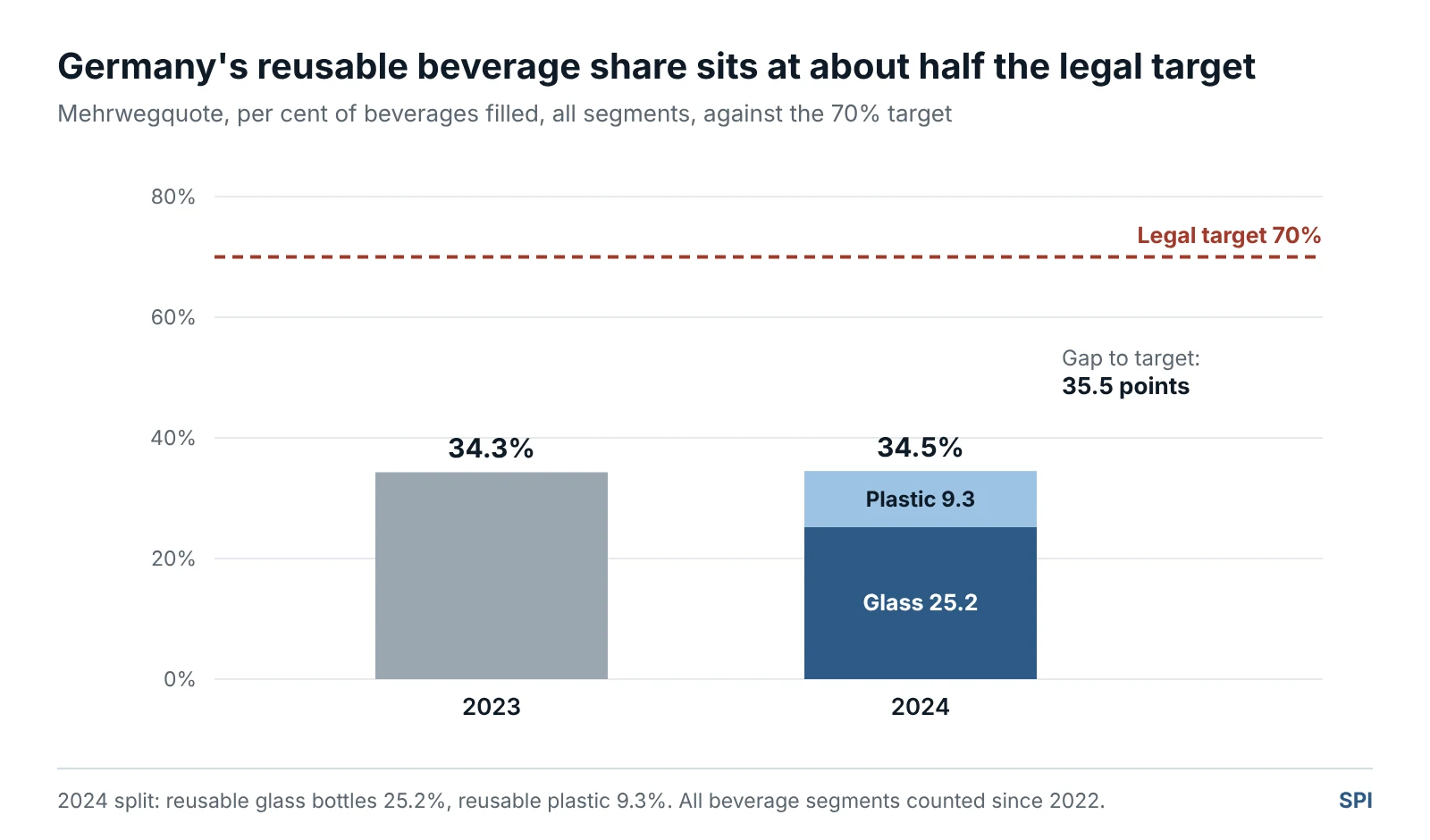
| Year | Reusable share, % | Of which glass, % | Of which plastic, % |
|---|---|---|---|
| 2023 | 34.3 | 24.9 | not shown |
| 2024 | 34.5 | 25.2 | 9.3 |
Note: Series covers all beverage segments since 2022. The 2023 split by material is not shown.
The law has changed under the quota. The Verpackungsrecht-Durchführungsgesetz (VerpackDG) has applied since 12 August 2026, the same day as the PPWR, and replaced the Verpackungsgesetz. Section 60 keeps the duty to offer takeaway food and drinks in reusable packaging at no higher price, and section 61 keeps the small-shop route (gesetze-im-internet.de). SPI’s German packaging law analysis covers the wider act. SPI has not yet confirmed how the VerpackDG words the 70% beverage target.
SPI analysis: three years of a reusable offer duty in German takeaway and a national 70% goal for beverages have not lifted the beverage share above 35%. For the PPWR’s 10% beverage target from 2030 that is a comfortable base for Germany, but it shows that an offer duty on its own does not shift what consumers choose.
France sets its reuse goal on producers, through Decree 2022-507 of 8 April 2022, in force since 1 January 2023 under Article L. 541-1 of the Code de l’environnement. It applies to producers placing at least 10,000 units of packaged products on the market a year, and the schedule depends on turnover.
| Producer turnover | 2023 | 2024 | 2025 | 2026 | 2027 |
|---|---|---|---|---|---|
| Above EUR 50 million | 5% | 6% | 7% | 8% | 10% |
| EUR 20 to 50 million | none | none | 5% | 7% | 10% |
| Under EUR 20 million | none | none | none | 5% | 10% |
Note: Producers placing at least 10,000 units of packaged products a year. Share counted per packaging unit, or a justified equivalent of 0.5 litre or 0.5 kg. Refilling at the point of sale counts as reuse.
Source: AIDA (INERIS), Décret n° 2022-507 du 8 avril 2022, article D. 541-352 (SPI summary)
The decree counts each packaging unit, primary, secondary or tertiary, and lets a producer use an equivalent unit of 0.5 litre or 0.5 kg where that fits its products better. Refilling at the point of sale, or at home in an organised refill system, counts as reuse. Packaging whose reuse is banned for hygiene or safety reasons is excluded (Decree 2022-507).
The results so far are low. The ministry’s interim review of the 3R strategy, published in June 2025, put reuse at 2.2% in 2023, against the 5% threshold for the largest producers. Citeo, the household packaging scheme, funds reuse through a contribution of 0.0140 euro cents on every sales unit in 2026 and links it to the 10% target for 2027 (Citeo guide 2026). SPI’s France AGEC analysis covers the labelling side of the same law.
Exhibit 6 puts the national and EU dates on one line, soonest first.
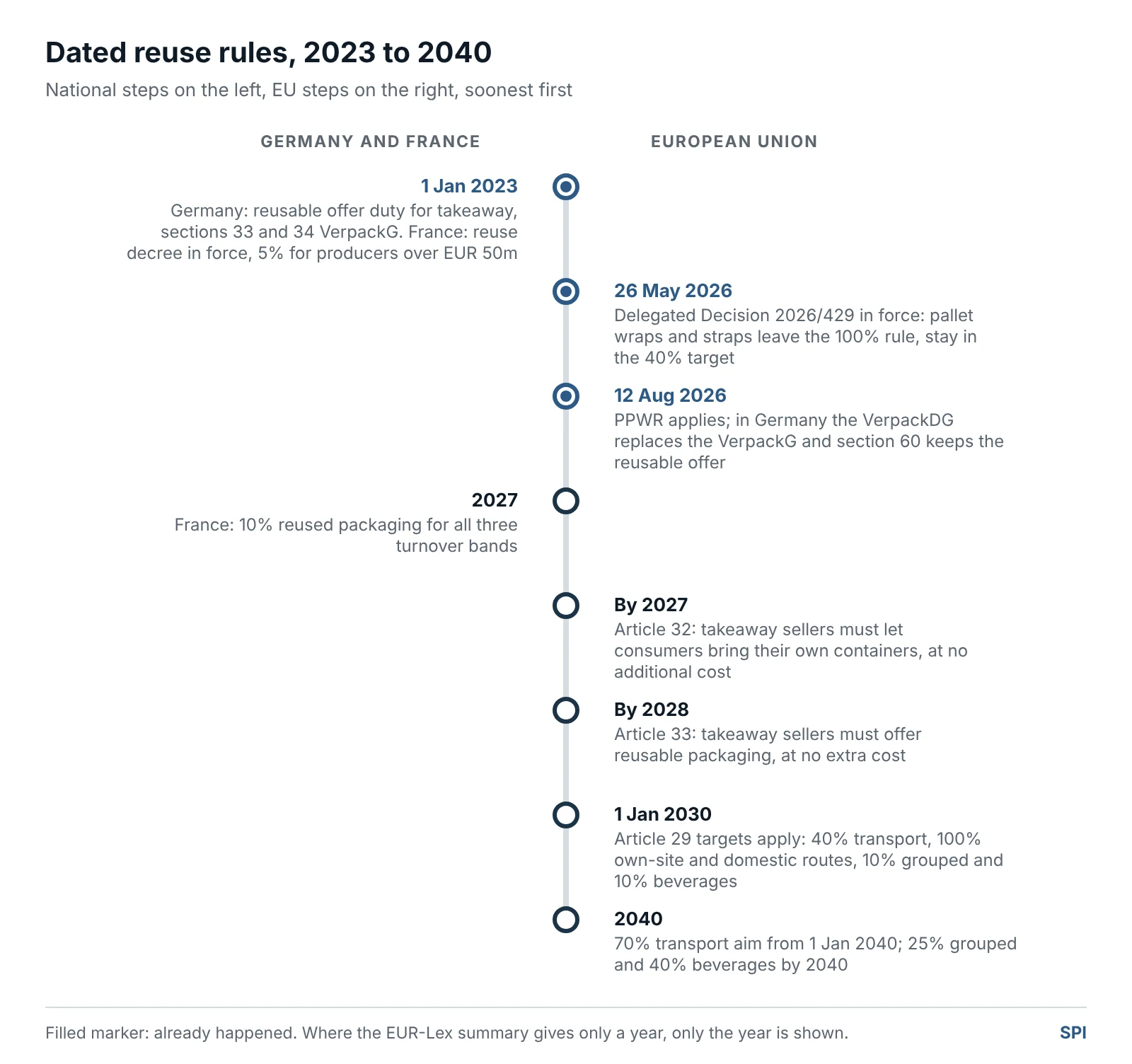
| Date | Label | Category | Link |
|---|---|---|---|
| 2023-01-01 | Germany reusable offer duty; France reuse decree in force | past | |
| 2026-05-26 | Delegated Decision 2026/429 in force | past | |
| 2026-08-12 | PPWR applies; VerpackDG replaces VerpackG | past | |
| 2027 | France 10% reused packaging for all bands | next | |
| By 2027 | Article 32 own-container duty for takeaway | next | |
| By 2028 | Article 33 reusable offer for takeaway | next | |
| 2030-01-01 | Article 29 targets apply | next | |
| 2040 | 2040 levels of 70%, 25% and 40% | next |
Note: Dates as stated in the sources. Where the EUR-Lex summary gives only a year, only the year is shown.
Extended producer responsibility (EPR) schemes charge packaging by weight and material, on the assumption that each pack is used once. Where a scheme table shows a reusable line, it is at or close to zero. SPI’s fee data hold four euro schemes with a published reusable treatment, set in Exhibit 7 against the line a single-use rigid PP pack would pay in the same table.
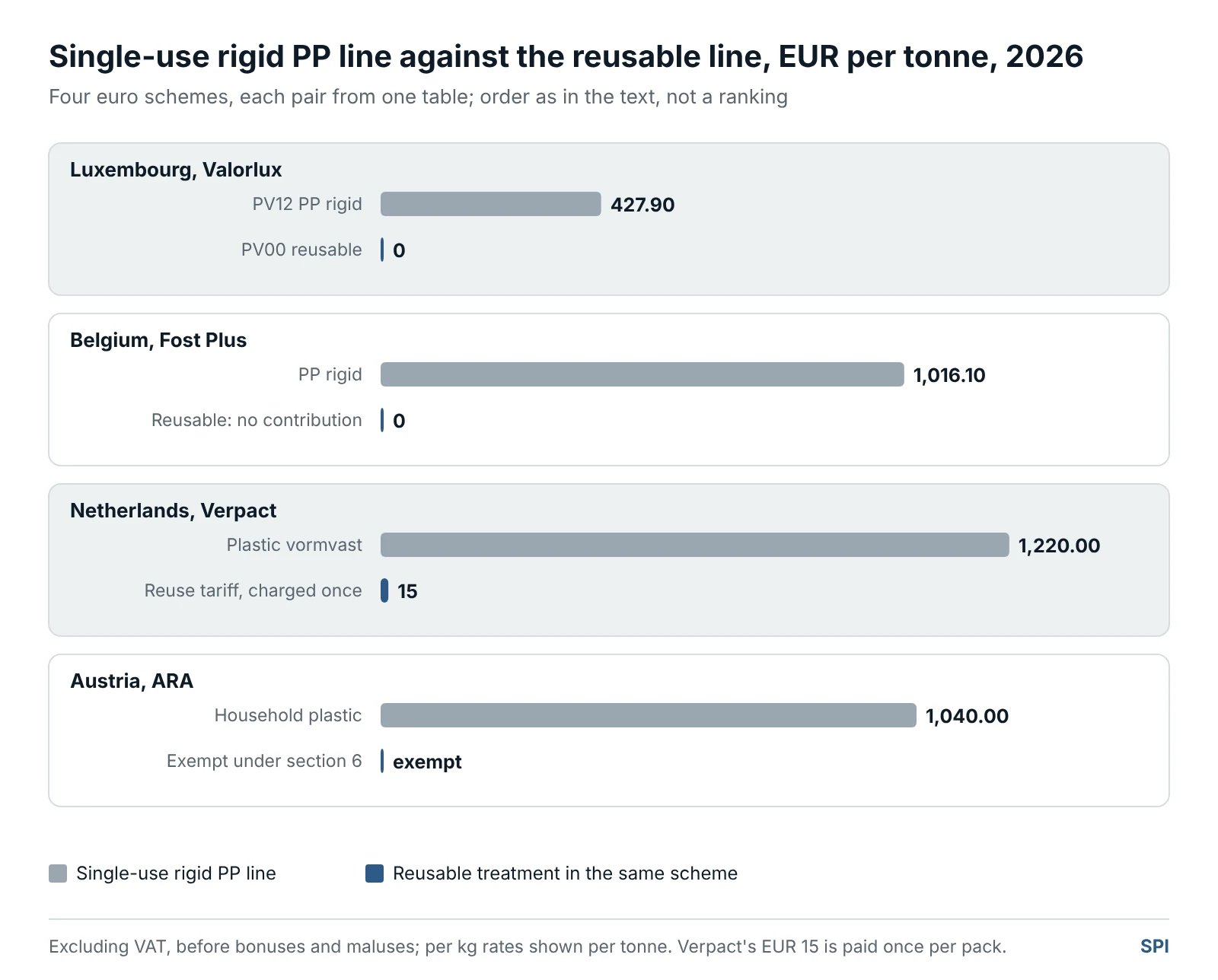
| Scheme | Single-use rigid PP line | Reusable treatment |
|---|---|---|
| Luxembourg, Valorlux | 427.90 | 0 (PV00) |
| Belgium, Fost Plus | 1,016.10 | 0, information duty only |
| Netherlands, Verpact | 1,220.00 | 15, charged once per pack |
| Austria, ARA | 1,040.00 | Exempt under section 6 |
Note: Per kg rates shown per tonne in the same currency. Base rates before bonuses and maluses. Ratios only inside one scheme.
The rate is rarely the hard part; the proof is. Valorlux’s zero rate applies to closed-loop packaging whose ownership is kept through collection. Fost Plus asks members to declare reusable household packaging next to single-use packaging, with only an information duty on it. Verpact levies its reuse tariff once per pack and asks for the reuse weight, pack weight times trips in the year, with no further charge. Austria takes packaging on deposit, or exchanged directly between supplier and customer, out of the participation duty, with a separate report to the register. Exhibit 8 sets out the six treatments SPI’s data hold, including the two outside these four tables.
| Scheme | Treatment of reusable packaging | Rate or effect, 2026 | Condition |
|---|---|---|---|
| Luxembourg, Valorlux | Own line, PV00 | EUR 0.0000 per kg | Closed loop, ownership kept |
| Belgium, Fost Plus | Information duty only | No contribution | Declared next to single-use packs |
| Netherlands, Verpact | Reuse tariff, levied once | EUR 0.015 per kg | Demonstrable reuse system; trips declared by weight |
| Austria, ARA and VerpackVO | Outside the participation duty | Not licensed | On deposit or direct exchange |
| France, Citeo | Reuse levy on every sales unit; bonus for new reusable packs | 0.0140 euro cents per unit | Funds the 10% target for 2027 |
| Oregon, CAA | No reuse line; Bonus C | 20% off base fees, capped at USD 40,000 in Tier 1 | Life cycle evaluation showing over 10% impact cut |
Note: Oregon in USD, all others in EUR; no comparison across currencies. SPI has not yet confirmed Citeo's 2026 bonus value for new reusable packaging.
Source: Valorlux 2026 table; Fost Plus declaration page; Beleid Verpact 2026, sections 3.1.6 and 4.1.3; ARA 2026 and Verpackungsverordnung 2014 section 6; Citeo guide du tarif 2026; Oregon DEQ subcommittee recommendations, 14 Jul 2025 (SPI summary)
SPI analysis: fee tables reward reuse, but the reward is small next to the 2030 duties. SPI’s reusable packaging EPR fee analysis prices one switch of 1,000,000 fills a year from a 50 g single-use rigid PP pack to an 80 g reusable one making 10 trips. At Verpact’s 2026 rates of EUR 1,220 a tonne for rigid plastic and EUR 15 a tonne for reuse, the yearly fee falls from EUR 61,000 on 50 tonnes to EUR 120 on the 8 tonnes of new reusable packs. On industrial lines the gap is narrower: Valorlux charges EUR 39.50 a tonne on its industrial plastic line in 2026, so 40 tonnes of single-use plastic crates pay EUR 1,580 a year; SPI has not yet confirmed whether its zero reusable line covers industrial packaging. For transport packaging the PPWR, not the fee, drives the switch.
Taxes add a further signal. Spain’s special tax on non-reusable plastic packaging, set by Law 7/2022, charges EUR 0.45 a kilogram of non-recycled plastic, and its scope is limited by name to non-reusable packaging (Agencia Tributaria). Deposit return systems for single-use drinks containers, which SPI covers in its deposit return analysis, sit beside the reusable bottle pools rather than inside them.
No official statistic measures the reusable packaging market on its own, by value or by tonnage, in the EU, Germany or France. Three official indicators touch it, each in its own unit.
The first is Eurostat’s. EU countries have reported data on reusable packaging since 2021, covering packaging first placed on the market and the number of rotations, by material and split between all packaging and sales packaging. Eurostat’s packaging waste article, extracted on 16 October 2026, charts reusable packaging first placed on the market in 2024 per inhabitant but gives no EU total. Finland reported 37.6 kg, Czechia 34.2 kg and Poland 26.1 kg, all provisional, followed by Spain at 25.9 kg and Germany at 23.0 kg; Luxembourg reported under 0.05 kg. Data are not available for Romania and Slovenia.
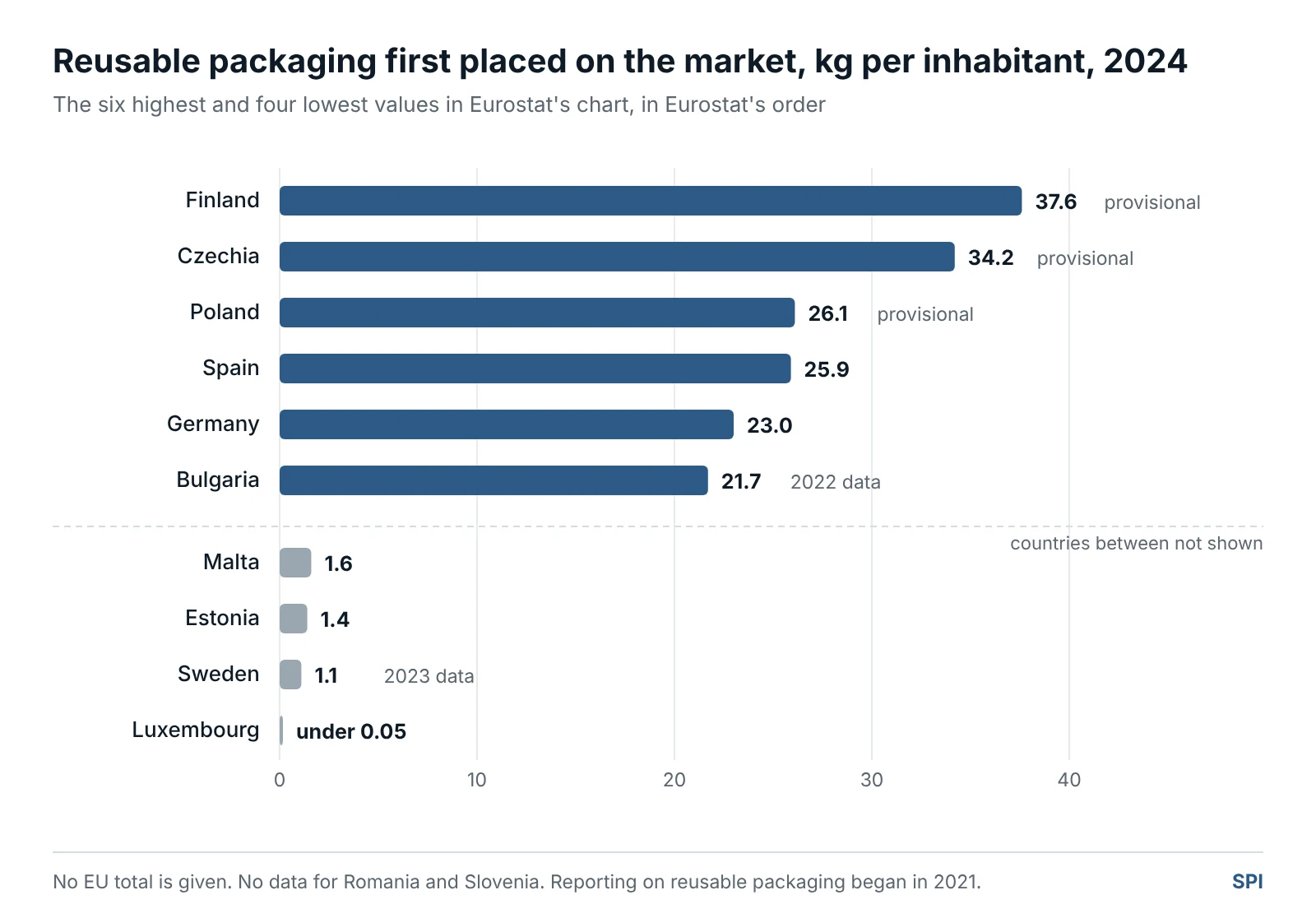
| Country | kg per inhabitant | Note |
|---|---|---|
| Finland | 37.6 | provisional |
| Czechia | 34.2 | provisional |
| Poland | 26.1 | provisional |
| Spain | 25.9 | |
| Germany | 23.0 | |
| Bulgaria | 21.7 | 2022 data |
| Malta | 1.6 | |
| Estonia | 1.4 | |
| Sweden | 1.1 | 2023 data |
| Luxembourg | under 0.05 |
Note: Order as given by Eurostat. Countries between the two groups are not shown. Data for Finland, Czechia and Poland are provisional.
The spread is wide, and it reflects reporting as much as practice: Luxembourg, where Valorlux prices reusable packaging at zero, reports almost none placed on the market. The same Eurostat article puts EU packaging waste at 81.5 million tonnes in 2024, or 181.0 kg per inhabitant, with wood, the material of most pallets, at 16.2% or 13.2 million tonnes. Those tonnages are waste, not reusable stock.
The second indicator is the UBA’s Mehrwegquote in Exhibit 4, a share of beverages filled, not a tonnage. The third is the French reuse share, 2.2% in 2023, from the ministry’s interim review. None of the three can be added to another, and none is a market size.
Reusable transport packaging is run largely through pools, in which an operator owns the pallets or crates, rents them to shippers and collects, repairs and cleans them. Brambles publishes segment figures for its pools; each is kept in its own currency.
Brambles, listed on the ASX and reporting in US dollars, runs the CHEP pallet and container pools. Its FY26 results presentation, for the year to 30 June 2026, reports group sales revenue of US$7,042.9 million, up 2% at constant exchange rates and 6% at actual rates, and underlying profit of US$1,494.4 million. CHEP EMEA, the region that includes the EU, reported US$2,579.9 million of sales revenue, of which pallets were US$2,351.5 million and reusable plastic containers US$38.7 million (Brambles FY26 results presentation). The presentation does not discuss the PPWR, so SPI does not link the result to the regulation.
| Operator | Measure | Value | Period |
|---|---|---|---|
| Brambles group | Sales revenue | US$7,042.9 million | FY26 |
| CHEP Americas | Sales revenue | US$3,867.1 million | FY26 |
| CHEP EMEA | Sales revenue | US$2,579.9 million | FY26 |
| CHEP EMEA | Pallets revenue | US$2,351.5 million | FY26 |
| CHEP EMEA | Reusable plastic container revenue | US$38.7 million | FY26 |
| CHEP Asia-Pacific | Sales revenue | US$595.9 million | FY26 |
Note: Company-reported figures; not a market size. Brambles' year ends 30 June 2026.
Source: Brambles FY26 results presentation, 20 Aug 2026 (SPI summary)
SPI analysis: the filings show that reusable transport packaging is already a large, rented asset base, not a 2030 invention. They also show its limits as a market measure: Brambles reports revenue for its own pools, which covers neither own fleets, reusable bottles nor takeaway systems. Under the PPWR the operator that uses the pooled pallet to place products on the EU market carries the target, not the pool (Commission Notice, section 20).
SPI publishes no price forecast for reusable packaging. What the sources state are regulatory costs and conditions: the fee lines in Exhibits 7 and 8, the no higher price rules for takeaway in Articles 32 and 33 and in Germany’s section 60, and Spain’s tax on non-reusable plastic. Pool rental rates, deposit levels charged by pools and the cost of washing and return logistics are not published by any of the sources on this page, and SPI has not yet confirmed them.
The outlook for the reusable packaging market in Europe can be read from the dates in Exhibit 6. Takeaway duties come first, in 2027 and 2028. The Article 29 targets follow on 1 January 2030.
Three variables are still open. The first is the implementing act under Article 30(3) that will set how the targets are calculated; it may settle whether units on 100% routes count in the 40% denominator. The second is how final distributors count beverages, since the Commission reads making available as an offer rather than a sale. The third is national: Article 29(14) lets Member States grant five-year exemptions where they beat the packaging recycling targets by 5 percentage points, cut packaging waste per head by at least 3% by 2028 against 2018 and the operators adopt a waste prevention and recycling plan (Commission Notice, section 24), while Article 33(6) leaves room for national measures (section 25). Germany’s 70% beverage goal and France’s 10% for 2027 already go further than the EU minimums.
This report was written on 29 November 2026 from official texts, regulators’ releases, scheme fee tables and company filings. PPWR targets and duties come from the Commission’s guidance notice C/2026/3084, Delegated Decision (EU) 2026/429 and the EUR-Lex summary of Regulation (EU) 2025/40; where those sources give only a year, only the year is shown. Fee lines come from SPI’s fee market data, compiled from each scheme’s 2026 tables and consulted on 3 November 2026; per kg rates are shown per tonne in the same currency. Statistics are shown in their own unit and year. Company figures are kept in their own currency and are not added, converted or ranked. No third-party market size, growth rate or share is shown, because no official statistic measures this market on its own.
Get sample pages with the market model, segment tables and the full table of contents.
What is moving demand for reusable packaging market up or down over , with the expected impact on growth.
Article 29 sets 40% for listed transport packaging, 100% on own-site and domestic routes, and 10% for grouped packaging and beverages from 2030.
Article 32 requires sellers to accept consumers' own containers by 2027 and Article 33 a reusable offer by 2028, at no additional cost.
Germany's reusable offer duty has applied since 1 January 2023, and France's decree requires 10% reused packaging in 2027.
Germany's reusable beverage share was 34.5% in 2024, 0.2 points above 2023, despite a 70% target and a takeaway offer duty.
Dangerous goods packaging, custom-designed packaging for large machinery and pallet wraps on 100% routes sit outside parts of Article 29.
Valorlux and Fost Plus charge nothing on reusable packaging and Verpact charges EUR 0.015 a kg once, against EUR 427.90 to EUR 1,220 a tonne for single-use rigid PP in 2026.
Where every listed pallet and crate on own-site or domestic routes must be reusable from 2030, shippers need a pool or an own fleet.
An implementing act under Article 30(3) is still to set how the Article 29 targets and the beverage offer are calculated.
Each scheme asks for different evidence, from closed-loop ownership at Valorlux to trip counts by weight at Verpact.
The rules that change material choice, design and cost for this market. Each one is covered in depth in the report.
| Rule | Jurisdiction | Status | What it means |
|---|---|---|---|
| Regulation (EU) 2025/40, Article 29 | European Union | Applies from 1 Jan 2030 | 40% reusable transport packaging, 100% on own-site and domestic routes, 10% grouped packaging and 10% beverages; 2040 levels of 70%, 25% and 40% |
| Regulation (EU) 2025/40, Article 32 | European Union | Applies by 2027 | Takeaway sellers must let consumers bring their own containers at no additional cost |
| Regulation (EU) 2025/40, Article 33 | European Union | Applies by 2028 | Takeaway sellers must offer reusable packaging at no extra cost |
| Delegated Decision (EU) 2026/429 | European Union | In force since 26 May 2026 | Pallet wraps and straps released from the 100% reuse rule; still in the 40% target |
| VerpackDG sections 60 and 61 | Germany | In force since 12 Aug 2026 | Keeps the takeaway reusable offer duty in force since 1 Jan 2023 and the small-shop route |
| Décret 2022-507 | France | In force since 1 Jan 2023 | Minimum reused packaging share rising to 10% in 2027 for producers of 10,000 units or more |
| Real Decreto 1055/2022, Article 8 | Spain | In force | Reuse shares for HORECA beverages, for example soft drinks 60% in 2025 and 70% in 2030 |
ASX-listed operator of the CHEP pallet and container pools; reports in US dollars.
Eurostat's packaging waste article charted reusable packaging placed on the market in 2024, with Finland at 37.6 kg per inhabitant.
Regulation (EU) 2025/40 began to apply and Germany's VerpackDG replaced the Verpackungsgesetz on 12 August.
Brambles reported FY26 sales revenue of US$7,042.9 million, with CHEP EMEA at US$2,579.9 million.
The Umweltbundesamt put Germany's reusable beverage share at 34.5% for 2024.
The Commission published guidance notice C/2026/3084, including sections on the reuse targets.
Delegated Decision (EU) 2026/429 released pallet wraps and straps from the 100% reuse rule.
| Base year | 2025 |
|---|---|
| Units | Value (USD Billion), volume (kilotonnes) |
| Regions covered | North America, Europe, Asia Pacific, Latin America, Middle East & Africa |
| Companies profiled | Brambles |
| Report coverage | Market size and forecast, segment and country analysis, packaging regulation, pricing, value chain, competitive landscape, company profiles |
| Customisation | Up to 10% additional scope free of charge before delivery |
Chapters are built from this report’s segmentation, regions and company list. Open a chapter to see every section.
Includes the list of tables and figures with sample data pages.
How Strategic Packaging Insights builds and checks the numbers in this report.
We fix the formats, substrates and end uses in scope, the unit of measure (USD and tonnes) and the base year (2025), so every number in the report counts the same thing.
Regulator texts (EU PPWR, national EPR schemes, plastic packaging taxes), customs and trade statistics for packaging HS codes, company annual reports and investor filings, trade association data and patent records.
Structured interviews with converters, resin and paper suppliers, brand-owner packaging and procurement teams, machinery suppliers and recyclers, used to test volumes, prices and adoption timing.
Demand in tonnes by substrate and end use, multiplied by regional average selling price per kilogram, built country by country.
Cross-check against end-use output (food, beverage, pharma, personal care, e-commerce shipments) and the reported packaging revenue of the leading companies.
The two views are reconciled, then forecast to 0 with drivers for demand, resin and fibre prices, and regulatory scenarios (recyclability grades, recycled-content targets, EPR fees).
Every figure is checked for arithmetic consistency (segments add to the total, shares add to 100%), every regulatory statement is checked against the official text, and a senior analyst signs off the release.
Single user, team and company-wide licences are available. Tell us who will use the report and we will send the licence options and pricing by email.
From 1 January 2030, at least 40% of listed transport packaging must be reusable within a re-use system, rising to an aim of 70% from 2040. Packaging moved between own sites or inside one Member State must be fully reusable. Grouped packaging must reach 10%, and final distributors must make 10% of beverages available in reusable packaging.
By 2027, restaurants and cafés providing takeaway food or drinks must allow consumers to bring their own containers, at no additional cost, according to the EUR-Lex summary of Regulation (EU) 2025/40. Article 33 then requires the same sellers to offer reusable packaging for takeaway items by 2028, again at no extra cost to the consumer.
The Umweltbundesamt put the share of beverages filled in reusable packaging at 34.5% in 2024, up 0.2 points on 2023. Reusable glass bottles were 25.2% and reusable plastic 9.3%. The legal target is 70%, so Germany missed it by 35.5 percentage points. The series has covered all beverage segments since 2022.
Decree 2022-507 sets minimum shares of reused packaging for producers placing at least 10,000 packaged units a year. Producers with turnover above EUR 50 million needed 5% in 2023, rising to 8% in 2026. All three turnover bands must reach 10% in 2027. The ministry's June 2025 review put reuse at 2.2% in 2023.
Mostly at or near zero, on conditions. Valorlux prices reusable packaging at EUR 0 per kg, Fost Plus charges no contribution, and Austria exempts packaging on deposit or direct exchange. Verpact charges EUR 0.015 per kg once per pack. Citeo instead levies 0.0140 euro cents on every sales unit to fund reuse in France.
No official statistic measures the market on its own. Eurostat publishes reusable packaging first placed on the market per inhabitant, 37.6 kg in Finland and 23.0 kg in Germany in 2024, without an EU total. Germany's UBA publishes a reusable beverage share, and pool operators such as Brambles report revenue in their own currency.
Public sources used alongside primary interviews and company filings.