
SPI Packaging Procurement & Supplier Intelligence
Answer: Packaging procurement intelligence is a sourced map of who could supply a pack, what each supplier publicly claims it can do, and how EPR fees, plastic taxes and recycled-content law change the cost of each option; Strategic Packaging Insights (SPI) builds it from public evidence and its own SPI Trackers.
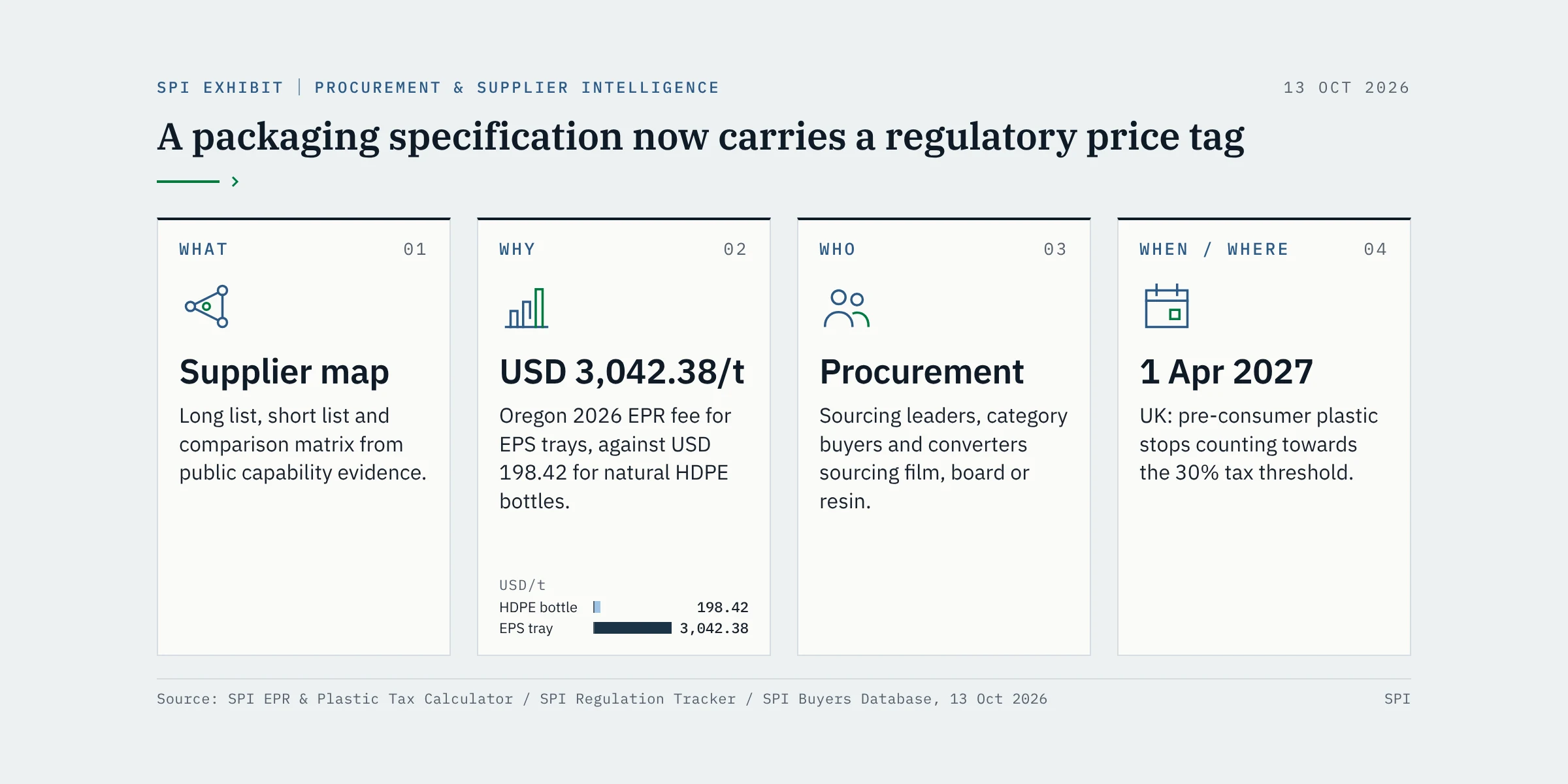
Packaging specifications now carry a regulatory price tag: in Oregon’s 2026 EPR schedule, an expanded polystyrene tray costs USD 3,042.38 per tonne in fees against USD 198.42 for a natural HDPE bottle. SPI helps procurement and sourcing teams find credible alternative suppliers and compare them on the evidence that now decides cost and compliance.
By the SPI team · Figures as of 13 October 2026
79
Packaging rules tracked
across 25 jurisdictions, each with its official source
SPI Regulation Tracker
216
Published EPR and tax rate rows
in 14 markets
SPI EPR & Plastic Tax Calculator
42
Brand owners and retailers
with public packaging targets and reported progress
SPI Buyers Database
15.3
Oregon 2026 fee ratio
EPS containers versus natural HDPE bottles, per tonne
CAA Oregon fee schedule, rows FEE-US-109 and FEE-US-102
Source: SPI Trackers, checked 14 Oct 2026.
Key facts
- Oregon’s 2026 packaging EPR fees run from USD 198.42 per tonne for natural HDPE bottles to USD 3,042.38 for expanded polystyrene containers, cups and trays (Circular Action Alliance 2026 schedule, calculator rows FEE-US-102 and FEE-US-109, checked 13 October 2026).
- Repak in Ireland charges EUR 165.70 per tonne for recycled rigid plastic and EUR 616.22 for non-recycled plastic in 2026 (Repak 2026 fees sheet, rows FEE-IE-005 and FEE-IE-007).
- The UK Plastic Packaging Tax is £228.82 per tonne from 1 April 2026 on components with less than 30% recycled plastic; from 1 April 2027 pre-consumer plastic no longer counts towards the 30% (PR-GB-001, GOV.UK and HMRC policy paper of 26 November 2025).
- Since 12 August 2026, EU food-contact packaging may not contain PFAS at or above the limits set in Regulation (EU) 2025/40, the PPWR (PR-EU-002).
- Single-use plastic beverage bottles in the EU need 30% recycled content from 2030 under the PPWR (PR-EU-004); California’s redemption-value plastic beverage containers need 50% from 1 January 2030 (PR-US-009, CalRecycle).
- India’s Category I rigid plastic packaging must contain 40% recycled plastic in 2026-27 and 60% from 2028-29, and the recycled material must meet IS 14534:2023 (PR-IN-002, G.S.R. 237(E), 31 March 2026).
- Walmart reports 12.0% post-consumer recycled content in North America private-brand plastic packaging for FY2026 against a 20% target for 2025 (SPI Buyers Database, company report).
The problem: why packaging supply bases are under pressure now
Packaging is often bought from a few qualified suppliers on multi-year terms. That worked while the main criteria were unit price, quality and service. Since 2025, four changes have made the supply base itself a cost and compliance question.
Fees and taxes now price the specification
EPR (extended producer responsibility) makes producers pay for collecting and recycling the packaging they place on the market. Many schemes now set different fees by material and format, a practice called eco-modulation. The result is that two suppliers offering the same pack in different materials can leave you with very different fee bills.
The same pattern appears in Europe. Recycled content and recyclable design lower the fee directly in some schemes, which makes a supplier’s recycled-content evidence a cost line, not only a sustainability claim.
| Market and scheme | Lower-fee specification | Fee per tonne | Higher-fee specification | Fee per tonne | Rows |
|---|---|---|---|---|---|
| Ireland, Repak (EUR) | Recycled rigid plastic | 165.7 | Non-recycled plastic | 616.22 | FEE-IE-005, FEE-IE-007 |
| Belgium, Fost Plus (EUR) | Clear colourless PET bottles | 360.4 | Other plastics incl. aluminium laminates and PVC | 4419 | FEE-BE-007, FEE-BE-019 |
| Spain, Ecoembes (EUR) | PET beverage bottles up to 3 litres | 271 | Plastic film and flexibles | 1243 | FEE-ES-103, FEE-ES-109 |
| United States, Oregon (USD) | HDPE bottles, natural | 198.42 | PS expanded containers, not accepted | 3042.38 | FEE-US-102, FEE-US-109 |
Source: SPI EPR & Plastic Tax Calculator, scheme fee tables, checked 13 Oct 2026.
Per tonne in each scheme's own currency; Fost Plus rates converted from per kg by multiplying by 1000.
Plastic taxes add a second layer. The UK Plastic Packaging Tax of £228.82 per tonne applies to finished plastic packaging components with less than 30% recycled plastic, and the converter or importer pays it (PR-GB-001). Spain charges EUR 0.45 per kg on the non-recycled plastic in non-reusable packaging (PR-ES-001). See plastic packaging taxes in 2026 and EPR fees per tonne for the full rate tables.
Recycled content is becoming a legal supply requirement
Recycled content used to be a target a brand set for itself. In 6 rules in the SPI Regulation Tracker it is now a legal minimum. The PPWR requires 30% recycled content in single-use plastic beverage bottles from 2030, while other categories have their own percentages, and how recycled content is calculated depends on a Commission implementing act due by 31 December 2026 (PR-EU-004). California requires 25% postconsumer recycled plastic in redemption-value beverage containers now and 50% from 1 January 2030, with a USD 0.20 per pound penalty on shortfalls (PR-US-009). India’s 2026 amendment rules set category-wise recycled-content obligations, require recycled packaging to meet IS 14534:2023 and let importers meet obligations by buying certificates (PR-IN-002).
The UK tax adds an evidence problem. From 1 April 2027, HMRC has announced that pre-consumer plastic will no longer count towards the 30% threshold and that a certified mass balance approach for chemically recycled plastic will be introduced (PR-GB-001, HMRC policy paper of 26 November 2025). A supplier whose recycled content is mostly factory scrap may stop qualifying.
Brand targets were missed, and supply was part of the reason
The SPI Buyers Database records 179 public packaging targets from 42 brand owners and retailers. Of the targets due in 2025 or earlier, 16 are reported as met and 19 as missed, with 24 where the company has not reported a clear outcome. Recycled content is where the gaps show most clearly.
- Target
- Latest reported
Source: SPI Buyers Database, company reports rechecked, checked 13 Oct 2026.
Company-reported figures; SPI does not audit them. Reporting years differ by company.
Show the data
| Company and target scope | Target | Latest reported |
|---|---|---|
| Walmart, North America private-brand plastic | 20 | 12.0 |
| Walmart, global private-brand plastic | 17 | 10.7 |
| The Estée Lauder Companies, all packaging | 25 | 20 |
| Kimberly-Clark, plastic packaging | 20 | 18 |
| Carrefour, own-brand plastic packaging | 30 | 24.0 |
AB InBev reports 89.7% of products in returnable or majority-recycled packaging in 2025 against a goal of 100%, mainly because of limited recycled PET supply. In India, Dabur reports 2%, 6% and 1% recycled content in Category I, II and III plastic packaging for FY 2025-26 against its targets of 30%, 10% and 5%.
SPI analysis
These figures suggest that food-grade recycled resin is a constrained input, and that the constraint will tighten as legal minimums rise in 2027, 2028-29 and 2030. Buyers that rely on one or two converters for recycled-content packs carry a concentration risk that a unit-price tender will not reveal.
Rules are moving demand between formats and suppliers
Some rules remove formats outright. From 1 January 2030, Article 25 and Annex V of the PPWR bar specified single-use plastic formats, including packaging for pre-packed fresh fruit and vegetables under 1.5 kg and grouped packaging films (PR-EU-008; see PPWR 2030 format restrictions). Deposit return systems change how drinks containers are specified and labelled: England and Northern Ireland start on 1 October 2027 under SI 2025/67 (PR-GB-004), and the PPWR requires 90% separate collection of single-use plastic bottles and metal cans by 2029 (PR-EU-007). The PFAS limit for EU food-contact packaging has applied since 12 August 2026, and the SPI note on PR-EU-002 recommends asking suppliers for declarations and test data per grade.
- Design rule
- Recycled content
- Tax or levy
- Deposit return
- Other
- EU PFAS limits in food-contact packaging apply (PR-EU-002)Design rule
- Commission implementing act on recycled-content calculation due (PR-EU-004)Recycled content
- UK tax: pre-consumer plastic stops counting towards 30% (PR-GB-001)Tax or levy
- Deposit return starts in England, Northern Ireland and Scotland (PR-GB-004, PR-GB-005)Deposit return
- 2028India Category I recycled content reaches 60% for 2028-29 (PR-IN-002)Recycled content
- PPWR: harmonised material-composition sorting label (PR-EU-003)Labelling
- EU 90% separate collection of drinks bottles and cans (PR-EU-007)Deposit return
- PPWR recycled content, format restrictions and recyclability apply (PR-EU-004, PR-EU-008, PR-EU-010)Recycled content
- California 50% recycled plastic in beverage containers (PR-US-009)Recycled content
- PPWR: 2030 reuse targets for transport and grouped packaging (PR-EU-006)Reuse target
- PPWR: maximum 50% empty space in grouped, transport and e-commerce packaging (PR-EU-009)Design rule
Source: SPI Regulation Tracker, checked 14 Oct 2026.
Show the data
| Date | Label | Category | Link |
|---|---|---|---|
| 2026-08-12 | EU PFAS limits in food-contact packaging apply (PR-EU-002) | design_rule | /data/packaging-regulation-tracker/european-union/ |
| 2026-12-31 | Commission implementing act on recycled-content calculation due (PR-EU-004) | recycled_content | /data/packaging-regulation-tracker/european-union/ |
| 2027-04-01 | UK tax: pre-consumer plastic stops counting towards 30% (PR-GB-001) | tax | /data/packaging-regulation-tracker/united-kingdom/ |
| 2027-10-01 | Deposit return starts in England, Northern Ireland and Scotland (PR-GB-004, PR-GB-005) | deposit_return | /data/packaging-regulation-tracker/united-kingdom/ |
| 2028 | India Category I recycled content reaches 60% for 2028-29 (PR-IN-002) | recycled_content | /data/packaging-regulation-tracker/india/ |
| 2029-01-01 | EU 90% separate collection of drinks bottles and cans (PR-EU-007) | deposit_return | /data/packaging-regulation-tracker/european-union/ |
| 2030-01-01 | PPWR recycled content, format restrictions and recyclability apply (PR-EU-004, PR-EU-008, PR-EU-010) | recycled_content | /data/packaging-regulation-tracker/european-union/ |
| 2030-01-01 | California 50% recycled plastic in beverage containers (PR-US-009) | recycled_content | /data/packaging-regulation-tracker/united-states/ |
| 2028-08-12 | PPWR: harmonised material-composition sorting label (PR-EU-003) | Labelling | https://www.strategicpackaginginsights.com/data/packaging-regulation-tracker/european-union/pr-eu-003/ |
| 2030-01-01 | PPWR: 2030 reuse targets for transport and grouped packaging (PR-EU-006) | Reuse target | https://www.strategicpackaginginsights.com/data/packaging-regulation-tracker/european-union/pr-eu-006/ |
| 2030-01-01 | PPWR: maximum 50% empty space in grouped, transport and e-commerce packaging (PR-EU-009) | Design rule | https://www.strategicpackaginginsights.com/data/packaging-regulation-tracker/european-union/pr-eu-009/ |
Who this service is for
- Procurement and sourcing leaders at brand owners and retailers who need a second or third source for a pack, or who are re-tendering a category and want the supply base mapped before they go to market.
- Category buyers who must pass on recycled-content, PFAS or recyclability requirements to suppliers and need to know which suppliers can evidence them.
- Converters sourcing materials, such as film, board, resin or recycled resin, who want alternatives to a concentrated upstream supply base.
- Finance and commercial teams who want to see how a supplier or specification change shifts EPR fees and plastic tax by market.
It suits teams with a named category, a geography and a decision date. It is not a supplier-matching or brokerage service, and SPI takes no fee from suppliers.
Scope: what SPI covers
- Supplier mapping by format, material, end use and region, built from company websites, annual reports, trade registers, trade-fair exhibitor lists and other public sources named in the source plan.
- Capability comparisons across the criteria you set: formats and materials offered, plant locations, recycled-content options, food-contact and other certifications as each supplier publicly claims them, and stated capacity where it is published.
- Sourcing intelligence: the regulatory and fee context of each option, using the SPI Regulation Tracker and the SPI EPR & Plastic Tax Calculator.
- Diversification options: second-source, dual-source, regional and material-switch options, each with its benefits, risks and evidence gaps.
Deliverables
| Deliverable | What it contains | Format |
|---|---|---|
| Supplier long list | Every supplier found that meets your basic criteria, with the public source for each fact and the date it was consulted | Spreadsheet |
| Supplier short list | The suppliers that best meet your weighted criteria, with reasons for inclusion and exclusion | Report section |
| Comparison matrix | Side-by-side scoring on your criteria; claimed certifications marked “as claimed” with source; gaps shown as gaps | Spreadsheet and summary table |
| Fee and rule overlay | EPR fee and plastic tax per tonne for the current and alternative specification in each market, with the rate rows used | Table and short memo |
| Diversification options memo | Options ranked by risk reduction, cost direction and time to qualify, with the evidence behind each | Report, 8 to 15 pages typical |
| Data annex and read-out | Source list, assumptions, corrections log and a read-out call with one round of clarifications | Spreadsheet, call |
Methodology: the SPI 6-step spine
Every SPI consulting assignment follows the same six steps, described in the SPI Methodology. For procurement work, the steps look like this.
| Step | What happens | Procurement output |
|---|---|---|
| 1. Scope | Scoping call and written brief: the decision, category, geographies, materials and time horizon | Agreed screening criteria and weights |
| 2. Source plan | Public, licensed and your own sources listed; each external fact gets an original source, date and scope | Named source list, approved by you |
| 3. Evidence | Desk research, SPI datasets, and interviews only when scoped and agreed | Long list with sourced capability evidence |
| 4. Analysis | Sourced facts kept separate from SPI judgement; assumptions listed | Short list, comparison matrix, fee overlay |
| 5. Check | A second SPI team member checks numbers and sources; corrections logged | QA record in the data annex |
| 6. Deliver | Report, data annex and read-out call, one round of clarifications | Options memo and decision read-out |
Source: SPI Methodology, checked 14 Oct 2026.
Screening criteria are agreed with you before the search starts, so the short list reflects your weights, not SPI’s preferences. Supplier claims stay labelled as claims, with the page or document where the supplier makes them.
Sample deliverable outline (illustration only)
The outline below illustrates the format of a typical diversification options memo. It is not a past project. It contains no real company names, figures or results.
| Criterion | Supplier A | Supplier B | Supplier C |
|---|---|---|---|
| Formats offered | Claimed, with source and date | Claimed, with source and date | Not stated publicly |
| Plants in target region | Listed on company site | Listed in annual report | Gap: not found |
| Recycled-content option | Claimed, share stated | Claimed, share not stated | Not stated publicly |
| Food-contact certification | As claimed, certificate number cited | As claimed, no number | Gap: not found |
| Fee overlay, current versus alternative spec | Rate rows cited | Rate rows cited | Rate rows cited |
| SPI judgement | Labelled SPI analysis | Labelled SPI analysis | Labelled SPI analysis |
Source: SPI illustration, not a past project, checked 14 Oct 2026.
Supplier names and entries are placeholders showing the format only.
A typical memo runs in this order:
- Decision and criteria. The sourcing decision, the deadline and the weighted criteria you agreed.
- Market context. The rules and fees that apply to the category in your markets, each with its rule ID and rate row.
- Long list summary. How many suppliers were found, by region and format, and which sources were searched.
- Short list and comparison matrix. The suppliers that met the criteria, with every claim sourced.
- Options. Second-source, dual-source, regional and material-switch options, each with risk, cost direction and time to qualify.
- Evidence gaps. What could not be confirmed from public sources and how you could close each gap, for example through a request for information or a supplier audit by a qualified provider.
- Annex. Sources, assumptions and the corrections log.
Engagement formats and typical timelines
| Format | Typical scope | Typical timeline | Pricing |
|---|---|---|---|
| Briefing | One question answered from existing SPI data, such as the fee and rule overlay for one pack in three markets | One 60-minute call plus a short memo; timing agreed at scoping | On request, fixed fee |
| Sprint | One category in one region: long list, short list, comparison matrix and options memo | Two to four weeks | On request, fixed fee per scope |
| Programme | Several categories or regions, delivered in phases | Six to twelve weeks | On request, fixed fee by phase |
| Retainer | Ongoing watch on rule and fee changes affecting your categories, with quarterly read-outs | Ongoing | On request, monthly fee |
Most procurement work starts as a Sprint. A Programme needs a named sponsor on your side.
What SPI needs from you
- The category and specification: format, material, weight per unit and any technical or food-contact requirements.
- The markets you sell into and, if relevant, the plants or regions you buy from.
- Your screening criteria and their weights, and any suppliers to include or exclude.
- Tonnages by material and market if you want the fee and tax overlay sized; otherwise SPI shows rates per tonne only.
- A named contact and your decision date.
SPI does not need your contracts, prices or supplier names unless you choose to share them. Anything you share stays confidential and is used only for your assignment.
Limitations: what this service does not do
- Supplier claims are reported as claimed. Certifications, capacities and recycled-content shares are shown with the supplier’s own source and date. SPI does not verify them by audit.
- No supplier audits, testing or certification. SPI does not visit plants, test materials or issue audit opinions. Where you need an audit or laboratory test, we say so and can point you to a qualified provider.
- Not legal advice. Rule overlays are decision support. Confirm obligations with qualified counsel and your compliance scheme.
- Public and licensed sources only. SPI does not invent contacts, purchase volumes, supplier relationships or specifications, and does not seek non-public information. Gaps are reported as gaps.
- Fee figures are estimates. They apply published rates to your inputs. UK PackUK Year 2 fees in the calculator are illustrative, and Germany and Ontario have no public fee table in the calculator.
- The SPI Converter & Supplier Directory, SPI Price Index and SPI Trade Flow Intelligence are not yet available. Supplier mapping is built fresh for each assignment from public sources.
SPI Trackers and tools this service draws on
- SPI Regulation Tracker: 79 rules in 25 jurisdictions, each with its official source, used for the rule overlay by market and material.
- SPI EPR & Plastic Tax Calculator: 216 published rate rows in 14 markets, used to compare the fee and tax per tonne of current and alternative specifications.
- SPI Buyers Database: public targets of 42 brand owners and retailers, used when your customers’ commitments shape the specification. It holds no supplier relationships or volumes.
All three are free to use without enquiring.
Where this fits in your decision
SPI organises its products and services around five stages: Discover, Understand, Evaluate, Decide and Implement. Procurement & Supplier Intelligence sits mainly at Discover (who could supply) and Evaluate (how the options compare on cost and compliance). If the question is which material to switch to, SPI Sustainable Packaging Strategy fits better. If the question is which rules apply and what they cost across your portfolio, see SPI Packaging Regulatory Intelligence. For a question none of these covers, see SPI Custom Packaging Research. Buyers who want the free data first can start at SPI Intelligence for Packaging Buyers.
How to enquire
Send an enquiry through the contact form with the category, markets and your decision date, or write to sales@strategicpackaginginsights.com. The SPI team aims to reply within two business days with a first view or a few questions. If the work fits, we hold a scoping call and send a written proposal with a fixed fee. Nothing is charged before a signed engagement.
Frequently asked questions
What is packaging procurement intelligence?
It is sourced evidence on who can supply a packaging format, how those suppliers compare on your criteria, and how rules and fees change the cost of each option. SPI builds it from public sources and its SPI Trackers, with every fact dated and sourced.
Can SPI find alternative packaging suppliers for us?
Yes. SPI builds a long list from public evidence, screens it against criteria you set and compares the short list side by side. SPI does not broker introductions or take fees from suppliers.
Does SPI verify supplier certifications?
No. Certifications and other capability claims are reported as claimed, with the supplier’s source and date. SPI does not audit suppliers; where an audit is needed, we can point you to a qualified provider.
How do EPR fees affect packaging procurement?
Many EPR schemes set fees by material and format. In Oregon’s 2026 schedule, expanded polystyrene containers cost USD 3,042.38 per tonne against USD 198.42 for natural HDPE bottles, so a supplier offering a different material can change your fee bill as much as your unit price.
Why does recycled content matter to supplier selection?
Recycled content is now a legal minimum in 6 rules in the SPI Regulation Tracker, including the PPWR, California AB 793 and India’s 2026 rules. It also lowers fees or tax in some markets, such as the UK Plastic Packaging Tax at 30% recycled plastic. Suppliers that can evidence it reduce both compliance and cost risk.
What changes for UK Plastic Packaging Tax in 2027?
HMRC has announced that from 1 April 2027 pre-consumer plastic will no longer count towards the 30% recycled-content threshold, and that a certified mass balance approach for chemically recycled plastic will be introduced. Buyers should check which supplier claims rely on pre-consumer plastic (PR-GB-001).
How long does a supplier mapping project take?
Most start as a Sprint of two to four weeks for one category in one region. Multi-category or multi-region work runs as a Programme of six to twelve weeks. Pricing is on request after a scoping call.
Does SPI have a supplier directory?
Not yet. The SPI Converter & Supplier Directory is planned but not available, so supplier mapping is built for each assignment from public sources named in the source plan.
Sources
- Circular Action Alliance, 2026 Oregon Producer Fee Schedule. https://static1.squarespace.com/static/64260ed078c36925b1cf3385/t/693b2c9103be112d168e1b19/1765485713621/OR+2026+Fee+Schedule+Public.pdf (rows FEE-US-101 to FEE-US-109; as held in the SPI calculator, 13 October 2026)
- Repak, Regular Member 2026 Fees Sheet. https://repak.ie/images/uploads/downloads/Repak_Regular_Member_2026_Fees_Sheet.pdf (rows FEE-IE-005, FEE-IE-007; 13 October 2026)
- Fost Plus, Green Dot tariffs 2026. https://www.fostplus.be/en/media/1930/download (rows FEE-BE-007, FEE-BE-019; 13 October 2026)
- Ecoembes, Precios 2026. https://ecoembesempresas.com/app/uploads/2025/06/Ecoembes_Precios2026.pdf (rows FEE-ES-103, FEE-ES-109; 13 October 2026)
- European Parliament Legislative Observatory, Regulation (EU) 2025/40 summary. https://oeil.europarl.europa.eu/oeil/en/document-summary?id=1802233 (PR-EU-002, PR-EU-004, PR-EU-007, PR-EU-008, PR-EU-010; checked 13 October 2026)
- GOV.UK, Plastic Packaging Tax: steps to take. https://www.gov.uk/guidance/check-if-you-need-to-register-for-plastic-packaging-tax (PR-GB-001; checked 13 October 2026)
- GOV.UK (HMRC), Plastic Packaging Tax: mass balance approach and removal of pre-consumer plastic, 26 November 2025. https://www.gov.uk/government/publications/plastic-packaging-tax-mass-balance-approach-and-removal-of-pre-consumer-plastic/plastic-packaging-tax-mass-balance-approach-and-removal-of-pre-consumer-plastic (checked 13 October 2026)
- legislation.gov.uk, SI 2025/67 and SSI 2025/188. https://www.legislation.gov.uk/uksi/2025/67/made (PR-GB-004, PR-GB-005; checked 13 October 2026)
- CalRecycle, AB 793 plastic minimum content. https://calrecycle.ca.gov/bevcontainer/bevdistman/plasticcontent/ (PR-US-009; checked 13 October 2026)
- MoEFCC Gazette G.S.R. 237(E), 31 March 2026. https://www.mpcb.gov.in/sites/default/files/standing_orders/Plastic_Waste_Management_2026.pdf (PR-IN-002; checked 13 October 2026)
- Agencia Tributaria, special tax on non-reusable plastic packaging. https://sede.agenciatributaria.gob.es/Sede/impuestos-especiales-medioambientales/impuesto-especial-sobre-envases-plastico-reutilizables/base-imponible-tipo-impositivo-cuota-tributaria.html (PR-ES-001; checked 13 October 2026)
- Walmart ESG, waste and circularity. https://corporate.walmart.com/purpose/esgreport/waste-and-circularity (rechecked 13 October 2026)
- The Estée Lauder Companies, Social Impact and Sustainability Report 2025. https://media.elcompanies.com/files/e/estee-lauder-companies/global/our-impact/si-s25/sis-2025.pdf (rechecked 13 October 2026)
- Kimberly-Clark, 2025 Sustainability Report. https://www.kimberly-clark.com/-/media/feature/kcc/corporate/pdf/key-download-pdf/KMB-2025-Sustainability-Report_Final.pdf (rechecked 13 October 2026)
- Carrefour, 2025 Universal Registration Document. https://www.carrefour.com/sites/default/files/2026-04/CFR2025_URD_EN_PDF_MEL_270326_0.pdf (rechecked 13 October 2026)
- AB InBev, Sustainability. https://www.ab-inbev.com/sustainability (rechecked 13 October 2026)
- Dabur India, Business Responsibility and Sustainability Report FY 2025-26. https://nsearchives.nseindia.com/corporate/BRSR_500096_06072026182932.pdf (rechecked 13 October 2026)
Ask the SPI team
What changes for your packaging next quarter?
Tell us your markets and materials. The SPI team walks you through the rules and buyer commitments that affect them.
Prefer email? Write to sales@strategicpackaginginsights.com.
- Q1
Which packaging rules apply to us in each market we sell in?
We map each market's EPR, tax, ban, recycled-content, labelling and deposit rules against your materials and formats, and show which are in force, adopted or only proposed.
- Q2
What could EPR fees and plastic taxes cost us next year?
We apply published fee tables and tax rates to your tonnages and recycled content, and show the result as scenarios with every rate sourced.
- Q3
Can you tell us when a rule changes?
Yes. The free tracker alerts cover rule changes by country; a monitoring retainer adds monthly notes on what the changes mean for your portfolio.