
SPI Intelligence for Converters
Answer: Converters face EU recyclability, recycled-content, labelling and format rules, plus EPR fees that charge flexible and laminated structures up to 11 times the rate for a rigid bottle, and Strategic Packaging Insights (SPI) shows each rule and each customer target with its source.
Your customers must meet design and labelling rules and the public targets they have set themselves, and those obligations now arrive as format requests and new specifications. This page shows which structures customers are likely to move away from, when, and what each costs them in fees.
By the SPI team · Figures as of 13 October 2026
11.3
Oregon laminate fee as a multiple of natural HDPE bottles
USD 2248.72 against 198.42 per tonne
SPI EPR & Plastic Tax Calculator, FEE-US-107 and FEE-US-102
15
Unilever flexible plastic reported recyclable, reusable or compostable (%)
against 75 for rigids, 2025
SPI Buyers Database, Unilever Annual Report 2025
179
Public packaging targets from 42 brand owners and retailers
each with the company's own source
SPI Buyers Database
2030
Year EU recyclability, recycled-content and Annex V rules apply
from 1 January (PR-EU-004, PR-EU-008, PR-EU-010)
SPI Regulation Tracker
Source: SPI EPR & Plastic Tax Calculator, SPI Buyers Database, SPI Regulation Tracker, checked 14 Oct 2026.
Key facts
- Regulation (EU) 2025/40 (PPWR) has applied since 12 August 2026, and its recyclability, recycled-content and Annex V format rules apply from 1 January 2030 (PR-EU-001, PR-EU-008, PR-EU-010, checked 13 October 2026).
- Since 3 July 2024, plastic caps on EU single-use beverage containers up to three litres, including cartons, must stay attached (PR-EU-015, Directive (EU) 2019/904).
- California SB 343 restricts recyclability claims on packaging made after 4 October 2026, but a federal court injunction of 14 July 2026 blocks enforcement (PR-US-011, CalRecycle, checked 13 October 2026).
- The EU harmonised material-composition label applies from 12 August 2028 or 24 months after the Commission implementing act, whichever is later; the act was still in preparation in October 2026 (PR-EU-003).
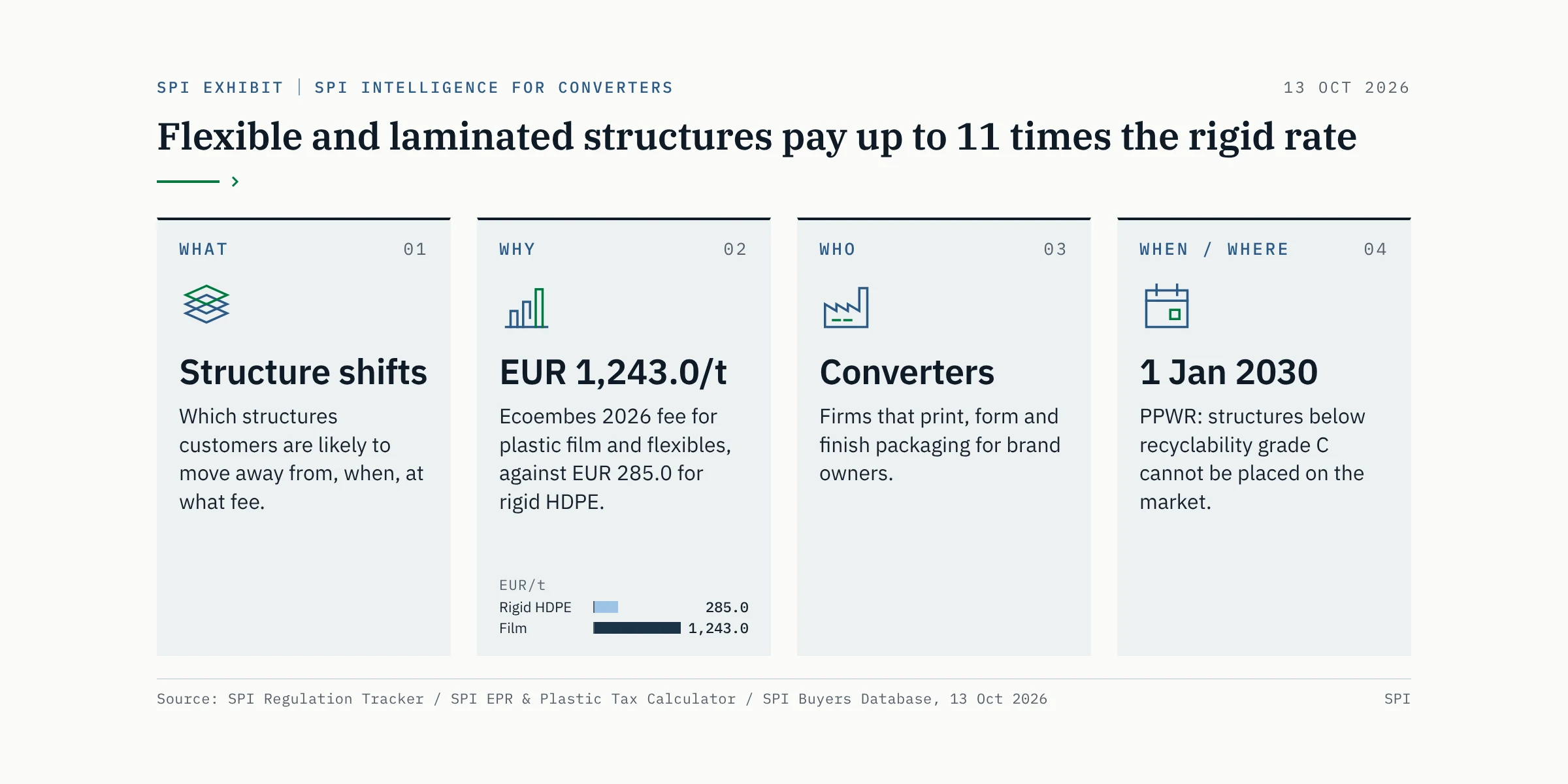
- Ecoembes charges EUR 1,243.0 per tonne for plastic film and flexibles in 2026, against EUR 285.0 for rigid HDPE (calculator rows FEE-ES-109 and FEE-ES-107).
- India’s multilayer (Category III) plastic packaging needs 5% recycled plastic in 2026-27 and 10% from 2027-28, counted on the plastic layers (PR-IN-002, G.S.R. 237(E) of 31 March 2026).
What is changing for converters
Design for recycling and format restrictions
Design for recycling means designing packaging so it can be collected, sorted and recycled in practice. The PPWR turns it into a market condition.
- Recyclability by 2030. Packaging placed on the EU market must be recyclable in an economically viable way by 2030, assessed against design-for-recycling criteria and graded A, B or C. Packaging below grade C is treated as non-recyclable, it must also be recycled at scale from 2035, and grade B becomes the minimum from 2038 (PR-EU-010). The delegated acts that set the criteria for each format were not adopted at 13 October 2026.
- Annex V formats. From 1 January 2030, Article 25 and Annex V bar specified single-use formats, mostly plastic: grouped packaging films, packaging for pre-packed fresh fruit and vegetables under 1.5 kg, food and drink filled and consumed on hospitality premises, single-portion condiments and sauces in hospitality, single-use hotel toiletries and very lightweight plastic carrier bags (PR-EU-008). Member States may set some exemptions, and Commission guidelines on Annex V are listed as due by 12 February 2027.
- Tethered caps. Tethered caps are caps and lids that stay attached to the container during use. Since 3 July 2024 they are required on EU single-use beverage containers up to three litres, including composite beverage packaging; glass and metal containers with plastic caps are outside the rule, and metal caps with plastic seals do not count as plastic (PR-EU-015).
- PFAS. Since 12 August 2026, EU food-contact packaging may not contain per- and polyfluoroalkyl substances at or above the PPWR limit values (PR-EU-002). Paper, board and moulded-fibre grades that used fluorinated barriers are most affected, and the Commission is due to review the restriction by 12 February 2030. Oregon has banned foodware containers with intentionally added PFAS since 1 January 2025 (PR-US-013).
- British Columbia. Food service ware made of polystyrene foam, PVC, PVDC, biodegradable or oxo-degradable plastic has been barred since 15 July 2024, and compostable plastic take-out containers are also banned; paper and plant-fibre take-out containers remain allowed. PVC film wrap is exempt until 1 July 2028 and foam meat trays until 1 July 2030 (PR-CA-005).
| Annex V format (PR-EU-008) | Converter segments most affected | Note |
|---|---|---|
| Single-use plastic grouped packaging films | Shrink and stretch film, collation film | For grouping items sold together |
| Single-use plastic packaging for pre-packed fresh fruit and vegetables under 1.5 kg | Nets, punnets, trays, flow-wrap | Member States may exempt where water loss or contamination is a concern |
| Single-use plastic packaging for food and drink filled and consumed on hospitality premises | Foodservice cups, trays, containers | Dine-in use only |
| Single-portion condiments, sauces and similar in hospitality | Sachets, portion pots | Hospitality only |
| Single-use hotel toiletry packaging for individual bookings | Small bottles, sachets | Entry not limited to plastic |
| Very lightweight plastic carrier bags | Bag converters | Exceptions for hygiene and loose moist foods |
Source: EUR-Lex, Regulation (EU) 2025/40, Article 25 and Annex V; SPI Regulation Tracker PR-EU-008, checked 14 Oct 2026.
Empty space and reuse
From 2030, operators that fill grouped, transport or e-commerce packaging in the EU must keep the empty space ratio at or below 50%; reusable packaging is excluded, and the measuring method is an implementing act due by 12 February 2028 (PR-EU-009). The PPWR also sets 2030 reuse targets of 40% for transport packaging, including sales packaging used for transport, and 10% for grouped packaging (PR-EU-006). Corrugated and transit packaging converters will see box ranges change and some single-use volume move to reusable pools.
Labelling
- EU harmonised label. The PPWR material-composition sorting label applies from 12 August 2028 or 24 months after the Commission implementing acts on label specifications enter into force, whichever is later (Article 12(1), per Commission Notice C/2026/3084). The labelling act was still being prepared in October 2026 (PR-EU-003). Transport packaging other than e-commerce packaging does not need the symbols.
- France. The Triman logo with Info-tri sorting instructions has been required on household packaging since a phased roll-out from summer 2022; mandatory dates vary by sector (PR-FR-003).
- California. SB 343 limits the chasing-arrows symbol and “recyclable” claims to materials meeting statutory criteria, such as collection by programmes serving at least 60% of the population, for products and packaging made after 4 October 2026. On 14 July 2026 a federal court issued a preliminary injunction in California League of Food Producers v. Bonta blocking enforcement (PR-US-011).
- UK deposit return. Drinks containers in the England, Northern Ireland and Scotland schemes from 1 October 2027 must carry the scheme logo and return code (PR-GB-004, PR-GB-005).
SPI analysis
Labelling timing is uncertain on both sides of the Atlantic: the EU label date depends on a pending act and SB 343 is enjoined. Printers should plan artwork capacity as a range, and help customers combine the French Info-tri retirement with the EU label in one redesign cycle where possible, without promising dates that may move.
Recycled content and plastic taxes
- EU. The PPWR sets minimum post-consumer recycled content in plastic packaging from 1 January 2030, including 30% for single-use plastic beverage bottles; other categories have their own percentages (PR-EU-004). The calculation and verification method is an implementing act listed as due by 31 December 2026.
- India. G.S.R. 237(E) of 31 March 2026 restates the category-wise recycled plastic content first set in Schedule II in 2022 (PR-IN-002). Category III (multilayer) is counted on its plastic layers only, and recycled packaging must meet IS 14534:2023.
- UK. The Plastic Packaging Tax applies to components with less than 30% recycled plastic, at £228.82 per tonne from 1 April 2026 (PR-GB-001). Converters that make or import finished components are the taxpayers; from 1 April 2027 pre-consumer plastic no longer counts towards the 30%.
LowerHigher(shade by fifths of all values in the table)
| Year | Category I (rigid) | Category II (flexible) | Category III (multilayer) |
|---|---|---|---|
| 2025-26 | 30 | 10 | 5 |
| 2026-27 | 40 | 10 | 5 |
| 2027-28 | 50 | 20 | 10 |
| 2028-29 onwards | 60 | 20 | 10 |
Source: MoEFCC Gazette G.S.R. 237(E), 31 March 2026, via SPI Regulation Tracker PR-IN-002, checked 14 Oct 2026.
Category names per Schedule II of the Plastic Waste Management Rules; Category III counted on plastic layers.
SPI analysis
India is moving faster on recycled content than many converters expect. Dabur India reports 2%, 6% and 1% recycled content in Category I, II and III non-food packaging for FY 2025-26, against its own 30%, 10% and 5% target. Converters that can supply IS 14534:2023 recycled material in rigid and flexible structures are answering a legal requirement, not a preference.
EPR fees by format
Extended producer responsibility (EPR) makes producers pay for the collection and recycling of their packaging, through fees collected by a producer responsibility organisation (PRO). Eco-modulation varies those fees by recyclability or design, through fee bands, bonuses or maluses. Your customers pay the fees, but your structures set the fee line.
| Scheme, 2026 | Rigid line | Flexible or complex line |
|---|---|---|
| France, Citeo (EUR/tonne) | PE bottle 770.1; rigid PET 840.1 | PE flexible 770.1; PP flexible 840.1; complex 1,400.1 |
| Spain, Ecoembes (EUR/tonne) | HDPE rigid body 285.0 | Film and flexibles 1,243.0 |
| Belgium, Fost Plus (EUR/kg) | Rigid PE 0.8019; rigid PP 1.0161 | PE films 1.0804; PP films 2.2095; aluminium laminates 4.419 |
| British Columbia, Recycle BC (CAD/kg) | HDPE bottles 0.47 | Plastic film 1.84; laminates 1.84 |
| Oregon, CAA (USD/tonne) | HDPE natural bottles 198.42 | PE film (PRO list) 947.99; laminates 2,248.72 |
Board and carton lines split in the same way. Oregon charges USD 1,058.22 per tonne for polycoated paperboard against USD 176.37 for paperboard, six times as much; Colorado’s CAA charges USD 440.92 against 176.37. Ecoembes charges EUR 533.0 per tonne for beverage and food cartons against EUR 115.0 for paper and board, and Fost Plus EUR 0.808 per kg for beverage cartons against 0.1503 for paper-cardboard. Repak in Ireland charges recycled rigid and flexible plastic the same EUR 165.7 per tonne. In the UK, PackUK’s illustrative 2026-27 plastic fees are £415, £455 and £545 per tonne for green, amber and red ratings, and fibre-based composite £475, £525 and £630 (PR-GB-003); confirmed fees are due by the end of November 2026. Our EPR fees per tonne article compares the tables in more detail.
SPI analysis
Carton and board converters face the same question as film converters. Polycoated board carries a higher fee line than plain board in every scheme above, and PFAS limits (PR-EU-002) remove one barrier option, so coatings and barriers are worth reviewing together rather than one at a time.
Key dates for converters
- EU
- Canada
- United States
- United Kingdom
- Tethered caps on beverage containers up to 3 litresEU
- Foam, PVC, PVDC and degradable plastic food service ware barredCanada
- Oregon PFAS and polystyrene foam foodware banUnited States
- PPWR applies; PFAS limits in food-contact packagingEU
- SB 343 compliance date (enforcement enjoined)United States
- Recycled-content calculation act dueEU
- Annex V guidelines dueEU
- UK deposit return logo and return code on drinks containersUnited Kingdom
- Empty space methodology dueEU
- B.C. PVC film wrap exemption endsCanada
- Harmonised material-composition label, at the earliestEU
- Recyclability, recycled content, Annex V, empty space and reuse rulesEU
- B.C. foam meat tray exemption endsCanada
- 2038Recyclability grade B becomes the minimumEU
Source: SPI Regulation Tracker and SPI rule notes, checked 14 Oct 2026.
Includes Commission act deadlines taken from SPI rule notes.
Show the data
| Date | Label | Category | Link |
|---|---|---|---|
| 2024-07-03 | Tethered caps on beverage containers up to 3 litres | EU | /data/packaging-regulation-tracker/european-union/ |
| 2024-07-15 | Foam, PVC, PVDC and degradable plastic food service ware barred | Canada | /data/packaging-regulation-tracker/canada/ |
| 2025-01-01 | Oregon PFAS and polystyrene foam foodware ban | United States | /data/packaging-regulation-tracker/united-states/ |
| 2026-08-12 | PPWR applies; PFAS limits in food-contact packaging | EU | /data/packaging-regulation-tracker/european-union/ |
| 2026-10-04 | SB 343 compliance date (enforcement enjoined) | United States | /data/packaging-regulation-tracker/united-states/ |
| 2026-12-31 | Recycled-content calculation act due | EU | /data/packaging-regulation-tracker/european-union/ |
| 2027-02-12 | Annex V guidelines due | EU | /data/packaging-regulation-tracker/european-union/ |
| 2027-10-01 | UK deposit return logo and return code on drinks containers | United Kingdom | /data/packaging-regulation-tracker/united-kingdom/ |
| 2028-02-12 | Empty space methodology due | EU | /data/packaging-regulation-tracker/european-union/ |
| 2028-07-01 | B.C. PVC film wrap exemption ends | Canada | /data/packaging-regulation-tracker/canada/ |
| 2028-08-12 | Harmonised material-composition label, at the earliest | EU | /data/packaging-regulation-tracker/european-union/ |
| 2030-01-01 | Recyclability, recycled content, Annex V, empty space and reuse rules | EU | /data/packaging-regulation-tracker/european-union/ |
| 2030-07-01 | B.C. foam meat tray exemption ends | Canada | /data/packaging-regulation-tracker/canada/ |
| 2038 | Recyclability grade B becomes the minimum | EU | /data/packaging-regulation-tracker/european-union/ |
| Date | Rule | What it means for converters |
|---|---|---|
| 12 February 2027 | Annex V guidelines (PR-EU-008) | Clarifies which film, tray and sachet uses end in 2030 |
| 1 October 2027 | UK deposit return (PR-GB-004, PR-GB-005) | New artwork for PET, steel and aluminium drinks containers |
| 12 August 2028 at the earliest | EU harmonised label (PR-EU-003) | EU-wide artwork change; 24 months after the act if later |
| 1 January 2030 | PPWR recyclability and formats (PR-EU-008, PR-EU-010) | Structures below grade C cannot be placed on the market |
What your customers have committed to
The SPI Buyers Database holds 179 public targets from 42 brand owners and retailers, many of them on recyclability. Definitions differ: some report all packaging, some plastic only, some own-brand only.
- Unilever targets 100% of plastic packaging reusable, recyclable or compostable by 2030 for rigids and 2035 for flexibles, and reports 57% overall in 2025. It is the only company in the database that splits rigid and flexible figures.
- Mars, a large user of flexible packaging, reports 67.6% of consumer-facing packaging designed to be reusable, recyclable or compostable and 9.2% recycled content in its plastic portfolio in 2025.
- Mondelēz International reports an 8.4% cut in rigid virgin plastic against a 25% target for 2030, and 3.7% recycled plastic content against 5%.
- Walmart, Carrefour, Colgate-Palmolive and Tesco missed 100% recyclability targets for 2025. Target and Ahold Delhaize report large gaps; Lidl says it reached the maximum possible level at 67%.
SPI analysis
Flexible packaging is where customer targets and fee lines meet. Unilever reports 15% of flexibles recyclable against 75% of rigids, and most fee schemes charge film and laminates several times the rigid rate. We expect requests for mono-material flexible structures to keep growing ahead of the 2030 PPWR date. Customers that missed 2025 targets have a public reason to review formats, and a costed redesign that shows the fee difference is easier for them to approve.
Questions you ask, and where SPI answers them
Which customers have public recyclability or recycled-content targets? Search the SPI Buyers Database. It shows target, year, progress and source, not specifications or volumes.
Which design rules apply to my formats in the EU? Filter the SPI Regulation Tracker by type “design rule” and by material. It does not assess whether a structure passes design-for-recycling criteria.
When does labelling artwork have to change? Filter by type “labelling” and check the upcoming-deadlines table, which records conditional dates such as PR-EU-003.
How much more does a laminate cost in EPR fees than a mono-material film? Enter tonnages by line in the SPI EPR & Plastic Tax Calculator. It applies published per-tonne or per-kilogram rates, without eco-modulation bonuses or per-unit charges.
Which formats does the PPWR restrict from 2030? Read PPWR 2030 format restrictions, which covers the adopted text, not national exemptions.
How SPI builds this
Each of the 79 rules in 25 jurisdictions carries its official source, dates, status and last-checked date, and its own page with an SPI note on scope, actions and open points. On 13 October 2026 the SPI team re-read 56 tracker records against their official sources and updated 46. Customer targets are taken from each company’s own report. Fee ratios on this page are SPI calculations from the 216 published rate rows in the calculator. See the SPI Methodology.
| Stage | Converter question | SPI tool | Next step if needed |
|---|---|---|---|
| Discover | Which customers and prospects have targets? | SPI Buyers Database | Market & Competitive Intelligence |
| Understand | Which design and labelling rules apply by market? | SPI Regulation Tracker | Regulatory monitoring |
| Evaluate | What do fee bands mean for my formats? | SPI EPR & Plastic Tax Calculator | Sustainable Packaging Strategy |
| Decide | Which formats or segments to prioritise? | SPI Briefing | Strategy & Growth |
| Implement | Plan the redesign or capacity change | Sprint or Programme | Custom research |
Limitations and what SPI does not do
The tracker’s 79 rules are not every packaging rule in those markets. The Buyers Database covers 42 large brand owners and retailers, using reports SPI does not audit, and holds no contacts, purchase volumes, supplier relationships or specifications. The calculator covers 14 markets; UK fees are illustrative, and Germany and Ontario are not included because no public fee table exists. SPI does not give legal advice, test or certify packaging, carry out recyclability lab tests or LCA certification, or make regulatory filings. Where you need these, we can point you to a qualified provider. See our corrections log.
When you need more than the data
The SPI Trackers stay free. Three SPI Consulting services fit converters:
- Packaging Market & Competitive Intelligence: competitor profiles from public information, benchmark tables, demand-driver analysis and a geography ranking.
- Sustainable Packaging Strategy: an options matrix with recyclability evidence and regulatory fit, a peer benchmark of public commitments and a redesign roadmap. Recyclability review is desk-based, not a lab test.
- Packaging Strategy & Growth: a scored opportunity map, growth options with benefits and risks, and a 12 to 24 month go-to-market plan.
Formats are Briefing, Sprint, Programme and Retainer; pricing is on request. To discuss a project, send an enquiry. Related: SPI Intelligence for Packaging Manufacturers and SPI Intelligence for Brand Owners and Packaging Buyers.
Frequently asked questions
What are tethered caps and when did they become mandatory?
Tethered caps stay attached to the container during use. Since 3 July 2024, single-use plastic beverage containers up to three litres in the EU, including composite beverage cartons, may only be placed on the market with tethered plastic caps and lids (PR-EU-015). Glass and metal containers with plastic caps are outside the rule.
Is California SB 343 being enforced?
No. SB 343 applies to products and packaging made after 4 October 2026, but a federal court issued a preliminary injunction on 14 July 2026 blocking enforcement (PR-US-011). CalRecycle says its study obligations continue, so keep claim evidence and alternative artwork ready.
When does the EU harmonised sorting label apply?
From 12 August 2028, or 24 months after the Commission implementing acts on label specifications enter into force, whichever is later (PR-EU-003). The labelling act was still being prepared in October 2026.
What are the PPWR requirements for recyclability?
From 2030, packaging on the EU market must be recyclable in an economically viable way, graded A, B or C against design-for-recycling criteria; below grade C it is treated as non-recyclable (PR-EU-010). It must be recycled at scale from 2035, and grade B is the minimum from 2038.
Do flexible plastics cost more in EPR fees than rigid plastics?
In most schemes in the SPI calculator, yes. Ecoembes charges EUR 1,243.0 per tonne for film and flexibles against EUR 285.0 for rigid HDPE, and Oregon’s CAA charges USD 2,248.72 per tonne for laminates against USD 198.42 for natural HDPE bottles. Repak, Sociedade Ponto Verde and Citeo’s PE film line charge the same as the rigid line.
Which single-use plastic packaging does the EU ban from 2030?
Annex V of the PPWR lists grouped packaging films, packaging for pre-packed fresh produce under 1.5 kg, dine-in hospitality packaging, single-portion condiments, hotel toiletries and very lightweight carrier bags (PR-EU-008). Earlier bans on plastic cutlery, plates, straws and EPS food containers have applied since 3 July 2021 (PR-EU-014).
What are India's recycled-content categories?
Category I (rigid) packaging needs 30% recycled plastic in 2025-26 rising to 60% from 2028-29, Category II (flexible) 10% to 20%, and Category III (multilayer) 5% to 10% (PR-IN-002). See the India country page.
Sources
- European Parliament Legislative Observatory, Regulation (EU) 2025/40 summary. https://oeil.europarl.europa.eu/oeil/en/document-summary?id=1802233 (checked 13 October 2026)
- EUR-Lex, Regulation (EU) 2025/40, Article 25 and Annex V. https://eur-lex.europa.eu/eli/reg/2025/40/oj/eng (checked 13 October 2026)
- EUR-Lex, Commission Notice C/2026/3084, guidance document for Regulation (EU) 2025/40. https://eur-lex.europa.eu/legal-content/EN/TXT/PDF/?uri=CELEX:52026XC03084 (checked 13 October 2026)
- European Commission (DG ENV), Packaging waste. https://environment.ec.europa.eu/topics/waste-and-recycling/packaging-waste_en (checked 13 October 2026)
- European Commission Green Forum, PPWR implementation timeline. https://green-forum.ec.europa.eu/packaging-and-packaging-waste-regulation-implementation_en (checked 13 October 2026)
- EUR-Lex, Directive (EU) 2019/904. https://eur-lex.europa.eu/legal-content/EN/TXT/HTML/?uri=CELEX:32019L0904 (checked 13 October 2026)
- French Ministry of Ecological Transition, Info-tri. https://www.ecologie.gouv.fr/info-tri (checked 13 October 2026)
- CalRecycle, SB 343 accurate recycling labels. https://calrecycle.ca.gov/wcs/recyclinglabels/ (checked 13 October 2026)
- Oregon DEQ, Foodware containers and polystyrene foam. https://www.oregon.gov/deq/mm/production/pages/polystyrene.aspx (checked 13 October 2026)
- GOV.UK, Plastic Packaging Tax: steps to take. https://www.gov.uk/guidance/check-if-you-need-to-register-for-plastic-packaging-tax (checked 13 October 2026)
- GOV.UK (PackUK), Year 2 illustrative waste disposal fees (updated 19 December 2025). https://www.gov.uk/government/publications/illustrative-waste-disposal-fees-2026-extended-producer-responsibility-for-packaging/year-2-illustrative-waste-disposal-fees-extended-producer-responsibility-for-packaging (checked 13 October 2026)
- legislation.gov.uk, SI 2025/67 and SSI 2025/188. https://www.legislation.gov.uk/uksi/2025/67/made ; https://www.legislation.gov.uk/ssi/2025/188/made (checked 13 October 2026)
- MoEFCC Gazette G.S.R. 237(E), 31 March 2026. https://www.mpcb.gov.in/sites/default/files/standing_orders/Plastic_Waste_Management_2026.pdf (checked 13 October 2026)
- B.C. Government, food service ware regulation factsheet. https://www2.gov.bc.ca/assets/gov/environment/waste-management/recycling/recycle/food_service_ware_regulation_factsheet.pdf (checked 13 October 2026)
- Citeo, Guide du tarif des emballages ménagers 2026. https://clients-cms.citeo.com/uploads/guide_du_tarif_des_emballages_menagers_2026_f9e4c5b4e6.pdf
- Ecoembes, Precios 2026. https://ecoembesempresas.com/app/uploads/2025/06/Ecoembes_Precios2026.pdf
- Fost Plus, Green Dot tariffs 2026. https://www.fostplus.be/en/media/1930/download
- Repak, Regular Member 2026 Fees. https://repak.ie/images/uploads/downloads/Repak_Regular_Member_2026_Fees_Sheet.pdf
- Recycle BC, 2026 Fee Schedule. https://recyclebc.ca/wp-content/uploads/2025/10/Recycle-BC-2026-Fee-Schedule.pdf
- Circular Action Alliance, Oregon 2026 Fee Schedule. https://static1.squarespace.com/static/64260ed078c36925b1cf3385/t/693b2c9103be112d168e1b19/1765485713621/OR+2026+Fee+Schedule+Public.pdf
- Circular Action Alliance, Colorado 2026 Dues Schedule. https://static1.squarespace.com/static/64260ed078c36925b1cf3385/t/693b45923163e42ba98d634f/1765492118120/CO+2026+Dues+Schedule+Public.pdf
- Valorlux, Verpact and Sociedade Ponto Verde 2026 tariffs, as linked from the SPI EPR & Plastic Tax Calculator (rows checked 13 October 2026).
- Company reports for each buyer, linked from its profile in the SPI Buyers Database (rechecked 13 October 2026).
Ask the SPI team
What changes for your packaging next quarter?
Tell us your markets and materials. The SPI team walks you through the rules and buyer commitments that affect them.
Prefer email? Write to sales@strategicpackaginginsights.com.
- Q1
Which packaging rules apply to us in each market we sell in?
We map each market's EPR, tax, ban, recycled-content, labelling and deposit rules against your materials and formats, and show which are in force, adopted or only proposed.
- Q2
What could EPR fees and plastic taxes cost us next year?
We apply published fee tables and tax rates to your tonnages and recycled content, and show the result as scenarios with every rate sourced.
- Q3
Can you tell us when a rule changes?
Yes. The free tracker alerts cover rule changes by country; a monitoring retainer adds monthly notes on what the changes mean for your portfolio.