
SPI Trackers: Packaging Regulation, Brand Target and EPR Fee Data
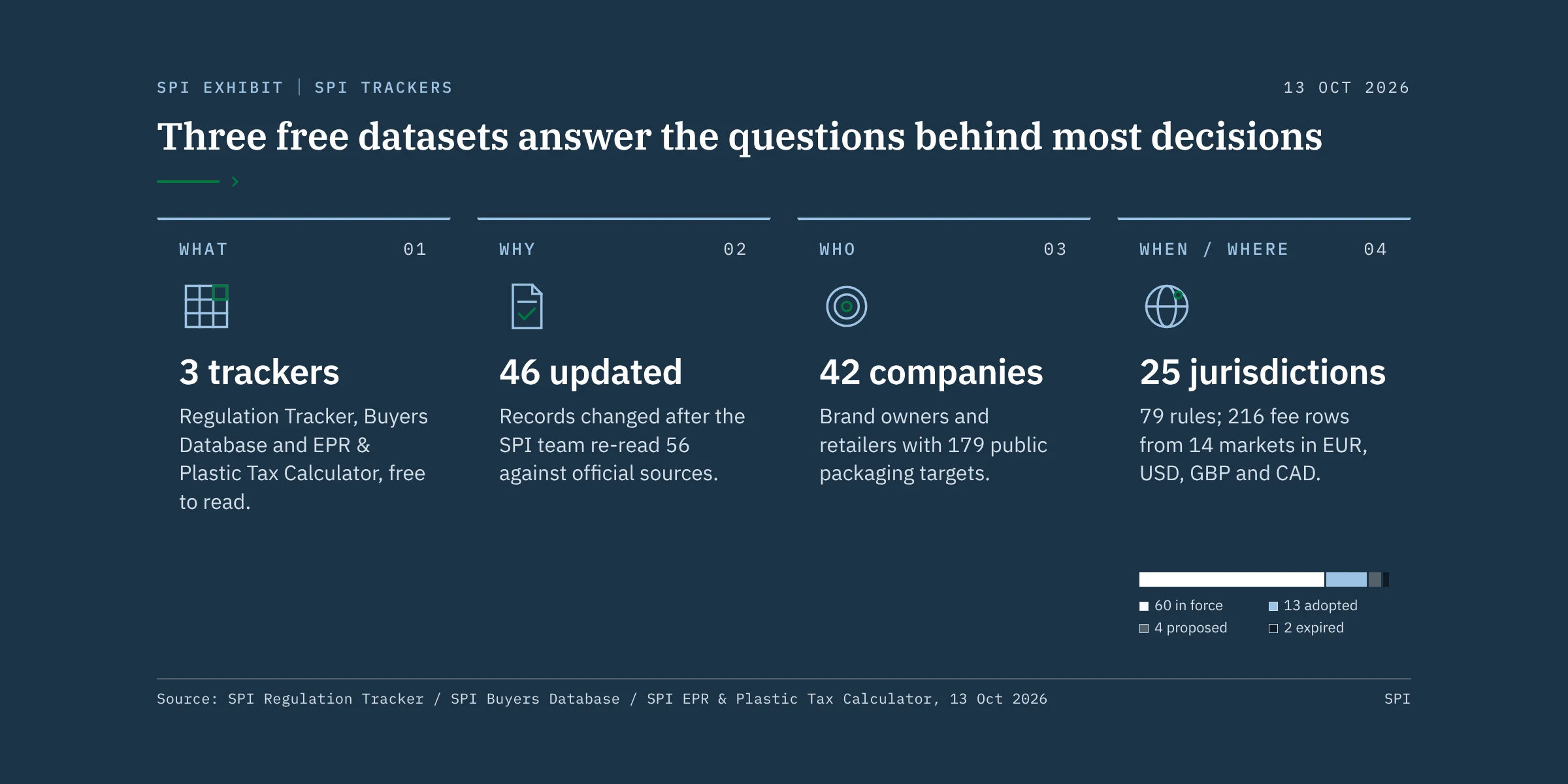
The SPI Trackers are three free, sourced packaging datasets from Strategic Packaging Insights (SPI): the SPI Regulation Tracker of packaging rules by country, the SPI Buyers Database of brand owner packaging targets, and the SPI EPR & Plastic Tax Calculator of published fee and tax rates.
Together they answer the three questions behind most packaging decisions: which rules apply and when, what the largest buyers have promised, and what producer responsibility will cost. Every row names its original source and the date that source was consulted, and on 13 October 2026 the SPI team re-read 56 tracker records against their official sources and updated 46.
By the SPI team · Figures as of 13 October 2026
79
Packaging rules tracked
in 25 jurisdictions, each with its official source
SPI Regulation Tracker, 13 Oct 2026
42
Brand owners and retailers
with 179 public packaging targets
SPI Buyers Database, 13 Oct 2026
216
Published EPR fee and plastic tax rates
from 14 markets, in each scheme's own currency
SPI EPR & Plastic Tax Calculator, 13 Oct 2026
1 October 2027
Next rule start date
drinks deposit return in England, Northern Ireland and Scotland (PR-GB-004, PR-GB-005)
SPI Regulation Tracker
Source: SPI Trackers, checked 13 Oct 2026.
Key facts
- The SPI Regulation Tracker holds 79 packaging rules in 25 jurisdictions: 60 in force, 13 adopted, 4 proposed and 2 expired (SPI Regulation Tracker, 13 October 2026).
- Extended producer responsibility (EPR) is the largest rule type, with 25 rules, followed by 17 bans and 7 deposit return rules (SPI Regulation Tracker, 13 October 2026).
- The SPI Buyers Database records 179 public packaging targets from 42 brand owners and retailers; of the targets due by 2025, 16 are reported met and 19 missed (SPI Buyers Database, 13 October 2026).
- The SPI EPR & Plastic Tax Calculator holds 216 published rate rows from 14 markets, in EUR, USD, GBP and CAD, and never converts between currencies (SPI EPR & Plastic Tax Calculator, 13 October 2026).
- Regulation (EU) 2025/40, the Packaging and Packaging Waste Regulation (PPWR), has generally applied since 12 August 2026, and five of its obligations start on 1 January 2030 (PR-EU-001, PR-EU-004, PR-EU-006, PR-EU-008, PR-EU-009, PR-EU-010; tracker sources checked 13 October 2026).
- UK PackUK Year 2 (2026-27) fees for plastic are GBP 415, 455 or 545 per tonne depending on recyclability rating, and are illustrative until confirmed (PR-GB-003; GOV.UK, checked 13 October 2026).
- All three SPI Trackers are free to read, and the tracker and database export to CSV (SPI Trackers, 13 October 2026).
The three SPI Trackers at a glance
| SPI Regulation Tracker | SPI Buyers Database | SPI EPR & Plastic Tax Calculator | |
|---|---|---|---|
| Question it answers | Which packaging rules apply, where and from when? | What have the largest buyers of packaging promised, and how far have they got? | What will EPR fees and plastic taxes cost at published rates? |
| What it holds | 79 rules in 25 jurisdictions | 179 targets from 42 brand owners and retailers | 216 rate rows from 14 markets |
| Unit of data | One rule: an obligation with its own dates | One public packaging target | One published rate for one material line |
| Source type | Official journals, legislatures, regulators, scheme bodies | The company's own reports, filings and websites | The scheme's or government's own fee table |
| Each row shows | Type, status, materials, dates, rate or target, quote, consulted date, SPI note | Wording, deadline, latest reported progress, status, quote, consulted date | Rate and unit as published, year, illustrative flag, quoted line, consulted date |
| Filters | Search, type, material, status, jurisdiction, enacted or proposed, checking | Search, end use, material, target type, headquarters country | Market, material, fee category |
| Output | Rule and jurisdiction pages, CSV export, weekly e-mail alerts | Company profiles, CSV export | Line-by-line estimate in the scheme's own currency |
| Stage in the SPI model | Understand | Discover | Evaluate |
| Link | /data/packaging-regulation-tracker/ | /data/packaging-buyers-database/ | /data/epr-plastic-tax-calculator/ |
Source: SPI Trackers, checked 13 Oct 2026.
SPI Regulation Tracker: packaging laws by country
The SPI Regulation Tracker records packaging rules made by public authorities: laws, regulations, decrees and the official schemes under them. A rule is one obligation, or a closely linked set, with its own dates, so a large law can appear as several rows. The PPWR, for example, is tracked obligation by obligation, from PFAS limits in food-contact packaging (PR-EU-002) to the 2030 format restrictions in Annex V (PR-EU-008).
What kinds of rule it covers
- EPR (extended producer responsibility) makes the company that places packaging on a market pay for its collection and recycling, usually through a producer responsibility organisation (PRO): 25 rules, from Germany’s VerpackDG (PR-DE-001) to California SB 54 (PR-US-004) and Vietnam’s Decree 110/2026/ND-CP (PR-VN-001).
- Bans remove formats or materials from sale: 17 rules, including the EU ban on single-use plastic cutlery, plates, straws and EPS food containers since 3 July 2021 (PR-EU-014).
- Deposit return schemes charge a refundable deposit on drinks containers: 7 rules, from Ireland and Portugal to the UK schemes starting on 1 October 2027.
- Design rules (6) and recycled content rules (6) set requirements on the pack itself, such as the PPWR 50% maximum empty space (PR-EU-009) and 30% recycled content in single-use plastic beverage bottles from 2030 (PR-EU-004).
- Taxes (4), labelling (3), reuse (3), plans (4), reporting (1) and other (3) complete the set.
Statuses: what applies now and what is coming
Each rule carries a status set from the official record. In force means the obligation applies now; adopted means it is law but starts later or cannot yet be enforced; proposed means it is not yet law; expired means repealed or past its date. On 13 October 2026 the tracker held 60 rules in force, 13 adopted and 4 proposed. Status definitions are on the SPI Methodology page.
The adopted rules are where planning pays off, because their dates have not yet arrived. Most of them cluster between late 2027 and 1 January 2030.
- United States
- United Kingdom
- India
- EU
- California SB 343 label date; enforcement enjoined since 14 July 2026 (PR-US-011)United States
- PackUK Year 2 fee calculation expected; confirmed fees not yet published (PR-GB-003)United Kingdom
- Drinks deposit return starts in England, Northern Ireland and Scotland (PR-GB-004, PR-GB-005)United Kingdom
- 2028India: 60% recycled content for Category I rigid plastic packaging from 2028-29 (PR-IN-002)India
- PPWR harmonised sorting label, or later if the implementing act is late (PR-EU-003)EU
- PPWR 90% separate collection of single-use plastic bottles and metal cans up to 3 litres (PR-EU-007)EU
- Washington: producers outside a PRO in good standing may not sell covered materials (PR-US-008)United States
- PPWR recyclability, recycled content, reuse, empty space and Annex V format restrictions (PR-EU-004, PR-EU-006, PR-EU-008, PR-EU-009, PR-EU-010)EU
- California recycled content in plastic beverage containers rises to 50% (PR-US-009)United States
Source: SPI Regulation Tracker and SPI rule notes, checked 13 Oct 2026.
Includes staged milestones from SPI rule notes; each rule page cites its official source.
Show the data
| Date | Label | Category | Link |
|---|---|---|---|
| 2026-10-04 | California SB 343 label date; enforcement enjoined since 14 July 2026 (PR-US-011) | United States | /data/packaging-regulation-tracker/united-states/ |
| 2026-11 | PackUK Year 2 fee calculation expected; confirmed fees not yet published (PR-GB-003) | United Kingdom | /data/packaging-regulation-tracker/united-kingdom/ |
| 2027-10-01 | Drinks deposit return starts in England, Northern Ireland and Scotland (PR-GB-004, PR-GB-005) | United Kingdom | /data/packaging-regulation-tracker/united-kingdom/ |
| 2028 | India: 60% recycled content for Category I rigid plastic packaging from 2028-29 (PR-IN-002) | India | /data/packaging-regulation-tracker/india/ |
| 2028-08-12 | PPWR harmonised sorting label, or later if the implementing act is late (PR-EU-003) | EU | /data/packaging-regulation-tracker/european-union/ |
| 2029-01-01 | PPWR 90% separate collection of single-use plastic bottles and metal cans up to 3 litres (PR-EU-007) | EU | /data/packaging-regulation-tracker/european-union/ |
| 2029-03-01 | Washington: producers outside a PRO in good standing may not sell covered materials (PR-US-008) | United States | /data/packaging-regulation-tracker/united-states/ |
| 2030-01-01 | PPWR recyclability, recycled content, reuse, empty space and Annex V format restrictions (PR-EU-004, PR-EU-006, PR-EU-008, PR-EU-009, PR-EU-010) | EU | /data/packaging-regulation-tracker/european-union/ |
| 2030-01-01 | California recycled content in plastic beverage containers rises to 50% (PR-US-009) | United States | /data/packaging-regulation-tracker/united-states/ |
How to use it
Filter by search term, type, material, status, jurisdiction, enacted or proposed, and checking (Verified or Sourced). Each jurisdiction has its own page, such as European Union, United States, United Kingdom and India. Each rule has its own page with an SPI note covering what it means in practice, who is in scope, what to do by when, related rules and open questions. Any filtered view downloads as CSV, and free e-mail alerts send at most one message a week, only when a rule in your chosen jurisdictions is added or changed.
SPI Buyers Database: brand owner packaging commitments
The SPI Buyers Database records the public packaging targets of 42 brand owners and retailers, 179 targets in all. A packaging target is a public commitment the company has published in its own report, filing, website or press release, recorded in the company’s wording. Most targets concern recyclability, recycled content, virgin plastic reduction and reuse; the rest cover weight reduction, deforestation-free paper and other goals.
Each target shows its deadline, the latest progress the company reports with its year, and a status: met, missed, in progress or not reported. SPI marks a target met or missed only on the company’s own reported figures. Across all 179 targets, 20 are reported met, 19 missed and 46 not yet reported (SPI Buyers Database, 13 October 2026). Detail matters: Unilever reports 57% of its plastic packaging reusable, recyclable or compostable in 2025, made up of 75% of rigids and only 15% of flexibles (Unilever Annual Report and Accounts 2025, as given in the database).
Each company has a profile at /data/packaging-buyers-database//, and the enriched layout first built for the Colgate-Palmolive profile adds company facts from filings, formats and materials, and two blocks of SPI analysis on regulatory exposure and supplier implications. The database holds no contacts, purchase volumes, suppliers or pack specifications: it is a register of public commitments, not a lead list.
SPI analysis
For converters and material suppliers, a brand that missed a recycled-content or recyclability target in 2025 and has since set a 2030 target is a buyer still looking for a route to meet it. Filtering the database by end use and target type turns that into a list a sales team can read source by source.
SPI EPR & Plastic Tax Calculator: what packaging costs
The SPI EPR & Plastic Tax Calculator multiplies the tonnes of packaging you place on a market, by material, by each scheme’s own published rate, and adds the UK, Isle of Man or Spanish plastic packaging tax where it applies. EPR fees go to a compliance scheme to fund collection and recycling; a plastic packaging tax is a government levy on the plastic itself, usually tied to recycled content. In the UK and Spain the same pack can owe both.
The 14 markets are Austria (ARA), Belgium (Fost Plus), British Columbia (Recycle BC), Colorado and Oregon (Circular Action Alliance), France (Citeo), Ireland (Repak), Italy (CONAI), Luxembourg (Valorlux), the Netherlands (Verpact), Portugal (Sociedade Ponto Verde), Spain (Ecoembes and the plastic tax), the United Kingdom (PackUK and the Plastic Packaging Tax) and the Isle of Man (Plastic Packaging Tax).
Rates are only compared inside one currency. Across the nine euro schemes, plastic lines run from EUR 51 per tonne (CONAI’s lowest band from 1 October 2026) to EUR 4,419 per tonne (Fost Plus’s line for other plastics, including aluminium laminates and PVC). In the United States, Circular Action Alliance charges USD 551.16 per tonne for clear PET bottles in Oregon and USD 330.69 in Colorado in 2026. In the UK, illustrative PackUK plastic fees run from GBP 415 to GBP 545 per tonne by recyclability rating, and the Plastic Packaging Tax is GBP 228.82 per tonne from 1 April 2026 on components with less than 30% recycled plastic (PR-GB-001, PR-GB-003).
Two gaps are stated rather than filled: Germany and Ontario are not included, because neither publishes a public fee table. The figures you enter are not stored, and results are estimates at published rates, not a statement of what you owe.
SPI analysis
Inside plastic, format moves the fee more than material does. Rigid mono-material packs sit in the lower bands of most schemes, and films, laminates and foamed plastics in the top ones, so the useful question is which of your formats sit in the top band and what moving them would cost. The Insights article on EPR fees per tonne in 2026 sets four schemes side by side.
Which SPI Tracker answers your question
| If your question is | Start with | Then |
|---|---|---|
| Does a packaging law apply in this market, and from when? | SPI Regulation Tracker, jurisdiction page | The rule page’s SPI note for scope and actions |
| What does PPWR require, and when? | SPI Regulation Tracker, filter European Union | PPWR 2030 format restrictions in Insights |
| Which US states have packaging EPR? | SPI Regulation Tracker, filter United States and EPR | Calculator for Oregon and Colorado fees |
| What have our customers promised on recycled content? | SPI Buyers Database, filter target type and end use | Each company profile and its source |
| What will EPR and plastic tax cost us next year? | SPI EPR & Plastic Tax Calculator | SPI Consulting exposure assessment |
| Which rules change in the next three years? | SPI Regulation Tracker, status Adopted | E-mail alerts for your jurisdictions |
How the SPI Trackers are built
All three follow the SPI Methodology. Each rule comes from an official source, each target from the company’s own report, and each rate from the scheme’s published table; each row records a short quote and the date the source was consulted. A second SPI team member checks each row before it is marked Verified, and the software does not let the person who last changed a row verify it. Sourced facts and SPI interpretation are kept in separate fields, and SPI’s reading is labelled “SPI analysis”. A weekly source check re-opens the sources behind open points, such as pending PPWR implementing acts and the SB 343 injunction, and errors are corrected and logged with their date (Corrections).
Limitations
- Not legal advice. Confirm obligations against the linked legal text and with qualified counsel or your compliance scheme.
- Coverage is growing. No tracker is complete for any market; each lists what it does not yet cover.
- Company-reported statuses. Buyer target results come from each company’s own reports, on its own bases, and SPI does not audit them.
- Estimates. Calculator results use published rates and stated assumptions; UK PackUK Year 2 fees are illustrative.
- Dates move. Where a date depends on a pending implementing act or a court case, the rule note says so.
SPI Trackers in development
| SPI Tracker | What it will cover | Status |
|---|---|---|
| SPI Packaging Plant Tracker | Converter and material plants: company, substrate, process, capacity and status, each row sourced | In development |
| SPI Packaging Deals Tracker | Acquisitions, capacity investments, closures and joint ventures in packaging | In development |
Source: SPI Trackers, checked 13 Oct 2026.
Neither has a launch date yet. They will be listed on this page when their rows meet the same sourcing and second-check standard as the live SPI Trackers.
Using and citing SPI data
You may read the SPI Trackers, use the calculator, download the CSV files and quote individual rows in your own work, including reports and publications, if you cite “Strategic Packaging Insights, name of the tracker, date accessed”. A written licence is needed to republish a tracker in bulk, resell or redistribute the data, load it into a product offered to others, or access it automatically at scale; see Data Licensing. Licence terms are agreed in writing and are available on request.
From data to decision: Discover, Understand, Evaluate, Decide, Implement
The SPI Trackers cover the first three stages of the SPI model. Discover who buys what in the SPI Buyers Database; understand which rules apply in the SPI Regulation Tracker; evaluate the cost in the SPI EPR & Plastic Tax Calculator. Decide and implement are where SPI Consulting applies the same rows to one organisation’s materials, markets and SKUs. Packaging Regulatory Intelligence delivers a jurisdiction-by-material obligation map, exposure scenarios at stated rates and a deadline calendar; Packaging Market & Competitive Intelligence uses the buyer data for demand and competitor work. Prices are available on request; to discuss a question, use the enquiry form.
Frequently asked questions
What are the SPI Trackers?
The SPI Trackers are three free packaging datasets from Strategic Packaging Insights (SPI): the SPI Regulation Tracker (79 rules in 25 jurisdictions), the SPI Buyers Database (179 targets from 42 brand owners and retailers) and the SPI EPR & Plastic Tax Calculator (216 rates from 14 markets). Every row names its source and consulted date.
Where can I find packaging regulations by country?
In the SPI Regulation Tracker at /data/packaging-regulation-tracker/. Each jurisdiction has its own page, and each rule shows its type, status, materials, dates, official source and SPI note, and can be exported as CSV.
Is there a free EPR calculator for packaging?
Yes. The SPI EPR & Plastic Tax Calculator applies published 2026 fee and tax rates in 14 markets to the tonnes you enter, by material, and shows the estimate line by line in the scheme’s own currency. It does not store what you enter.
Where can I see brand owners' packaging commitments?
In the SPI Buyers Database, which records 179 public packaging targets from 42 brand owners and retailers, each with the company’s own source. Statuses are company-reported, and SPI does not audit them.
Are the SPI Trackers free, and can I download the data?
Yes. All three are free to read, and the tracker and database export filtered views to CSV. Rows may be quoted with a citation; bulk republishing, resale or automated access at scale needs a written licence.
How up to date are the SPI Trackers?
Each row shows the date its source was consulted. On 13 October 2026 the SPI team re-read 56 tracker records against their official sources and updated 46. A weekly source check re-opens the sources behind open points such as pending implementing acts and court cases.
Which SPI Tracker should I use for PPWR?
The SPI Regulation Tracker, filtered to the European Union. It tracks the PPWR obligation by obligation, from PFAS limits that apply since 12 August 2026 to the recyclability, recycled-content, reuse, empty-space and format rules that start on 1 January 2030.
Are the SPI Trackers legal advice?
No. They summarise official texts and company reports, and label SPI’s own reading as SPI analysis. Confirm obligations against the linked legal text and with qualified counsel or your compliance scheme.
Sources
- SPI Regulation Tracker and SPI rule notes, data as of 13 October 2026. /data/packaging-regulation-tracker/
- SPI Buyers Database, data as of 13 October 2026. /data/packaging-buyers-database/
- SPI EPR & Plastic Tax Calculator, data as of 13 October 2026. /data/epr-plastic-tax-calculator/
- European Parliament Legislative Observatory, Regulation (EU) 2025/40 summary (PR-EU-001, PR-EU-003, PR-EU-004, PR-EU-006, PR-EU-007, PR-EU-009). https://oeil.europarl.europa.eu/oeil/en/document-summary?id=1802233 (as given in SPI Regulation Tracker, checked 13 October 2026)
- EUR-Lex, Regulation (EU) 2025/40, Article 25 and Annex V (PR-EU-008). https://eur-lex.europa.eu/eli/reg/2025/40/oj/eng (as given in SPI Regulation Tracker, checked 13 October 2026)
- CalRecycle, SB 343 Accurate Recycling Labels (PR-US-011). https://calrecycle.ca.gov/wcs/recyclinglabels/ (as given in SPI Regulation Tracker, checked 13 October 2026)
- CalRecycle, Plastic Minimum Content Standards and Reporting, AB 793 (PR-US-009). https://calrecycle.ca.gov/bevcontainer/bevdistman/plasticcontent/ (as given in SPI Regulation Tracker, checked 13 October 2026)
- GOV.UK, Year 2 illustrative waste disposal fees, EPR for packaging (PR-GB-003). https://www.gov.uk/government/publications/illustrative-waste-disposal-fees-2026-extended-producer-responsibility-for-packaging/year-2-illustrative-waste-disposal-fees-extended-producer-responsibility-for-packaging (as given in SPI Regulation Tracker, checked 13 October 2026)
- GOV.UK, Plastic Packaging Tax: steps to take (PR-GB-001). https://www.gov.uk/guidance/check-if-you-need-to-register-for-plastic-packaging-tax (as given in SPI Regulation Tracker, checked 13 October 2026)
- legislation.gov.uk, SI 2025/67 (PR-GB-004). https://www.legislation.gov.uk/uksi/2025/67/made (as given in SPI Regulation Tracker, checked 13 October 2026)
- legislation.gov.uk, SSI 2025/188 (PR-GB-005). https://www.legislation.gov.uk/ssi/2025/188/article/3 (as given in SPI Regulation Tracker, checked 13 October 2026)
- Washington Department of Ecology, Recycling Reform Act (PR-US-008). https://ecology.wa.gov/waste-toxics/reducing-recycling-waste/our-recycling-programs/recycling-reform-act (as given in SPI Regulation Tracker, checked 13 October 2026)
- MoEFCC, Gazette G.S.R. 237(E), Plastic Waste Management Amendment Rules 2026 (PR-IN-002). https://www.mpcb.gov.in/sites/default/files/standing_orders/Plastic_Waste_Management_2026.pdf (as given in SPI Regulation Tracker, checked 13 October 2026)
- Unilever, Annual Report and Accounts 2025. https://www.unilever.com/files/unilever-annual-report-and-accounts-2025.pdf (as given in SPI Buyers Database, consulted 13 October 2026)
- Circular Action Alliance, 2026 Oregon Producer Fee Schedule and 2026 Colorado Producer Dues Schedule, via SPI EPR & Plastic Tax Calculator rows (consulted 13 October 2026). https://static1.squarespace.com/static/64260ed078c36925b1cf3385/t/693b2c9103be112d168e1b19/1765485713621/OR+2026+Fee+Schedule+Public.pdf
- CONAI, Contributo Ambientale (CAC) EPR fee table (FEE-IT-012). https://www.conai.org/en/companies/services-for-managing-consortium-obligations-and-business-opportunities/epr-fee/ (as given in SPI EPR & Plastic Tax Calculator, consulted 13 October 2026)
- Fost Plus, Green Dot rates 2026 (FEE-BE-019). https://www.fostplus.be/en/media/1930/download (as given in SPI EPR & Plastic Tax Calculator, consulted 13 October 2026)
Ask the SPI team
What changes for your packaging next quarter?
Tell us your markets and materials. The SPI team walks you through the rules and buyer commitments that affect them.
Prefer email? Write to sales@strategicpackaginginsights.com.
- Q1
Which packaging rules apply to us in each market we sell in?
We map each market's EPR, tax, ban, recycled-content, labelling and deposit rules against your materials and formats, and show which are in force, adopted or only proposed.
- Q2
What could EPR fees and plastic taxes cost us next year?
We apply published fee tables and tax rates to your tonnages and recycled content, and show the result as scenarios with every rate sourced.
- Q3
Can you tell us when a rule changes?
Yes. The free tracker alerts cover rule changes by country; a monitoring retainer adds monthly notes on what the changes mean for your portfolio.