
PPWR 90% collection target
High impactArticle 50 requires 90% separate collection of plastic bottles and metal drinks containers by 1 January 2029, through a deposit system unless a state reached 80% in 2026.

Sustainable Packaging · Market Research Report
Answer: The deposit return scheme equipment market, meaning reverse vending machines, manual return points and the counting centres behind them, is set by law. PPWR Article 50 requires each EU Member State to collect 90% of single-use plastic bottles and metal drinks containers by 1 January 2029, normally through a deposit system, and the UK starts on 1 October 2027.
This report sets out the rules that create demand for return equipment, the national launch dates and operators, the return rates that operators publish, the shop size thresholds that decide who must take containers back, what operators pay for machine and manual returns, and what two listed machine makers, TOMRA and Envipco, report in their filings. It is written by the SPI team from laws, ministry pages, scheme operator reports and company filings, dated 29 November 2026.
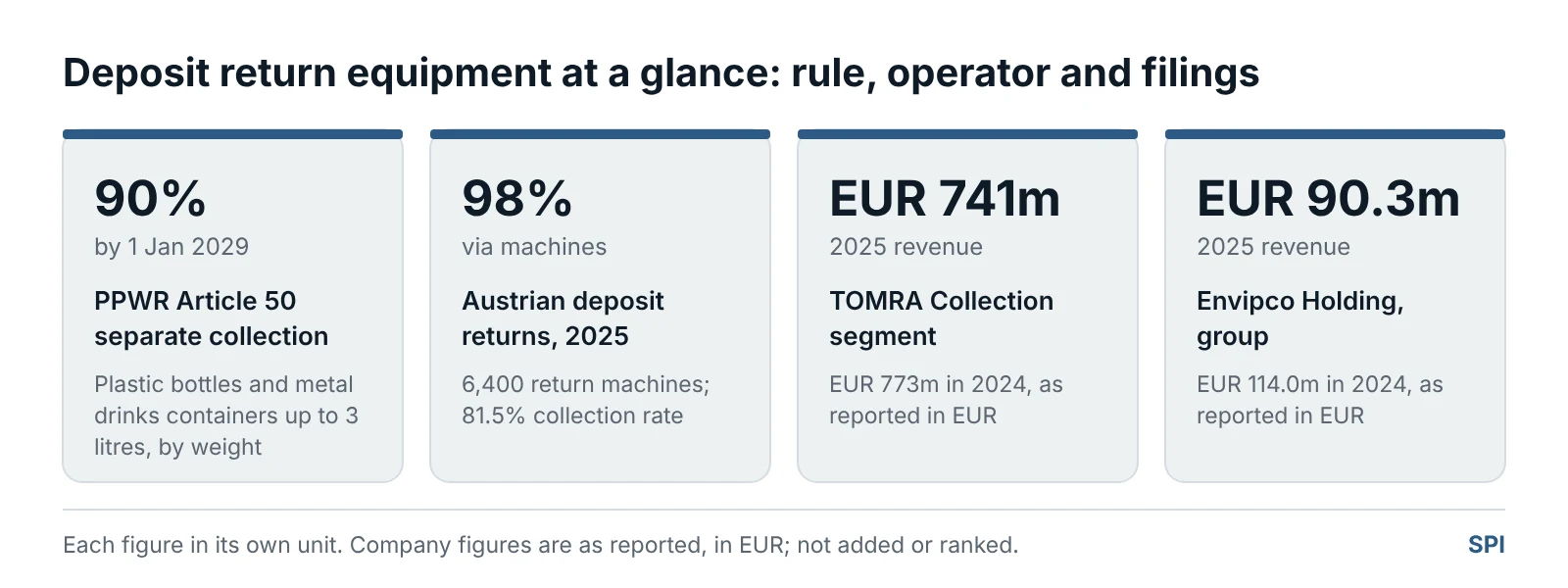
| Label | Value | Note | Source |
|---|---|---|---|
| PPWR separate collection, plastic bottles and metal drinks containers | 90% by 1 Jan 2029 | Up to 3 litres, by weight | Regulation (EU) 2025/40, Article 50 |
| Share of Austrian deposit returns through machines, 2025 | 98% | 6,400 return machines; 81.5% collection rate | Recycling Pfand Österreich, Jahresbilanz 2025 |
| TOMRA Collection segment revenue, 2025 | EUR 741 million | EUR 773 million in 2024 | TOMRA Annual Report 2025 |
| Envipco Holding revenue, 2025 | EUR 90.3 million | EUR 114.0 million in 2024 | Envipco annual financial report 2025 |
Note: Each tile in its own unit. Company figures as reported, in EUR; not added or ranked.
Deposit return equipment is the kit that takes an empty drinks container back, identifies it, refunds the deposit and passes the material on. In store, that is the reverse vending machine (RVM), which reads the barcode and deposit mark, checks shape or material, and compacts or stores the container. Where a shop takes containers over the counter, the return point is manual, and the containers go in bags or crates to a counting centre, where the scheme operator or its contractor counts them and settles the deposit with the retailer.
The rules decide which of these routes a scheme leans on. A law that obliges large shops to take containers back, and an operator that pays more for a machine return than a manual one, push retailers towards machines. A law that exempts small shops, or lets them take back by hand, keeps manual points and counting centres in the mix. The sections below set out those rules market by market.
No official statistic measures the deposit return equipment market on its own. Customs codes group return machines with other machinery, and SPI has not yet confirmed a CN or HS code that isolates them, so trade data cannot stand in for market size. The indicators used here are the counts that scheme operators publish, the fees they pay per container, and the revenue that listed makers report in their filings, each in its own unit and currency.
The EU rule that matters most for return equipment is Article 50 of the Packaging and Packaging Waste Regulation (PPWR), Regulation (EU) 2025/40, which has applied since 12 August 2026. Article 50(1) sets the level: each Member State must separately collect at least 90% by weight per year of single-use plastic drinks bottles and single-use metal drinks containers up to 3 litres by 1 January 2029. Article 50(2) then requires a deposit and return system that charges a deposit at the point of sale, as the Commission’s guidance notice C/2026/3084 sets out.
The only way out is performance. A Member State that separately collected 80% or more of that packaging placed on the market in 2026 may ask for an exemption, with an implementation plan, by 1 January 2028. Annex X lists minimum requirements for deposit systems, which apply by 1 January 2029; a system set up before the Regulation entered into force is outside them if it reaches the 90% level by that date. SPI’s Article 50 Ledger reads the article paragraph by paragraph.
| Element | What it says | Date |
|---|---|---|
| Collection target, Article 50(1) | At least 90% by weight per year, plastic bottles and metal drinks containers up to 3 litres | 1 Jan 2029 |
| Deposit duty, Article 50(2) | A deposit and return system charging a deposit at the point of sale | 1 Jan 2029 |
| Exemption, Article 50(5) | Open to a state that collected 80% or more in 2026; request and plan due | 1 Jan 2028 |
| Minimum design, Annex X | Minimum requirements for deposit systems; earlier systems that reach 90% are outside them | 1 Jan 2029 |
| Starting point | 6 of 27 Member States above 90% for plastic bottles in 2022 | Reference year 2022 |
Note: Wording paraphrased. The 2022 count covers single-use plastic drinks bottles only, as reported under Directive (EU) 2019/904; metal containers are not in that dataset.
Source: Regulation (EU) 2025/40, Article 50 and Annex X; Commission Notice C/2026/3084, section 28; European Commission COM(2026) 160, Annex 3 (SPI summary)
For equipment, the arithmetic is about time. From the page date of 29 November 2026, there are 398 days to the exemption deadline and 764 days to the 90% deadline, by SPI’s calculation. The Commission’s report COM(2026) 160 lists six Member States above 90% for plastic bottles in 2022: Estonia, Poland, Finland, Germany, Denmark and Sweden. Those without a scheme must either show 80% from 2026 data or build a return network in time for 2029.
SPI analysis
Article 50 turns a recycling target into an equipment timetable. A state that cannot show 80% in 2026 has no route but a deposit system, and a deposit system needs return points, machines or counting capacity in place before its first full year of reporting. The binding dates for orders are therefore earlier than 2029.
Six European schemes in this report have started since late 2023, each under its own law and operator. Romania’s system became mandatory on 30 November 2023, with a RON 0.50 deposit, run by RetuRO (Romanian Ministry of Environment). Hungary’s mandatory system, run by MOHU MOL Hulladékgazdálkodási Zrt., started on 1 January 2024 with a HUF 50 deposit on non-reusable drinks containers of 1 dl to 3 litres (Government of Hungary). Ireland’s Re-turn scheme went live on 1 February 2024, with deposits of EUR 0.15 and EUR 0.25 by size (gov.ie).
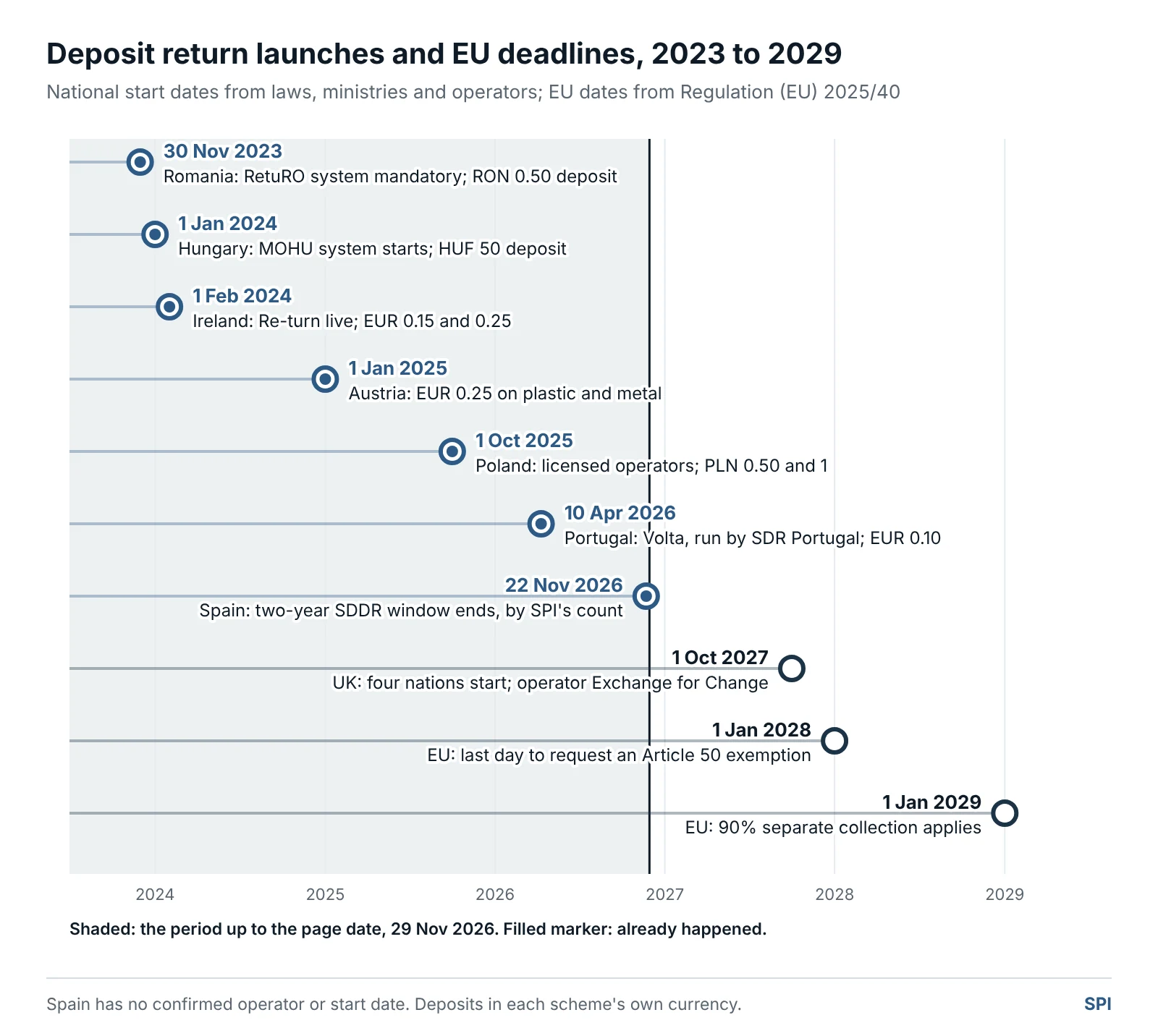
| Date | Label | Category | Link |
|---|---|---|---|
| 2023-11-30 | Romania: RetuRO system mandatory; RON 0.50 deposit | past | |
| 2024-01-01 | Hungary: MOHU system starts; HUF 50 deposit | past | |
| 2024-02-01 | Ireland: Re-turn live; EUR 0.15 and 0.25 | past | |
| 2025-01-01 | Austria: EUR 0.25 on plastic and metal | past | |
| 2025-10-01 | Poland: licensed operators; PLN 0.50 and PLN 1 | past | |
| 2026-04-10 | Portugal: Volta, run by SDR Portugal; EUR 0.10 | past | |
| 2026-11-22 | Spain: two-year window for a national SDDR ends, by SPI’s count | past | |
| 2027-10-01 | UK: four nations start; operator Exchange for Change | next | |
| 2028-01-01 | EU: last day to request an Article 50 exemption | next | |
| 2029-01-01 | EU: 90% separate collection applies | next |
Note: Deposits in each scheme's own currency. Spain has no confirmed operator or start date.
Austria’s deposit ordinance, BGBl. II Nr. 283/2023, has charged EUR 0.25 on single-use plastic and metal drinks containers since 1 January 2025, with EWP Recycling Pfand Österreich gGmbH as the central body. Poland’s system has run since October 2025, with its obligations applying from 1 October 2025 under the amending act Dz.U. 2024 poz. 1911, and, unlike the others, licenses several operators: the climate ministry’s list shows eight permit holders. Portugal launched its Volta system on 10 April 2026, run by SDR Portugal, with a EUR 0.10 deposit; the government put the investment at about EUR 150 million, paid by producers and packers. SPI’s Poland Ledger and Europe deposit return Ledger cover the scheme rules.
| Market | Start | Operator | Deposit per container |
|---|---|---|---|
| Romania | 30 Nov 2023 | RetuRO | RON 0.50 |
| Hungary | 1 Jan 2024 | MOHU MOL Hulladékgazdálkodási Zrt. | HUF 50 |
| Ireland | 1 Feb 2024 | Deposit Return Scheme Ireland CLG (Re-turn) | EUR 0.15 or EUR 0.25 by size |
| Austria | 1 Jan 2025 | EWP Recycling Pfand Österreich gGmbH | EUR 0.25 |
| Poland | 1 Oct 2025 | Eight licensed operators | PLN 0.50; PLN 1 on reusable glass |
| Portugal | 10 Apr 2026 | SDR Portugal (Volta) | EUR 0.10 |
| United Kingdom | 1 Oct 2027 | Exchange for Change | 20p, stated by the operator |
| Spain | Not yet set | SPI has not yet confirmed an operator | SPI has not yet confirmed |
Note: Each deposit in its own currency; not converted or compared. UK deposit is the operator's stated figure, not a figure in the regulations.
Source: Romanian Ministry of Environment; Government of Hungary; gov.ie; RIS BGBl. II Nr. 283/2023; gov.pl; Government of Portugal; SI 2025/67; Government of Spain answer to Congress, 29 Jan 2025 (SPI summary)
Spain’s obligation. Spain wrote a deposit trigger into Ley 7/2022: if separate collection of single-use plastic drinks bottles missed the intermediate target, a national deposit system (SDDR) must follow. The Government told Congress on 29 January 2025 that the ecological transition ministry, MITECO, published its report on 22 November 2024, that 2023 collection was 41.3%, short of the law’s separate collection targets, and that a national SDDR must be in place within two years. By SPI’s count that window closed on 22 November 2026. SPI has not yet confirmed an authorised operator or a start date, as SPI’s Spain deposit return report sets out.
The UK. SI 2025/67 brings the main deposit duties into force in England and Northern Ireland on 1 October 2027 for single-use PET, steel and aluminium containers of 150 ml to 3 litres, and Scotland’s SSI 2025/188 moved its start to the same day. Exchange for Change, the operator for all four nations, stated a 20p deposit and published its first list of certified reverse vending machines on 29 October 2026, each tested against 77 requirements, as SPI’s UK deposit return report explains. Launch is 306 days from the page date, by SPI’s calculation.
Return rates are the test each scheme is run against, and they tell machine buyers how much throughput a network must carry. Three operators publish a rate. RetuRO’s 2026 presentation on its administration fee puts Romania’s 2025 collection rate at 83%, and its website gives 87.2% for January to October 2026. Recycling Pfand Österreich’s annual statement for 2025 gives a collection rate of 81.5%, with about 1.4 billion containers collected against about 2 billion placed on the market, and says 98% were collected through machines and 2% by hand.
Re-turn’s 2025 annual report gives an overall return rate of 76.4% of in-scope containers, against 66% for June to December 2024, and 1,434,857,656 containers returned in 2025: 749,128,937 cans and 685,728,719 plastic bottles. The same report gives net unredeemed deposit income of EUR 60.1 million in 2025, down from EUR 66.7 million.
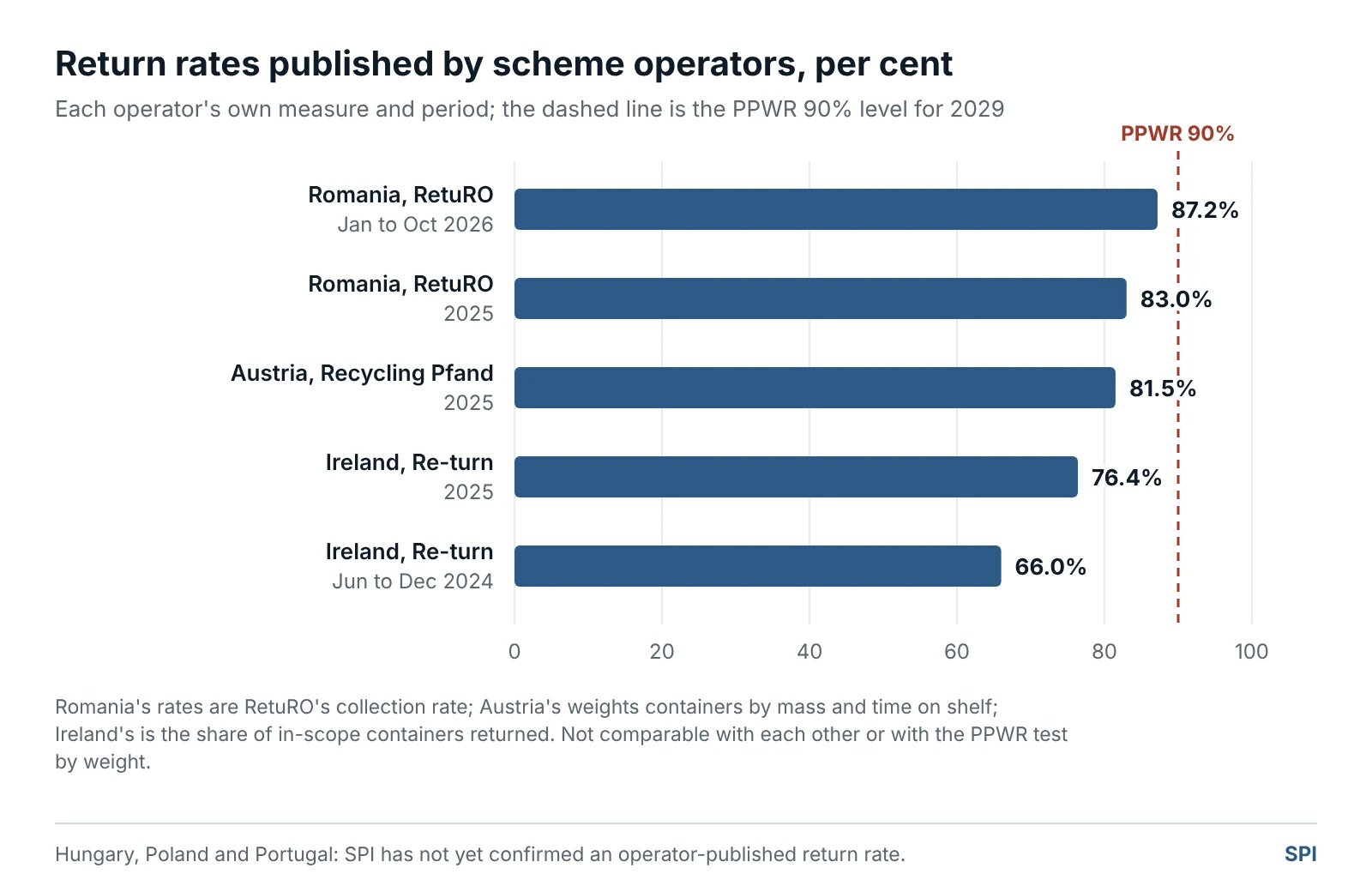
| Operator and period | Rate |
|---|---|
| Romania, RetuRO, Jan to Oct 2026 | 87.2 |
| Romania, RetuRO, 2025 | 83.0 |
| Austria, Recycling Pfand Österreich, 2025 | 81.5 |
| Ireland, Re-turn, 2025 | 76.4 |
| Ireland, Re-turn, Jun to Dec 2024 | 66.0 |
Note: Romania's rates are RetuRO's collection rate; Austria's weights containers by mass and average time on shelf; Ireland's is the share of in-scope containers returned. Not comparable with each other or with the PPWR test by weight.
Poland publishes counts, not a rate. The climate ministry’s deposit page gives 5 billion containers returned from October 2025 to September 2026, after 3.2 billion reported on 21 August 2026. Neither the ministry nor the operators publish containers placed on the market against containers returned, so SPI has not yet confirmed a Polish return rate. SPI has not yet confirmed an operator-published rate for Hungary or Portugal.
SPI analysis
No published rate in Exhibit 5 has yet reached 90%. For equipment buyers that points to more capacity after launch, not less: return volumes in Ireland grew from 877 million in 2024, a year of 11 months from launch, to 1.43 billion in 2025, a 64% rise by SPI’s calculation from Re-turn’s figures, and the store network had to absorb it.
Which shops must host a return point decides how many machines and manual points a market needs. Every scheme in this report draws the line by sales floor area, and none draws it in the same place.
In the UK, groceries retailers must host a return point unless exempt; urban shops under 100 m2 are exempt by law, and Exchange for Change has agreed wider criteria that cover some urban stores up to 199 m2 and rural stores under 200 m2 (SI 2025/67; Exchange for Change). In Poland, all shops over 200 m2 must accept deposit containers and smaller shops do so only if they join (gov.pl). In Ireland, stores of 250 m2 or less may agree a take-back exemption but still charge the deposit (S.I. No. 33 of 2024). In Hungary, food stores with more than 400 m2 of sales area must offer automated take-back, and a take-back point is also required in settlements of more than 1,000 people (Government of Hungary). In Portugal, shops of 400 m2 or more take back all in-scope containers, shops over 50 m2 take back what they sell, and shops of 50 m2 or less are exempt (APA, SDR FAQ).
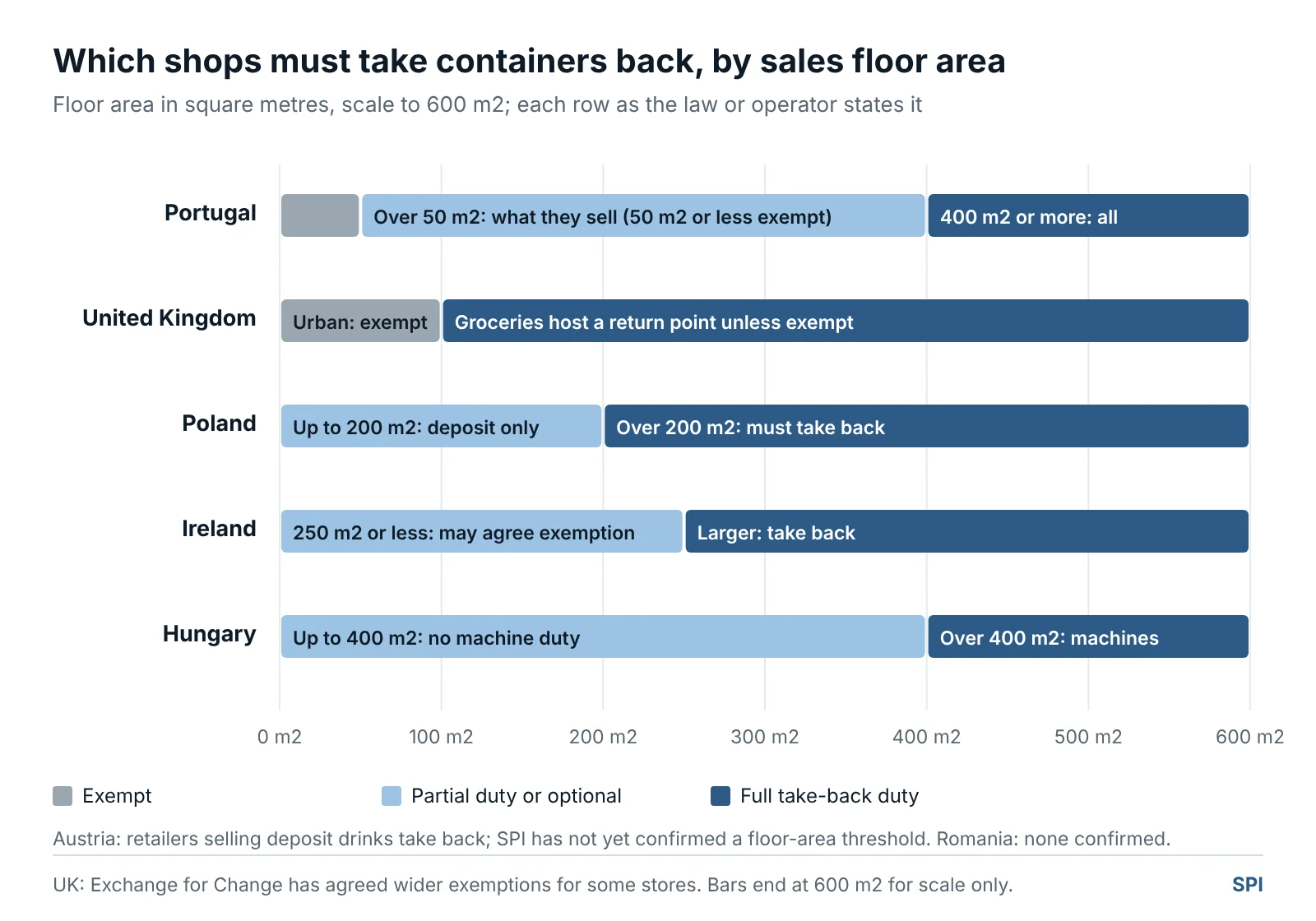
Hungary is the only market here whose rule names machines: its 400 m2 duty is for automated take-back. In the UK the law requires a return point, and the operator’s fees, set out below, decide whether a retailer chooses a machine or a counter. Austria’s retailers that sell deposit drinks take containers back and refund them; SPI has not yet confirmed a floor-area threshold there or in Romania.
SPI analysis
A size threshold is the closest thing in law to a machine count. The lower it sits, the more shops enter the network and the more of them are small sites where a manual point or a compact machine fits better than a large back-room system.
Operators pay retailers a handling fee for each container returned, and the fee schedule tells a retailer what a machine is worth. In the UK, Exchange for Change’s support package of 10 June 2026 pays 3p per container at a manual return point and 5p at an automated point for up to 225,000 in-scope items a year, then 1.3p above that. It also set aside GBP 60 million of grants for up to 10,000 small independent retailers, at GBP 6,000 a site paid as three annual amounts of GBP 2,000, to help pay for machines.
Austria pays machine and manual returns on close terms. Recycling Pfand Österreich’s handling fee sheet for 2026 sets EUR 0.0365 per plastic bottle and EUR 0.0341 per can returned by machine, and EUR 0.0384 and EUR 0.0312 for manual returns, for returns from June 2026.
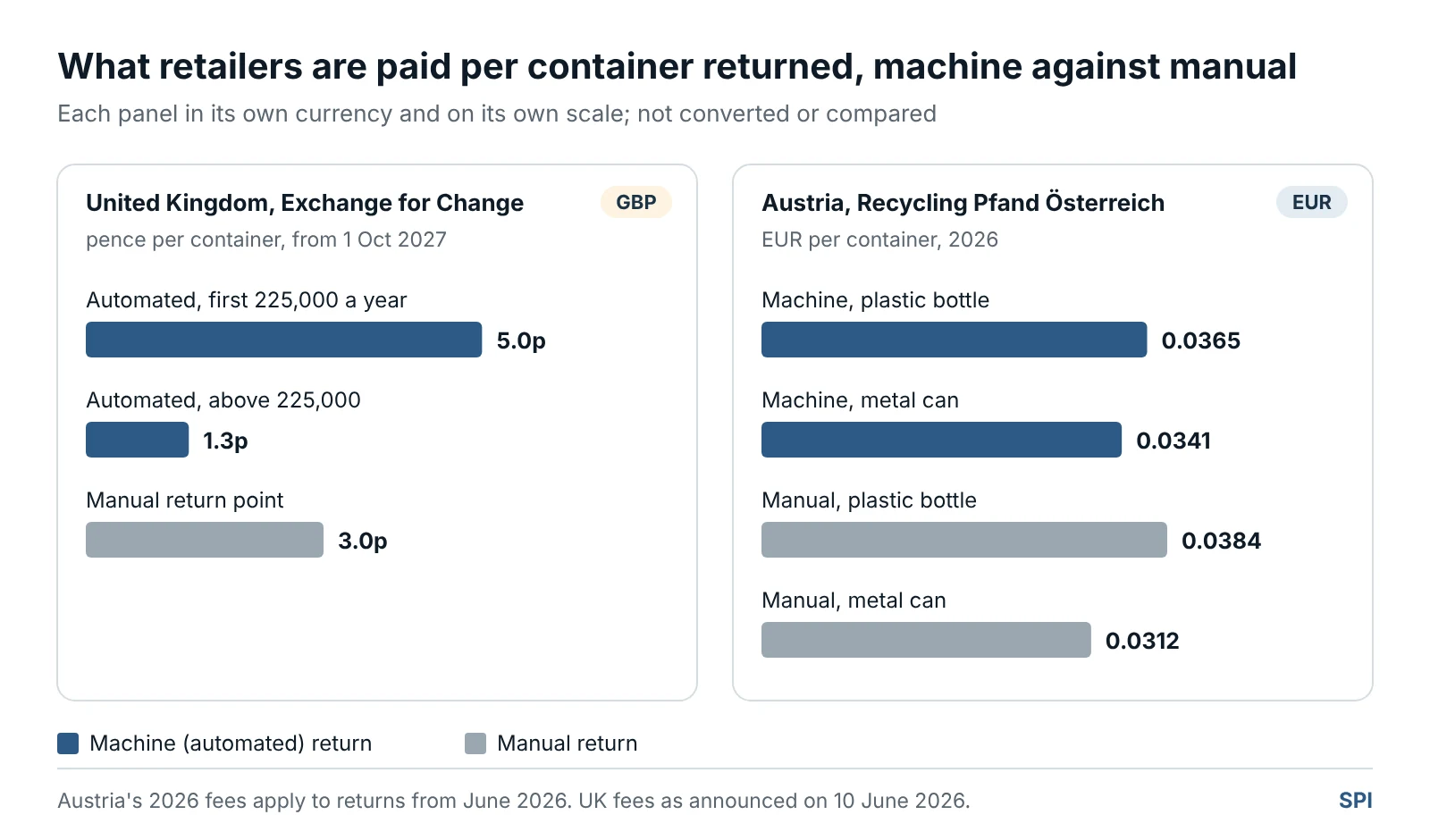
SPI calculation In the UK, an automated point returning 225,000 items a year earns GBP 11,250 at 5p, against GBP 6,750 at a manual point at 3p. Above 225,000 the machine rate drops to 1.3p, so a manual point earns more in total from about 490,000 items a year. All amounts are in GBP.
SPI calculation In Austria, 98% of about 1.4 billion containers came back through about 6,400 machines in 2025, which is roughly 214,000 containers per machine for the year. The figure is rough because both inputs are rounded, and it sits close to the 225,000 item tier in the UK fee schedule.
Operators and makers publish machine and return point counts, on different dates and bases. They show the size of each national network and the installed base each maker reports.
| Source | Count | Basis and date |
|---|---|---|
| Re-turn, Ireland | 2,815 reverse vending machines; 555 manual return points | At 31 Dec 2025 |
| Recycling Pfand Österreich | About 6,400 return machines; 16,300 registered return points | 2025 |
| TOMRA Collection | 91,900 installed machines | Company-wide, Annual Report 2025 |
| Envipco | Installed base of about 13,000 RVMs in 17 markets | Company-wide, Annual Report 2025 |
| Envipco, UK | 7,100 committed RVM orders | To 11 Nov 2026 |
Note: Counts as each operator or company states them, on different dates and bases. Maker counts are company-wide installed bases, not counts in one market. Not added across rows.
Source: Re-turn, Annual Report and Financial Statements 2025; Recycling Pfand Österreich, Jahresbilanz 2025; TOMRA Annual Report 2025; Envipco annual financial report 2025; Envipco Q3 2026 report, 11 Nov 2026 (SPI summary)
Re-turn’s report gives 2,624 return locations alongside its machine and manual counts, and does not explain how the figures relate. SPI has not yet confirmed machine counts for Hungary, Romania, Poland or Portugal from the operators’ own pages.
TOMRA Systems ASA, listed in Oslo, and Envipco Holding N.V., listed in Amsterdam, are return machine makers that publish segment or group figures. Both report in euros. Other makers also supply machines certified for the UK scheme; this section covers the two that file segment or group figures.
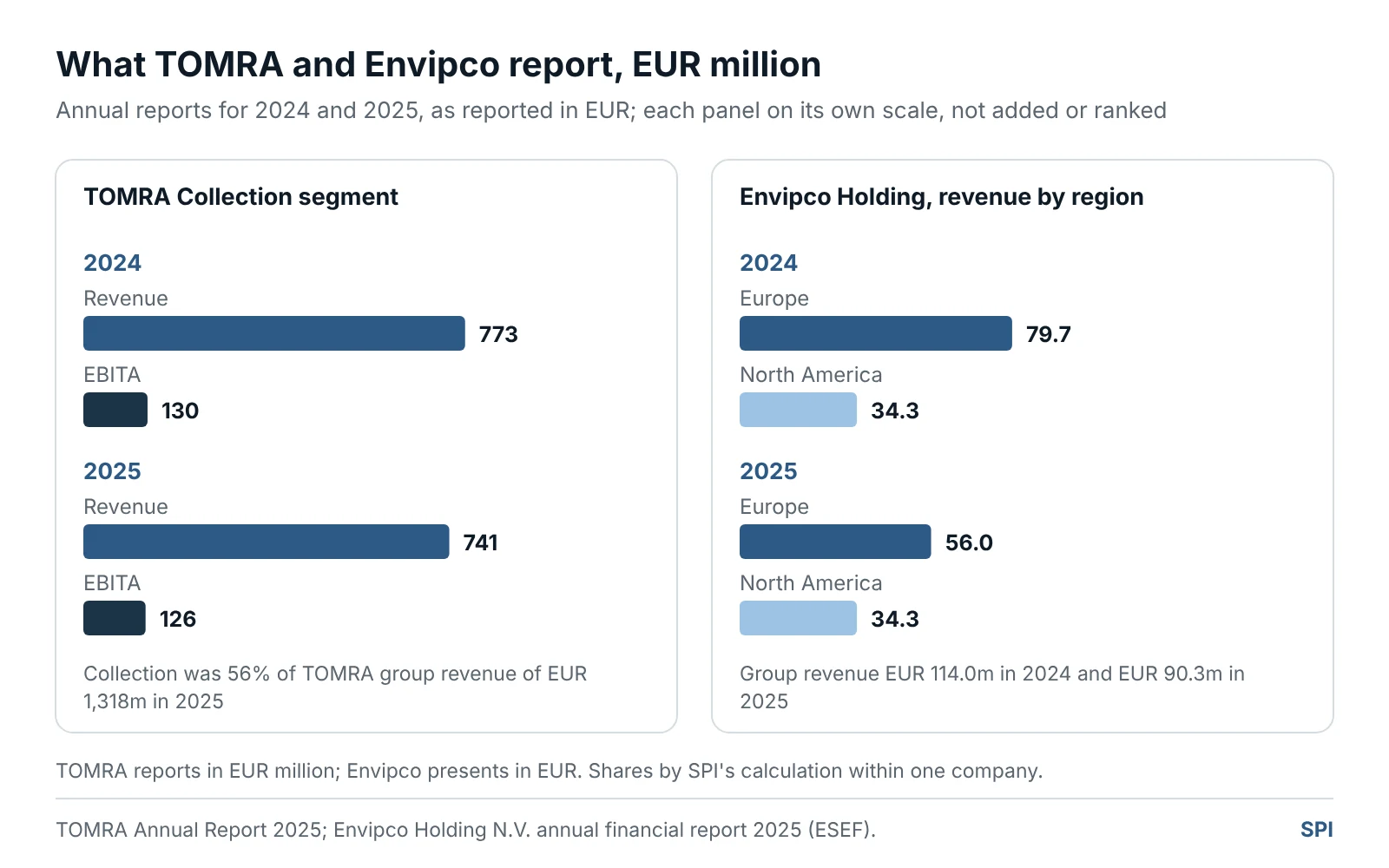
TOMRA. TOMRA’s Annual Report 2025 gives Collection segment revenue of EUR 741 million in 2025, down 4% from EUR 773 million in 2024, and Collection EBITA of EUR 126 million against EUR 130 million. Group operating revenue was EUR 1,318 million against EUR 1,348 million, so Collection was 56% of group revenue in 2025, by SPI’s calculation. The report says 87% of Collection revenue came from established deposit markets and 13% from new markets, and gives 91,900 installed machines.
Envipco. Envipco’s annual financial report for 2025, filed in ESEF format, presents revenue of EUR 90.3 million against EUR 114.0 million in 2024, with Europe at EUR 56.0 million against EUR 79.7 million and North America at EUR 34.3 million in both years. Its operating result was minus EUR 7.6 million against EUR 3.7 million. In its third quarter 2026 report of 11 November, Envipco gave revenue of EUR 26.5 million, up 18%, with Europe at EUR 15.2 million and North America at EUR 11.3 million, and 7,100 committed RVM orders in the UK.
SPI analysis
Both filings suggest that machine revenue moves with launch dates rather than along a smooth trend. TOMRA’s Collection revenue and Envipco’s European revenue both fell in 2025, after the Romanian, Hungarian, Irish and Austrian launches and before the UK start. Envipco’s European revenue grew 7% in the third quarter of 2026, and it reported 7,100 committed UK orders.
TOMRA set out its own view of the next European launches, the UK rollout and its Collection targets at its Capital Markets Day on 24 November 2026, which SPI’s TOMRA Capital Markets Day report of 28 November covers.
| Item | Q3 2026 | Change stated |
|---|---|---|
| Group revenue | EUR 26.5 million | Up 18% |
| RVM revenue | EUR 15.3 million | Up 17% |
| Program services revenue | EUR 11.2 million | Up 19% |
| Europe | EUR 15.2 million | Up 7% |
| North America | EUR 11.3 million | Up 37% |
| UK committed RVM orders | 7,100 | To date |
Note: EUR million as reported. Growth rates are Envipco's, against the third quarter of 2025.
Source: Envipco Holding N.V., Q3 2026 report, 11 Nov 2026 (SPI summary)
The outlook for deposit return equipment can be set out from dates in law. The UK start, the EU exemption deadline and the EU collection deadline are fixed; Spain’s start is not.
| Date | Milestone | Equipment link |
|---|---|---|
| Jan 2027 | UK phase 2 producer registration opens, according to Exchange for Change | Product registration before launch |
| 1 Oct 2027 | UK deposit return starts in four nations | Return points must be in place |
| 1 Jan 2028 | Last day for an Article 50 exemption request | States below 80% in 2026 need a deposit system |
| 1 Jan 2029 | EU 90% separate collection and Annex X apply | Deposit systems in place in states without exemption |
Note: Dates as stated in the sources. Spain has no confirmed SDDR start date.
Source: SI 2025/67 and SSI 2025/188; Exchange for Change; Regulation (EU) 2025/40, Article 50; Commission Notice C/2026/3084 (SPI summary)
Two things in Exhibit 11 have no date yet: Spain’s operator and start, and which Member States will ask for an Article 50 exemption by 1 January 2028. Both decide how many new return networks Europe builds before 2029.
This page was written on 29 November 2026 from laws, ministry pages, scheme operator reports and company filings. Start dates, deposits and shop thresholds come from each law, ministry or operator, and from SPI’s deposit return Ledgers built on them. Return rates are quoted only where the operator publishes them, with the period and basis given. Company figures come from the TOMRA Annual Report 2025, Envipco’s annual financial report 2025 filed in ESEF format and Envipco’s third quarter 2026 report, each in the currency reported. SPI never adds, converts or ranks amounts across currencies, and SPI shows no market size, growth rate or share: no official statistic measures this market on its own. Calculations are SPI’s and are labelled. Figures without a source are not shown.
Get sample pages with the market model, segment tables and the full table of contents.
What is moving demand for deposit return scheme equipment market up or down over , with the expected impact on growth.
Article 50 requires 90% separate collection of plastic bottles and metal drinks containers by 1 January 2029, through a deposit system unless a state reached 80% in 2026.
SI 2025/67 and SSI 2025/188 start deposit duties on 1 October 2027, and groceries retailers must host a return point unless exempt.
Exchange for Change pays 5p per container at an automated point up to 225,000 items a year, against 3p at a manual point.
Urban UK shops under 100 m2 are exempt, and Portuguese shops of 50 m2 or less are exempt from take-back.
Spain has no confirmed SDDR operator or start date, although its two-year window closed on 22 November 2026 by SPI's count.
States below 80% collection in 2026 cannot use the Article 50 exemption and need a deposit system by 2029.
Exchange for Change set aside GBP 60 million of grants, GBP 6,000 a site, for up to 10,000 small independent retailers to pay for machines.
No operator-published rate in this report has reached 90%; Re-turn reported 76.4% for Ireland in 2025.
The UK automated fee drops to 1.3p above 225,000 items a year, so a manual point earns more in total from about 490,000 items.
The rules that change material choice, design and cost for this market. Each one is covered in depth in the report.
| Rule | Jurisdiction | Status | What it means |
|---|---|---|---|
| Regulation (EU) 2025/40, Article 50 | European Union | Applies since 12 Aug 2026 | 90% separate collection of plastic bottles and metal drinks containers by 1 Jan 2029 through a deposit system; exemption request by 1 Jan 2028 at 80% |
| SI 2025/67 and SSI 2025/188 | United Kingdom | Adopted; duties from 1 Oct 2027 | Deposit on PET, steel and aluminium containers of 150 ml to 3 litres; groceries retailers host return points; urban shops under 100 m2 exempt |
| Pfandverordnung, BGBl. II Nr. 283/2023 | Austria | In force since 1 Jan 2025 | EUR 0.25 deposit on single-use plastic and metal drinks containers of 0.1 to 3 litres |
| Separate Collection (Deposit Return Scheme) Regulations 2024, S.I. No. 33 of 2024 | Ireland | In force | EUR 0.15 and 0.25 deposits; stores of 250 m2 or less may agree a take-back exemption |
| Polish deposit system, Dz.U. 2023 poz. 1852 and 2024 poz. 1911 | Poland | In force since 1 Oct 2025 | Licensed operators; shops over 200 m2 take back; PLN 0.50 and PLN 1 deposits |
| Mandatory deposit return system | Hungary | In force since 1 Jan 2024 | HUF 50 deposit; food stores over 400 m2 offer automated take-back |
| Sistema Garanție-Returnare | Romania | In force since 30 Nov 2023 | RON 0.50 deposit; operator RetuRO |
| Ley 7/2022 | Spain | SDDR triggered; no start date confirmed | 2023 bottle collection of 41.3% missed the separate collection targets, so a national deposit system must follow within two years |
Norwegian maker of reverse vending machines and sorting systems; reports a Collection segment in EUR.
Maker of reverse vending machines and return programme services; presents its accounts in EUR.
Spain's two-year window for a national deposit system closed on 22 November, by SPI's count.
TOMRA held its Capital Markets Day on 24 November; Envipco reported Q3 2026 revenue of EUR 26.5 million on 11 November.
Exchange for Change published its first list of certified reverse vending machines for the UK scheme.
Regulation (EU) 2025/40, including Article 50, began to apply on 12 August.
Exchange for Change set UK return handling fees of 3p manual and 5p automated per container.
Portugal launched its Volta deposit system on 10 April.
| Base year | 2025 |
|---|---|
| Units | Value (USD Billion), volume (kilotonnes) |
| Regions covered | North America, Europe, Asia Pacific, Latin America, Middle East & Africa |
| Companies profiled | TOMRA, Envipco |
| Report coverage | Market size and forecast, segment and country analysis, packaging regulation, pricing, value chain, competitive landscape, company profiles |
| Customisation | Up to 10% additional scope free of charge before delivery |
Chapters are built from this report’s segmentation, regions and company list. Open a chapter to see every section.
Includes the list of tables and figures with sample data pages.
How Strategic Packaging Insights builds and checks the numbers in this report.
We fix the formats, substrates and end uses in scope, the unit of measure (USD and tonnes) and the base year (2025), so every number in the report counts the same thing.
Regulator texts (EU PPWR, national EPR schemes, plastic packaging taxes), customs and trade statistics for packaging HS codes, company annual reports and investor filings, trade association data and patent records.
Structured interviews with converters, resin and paper suppliers, brand-owner packaging and procurement teams, machinery suppliers and recyclers, used to test volumes, prices and adoption timing.
Demand in tonnes by substrate and end use, multiplied by regional average selling price per kilogram, built country by country.
Cross-check against end-use output (food, beverage, pharma, personal care, e-commerce shipments) and the reported packaging revenue of the leading companies.
The two views are reconciled, then forecast to 0 with drivers for demand, resin and fibre prices, and regulatory scenarios (recyclability grades, recycled-content targets, EPR fees).
Every figure is checked for arithmetic consistency (segments add to the total, shares add to 100%), every regulatory statement is checked against the official text, and a senior analyst signs off the release.
Single user, team and company-wide licences are available. Tell us who will use the report and we will send the licence options and pricing by email.
Article 50 of Regulation (EU) 2025/40 requires each Member State to separately collect at least 90% by weight of single-use plastic drinks bottles and metal drinks containers up to 3 litres by 1 January 2029, through a deposit system. A state that collected 80% in 2026 may ask for an exemption by 1 January 2028.
Romania started on 30 November 2023, Hungary on 1 January 2024, Ireland on 1 February 2024, Austria on 1 January 2025, Poland on 1 October 2025 and Portugal on 10 April 2026. The UK starts on 1 October 2027. Spain's two-year window for a national system closed on 22 November 2026 by SPI's count.
RetuRO reports 83% for Romania in 2025 and 87.2% for January to October 2026. Recycling Pfand Österreich reports 81.5% for 2025, and Re-turn reports 76.4% for Ireland in 2025. Each uses its own measure and period, so the rates are not directly comparable with each other or with the PPWR test.
It depends on floor area. Urban UK shops under 100 m2 are exempt; Polish shops over 200 m2 must take back; Irish stores of 250 m2 or less may agree an exemption; Hungarian food stores over 400 m2 need machine take-back; Portuguese shops of 400 m2 or more take back all in-scope containers.
TOMRA's Annual Report 2025 gives Collection segment revenue of EUR 741 million, down from EUR 773 million in 2024. Envipco's 2025 annual report gives group revenue of EUR 90.3 million, down from EUR 114.0 million. Both report in euros, and SPI does not add or rank the two companies' figures here.
Public sources used alongside primary interviews and company filings.