
The SPI Team: How SPI Researches, Checks and Maintains Packaging Data
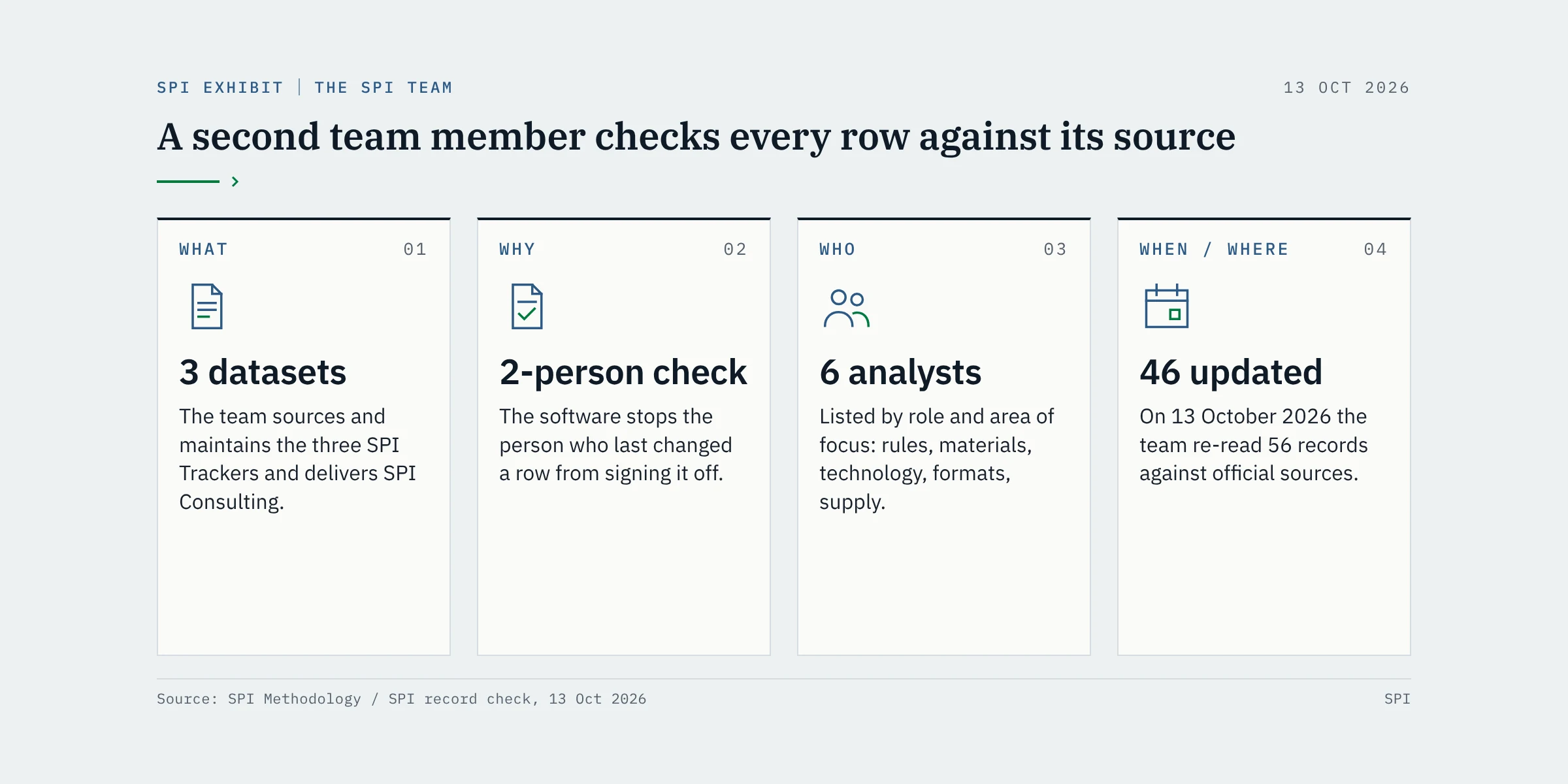
The SPI team is the group of analysts and consultants at Strategic Packaging Insights (SPI) who source and maintain the SPI Trackers and deliver SPI Consulting, organised by coverage area, with each row marked verified only after a second team member has checked it against its source.
SPI works on one industry, packaging, and the team is split by the questions packaging businesses ask: rules, materials and prices, technology, formats and end markets, and the supply chain. On 13 October 2026 the SPI team re-read 56 tracker records against their official sources and updated 46.
By the SPI team · Figures as of 13 October 2026
79
Packaging rules maintained
in 25 jurisdictions, each with its official source
SPI Regulation Tracker
179
Public packaging targets recorded
from 42 brand owners and retailers
SPI Buyers Database
216
Published fee and tax rates kept current
from 14 markets
SPI EPR & Plastic Tax Calculator
Source: SPI Trackers, checked 14 Oct 2026.
Key facts
- The SPI team sources and maintains the SPI Regulation Tracker (79 rules in 25 jurisdictions), the SPI Buyers Database (42 companies, 179 targets) and the SPI EPR & Plastic Tax Calculator (216 rate rows from 14 markets) (SPI Trackers, 13 October 2026).
- Every tracker row is added by one SPI team member and marked verified only after a second team member has checked every field and the quote against the source; the software does not let the person who last added or changed a row verify it (SPI Methodology, 13 October 2026).
- On 13 October 2026 the SPI team re-read 56 tracker records against their official sources and updated 46 (SPI record check, 13 October 2026).
- The Our team page groups the team into research desk management, the packaging practice that runs SPI’s coverage areas, and research analysts covering formats, end markets, printing and materials (SPI Our team page, 13 October 2026).
- Every SPI Consulting assignment includes a check of numbers and sources by a second SPI team member before delivery (SPI Consulting service definitions, 13 October 2026).
- SPI pages and SPI notes are published under the byline “SPI team”, and SPI interpretation is labelled “SPI analysis” (SPI rule notes, 13 October 2026).
How the SPI team is organised
The team is organised around coverage, not around products. The same analysts who maintain a dataset use it in consulting work, so a question about Washington’s EPR law or a brand owner’s recycled-content target reaches someone who has read the source.
| Group | What it does |
|---|---|
| Research desk | Research desk management and quality review of tracker rows and deliverables |
| Packaging practice | The strategists and analysts who run SPI's coverage areas: circular economy rules and materials transition, packaging finance and market risk, and packaging technology |
| Research analysts | Packaging formats and the end markets that buy them, digital printing, barrier materials and supply chain intelligence |
Source: SPI Our team page, checked 8 Nov 2026.
This page lists the six SPI analysts by role and area of focus only. This text describes how the work is divided and checked, so it stays accurate when people join or leave.
What each coverage area covers
| Coverage area | Topics | SPI product it maintains or uses | Closest SPI Consulting service |
|---|---|---|---|
| Research management and quality review | Review of every row and deliverable, market estimation | All SPI Trackers | All services (second-person check) |
| Circular economy and regulation | Circular economy rules, regulatory compliance, materials transition, EPR and PPWR | SPI Regulation Tracker | Packaging Regulatory Intelligence; Sustainable Packaging Strategy |
| Finance, chemicals and market risk | Polymer and chemical prices, market risk, investment cases | Not tied to one dataset | Packaging Strategy & Growth; Packaging Investment & Transaction Intelligence |
| Technology and infrastructure | Smart and connected packs, automation, plant infrastructure | Not tied to one dataset | Packaging Innovation & Technology |
| Formats and end markets | Packaging formats; FMCG, personal care and pharmaceuticals | Not tied to one dataset | Packaging Market & Competitive Intelligence |
| Printing, materials and supply chain | Digital printing, barrier materials, supply chain intelligence for converters and their suppliers | Not tied to one dataset | Packaging Procurement & Supplier Intelligence; Packaging Innovation & Technology |
Source: SPI Our team page and SPI Consulting service definitions, checked 8 Nov 2026.
SPI analysis
Packaging questions rarely stay in one box. A brand owner asking whether to move a flexible pouch to mono-material needs the PPWR recyclability rule (PR-EU-010), the EPR fee difference between recyclability bands, and what its own peers have promised. That is why the coverage areas share one set of data.
How a row is made and checked
The core of the team’s work is the row: one rule, one company target or one fee rate, with its source. The SPI Methodology sets out the steps for the SPI Regulation Tracker, and the same principle runs through the other datasets.
| Step | Who | What happens | What the reader sees |
|---|---|---|---|
| Find | First team member | Finds the rule in its official source | Source name and link |
| Record | First team member | Records the facts (authority, dates, rate, materials) and copies a short quote | The row's fields and quote |
| Interpret | First team member | Writes the SPI summary and SPI note, labelled as SPI's reading | "SPI analysis" label on the note |
| Verify | Second team member | Re-checks every field and the quote against the source | Marked "Verified", with the check date, once this check is done |
| Change | Any team member | A later change to the facts sends the row back to "Sourced" and is logged | An entry in the rule's history |
| Re-verify | A different team member | Checks the changed row again | Marked "Verified", with the new date, once this check is done |
Source: SPI Methodology and SPI Regulation Tracker, checked 14 Oct 2026.
Three rules keep this honest. Sourced facts, SPI estimates and SPI interpretation sit in separate fields and are labelled. Where there is no reliable source, the team records a gap instead of filling it. And the software, not goodwill, enforces the second check: the person who last added or changed a row cannot verify it.
What the team checks on the regulatory desk
The SPI Regulation Tracker is the dataset the team checks most often, because laws move. It holds 79 rules: 60 in force, 13 adopted, 4 proposed and 2 expired on 13 October 2026.
The 13 October 2026 record check shows why rows are re-read against their sources. In it the SPI team re-read 56 tracker records and updated 46. The updates being published include the status of Minnesota’s, Maryland’s and Washington’s EPR laws (PR-US-006, PR-US-007, PR-US-008), moving to “in force”, because their producer or PRO duties have started, and of California SB 343 (PR-US-011) to “adopted”, because a federal court preliminary injunction has blocked its enforcement since 14 July 2026 (CalRecycle, consulted 13 October 2026). The Corrections page explains each change.
What the team checks in the buyer and fee data
In the SPI Buyers Database, each of the 179 targets comes from the company’s own report or announcement, with a quote, the source link and the date consulted. Reported progress is shown only where the company has published it. Headquarters countries and end-use categories are assigned by the SPI team and are not separately sourced, and the page says so. In the SPI EPR & Plastic Tax Calculator, each rate is copied from the scheme’s or government’s own fee table with the quoted line, rates that are illustrative rather than final are flagged, and markets the team cannot source, such as Germany and Ontario, are listed as gaps.
How the team works on consulting assignments
SPI Consulting is delivered by the same team on the same data. Every assignment follows six steps from the SPI Consulting service definitions.
| Step | What the team does |
|---|---|
| Scope | A scoping call and a written brief: the decision to support, geographies, materials and formats, and time horizon |
| Source plan | The public, licensed and supplied sources to be used; every external fact keeps its original source, date and scope |
| Evidence | Desk research and SPI datasets such as the SPI Regulation Tracker and SPI Buyers Database, plus interviews only when scoped and agreed |
| Analysis | Sourced data kept visibly separate from SPI estimates and interpretation, with every assumption listed |
| Check | A second member of the SPI team checks numbers and sources before delivery; corrections are logged |
| Deliver | A report or deck, a data annex and a read-out call, with one round of clarifications included |
Source: SPI Consulting service definitions, checked 8 Nov 2026.
Work comes in four formats: a briefing (one question answered from existing SPI data, as a call and a short memo), a sprint (two to four weeks on one market or topic), a programme (six to twelve weeks across several markets or workstreams) and a retainer (ongoing monitoring with regular change notes and read-outs). Prices are given on request after a scoping call.
SPI analysis
The scoping step is the cheapest place to save effort. Writing down the decision, the markets and the materials can show that a briefing from the free data already answers the question.
How the team keeps the data current
Packaging rules, fee tables and company reports change on their own timetables, so the team works to dates rather than to news. Each row shows the date its source was last consulted, which tells a reader how fresh it is without asking. When a source changes, the row is updated, sent back to “Sourced”, logged in its history and verified again by a second team member. The tracker’s list of latest changes shows rules added, changed, verified or removed, newest first, and readers who sign up for the tracker’s weekly email alerts hear about changed rules in the jurisdictions they chose.
Three kinds of date drive the team’s checking calendar: start dates written into a law (for example Washington’s 1 March 2029 market access date under PR-US-008), publication dates for fee tables (such as PackUK’s confirmed Year 2 fees, which follow later in 2026 according to the calculator’s gaps list), and the dates companies publish their annual sustainability reports. A row is checked when one of these dates passes, and again whenever a reader reports a problem.
SPI analysis
A dated row is more useful than a perfect one. No team can promise that every packaging rule in 25 jurisdictions is current on every day, but a reader who can see the check date and open the source can judge for themselves whether to rely on it.
What happens when a reader reports a problem
Reader reports are part of how the data stays current, and the team handles each one the same way. The report is logged with the row it concerns, and a member of the SPI team opens the original source the row cites, whether that is a law, a regulator’s guidance page, a scheme’s fee table or a company report. If the source supports the report, the row is corrected, its history records what changed and when, and it returns to “Sourced” until a second team member checks it before it can be marked verified. If the source does not support the report, the row stays as it is and the reader is told why, with the passage that was relied on. Either way the reader gets an answer by email.
The most useful reports name the rule ID or company, the field that looks wrong and the source that shows it. A report that links to a newer official document is usually the fastest to resolve, because the team can compare the two texts directly. Reports about fee rates are checked against the scheme’s own published table for the same year, because schemes publish their rates year by year.
SPI analysis
Most packaging data goes stale because the source moves, not because it was copied wrongly. Readers who work with a rule every day often see that change first, so a short report with a link is one of the quickest ways to keep a shared dataset accurate.
What the team does not do
The team’s work is decision support from public sources. SPI does not give legal advice or legal representation, carry out certified or laboratory testing, issue certifications or audit opinions, or file with regulators on anyone’s behalf; recyclability reviews are desk reviews. The team does not invent contacts, purchase volumes, supplier relationships or packaging specifications, and gaps are reported as gaps. Where a project needs one of these services, the proposal says so.
How to reach the right person
You do not need to know who covers what. Write to sales@strategicpackaginginsights.com or use the enquiry form: each message goes to the SPI team member closest to the topic, who replies by email with a first view or a few clarifying questions. SPI aims to reply within two business days. Mention the packaging materials, the countries involved and the decision you need to make. To report an error in any SPI dataset, see Corrections.
Where the team fits in a packaging decision
SPI’s products follow the order in which packaging decisions are made: Discover (who buys what, from the SPI Buyers Database), Understand (which rules apply, from the SPI Regulation Tracker), Evaluate (what it will cost, from the SPI EPR & Plastic Tax Calculator), Decide (which option, market or asset) and Implement (a sprint, programme or retainer). The team maintains the free data behind the first three stages and works with you on the last two. About SPI gives the company details: Strategic Packaging Insights (SPI) is a trading name of SRI Consulting Group Ltd, registered in England and Wales (company no. 16581261), Suite 10 Capital House, 61 Amhurst Road, London E8 1LL.
Frequently asked questions
Who works at Strategic Packaging Insights?
SPI is a team of packaging analysts and consultants grouped into research desk management, a packaging practice that runs SPI’s coverage areas, and research analysts. Each person’s role and areas of focus are shown on the Our team page.
How does the SPI team check its data?
Every tracker row is added by one team member and verified only after a second team member has checked every field and the quote against the source. The software does not let the person who last changed a row verify it, and every change is logged with its date.
What does the SPI team cover?
Packaging regulation and the circular economy, packaging finance and market risk, packaging technology, packaging formats and end markets, and printing, materials and the supply chain. The team maintains 79 rules, 179 brand targets and 216 fee and tax rates across the SPI Trackers.
Can I speak to an SPI analyst?
Yes. Write to sales@strategicpackaginginsights.com or use the enquiry form. Your message goes to the team member closest to the topic, who replies by email.
Does the SPI team give legal advice?
No. The team provides decision support from public sources and does not give legal advice, test or certify packaging, give audit opinions or file with regulators. Obligations should be confirmed with qualified counsel and the relevant compliance scheme.
Who writes the SPI notes on rule pages?
The SPI team. Each note is labelled “SPI analysis” so readers can tell SPI’s reading of a rule from the sourced facts, and it lists the official sources used and the date they were consulted.
Does the same team do the data and the consulting?
Yes. SPI Consulting is delivered by the SPI team on the same sourced data as the SPI Trackers, and every deliverable is checked by a second team member before delivery.
Sources
- SPI website, Our team page (theme 1.14.0): team groups and coverage areas. /our-team/ (as of 13 October 2026)
- SPI website, SPI Methodology: principles, two-person review, history, buyer and calculator rules. /methodology/ (as of 13 October 2026)
- SPI website, SPI Consulting service definitions: six-step method, formats, what SPI does not do. /consulting/ (as of 13 October 2026)
- SPI website, Contact us: routing of enquiries. /contact-us/ (as of 13 October 2026)
- SPI Regulation Tracker, data and 13 October 2026 record check (56 records re-read, 46 updated). /data/packaging-regulation-tracker/
- SPI Buyers Database, data as of 13 October 2026. /data/packaging-buyers-database/
- SPI EPR & Plastic Tax Calculator, data as of 13 October 2026. /data/epr-plastic-tax-calculator/
- CalRecycle, SB 343 Accurate Recycling Labels (PR-US-011). https://calrecycle.ca.gov/wcs/recyclinglabels/ (consulted 13 October 2026)
Ask the SPI team
What changes for your packaging next quarter?
Tell us your markets and materials. The SPI team walks you through the rules and buyer commitments that affect them.
Prefer email? Write to sales@strategicpackaginginsights.com.
- Q1
Which packaging rules apply to us in each market we sell in?
We map each market's EPR, tax, ban, recycled-content, labelling and deposit rules against your materials and formats, and show which are in force, adopted or only proposed.
- Q2
What could EPR fees and plastic taxes cost us next year?
We apply published fee tables and tax rates to your tonnages and recycled content, and show the result as scenarios with every rate sourced.
- Q3
Can you tell us when a rule changes?
Yes. The free tracker alerts cover rule changes by country; a monitoring retainer adds monthly notes on what the changes mean for your portfolio.