
SPI Packaging Innovation & Technology
Answer: A packaging technology scan tells you which materials and processes are maturing, who holds the patents and launches behind them, and whether they will pass the recyclability, PFAS and fee rules that apply from 2026 to 2030; Strategic Packaging Insights (SPI) builds that scan from documented patent searches, public launch evidence and its own SPI Trackers.
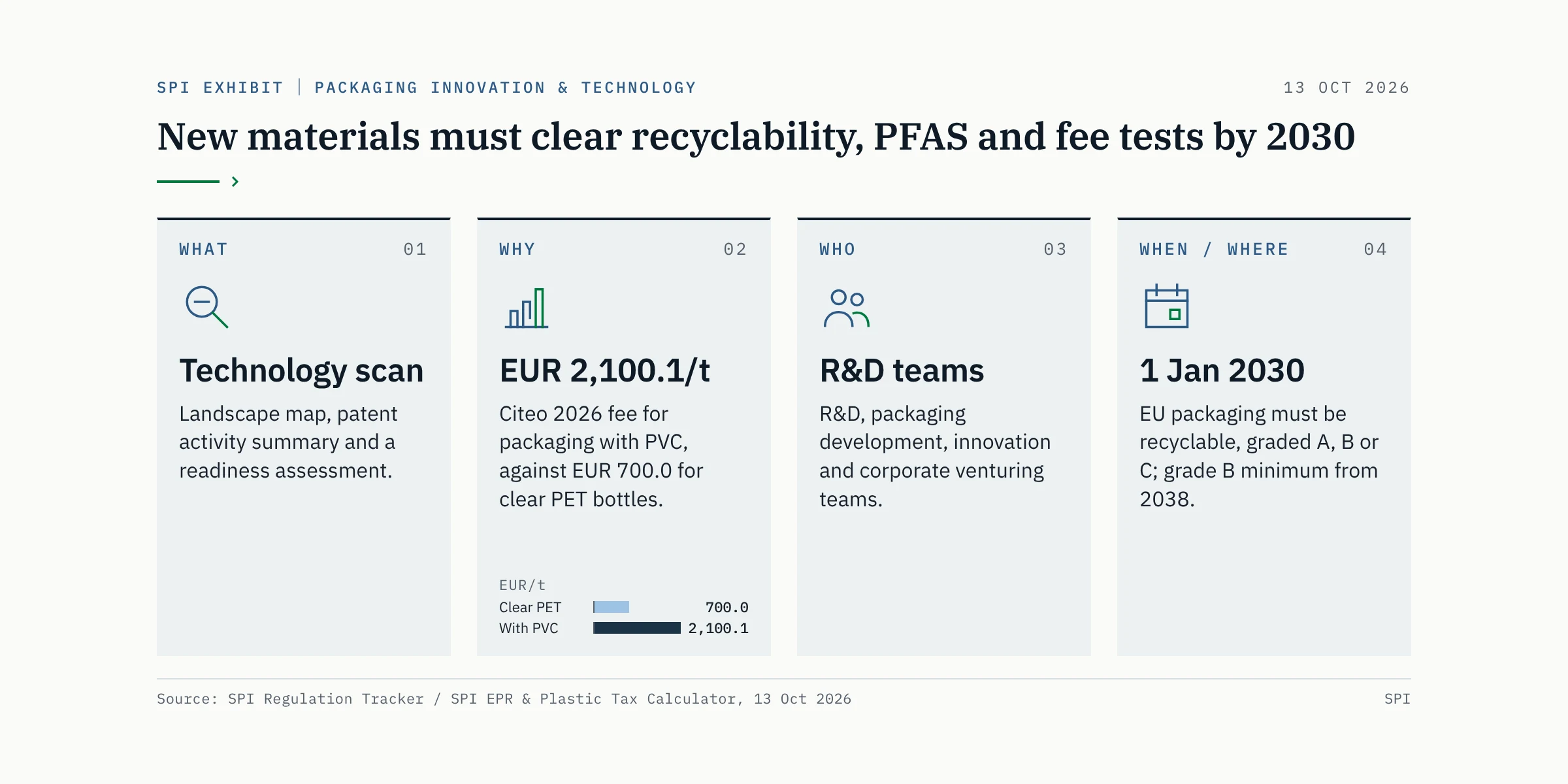
Regulation (EU) 2025/40 requires all packaging on the EU market to be recyclable from 1 January 2030, graded A, B or C against design-for-recycling criteria, and EPR fee schedules already charge non-recyclable formats several times more. SPI helps R&D, innovation and venturing teams decide which technologies are ready, and where the evidence is still thin.
By the SPI team · Figures as of 13 October 2026
79
Packaging rules tracked
across 25 jurisdictions
SPI Regulation Tracker
6
Design rules
including PPWR recyclability, PFAS and empty-space limits
SPI Regulation Tracker
216
Published fee rows
in 14 markets, many modulated by recyclability
SPI EPR & Plastic Tax Calculator
15
Unilever flexible plastics recyclable
per cent in 2025, against 75 per cent of rigids
SPI Buyers Database, Unilever Annual Report 2025
Source: SPI Trackers, checked 14 Oct 2026.
Key facts
- From 1 January 2030, packaging placed on the EU market is to be recyclable, graded A, B or C against design-for-recycling criteria; packaging below grade C is treated as technically non-recyclable, and grade B becomes the minimum from 1 January 2038 (PR-EU-010, PPWR recital 28).
- Since 12 August 2026, EU food-contact packaging may not contain PFAS at or above the PPWR limit values; the Commission is to review the restriction by 12 February 2030 (PR-EU-002).
- In Oregon’s 2026 EPR schedule, polycoated paperboard that is not accepted for collection pays USD 1,058.22 per tonne against USD 176.37 for paperboard (Circular Action Alliance, rows FEE-US-113 and FEE-US-111).
- Citeo’s 2026 French household fee is EUR 2,100.1 per tonne for packaging containing PVC and EUR 1,400.1 for complex or multi-resin packaging, against EUR 700.0 for clear PET bottles (rows FEE-FR-115, FEE-FR-114, FEE-FR-106).
- From 1 April 2027, the UK Plastic Packaging Tax is to accept a certified mass balance approach for chemically recycled plastic (PR-GB-001, HMRC policy paper of 26 November 2025).
- Unilever reports 57% of its plastic packaging reusable, recyclable or compostable in 2025: 75% of rigids but 15% of flexibles (SPI Buyers Database, Unilever Annual Report and Accounts 2025).
The problem: why technology choices carry more risk now
Innovation teams have always had to judge whether a new material performs and scales. Since 2025, they also have to judge whether it will be legal, collectable and affordable under rules that are now dated. A material that works on the line can still fail on recyclability grade, PFAS content or fee band.
Recyclability becomes a market-access test
The PPWR, Regulation (EU) 2025/40, has applied since 12 August 2026 (PR-EU-001). From 1 January 2030, packaging is expected to be recyclable, assessed against design-for-recycling criteria in Commission delegated acts and expressed as performance grades A, B or C. From 2035 it is also to be measured against recycling at scale, and from 1 January 2038 the minimum is grade B, according to the SPI note on PR-EU-010, which cites PPWR recitals 28 and 31. Recital 33 allows innovative packaging additional time.
Design for recycling means designing a pack so that collection, sorting and recycling systems can recover its material: for example, a single polymer rather than a laminate, or a label and adhesive that separate in the wash.
SPI analysis
Until the delegated acts set the grading criteria, any claim that a new material “will be grade A” is a forecast. SPI scans therefore show each technology against the criteria as published, and mark where a grade depends on an act that has not been adopted.
Fee schedules already price recyclability
EPR schemes set fees by material and, increasingly, by whether a format is collected and recycled. In the SPI EPR & Plastic Tax Calculator, the spread between collected and not-accepted formats is large.
- Collected format
- Not-accepted format
Source: Circular Action Alliance, 2026 Oregon Producer Fee Schedule, checked 13 Oct 2026.
Rows FEE-US-105, FEE-US-107, FEE-US-108, FEE-US-109, FEE-US-111, FEE-US-113. PRO list and statewide list items are collected; not accepted items are not.
Show the data
| Material family | Collected format | Not-accepted format |
|---|---|---|
| Paper-based board | 176.37 | 1,058.22 |
| Flexible plastic | 947.99 | 2,248.72 |
| Expanded polystyrene | 1,587.33 | 3,042.38 |
In Belgium, the Fost Plus 2026 tariff varies even within one polymer. A clear colourless PET bottle pays EUR 0.3604 per kg and an opaque PET bottle EUR 0.8776, while other plastics including aluminium laminates and PVC pay EUR 4.419 per kg.
Italy’s CONAI sets a separate 2026 band for biodegradable and compostable plastic at EUR 246 per tonne, inside a plastic range that runs from EUR 51 to EUR 922 per tonne by band (rows FEE-IT-012 to FEE-IT-021). Fee treatment is therefore part of the business case for any new material, and it differs by market.
Substances and formats are being restricted
The PFAS limit for EU food-contact packaging, in force since 12 August 2026, mainly touches paper, board and moulded-fibre grades that relied on fluorinated treatments for grease and water resistance, according to the SPI note on PR-EU-002. That creates demand for alternative barrier technologies, and a need for evidence that they sit below the limits. From 1 January 2030, Article 25 and Annex V of the PPWR also bar specified single-use plastic formats, such as packaging for pre-packed fresh fruit and vegetables under 1.5 kg (PR-EU-008; see PPWR 2030 format restrictions). The 2030 reuse targets of 40% for transport packaging and 10% for grouped packaging (PR-EU-006) and the 50% empty-space limit for grouped, transport and e-commerce packaging (PR-EU-009) open space for reusable and right-sizing systems.
In the United States, California SB 343 limits recyclability claims, including the chasing-arrows symbol, on products made after 4 October 2026. Its enforcement has been blocked by a preliminary injunction since 14 July 2026, and its status in the tracker is being updated in the 13 October check (PR-US-011).
Recycling technology is being written into tax and content rules
The PPWR sets minimum recycled content in plastic packaging from 2030, rising to up to 65% for single-use plastic beverage bottles by 2040 (PR-EU-004, PR-EU-005), and the EUR-Lex summary lists compostable plastic packaging among the exceptions. In the UK, HMRC has announced a certified mass balance approach for chemically recycled plastic from 1 April 2027 (PR-GB-001). Mass balance is an accounting method that allocates recycled input to outputs across a process where recycled and virgin feedstock are mixed.
- Design rule
- Ban
- Tax or levy
- Recycled content
- Other
- PPWR applies; PFAS limits for food-contact packaging (PR-EU-001, PR-EU-002)Design rule
- Commission guidelines on Annex V format restrictions due (PR-EU-008)Ban
- UK tax: certified mass balance for chemically recycled plastic (PR-GB-001)Tax or levy
- Deposit return scheme for drinks containers (England and Northern Ireland) (PR-GB-004)Deposit return
- Scotland deposit return scheme start moved to October 2027 (PR-GB-005)Deposit return
- Implementing act on empty-space ratio method due (PR-EU-009)Design rule
- PPWR: harmonised material-composition sorting label (PR-EU-003)Labelling
- PPWR: 90% separate collection of beverage containers (deposit systems) (PR-EU-007)Deposit return
- Recyclability grades, format restrictions, reuse and recycled-content targets apply (PR-EU-010, PR-EU-008, PR-EU-006, PR-EU-004)Design rule
- Commission review of the PFAS restriction (PR-EU-002)Design rule
- Grade B becomes the minimum recyclability grade (PR-EU-010)Design rule
- 2040Recycled content up to 65% for single-use plastic beverage bottles (PR-EU-005)Recycled content
Source: SPI Regulation Tracker, checked 14 Oct 2026.
Show the data
| Date | Label | Category | Link |
|---|---|---|---|
| 2026-08-12 | PPWR applies; PFAS limits for food-contact packaging (PR-EU-001, PR-EU-002) | design_rule | /data/packaging-regulation-tracker/european-union/ |
| 2027-02-12 | Commission guidelines on Annex V format restrictions due (PR-EU-008) | ban | /data/packaging-regulation-tracker/european-union/ |
| 2027-04-01 | UK tax: certified mass balance for chemically recycled plastic (PR-GB-001) | tax | /data/packaging-regulation-tracker/united-kingdom/ |
| 2028-02-12 | Implementing act on empty-space ratio method due (PR-EU-009) | design_rule | /data/packaging-regulation-tracker/european-union/ |
| 2030-01-01 | Recyclability grades, format restrictions, reuse and recycled-content targets apply (PR-EU-010, PR-EU-008, PR-EU-006, PR-EU-004) | design_rule | /data/packaging-regulation-tracker/european-union/ |
| 2030-02-12 | Commission review of the PFAS restriction (PR-EU-002) | design_rule | /data/packaging-regulation-tracker/european-union/ |
| 2038-01-01 | Grade B becomes the minimum recyclability grade (PR-EU-010) | design_rule | /data/packaging-regulation-tracker/european-union/ |
| 2040 | Recycled content up to 65% for single-use plastic beverage bottles (PR-EU-005) | recycled_content | /data/packaging-regulation-tracker/european-union/ |
| 2027-10-01 | Deposit return scheme for drinks containers (England and Northern Ireland) (PR-GB-004) | Deposit return | https://www.strategicpackaginginsights.com/data/packaging-regulation-tracker/united-kingdom/pr-gb-004/ |
| 2027-10-01 | Scotland deposit return scheme start moved to October 2027 (PR-GB-005) | Deposit return | https://www.strategicpackaginginsights.com/data/packaging-regulation-tracker/united-kingdom/pr-gb-005/ |
| 2028-08-12 | PPWR: harmonised material-composition sorting label (PR-EU-003) | Labelling | https://www.strategicpackaginginsights.com/data/packaging-regulation-tracker/european-union/pr-eu-003/ |
| 2029-01-01 | PPWR: 90% separate collection of beverage containers (deposit systems) (PR-EU-007) | Deposit return | https://www.strategicpackaginginsights.com/data/packaging-regulation-tracker/european-union/pr-eu-007/ |
Brand owners need solutions they do not yet have
The SPI Buyers Database shows the gap between recyclability targets and reported progress, especially for flexible packaging.
- Target
- Latest reported
Source: SPI Buyers Database, company reports rechecked, checked 13 Oct 2026.
Company-reported; definitions of recyclable, reusable or compostable differ by company. Estée Lauder's target was 75 to 100 per cent; the lower bound is shown.
Show the data
| Company and scope | Target | Latest reported |
|---|---|---|
| Unilever, flexible plastic packaging (2035 target) | 100 | 15 |
| Unilever, rigid plastic packaging (2030 target) | 100 | 75 |
| Walmart, global private-brand packaging (2025 target) | 100 | 64.3 |
| Carrefour, own-brand packaging (2025 target) | 100 | 67.2 |
| The Estée Lauder Companies, all packaging (2025 target) | 75 | 72 |
| Nestlé, all packaging (2025 target) | 100 | 89.5 |
SPI analysis
The 60-point gap between Unilever’s reported rigid and flexible recyclability is the clearest signal in the database of where technology is missing: mono-material flexible structures, recyclable barriers and sorting-friendly formats. These are also the areas where performance claims are hardest to test from public evidence, so a scan has to separate what is shown from what is claimed.
Who this service is for
- R&D and packaging development teams at brand owners and converters who need to know which alternative materials or barrier technologies are close to commercial use.
- Innovation and corporate venturing teams screening start-ups, licences or partnerships in a packaging technology area.
- Material start-ups and scale-ups who want an outside view of the competitive patent and launch landscape, and the rules their technology must meet in target markets.
- Strategy teams at material suppliers deciding where to commercialise a technology first.
Scope: what SPI covers
- Technology landscaping: the technologies, materials and process routes that address a defined packaging problem, such as a PFAS-free grease barrier or a recyclable high-barrier flexible film, grouped by approach.
- Patent monitoring: documented searches in public patent databases such as the European Patent Office’s Espacenet and WIPO PATENTSCOPE, with the queries, classification codes and date ranges recorded so they can be repeated.
- Emerging material assessment: performance claims, published test results, launches, announced capacity and supply chain, each with its source.
- Regulatory and fee fit: each technology mapped against the design rules, recycled-content rules and fee schedules in the SPI Trackers for your target markets.
- Commercialisation opportunities: where and with whom a technology could be launched first, based on rule timing, buyer commitments and fee incentives.
Deliverables
| Deliverable | What it contains | Format |
|---|---|---|
| Technology landscape map | Approaches to the problem, the main technologies in each, and who is active, from public evidence | Diagram and report section |
| Patent activity summary | Filing activity by applicant, year and technology group, with every search query documented | Spreadsheet and summary charts |
| Readiness assessment | Each technology placed on the SPI evidence ladder, with the evidence and gaps stated | Table and narrative |
| Regulatory and fee fit | Rules and fee bands that apply in your markets, with rule IDs and rate rows | Table |
| Commercialisation options | First markets, customer segments and partnership routes, with risks and evidence gaps | Report, 10 to 20 pages typical |
| Data annex and read-out | Sources, queries, assumptions, corrections log and a read-out call with one round of clarifications | Spreadsheet, call |
Methodology: the SPI 6-step spine
All SPI consulting follows the six steps set out in the SPI Methodology. For technology work, they look like this.
| Step | What happens | Technology output |
|---|---|---|
| 1. Scope | Scoping call and written brief: the problem, the technologies in and out of scope, target markets, time horizon | Agreed technology boundary and questions |
| 2. Source plan | Patent databases, journals, company disclosures and SPI datasets listed; each fact gets source, date and scope | Named sources and draft search strings |
| 3. Evidence | Documented patent searches, launch tracking, SPI rule and fee data; expert interviews only if scoped | Patent set, launch list, claims register |
| 4. Analysis | Sourced facts kept separate from SPI judgement; readiness placed on the evidence ladder | Landscape map, readiness table, fit table |
| 5. Check | Second SPI team member re-runs sample queries and checks numbers and sources | QA record and corrections log |
| 6. Deliver | Report, data annex and read-out call, one round of clarifications | Commercialisation options and read-out |
Source: SPI Methodology, checked 14 Oct 2026.
Patent searches are recorded query by query, so you can re-run them or hand them to your patent counsel. Readiness is an SPI judgement and is always shown with the evidence behind it.
Sample deliverable outline (illustration only)
The tables and outline below illustrate the format of a typical readiness assessment. They are not from a past project and contain no real company names, technologies or results.
| Level | Evidence SPI looks for | Example of what would be cited |
|---|---|---|
| 1. Claimed | Company or inventor claims performance | Press release or website page, dated |
| 2. Protected | Patent applications or grants cover the approach | Patent numbers from the documented search |
| 3. Tested | Published test results or third-party trial data | Journal article, trade test report |
| 4. Piloted | Named pilot line or market trial | Company announcement with location and date |
| 5. Launched | Commercial product on sale in at least one market | Product listing or annual report |
| 6. Scaled | Announced capacity and more than one customer or market | Capacity announcement, multiple launches |
Source: SPI illustration, not a past project, checked 14 Oct 2026.
Levels describe the public evidence available, not a technical rating.
A typical readiness report runs in this order:
- Problem and boundary. The packaging problem, the technologies in scope and the markets that matter.
- Rules and fees that set the bar. Design rules, recycled-content rules and fee bands, with rule IDs and rate rows.
- Landscape. Approaches grouped by mechanism, with active organisations from public evidence.
- Patent activity. Filing trends and main applicants by technology group, with queries in the annex.
- Readiness table. Each technology on the evidence ladder, with the evidence and the gaps.
- Commercialisation options. Where each ready technology could go first, and what would need to be true.
- Annex. Search strings, sources, assumptions and the corrections log.
Engagement formats and typical timelines
| Format | Typical scope | Typical timeline | Pricing |
|---|---|---|---|
| Briefing | One question from existing SPI data, such as which rules and fee bands a new material faces in three markets | One 60-minute call plus a short memo; timing agreed at scoping | On request, fixed fee |
| Sprint | One technology area: landscape, patent summary, readiness and fit | Two to four weeks | On request, fixed fee per scope |
| Programme | Several technology areas or a full commercialisation study, in phases | Six to twelve weeks | On request, fixed fee by phase |
| Retainer | Repeat patent and launch searches and rule changes, with quarterly read-outs | Ongoing | On request, monthly fee |
What SPI needs from you
- The packaging problem and the performance requirements a solution must meet.
- Technologies, companies or patent families to include or exclude, if you already have a view.
- Target markets, end uses and the time horizon for commercial launch.
- Any internal test data or patent searches you want SPI to take into account, shared under confidentiality.
- A named contact and your decision date.
Limitations: what this service does not do
- Not freedom-to-operate and not a legal opinion. Patent analysis is landscape-level. SPI does not assess infringement, validity or patentability. For those, you need qualified patent counsel, and we can point you to a qualified provider.
- No testing or certification. SPI does not test materials, certify recyclability or compostability, or carry out life-cycle assessments. Where you need a laboratory test or certified assessment, we say so.
- Readiness is an SPI judgement. It is based on public evidence and stated as such, with the evidence shown.
- Rule fit is not legal advice. Grades under PR-EU-010 depend on delegated acts not yet adopted; confirm obligations with counsel.
- Public and licensed sources only. SPI does not seek confidential or improperly obtained information about any company’s technology.
- The SPI Innovation & Launch Tracker and the SPI Patent Tracker are not yet available. Patent and launch evidence is built for each assignment from public databases.
SPI Trackers and tools this service draws on
- SPI Regulation Tracker: 79 rules in 25 jurisdictions, including 6 design rules and 6 recycled-content rules.
- SPI EPR & Plastic Tax Calculator: 216 published rate rows in 14 markets, used to compare the fee band of a new material with the incumbent.
- SPI Buyers Database: 179 public packaging targets from 42 brand owners and retailers, used to show where buyers need new solutions.
Where this fits in your decision
In SPI’s Discover, Understand, Evaluate, Decide and Implement model, Innovation & Technology sits at Understand (what is maturing and what the rules require) and Evaluate (which option is ready). Once a material is chosen, SPI Sustainable Packaging Strategy covers redesign and roll-out priorities. Investors assessing a technology company can combine this with SPI Packaging Investment & Transaction Intelligence. Free context on materials is at SPI Intelligence for Packaging Manufacturers.
How to enquire
Send an enquiry through the contact form with the packaging problem, the technologies of interest and your decision date, or write to sales@strategicpackaginginsights.com. The SPI team aims to reply within two business days. If the work fits, we hold a scoping call and send a written proposal with a fixed fee.
Frequently asked questions
What does a packaging technology landscape include?
It groups the approaches to a defined packaging problem, lists the main technologies and the organisations active in each from public evidence, and adds patent activity and launches. SPI also maps each technology against the rules and fee bands in your markets.
Is SPI's patent analysis a freedom-to-operate review?
No. SPI’s patent work is landscape-level: it shows who is filing and in which technology groups, with every query documented. It is not a freedom-to-operate review or a legal opinion; for that you need qualified patent counsel.
What does PPWR recyclability mean for new packaging materials?
From 1 January 2030, packaging on the EU market is to be recyclable, graded A, B or C against design-for-recycling criteria in delegated acts, with grade B the minimum from 2038 (PR-EU-010). A new material needs a credible route to an acceptable grade in the markets where it will be sold.
Does SPI test or certify packaging materials?
No. SPI does not test, certify or run life-cycle assessments. It reviews published evidence and says where a laboratory test or certified assessment is needed, and can point you to a qualified provider.
How does SPI judge whether a technology is ready to scale?
SPI places each technology on an evidence ladder from claimed to scaled, based on public evidence such as patents, published tests, pilots, launches and announced capacity. Readiness is stated as an SPI judgement with the evidence shown.
Why do EPR fees matter for packaging innovation?
Fees often depend on whether a format is collected and recycled. In Oregon’s 2026 schedule, not-accepted polycoated paperboard pays USD 1,058.22 per tonne against USD 176.37 for paperboard, so a recyclable design can cut a customer’s fee bill as well as meet the rules.
Does SPI have a patent tracker?
Not yet. The SPI Patent Tracker and SPI Innovation & Launch Tracker are planned but not available. Patent and launch evidence is built for each assignment from public databases, with the searches documented.
Sources
- European Parliament Legislative Observatory, Regulation (EU) 2025/40 summary. https://oeil.europarl.europa.eu/oeil/en/document-summary?id=1802233 (PR-EU-001, PR-EU-002, PR-EU-004 to PR-EU-006, PR-EU-009, PR-EU-010; checked 13 October 2026)
- EUR-Lex, Regulation (EU) 2025/40, recitals 28, 31 and 33, Article 25 and Annex V. https://eur-lex.europa.eu/eli/reg/2025/40/oj/eng (PR-EU-008, PR-EU-010; checked 13 October 2026)
- European Commission (DG ENV), Packaging waste. https://environment.ec.europa.eu/topics/waste-and-recycling/packaging-waste_en (checked 13 October 2026)
- Circular Action Alliance, 2026 Oregon Producer Fee Schedule. https://static1.squarespace.com/static/64260ed078c36925b1cf3385/t/693b2c9103be112d168e1b19/1765485713621/OR+2026+Fee+Schedule+Public.pdf (rows FEE-US-105 to FEE-US-113; as held in the SPI calculator, 13 October 2026)
- Fost Plus, Green Dot tariffs 2026. https://www.fostplus.be/en/media/1930/download (rows FEE-BE-007 to FEE-BE-019; 13 October 2026)
- Citeo, Guide du tarif des emballages ménagers 2026. https://clients-cms.citeo.com/uploads/guide_du_tarif_des_emballages_menagers_2026_f9e4c5b4e6.pdf (rows FEE-FR-106, FEE-FR-114, FEE-FR-115; 13 October 2026)
- CONAI, Contributo Ambientale 2026. https://www.conai.org/en/companies/services-for-managing-consortium-obligations-and-business-opportunities/epr-fee/ (rows FEE-IT-012 to FEE-IT-021; 13 October 2026)
- GOV.UK (HMRC), Plastic Packaging Tax: mass balance approach and removal of pre-consumer plastic, 26 November 2025. https://www.gov.uk/government/publications/plastic-packaging-tax-mass-balance-approach-and-removal-of-pre-consumer-plastic/plastic-packaging-tax-mass-balance-approach-and-removal-of-pre-consumer-plastic (PR-GB-001; checked 13 October 2026)
- CalRecycle, SB 343 Accurate Recycling Labels. https://calrecycle.ca.gov/wcs/recyclinglabels/ (PR-US-011; checked 13 October 2026)
- Unilever, Annual Report and Accounts 2025. https://www.unilever.com/files/unilever-annual-report-and-accounts-2025.pdf (rechecked 13 October 2026)
- Walmart ESG, waste and circular economy. https://corporate.walmart.com/content/corporate/en_us/purpose/esgreport/environmental/waste-circular-economy.html (rechecked 13 October 2026)
- Carrefour, 2025 Universal Registration Document. https://www.carrefour.com/sites/default/files/2026-04/CFR2025_URD_EN_PDF_MEL_270326_0.pdf (rechecked 13 October 2026)
- The Estée Lauder Companies, Social Impact and Sustainability Report 2025. https://media.elcompanies.com/files/e/estee-lauder-companies/global/our-impact/si-s25/sis-2025.pdf (rechecked 13 October 2026)
- Nestlé UK, Progress on packaging and plastics. https://www.nestle.co.uk/en-gb/stories/progress-packaging-plastics (rechecked 13 October 2026)
Ask the SPI team
What changes for your packaging next quarter?
Tell us your markets and materials. The SPI team walks you through the rules and buyer commitments that affect them.
Prefer email? Write to sales@strategicpackaginginsights.com.
- Q1
Which packaging rules apply to us in each market we sell in?
We map each market's EPR, tax, ban, recycled-content, labelling and deposit rules against your materials and formats, and show which are in force, adopted or only proposed.
- Q2
What could EPR fees and plastic taxes cost us next year?
We apply published fee tables and tax rates to your tonnages and recycled content, and show the result as scenarios with every rate sourced.
- Q3
Can you tell us when a rule changes?
Yes. The free tracker alerts cover rule changes by country; a monitoring retainer adds monthly notes on what the changes mean for your portfolio.