
SPI Sustainable Packaging Strategy: Material Alternatives, Recyclability and Redesign Roadmaps
SPI Sustainable Packaging Strategy helps you choose the material alternatives and redesigns that meet your public targets and the packaging rules in your markets without breaking cost or pack performance, and sets them out as a prioritised roadmap with the evidence for each option.
Many 2025 packaging targets have now been reported against, and a large share fell short, while the EU’s 2030 recyclability and recycled-content rules are fixed in law. Strategic Packaging Insights (SPI) compares the realistic options for each pack on recyclability evidence, regulatory fit and cost direction, using the SPI Buyers Database, the SPI Regulation Tracker and published fee tables.
By the SPI team · Figures as of 13 October 2026
179
Public packaging targets tracked
from 42 brand owners and retailers
SPI Buyers Database
19
Targets due by 2025 reported missed
against 16 reported met
SPI Buyers Database
30
Recycled content in EU single-use plastic drinks bottles from 2030
per cent, rising to 65 by 2040
PR-EU-004, PR-EU-005
30
UK Plastic Packaging Tax recycled-content threshold
per cent; GBP 228.82 per tonne below it
PR-GB-001
Source: SPI Buyers Database; SPI Regulation Tracker, checked 14 Oct 2026.
Key facts
- The SPI Buyers Database tracks 179 public packaging targets from 42 brand owners and retailers; of the 60 targets due in 2025 or earlier, companies report 16 as met and 19 as missed (SPI Buyers Database, 13 October 2026).
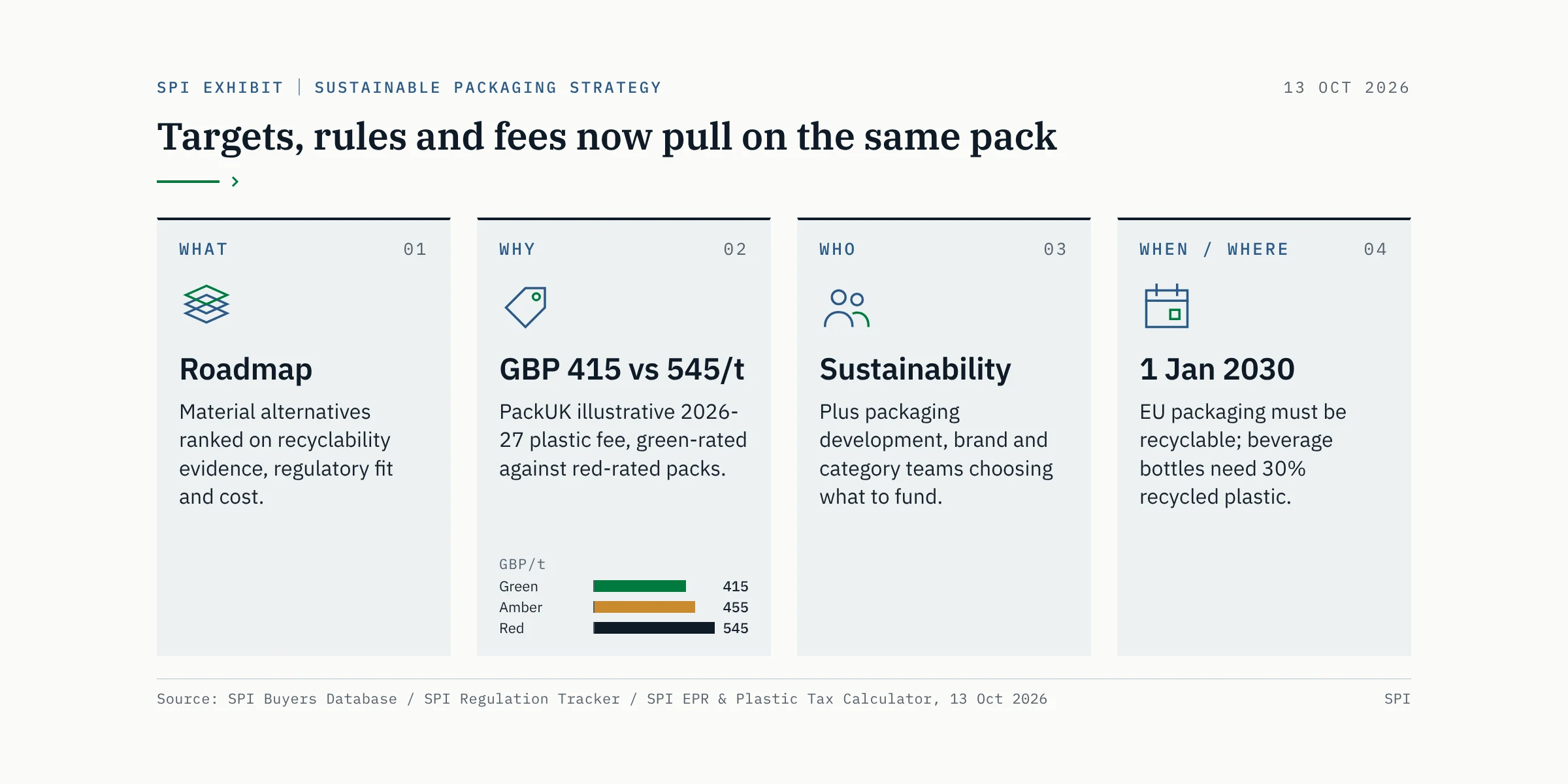
- From 1 January 2030, packaging placed on the EU market must be recyclable under design-for-recycling criteria, and from 1 January 2038 the minimum is performance grade B (PR-EU-010, PPWR recital 28, SPI rule note).
- Single-use plastic beverage bottles in the EU must contain 30% post-consumer recycled plastic from 2030, rising to up to 65% by 2040 (PR-EU-004, PR-EU-005).
- California requires 25% postconsumer recycled plastic in redemption-value beverage containers since 1 January 2025, rising to 50% on 1 January 2030 (PR-US-009, CalRecycle).
- India’s Plastic Waste Management Rules, as revised by the 2026 amendment rules, set recycled-plastic shares for Category I rigid packaging rising to 60% from 2028-29 (PR-IN-002, G.S.R. 237(E)).
- The PPWR sets binding 2030 reuse targets of 40% for transport packaging and 10% for grouped packaging (PR-EU-006).
- Fees reward recyclable formats: PackUK’s illustrative 2026-27 plastic fee is £415 per tonne for green-rated and £545 for red-rated packaging (PR-GB-003).
The problem: targets, rules and fees now pull on the same pack
Sustainability teams used to choose materials against their own public commitments. In 2026 the same pack has to satisfy three tests at once: the company’s target, the rules in each market, and a fee schedule that charges more for formats that are hard to recycle. The three do not always point the same way.
The 2025 targets came due, and many were missed
Brand owners set a wave of packaging targets for 2025, and their 2025 and fiscal 2026 reports now give the outcome. In the SPI Buyers Database, companies report 19 targets due by 2025 as missed and 16 as met; for 24 more, no outcome has been reported yet. The recycled-content targets show the pattern.
- Target
- Latest
Source: SPI Buyers Database (company reports), checked 13 Oct 2026.
Latest reported figure against each 2025 recycled-content target; Walmart figures are fiscal 2026, Diageo and Estee Lauder fiscal 2025; targets are company-defined and not directly comparable.
Show the data
| Company target | Target | Latest |
|---|---|---|
| L'Oréal (by 2030, not reported) | 100 | 50 |
| HEINEKEN (by 2030, in progress) | 50 | 48 |
| Diageo (by 2030, in progress) | 50 | 47 |
| Diageo (by 2025, met) | 35 | 44 |
| L'Oréal (by 2030, in progress) | 50 | 44 |
| ITC Limited (by 2030, on track) | 60 | 35.5 |
| Marico (by 2030, in progress) | 60 | 32.2 |
| The Coca-Cola Company (by 2035, in progress) | 35 | 30 |
| Henkel (by 2030, in progress) | 35 | 28 |
| Colgate-Palmolive (by 2025, met) | 25 | 27 |
| Lidl (by 2025, met) | 25 | 26 |
| Starbucks (by 2030, in progress) | 25 | 25 |
| Unilever (by 2025, met) | 25 | 25 |
| Carrefour (by 2025, missed) | 30 | 24 |
| Nestlé (no year, not reported) | no data | 20.6 |
| The Coca-Cola Company (by 2035, in progress) | 30 | 20 |
| The Estée Lauder Companies (by 2025, missed) | 25 | 20 |
| The Estée Lauder Companies (by 2030, in progress) | 25 | 20 |
| Kimberly-Clark (by 2025, missed) | 20 | 18 |
| PepsiCo (by 2035, in progress) | 40 | 18 |
| Keurig Dr Pepper (by 2035, in progress) | 25 | 16 |
| Keurig Dr Pepper (by 2025, not reported) | 25 | 16 |
| Ahold Delhaize (by 2025, not reported) | 25 | 15.7 |
| Target (by 2025, not reported) | 20 | 13 |
| Henkel (by 2028, in progress) | 45 | 12 |
| Reckitt (by 2025, not reported) | 25 | 12 |
| Walmart (by 2025, missed) | 20 | 12 |
| Walmart (by 2025, missed) | 17 | 10.7 |
| Mars (no year, in progress) | 30 | 9.2 |
| Mars (by 2025, not reported) | 30 | 9.2 |
| ITC Limited (by 2030, on track) | 20 | 4.5 |
| Mondelēz International (by 2030, in progress) | 5 | 3.7 |
| Dabur India (by 2026, not reported) | 30 | 2 |
Recyclability targets show a similar gap. Walmart reports 64.3% of global private-brand packaging recyclable, reusable or industrially compostable in fiscal 2026 against a 100% target for 2025; Carrefour reports 67.2% of own-brand packaging reusable, recyclable or compostable in 2025 against 100%; Nestlé reports 89.5% against its earlier 100% target (SPI Buyers Database, company reports). AB InBev reports 89.7% of products in returnable or majority-recycled packaging in 2025 against a 100% goal, and cites limited recycled PET supply (SPI Buyers Database, AB InBev 2025 Annual Report).
SPI analysis
The shortfalls are concentrated where supply or infrastructure is the constraint, food-grade recycled resin and flexible packaging recyclability, not where the brand controls the design alone. A restated target that ignores those constraints is likely to be missed again. A credible target is built bottom-up from the pack list, with the supply and collection evidence for each format.
The rules set floors that targets cannot go below
The rules in the SPI Regulation Tracker now set minimums in several markets.
| Market | Rule | Requirement | From | Rule ID |
|---|---|---|---|---|
| EU | Single-Use Plastics Directive | 25% recycled plastic in PET beverage bottles; 30% in all plastic beverage bottles (Member State average) | 2025; 2030 | PR-EU-016 |
| EU | PPWR | 30% recycled content in single-use plastic beverage bottles, other categories have their own percentages | 2030-01-01 | PR-EU-004 |
| EU | PPWR | Up to 65% for single-use plastic beverage bottles | 2040 | PR-EU-005 |
| EU | PPWR | All packaging recyclable under design-for-recycling criteria | 2030-01-01 | PR-EU-010 |
| EU | PPWR | Reuse: 40% transport packaging, 10% grouped packaging | 2030-01-01 | PR-EU-006 |
| California | AB 793 | 25% postconsumer recycled plastic in redemption-value beverage containers, 50% from 2030; shortfall penalty USD 0.20 per pound | 2025-01-01 | PR-US-009 |
| New Jersey | Recycled Content Law | 15% in plastic beverage containers, 20% from 2027, 50% by 2044 | 2024 | PR-US-010 |
| United Kingdom | Plastic Packaging Tax | GBP 228.82 per tonne on components with less than 30% recycled plastic | 2026-04-01 rate | PR-GB-001 |
| Spain | Royal Decree 1055/2022 | 20% reusable commercial and industrial packaging in 2030, 30% in 2035 | 2030 | PR-ES-002 |
| India | PWM Amendment Rules 2026 | Category I rigid plastic 30% rising to 60% recycled content from 2028-29 | 2025-26 | PR-IN-002 |
Source: SPI Regulation Tracker and SPI rule notes, checked 14 Oct 2026.
Two details change design choices. First, how recycled content is measured is not settled everywhere: the PPWR calculation method depends on a Commission implementing act, and HMRC has announced that from 1 April 2027 pre-consumer plastic will no longer count towards the UK 30% threshold (PR-EU-004, PR-GB-001, SPI rule notes). Second, the PPWR recyclability test grades formats A, B or C, and packaging below grade C is treated as non-recyclable (PR-EU-010, SPI rule note). A format that passes today’s fee test may still need redesign for the 2030 grade.
Fees already price recyclability
EPR fee schedules in the SPI EPR & Plastic Tax Calculator make the cost of a poor format visible.
| Scheme | Lower-fee format | Rate per tonne | Higher-fee format | Rate per tonne | Currency |
|---|---|---|---|---|---|
| PackUK, United Kingdom | Plastic, green rating | 415 | Plastic, red rating | 545 | GBP |
| Repak, Ireland | Recycled rigid plastic category | 165.7 | Non-recycled plastic category | 616.22 | EUR |
| Citeo, France | Clear PET bottle | 700 | Packaging containing PVC | 2100.1 | EUR |
| Fost Plus, Belgium | Clear colourless PET bottle | 360.4 | PP film | 2209.5 | EUR |
| CAA, Oregon | Natural HDPE bottle | 198.42 | PP film (not accepted) | 2248.72 | USD |
| Recycle BC, British Columbia | HDPE bottle | 470 | Expanded polystyrene | 4070 | CAD |
Source: SPI EPR & Plastic Tax Calculator, checked 13 Oct 2026.
Rates per tonne in each scheme's own currency, 2026 (PackUK illustrative 2026-27); per kg rates multiplied by 1000; no currency conversion.
SPI analysis
Fee gaps of this size can pay for part of a redesign, but only for the markets and volumes where they apply. SPI works out the fee effect per market in each currency and sets it against the cost direction of the alternative, so a redesign is chosen on its whole effect, not on one market’s fee table.
Who this service is for
- Sustainability teams setting or restating packaging targets that must stand up against regulation and peers.
- Packaging development and technical teams choosing between materials or formats for a specific pack or range.
- Brand and category teams who need to know which redesign to fund first.
- Converters and material suppliers preparing a proposal for a customer whose public target they must help meet.
Scope: what SPI covers
- Material alternatives for a pack or range, compared on recyclability evidence, regulatory fit, fee effect and indicative cost direction.
- Desk-based recyclability review against published design-for-recycling guidance and the recyclability rules of your markets.
- Reuse and refill options, including what the PPWR and national reuse targets require of transport and grouped packaging.
- Peer benchmarks of public packaging commitments and reported progress, from the SPI Buyers Database and company reports.
- Redesign opportunities and priorities, ranked on criteria you agree.
Deliverables
| Deliverable | What it contains | Format |
|---|---|---|
| Options matrix | Each pack and its alternatives: material, recyclability evidence and its source, regulatory fit by market, fee effect, indicative cost direction, open questions | Spreadsheet and report section |
| Peer benchmark | Named peers' public packaging targets, baselines, deadlines and latest reported progress, each with its source and date | Table and commentary |
| Redesign roadmap | Prioritised redesigns with the rules and dates that drive them, the evidence still needed and suggested sequencing over 12 to 36 months | Report and roadmap chart |
Source: SPI Consulting service definitions, checked 14 Oct 2026.
Methodology: the SPI 6-step spine, applied to materials
| Step | Common to every SPI engagement | Specific to Sustainable Packaging Strategy |
|---|---|---|
| 1 Scope | Scoping call and written brief | Packs and ranges in scope, markets, targets to meet, performance constraints |
| 2 Source plan | Sources named with date, scope and licence | Published design-for-recycling guidance, rule texts, fee tables, company reports |
| 3 Evidence | Desk research and SPI datasets | Pack specifications you supply, SPI Regulation Tracker, SPI Buyers Database, calculator rows |
| 4 Analysis | Facts separate from SPI estimates | Each option scored on stated criteria; evidence gaps flagged, not filled by assumption |
| 5 Check | Second-person check of numbers and sources | Each rule, rate and peer figure re-opened on its source |
| 6 Deliver | Report, data annex, read-out call | Options matrix, peer benchmark, roadmap |
Source: SPI Methodology; SPI Consulting service definitions, checked 14 Oct 2026.
Options are mapped against published recyclability guidelines and the rules in the SPI Regulation Tracker; peer commitments come from the SPI Buyers Database and company reports. Where the evidence on an option is thin, for example a new material without collection at scale in your markets, the matrix says so rather than giving it a score it has not earned. See the SPI Methodology for how SPI keeps facts and judgement apart.
How SPI ranks the options
Each alternative is scored on criteria agreed in the brief, and the weights are written down before scoring starts, so the ranking cannot be tuned after the fact. The usual criteria are:
- Regulatory fit: does the option meet the recyclability, recycled-content, reuse and format rules in every market in scope, and from which date? An option that fails the PPWR test in 2030 scores low even if it is cheaper today.
- Recyclability evidence: is there published design-for-recycling guidance that supports it, and is collection and sorting in place in your markets? Evidence is graded strong, partial or thin, with the source named.
- Fee and tax effect: the change in EPR fees and plastic taxes per market, in each scheme’s own currency, from the published rows in the calculator.
- Cost direction: whether material and conversion cost is likely to rise, fall or stay level, from public and supplied data.
- Performance risk: shelf life, barrier, filling-line and transport constraints you set, and what testing would be needed to confirm them.
- Target contribution: how much the change moves your public targets, measured on the same definition and baseline as the target itself.
SPI analysis
The most common reason a redesign disappoints is that it was chosen on one criterion. A switch from multilayer plastic to paper-based packaging may lower one fee line while raising weight, transport cost and fees in markets that charge composites heavily. Scoring every option on every criterion makes those trade-offs visible before money is spent.
Where this service fits
In the SPI path from Discover to Implement, Sustainable Packaging Strategy sits at the Evaluate stage. Readers usually arrive after checking peer targets in the SPI Buyers Database (Discover) and the rules for their markets in the SPI Regulation Tracker (Understand). The roadmap then feeds the Decide and Implement stages: a funding decision on the first redesign wave, followed by a retainer that tracks rule and peer changes against the plan.
Sample deliverable outline (illustration only)
The outline below illustrates the format of an SPI options matrix and roadmap. It is not a past project. It names no company and reports no results; it shows the structure and the kind of evidence each row carries.
| Section | What it shows | Illustrative row |
|---|---|---|
| 1 Decision and scope | The pack, markets, targets and constraints agreed in the brief | Snack pouch range sold in the UK, France and Oregon |
| 2 Current pack baseline | Material, format, fee band and rule exposure today | Multilayer plastic pouch: PackUK rating [your RAM rating]; Citeo complex packaging line EUR 1400.1 per tonne |
| 3 Options matrix | Each alternative with evidence, regulatory fit, fee effect and cost direction | Mono-material PE pouch: recyclability evidence [source]; Oregon PRO-list film line USD 947.99 per tonne |
| 4 Regulatory fit | Which rules each option meets, and from when | PPWR recyclability from 2030-01-01 (PR-EU-010); grade B minimum from 2038 |
| 5 Peer benchmark | Peers' targets and progress, sourced | [named peers] recyclability target, deadline, latest figure |
| 6 Roadmap | Sequenced redesigns with decision points | Wave 1 before 2030-01-01; wave 2 after the delegated act on grades |
| 7 Evidence gaps | What needs lab testing or supplier data | Seal performance needs testing by a qualified provider |
| Annex | Sources, assumptions, corrections log | Source list with consulted dates |
Source: SPI Consulting format illustration, checked 14 Oct 2026.
Rule references and rates are public SPI data; option assessments are placeholders.
Formats, timelines and pricing
| Format | Typical use for this service | Typical timeline | Pricing |
|---|---|---|---|
| Briefing | One pack, one question, answered from existing SPI data | 60-minute call and short memo | On request |
| Sprint | Options matrix for one pack family in one region | 2 to 4 weeks | On request |
| Programme | Several ranges and regions, peer benchmark and full roadmap | 6 to 12 weeks | On request |
| Retainer | Quarterly peer and rule updates against your roadmap | Ongoing | On request |
Prices are quoted after a scoping call and fixed in a written proposal.
What SPI needs from you
- The packs in scope with their current specifications: materials, layers, components, weights and formats.
- Your public and internal packaging targets, with baselines and deadlines.
- Sales volumes or tonnages by market, so fee and tax effects can be weighted.
- Performance constraints: shelf life, barrier, filling line and transport requirements.
- Any recyclability ratings, test results or supplier declarations you already hold.
- The peers you want to be benchmarked against.
Limitations: what SPI does not do
- A recyclability review is a desk review against published guidance. It is not a laboratory test, a recyclability certification or an audit opinion.
- SPI does not carry out or certify life-cycle assessments. Where you need laboratory testing or a certified LCA, SPI says so and can point you to a qualified provider.
- Cost direction is indicative, from public and supplied data; it is not a supplier quotation.
- Peer data is company-reported. SPI quotes it with its source and does not audit it.
- Regulatory content is decision support, not legal advice.
SPI Trackers this service draws on
- SPI Buyers Database: 179 public packaging targets from 42 brand owners and retailers, each with its source quote and reported progress.
- SPI Regulation Tracker: recycled-content, reuse, design and ban rules, including the PPWR 2030 obligations and their SPI rule notes.
- SPI EPR & Plastic Tax Calculator: published fee lines by material and format, used to price each option’s fee effect per market.
Related reading: the PPWR 2030 format restrictions and plastic packaging taxes in 2026. For the full rule and cost picture across your markets, see SPI Packaging Regulatory Intelligence; for emerging materials not yet at scale, see SPI Packaging Innovation & Technology. Sustainability teams can start from SPI Intelligence for Sustainability teams.
How to enquire
Send the enquiry form or write to sales@strategicpackaginginsights.com with the packs, markets and targets in question and your decision deadline. The SPI team aims to reply within two business days, then holds a scoping call and sends a written proposal with a fixed price.
Frequently asked questions
What is a sustainable packaging strategy?
It is a plan for which packs to change, to what, in what order and why, so that packaging meets your targets and the rules in your markets at an acceptable cost and performance. SPI builds it from your pack list, published recyclability guidance, the rules in the SPI Regulation Tracker and peer evidence from the SPI Buyers Database.
What does the PPWR require on recycled content?
Regulation (EU) 2025/40 requires minimum post-consumer recycled content in plastic packaging from 2030, including 30% for single-use plastic beverage bottles, rising to up to 65% by 2040, with separate percentages for other categories. The calculation method depends on a Commission implementing act.
Are brand owners meeting their packaging targets?
Many are not. Of 60 public packaging targets due by 2025 in the SPI Buyers Database, companies report 16 as met and 19 as missed, with the rest not yet reported. Shortfalls are most common on recycled content and recyclability.
Can SPI tell us if our packaging is recyclable?
SPI reviews your packaging on paper against published design-for-recycling guidance and the rules of your markets, and says where the evidence is strong or thin. It does not test packaging or certify recyclability; where testing is needed, SPI says so and can point you to a qualified provider.
Do you carry out life-cycle assessments?
No. SPI does not carry out or certify LCAs. If your decision needs a certified LCA, SPI says so in the proposal and can point you to a qualified provider.
How do EPR fees affect material choice?
Many schemes charge less for formats that recycle well. PackUK’s illustrative 2026-27 plastic fee is £415 per tonne for green-rated and £545 for red-rated packaging, and Citeo’s 2026 tariff is EUR 700 per tonne for clear PET bottles against EUR 2,100.1 for packaging containing PVC. SPI prices this effect for each option in each market.
How do our packaging targets compare with our peers?
SPI benchmarks the public commitments and reported progress of the companies you name, each with its source and date, starting from the SPI Buyers Database. The benchmark shows baselines and definitions, because targets that look similar are often measured differently.
Sources
- SPI Buyers Database, /data/packaging-buyers-database/, data as of 13 October 2026; each target links to the company report it is quoted from (including Diageo, Colgate-Palmolive, Lidl, Unilever, Kimberly-Clark, The Estee Lauder Companies, Carrefour, Walmart, Nestle and AB InBev reports cited there).
- SPI Regulation Tracker and SPI rule notes, /data/packaging-regulation-tracker/, data as of 13 October 2026.
- SPI EPR & Plastic Tax Calculator, /data/epr-plastic-tax-calculator/, data as of 13 October 2026; each fee row links to its scheme’s published 2026 table.
- European Parliament Legislative Observatory: Regulation (EU) 2025/40 summary, https://oeil.europarl.europa.eu/oeil/en/document-summary?id=1802233, checked 13 October 2026.
- European Commission (DG ENV): Packaging waste, https://environment.ec.europa.eu/topics/waste-and-recycling/packaging-waste_en, checked 13 October 2026.
- EUR-Lex: Directive (EU) 2019/904, https://eur-lex.europa.eu/legal-content/EN/TXT/HTML/?uri=CELEX:32019L0904, checked 13 October 2026.
- CalRecycle: Plastic Minimum Content Standards and Reporting (AB 793), https://calrecycle.ca.gov/bevcontainer/bevdistman/plasticcontent/, checked 13 October 2026.
- NJDEP Recycled Content Law FAQ, https://www.nj.gov/dep/dshw/recycled-content/recycled_content_faqs.pdf, checked 13 October 2026.
- MoEFCC Gazette G.S.R. 237(E), https://www.mpcb.gov.in/sites/default/files/standing_orders/Plastic_Waste_Management_2026.pdf, checked 13 October 2026.
- GOV.UK: Plastic Packaging Tax: steps to take, https://www.gov.uk/guidance/check-if-you-need-to-register-for-plastic-packaging-tax, checked 13 October 2026.
- GOV.UK: Year 2 illustrative waste disposal fees, EPR for packaging, https://www.gov.uk/government/publications/illustrative-waste-disposal-fees-2026-extended-producer-responsibility-for-packaging/year-2-illustrative-waste-disposal-fees-extended-producer-responsibility-for-packaging, checked 13 October 2026.
- BOE: Real Decreto 1055/2022, https://www.boe.es/buscar/act.php?id=BOE-A-2022-22690, checked 13 October 2026.
Ask the SPI team
What changes for your packaging next quarter?
Tell us your markets and materials. The SPI team walks you through the rules and buyer commitments that affect them.
Prefer email? Write to sales@strategicpackaginginsights.com.
- Q1
Which packaging rules apply to us in each market we sell in?
We map each market's EPR, tax, ban, recycled-content, labelling and deposit rules against your materials and formats, and show which are in force, adopted or only proposed.
- Q2
What could EPR fees and plastic taxes cost us next year?
We apply published fee tables and tax rates to your tonnages and recycled content, and show the result as scenarios with every rate sourced.
- Q3
Can you tell us when a rule changes?
Yes. The free tracker alerts cover rule changes by country; a monitoring retainer adds monthly notes on what the changes mean for your portfolio.