
EU concentration limits
High impactArticle 5(5) of Regulation (EU) 2025/40 has applied to food contact packaging of every material since 12 August 2026, with no exception for recycled material.

Paper Packaging · Market Research Report
Answer: No official statistic measures the PFAS-free food contact packaging market on its own; the rules define it. Since 12 August 2026 the EU has barred food contact packaging with 25 ppb or more of any single PFAS, nine US states restrict PFAS in food packaging, and the US FDA said in February 2024 that PFAS grease-proofing agents are no longer sold for US food contact use.
This report is the market view that sits beside SPI’s compliance work on the same subject. It sets out what “PFAS-free” means in each official text, the dated restrictions in Denmark, the EU, the UK and the US, the substitute barriers that regulators name, trade indicators for the paper headings that carry most barrier-coated food packaging, and what company reports disclose. It is written by the SPI team from regulators’ pages, statutes, Eurostat Comext, UN Comtrade and company reports, dated 29 November 2026.
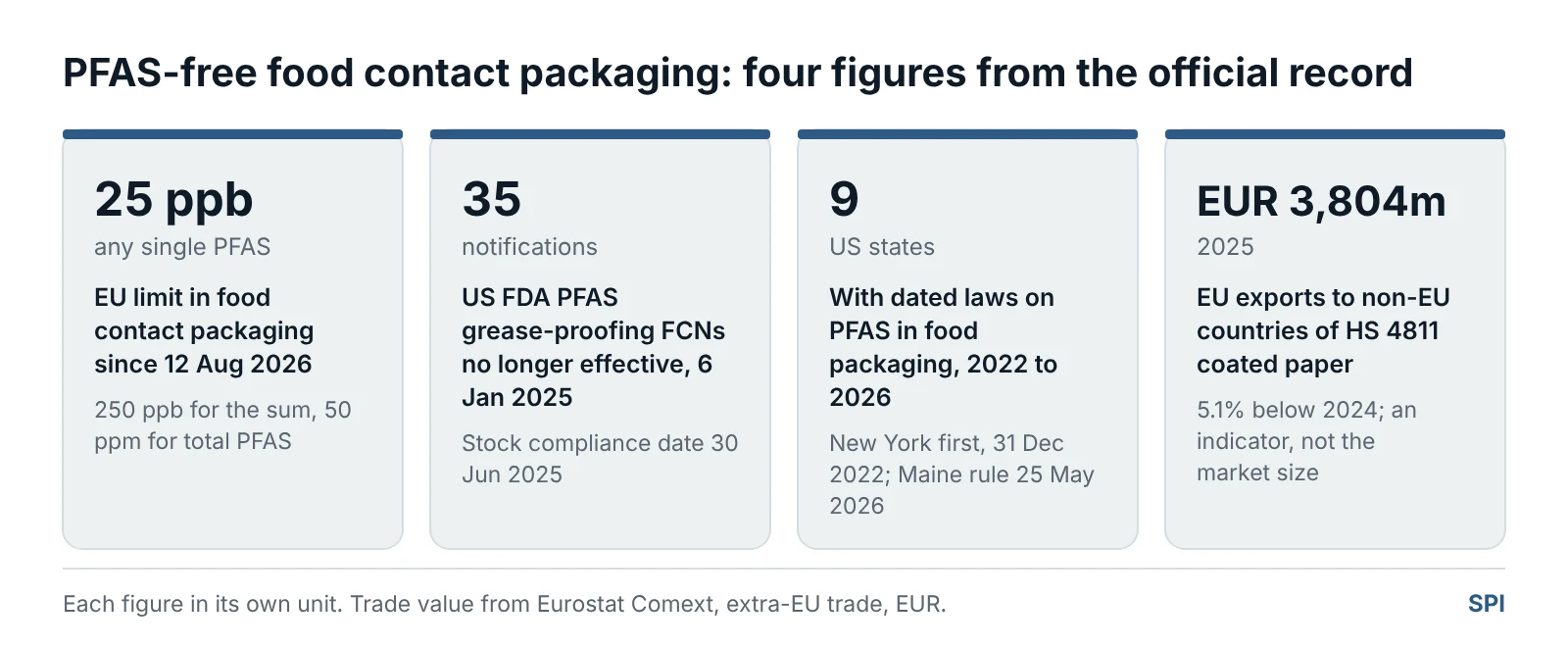
| Label | Value | Note | Source |
|---|---|---|---|
| EU limit, any single PFAS, food contact packaging | 25 ppb | 250 ppb sum, 50 ppm total PFAS; applies since 12 Aug 2026 | Commission Notice C/2026/3084 |
| FDA PFAS grease-proofing notifications no longer effective | 35 | From 6 Jan 2025; stock compliance date 30 Jun 2025 | US FDA, 3 Jan 2025 |
| US states with dated PFAS food packaging laws | 9 | New York 31 Dec 2022 to Maine 25 May 2026 | State agency and legislature pages |
| EU extra-EU exports of HS 4811, 2025 | EUR 3,804.4 million | 5.1% below EUR 4,010.5 million in 2024 | Eurostat Comext |
Note: Each tile in its own unit. The trade value is extra-EU exports in EUR and covers all goods under HS 4811, not only food contact grades.
“PFAS-free” is a marketing phrase. None of the texts cited here uses it as a legal standard. Each sets its own test, and the test decides whether a pack can be sold.
The EU test is a concentration. Commission Notice C/2026/3084 quotes Article 5(5) in full: from 12 August 2026, food contact packaging may not be placed on the market if it contains PFAS at or above 25 ppb for any PFAS by targeted analysis, 250 ppb for the sum of targeted PFAS, or 50 ppm for PFAS including polymeric PFAS. Where total fluorine exceeds 50 mg/kg, the operator must, on request, provide proof of how much of it is PFAS. The rule names no material and asks nothing about intent.
Most US state laws use intent. New York’s Department of Environmental Conservation (DEC) defines PFAS as fluorinated organic chemicals containing at least one fully fluorinated carbon atom, and an intentionally added chemical as one that serves an intended function in the product component. California’s AB 1200 adds a measured route: according to the state Attorney General’s enforcement advisory of 17 October 2023, regulated PFAS include PFAS present at or above 100 parts per million, measured as total organic fluorine.
Denmark uses an indicator. Since 1 July 2020 it has been illegal in Denmark to market paper and board food contact materials with fluorinated substances, and the Danish Veterinary and Food Administration (Fødevarestyrelsen) treats 20 micrograms of organic fluorine per gram of paper as the indicator value; levels below it are treated as unintended background contamination. The UK’s RAM 2027 guidance, for the 2027 reporting year, rates packaging red automatically if it contains more than 1 ppm of total PFAS, or more than 25 ppb in food packaging, individually or as a sum.
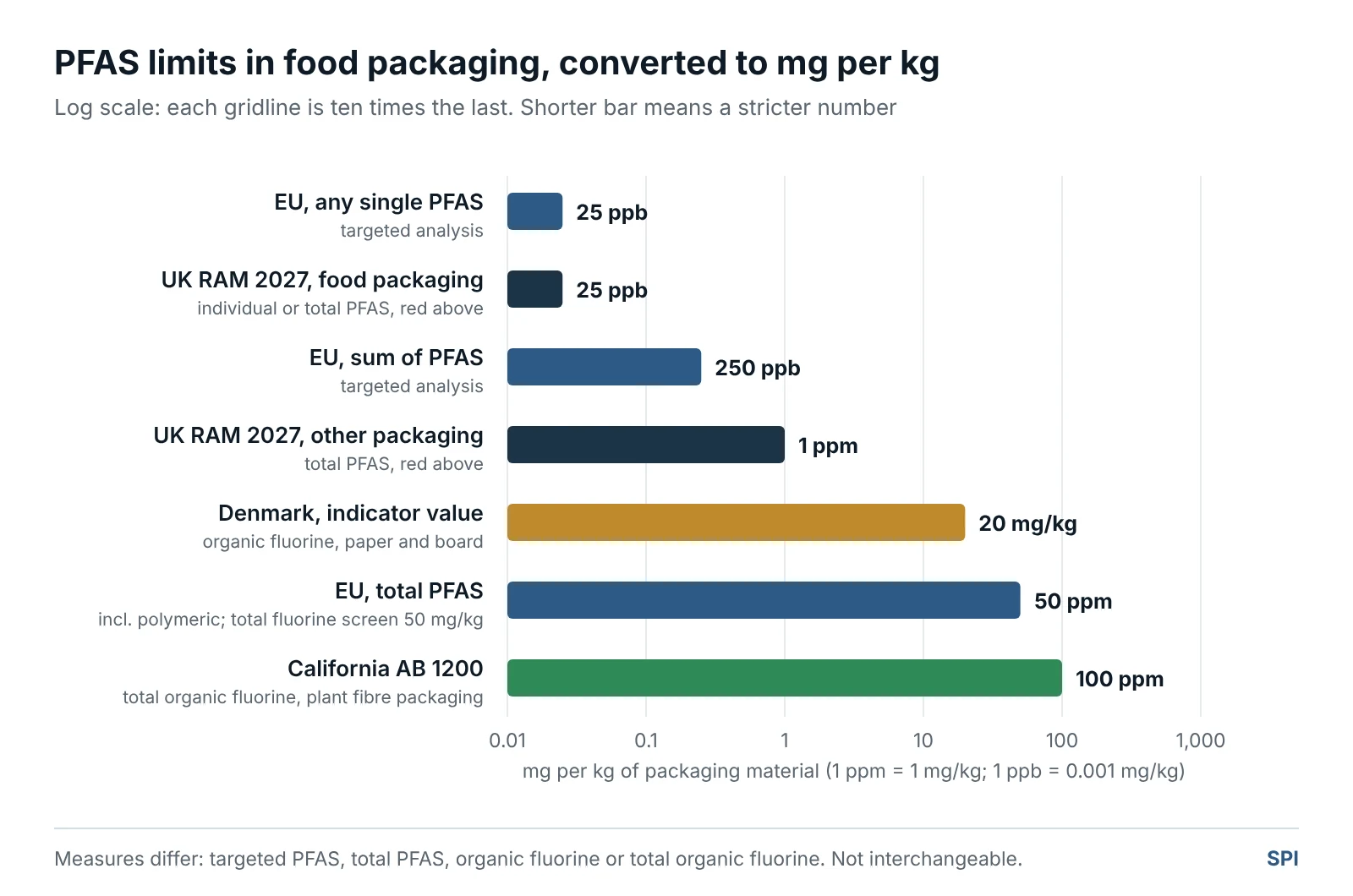
| Regime | Limit | In mg/kg | What is measured |
|---|---|---|---|
| EU, any single PFAS | 25 ppb | 0.025 | Targeted PFAS analysis |
| UK RAM 2027, food packaging | 25 ppb | 0.025 | Individual or total PFAS; red above |
| EU, sum of PFAS | 250 ppb | 0.25 | Sum of targeted PFAS |
| UK RAM 2027, other packaging | 1 ppm | 1 | Total PFAS; red above |
| Denmark, indicator value | 20 µg/g | 20 | Organic fluorine in paper and board |
| EU, total PFAS | 50 ppm | 50 | PFAS including polymeric PFAS |
| California AB 1200 | 100 ppm | 100 | Total organic fluorine, plant fibre packaging |
Note: Ordered from strictest to least strict number. Conversion: 1 ppm = 1 mg/kg; 1 ppb = 0.001 mg/kg. Targeted PFAS, total PFAS, organic fluorine and total organic fluorine are different measures.
SPI analysis: the split between intent and concentration is the commercial point. A fibre pack that a supplier sells as PFAS-free in New York or Washington because nothing fluorinated was added still has to pass a measured test in the EU, where the Commission states that there are no exceptions for packaging containing recycled material. Recycled fibre and inks can carry fluorine into a grade that was never treated, so EU buyers are likely to ask for lot-level fluorine results, not only a statement of intent.
Article 5(5) is the one substance rule in the Packaging and Packaging Waste Regulation (PPWR) that already applies with fixed numbers. The PPWR names no harmonised test method, so the Commission’s June 2026 guidance sets out a recommended sequence: total fluorine first, where a result below 50 mg/kg could be considered compliant; then a method such as pyrolysis-GC/MS to tell organic from inorganic fluorine; then direct total oxidisable precursor (TOP) analysis against the 25 and 250 microgram per kg limits. The Commission says that, on current evidence, every sample that passes the first step also passes the other two (Commission Notice C/2026/3084).
Timing follows the moment of placing on the market. The guidance gives no transitional period for selling off stock, but packaging placed on the market before 12 August 2026 may stay there and need not be withdrawn. The Commission’s implementation timeline lists a review of the restriction by 12 February 2030. SPI’s compliance analysis of the EU PFAS limits for paper and board covers the test sequence, the stock rule and who signs the declaration of conformity; the rule record sits in SPI’s regulation tracker entry for Article 5(5), and the wider regulation in PPWR after August 2026.
For the market, the EU limit matters in three ways. It is material-neutral, so plastic, coated board and moulded fibre all fall under the same numbers. It applies to imports at release for free circulation. And it reaches every member state at once, unlike the state-by-state US picture.
Denmark is the longest-running test of a PFAS-free requirement for fibre food packaging. Its ban on fluorinated substances in paper and board food contact materials has applied since 1 July 2020. Where analysis finds PFAS in the material, the Danish fact sheet says the authority will as a starting point require a functional barrier, a layer that stops transfer, so that the PFAS cannot reach the food; the company must make sure that the barrier suits the food type, contact time and temperature.
The Danish Veterinary and Food Administration’s 2024 campaign shows how that works in practice. Its report of 8 May 2025 covers 51 paper and board samples taken from 48 companies, 45 wholesalers and 3 retailers. Twelve samples were above the 20 mg/kg organic fluorine indicator and, by SPI’s count from the report’s results table, two were above 50 mg/kg, the screening value in the EU guidance. The report says nine of the 48 companies were not aware of the applicable rules and had not obtained PFAS documentation from their suppliers.
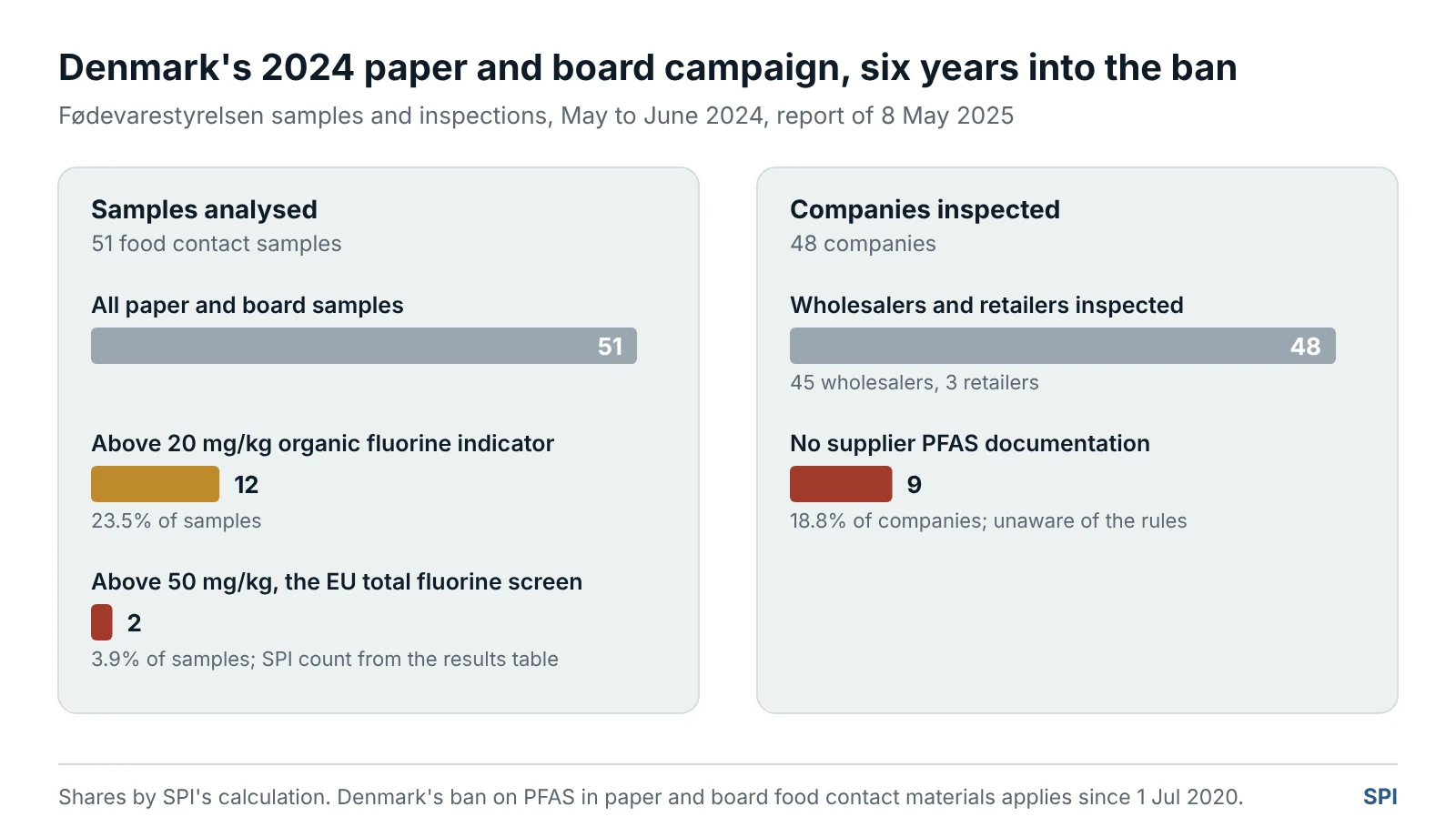
| Measure | Count | Share |
|---|---|---|
| Paper and board samples analysed | 51 | 100% |
| Samples above 20 mg/kg organic fluorine | 12 | 23.5% |
| Samples above 50 mg/kg, SPI count | 2 | 3.9% |
| Companies inspected | 48 | 100% |
| Companies without supplier PFAS documentation | 9 | 18.8% |
Note: Shares by SPI's calculation from the campaign counts. The count above 50 mg/kg is SPI's, from the report's results table.
SPI analysis: six years in, the Danish gap was mostly paperwork, not chemistry. Three in four samples sat under the indicator, but nearly one company in five held no supplier evidence. For a market that sells on the PFAS-free claim, the documentation is part of the product.
The UK has no ban on PFAS in food packaging in the texts cited here, but from 2027 it prices them. PackUK’s RAM 2027 materials assessment guidance, which covers the reporting year from 1 January to 31 December 2027, says packaging must be rated red automatically if it contains more than 1 ppm of total PFAS, or more than 25 ppb of PFAS in food packaging, without any further recyclability assessment. A red rating carries the highest modulated fee under UK packaging extended producer responsibility (EPR). SPI’s news report on the RAM 2027 PFAS test covers the detail.
The UK food packaging threshold of 25 ppb matches the EU single-PFAS limit. A UK and EU supplier that meets the EU limit for any single PFAS therefore has a common reference number for both markets, although the UK test also applies to the sum.
At federal level, the US market moved through voluntary industry action recorded by the Food and Drug Administration (FDA) rather than through a ban. The FDA’s phase-out page sets out the steps. Long-chain PFAS stopped being used in US food contact applications by November 2016. In 2020 the FDA raised safety questions about 6:2 fluorotelomer alcohol; one manufacturer had already told the FDA in 2019 that it had stopped sales, and three others agreed in July 2020 to a three-year phase-out starting in January 2021. In 2023 the makers of all remaining authorised PFAS grease-proofing agents confirmed that they had stopped sales, for business reasons.
On 28 February 2024 the FDA announced that grease-proofing substances containing PFAS are no longer being sold for food contact use in the US, and said this eliminates the primary source of dietary exposure to PFAS from authorised food contact uses. On 3 January 2025 it went further: 35 food contact notifications (FCNs) for grease-proofing coatings on paper and paperboard stopped being effective on 6 January 2025, with a compliance date of 30 June 2025 for existing packaging stock (US FDA).
SPI analysis: for US fibre packaging, the federal supply of fluorinated grease-proofing chemistry has closed. The question for the US market is no longer whether a PFAS treatment is available, but which substitute barrier performs, and the state laws below set who may sell what.
State laws arrived before the federal phase-out ended and now set the legal floor. Exhibit 4 places them on one timeline with the EU, Danish, UK and FDA dates; Exhibit 5 lists each state’s scope.
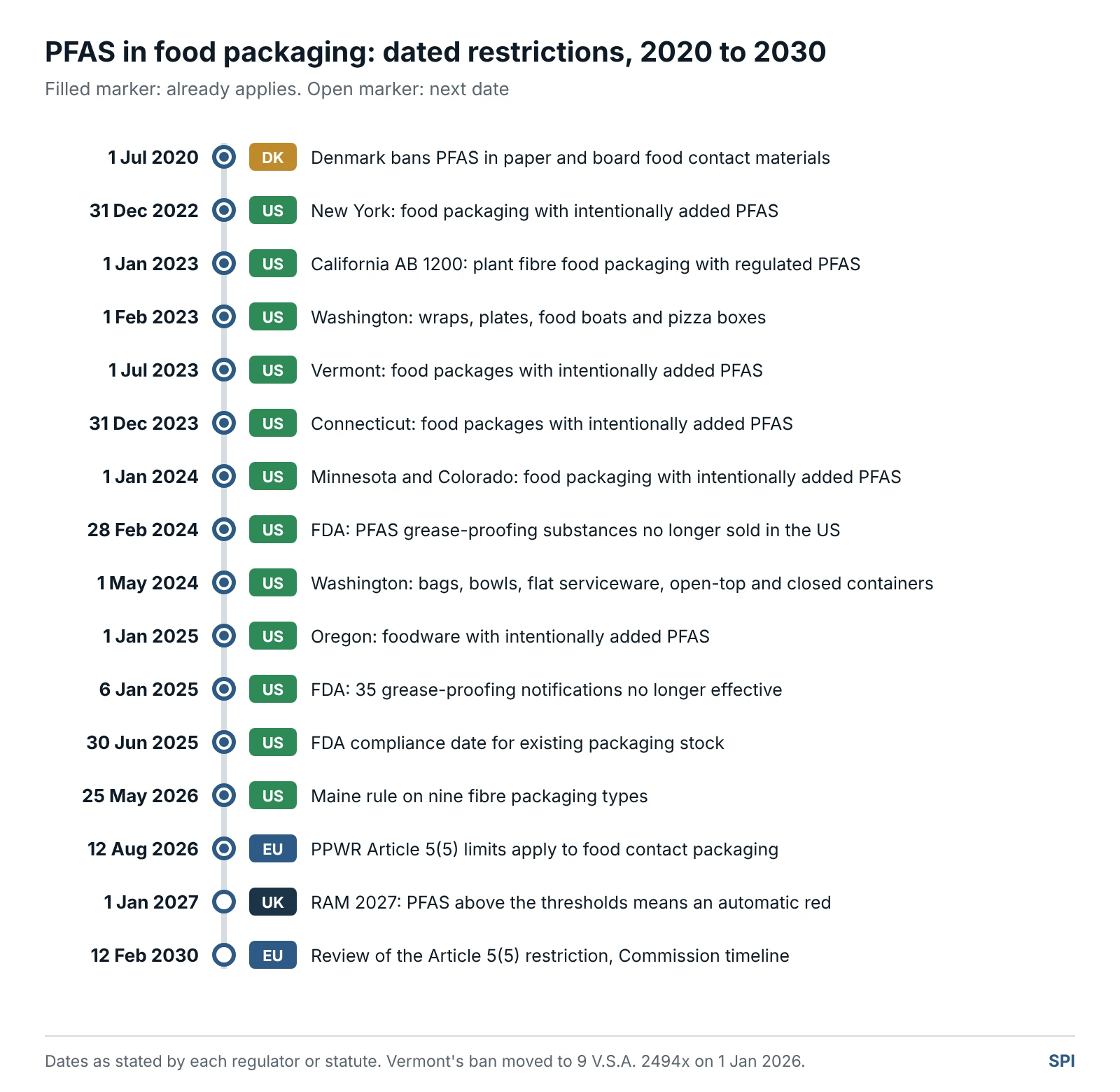
| Date | Label | Category | Link |
|---|---|---|---|
| 2020-07-01 | Denmark bans PFAS in paper and board food contact materials | past | |
| 2022-12-31 | New York: food packaging with intentionally added PFAS | past | Source |
| 2023-01-01 | California AB 1200: plant fibre food packaging with regulated PFAS | past | |
| 2023-02-01 | Washington: wraps, plates, food boats and pizza boxes | past | |
| 2023-07-01 | Vermont: food packages with intentionally added PFAS | past | |
| 2023-12-31 | Connecticut: food packages with intentionally added PFAS | past | |
| 2024-01-01 | Minnesota and Colorado: food packaging with intentionally added PFAS | past | |
| 2024-02-28 | FDA: PFAS grease-proofing substances no longer sold for US food contact | past | |
| 2024-05-01 | Washington: bags, bowls, flat serviceware, open-top and closed containers | past | |
| 2025-01-01 | Oregon: foodware with intentionally added PFAS | past | |
| 2025-01-06 | FDA: 35 grease-proofing notifications no longer effective | past | |
| 2025-06-30 | FDA compliance date for existing packaging stock | past | |
| 2026-05-25 | Maine rule on nine fibre packaging types | past | |
| 2026-08-12 | EU Article 5(5) limits apply to food contact packaging | past | |
| 2027-01-01 | UK RAM 2027: PFAS above thresholds means automatic red | next | |
| 2030-02-12 | Review of the Article 5(5) restriction, Commission timeline | next |
Note: Dates as stated by each regulator or statute. Vermont's ban moved to 9 V.S.A. 2494x on 1 January 2026.
The laws differ in scope. Washington’s Department of Ecology restricts paper or other plant fibre food packaging with intentionally added PFAS by product type: wraps, plates, food boats and pizza boxes from 1 February 2023, and bags and sleeves, bowls, flat serviceware, open-top containers and closed containers from 1 May 2024. Manufacturers must keep a certificate of compliance on file. Maine’s rule, Chapter 80, section 5, adopted on 18 April 2024, applies from 25 May 2026 to nine types of fibre packaging meant for short-term storage or freshly prepared food, and does not apply to a food or beverage manufacturer with less than USD 1 billion in total annual national sales (Maine DEP).
Minnesota’s statute, section 325F.075, reaches further than fibre. Its definition of a food package includes cups, plates, bowls, rigid foil trays, wrappers and wrapping films, bags and tubs, and assembled parts such as coatings, closures, inks and labels; the Minnesota Pollution Control Agency states that the prohibition took effect on 1 January 2024.
| State | Applies from | Scope | Test |
|---|---|---|---|
| New York | 31 Dec 2022 | Food packaging mainly of paper, paperboard or other plant fibre | Intentionally added PFAS |
| California (AB 1200) | 1 Jan 2023 | Food packaging made in substantial part of plant fibre | Intentionally added, or 100 ppm total organic fluorine or more |
| Washington | 1 Feb 2023 and 1 May 2024 | Nine fibre product types in two phases | Intentionally added PFAS |
| Vermont | 1 Jul 2023 | Food packages; 9 V.S.A. 2494x from 1 Jan 2026 | Intentionally added PFAS in any amount |
| Connecticut | By 31 Dec 2023 | Food packages | Intentionally introduced PFAS |
| Minnesota | 1 Jan 2024 | Food packages, including coatings, inks and labels | Intentionally added PFAS |
| Colorado (HB22-1345) | 1 Jan 2024 | Food packaging among other products | Intentionally added PFAS |
| Oregon | 1 Jan 2025 | Foodware used to serve or hold prepared food | Intentionally added PFAS |
| Maine | 25 May 2026 | Nine fibre packaging types; firms under USD 1 billion in sales exempt | Intentionally added PFAS |
Note: Wording paraphrased from each official page. Vermont's ban took effect on 1 July 2023 under 18 V.S.A. chapter 33A (Act 36 of 2021) and moved to 9 V.S.A. 2494x from 1 January 2026. California's date is the start of 2023, as stated in the Attorney General's advisory. Connecticut's date is from the General Assembly's Office of Legislative Research. Not legal advice.
Source: New York DEC; California Attorney General AB 1200 enforcement advisory; Washington Ecology; Connecticut OLR report 2023-R-0258; Minnesota MPCA and Minnesota Statutes 325F.075; Colorado General Assembly HB22-1345; Oregon DEQ; Vermont Legislature 9 V.S.A. 2494x, 18 V.S.A. chapter 33A and S.20 of 2021; Maine DEP (SPI summary)
SPI analysis: all nine laws turn on intentionally added PFAS, and only California adds a measured threshold, one that is four thousand times higher than the EU single-PFAS limit. A US supplier’s PFAS-free claim is therefore usually a formulation claim backed by a certificate, while an EU claim is a test result. Firms that sell into both need both.
Most official texts set a limit and leave the substitute to the market. The EU guidance on Article 5(5) names no alternative barrier in its section on PFAS, the UK RAM 2027 guidance sets a rating and not a material, and the FDA pages record the end of PFAS sales without naming replacements.
Three texts go further. California’s AB 1200, as summarised by the Attorney General, requires manufacturers to use the least toxic alternative when they replace regulated PFAS in food packaging. Denmark, where PFAS are found, requires as a starting point a functional barrier that stops transfer to the food. And Washington’s Department of Ecology, which had to find safer alternatives before each phase of its ban could start, named them product by product.
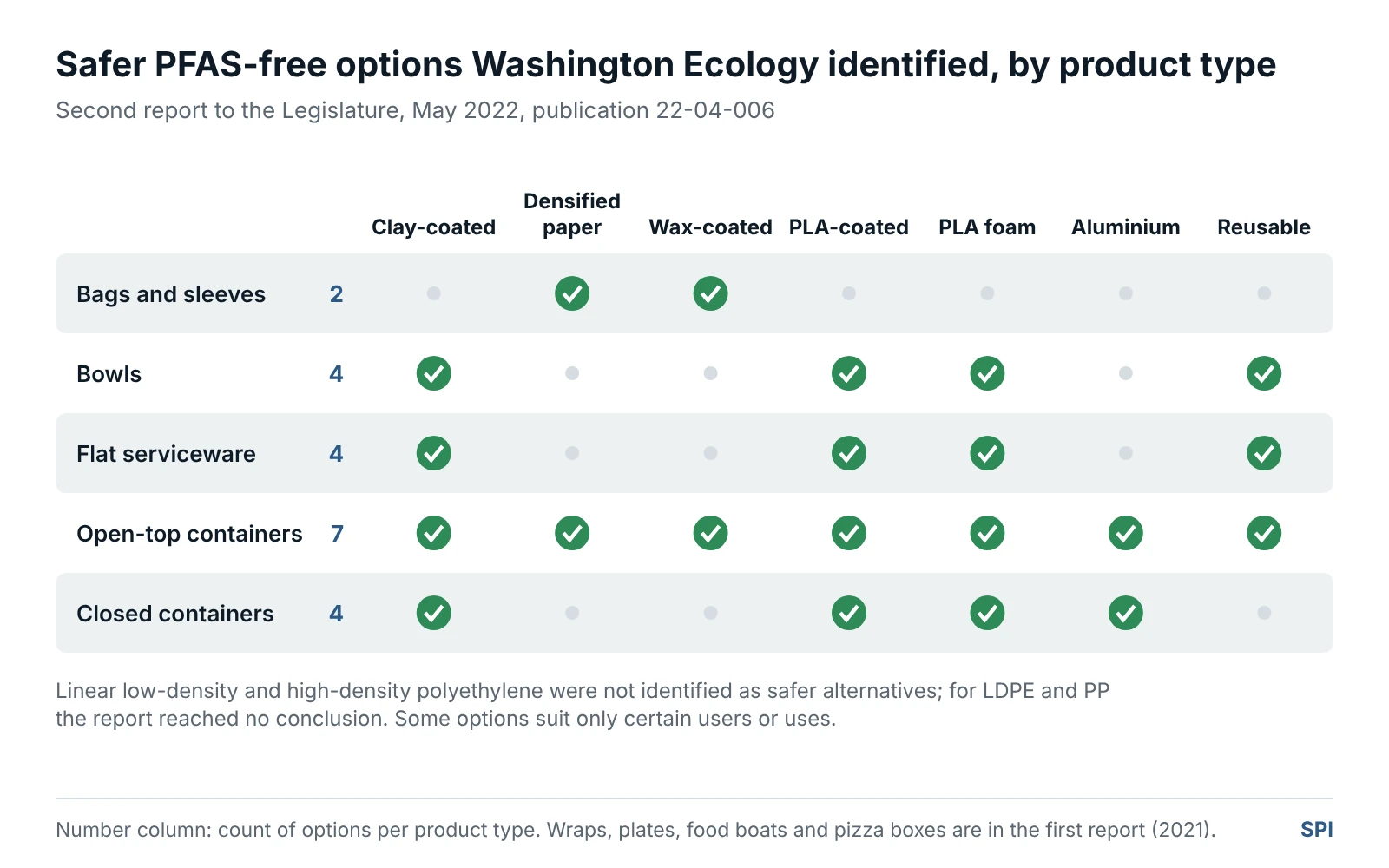
| Text | What it says on substitutes |
|---|---|
| Washington Ecology, 2022 | Names clay, wax and PLA coatings, densified paper, PLA foam, aluminium and reusables by product type; LLDPE and HDPE not identified as safer |
| California AB 1200 | Manufacturers must use the least toxic alternative when replacing regulated PFAS |
| Denmark | Where PFAS are found, requires as a starting point a functional barrier that stops transfer to the food |
| EU, Commission Notice C/2026/3084 | Sets limits and a test sequence; names no substitute |
| UK RAM 2027 | Sets an automatic red rating; names no substitute |
| US FDA | Records the end of PFAS grease-proofing sales; names no substitute |
Note: Paraphrased from each source. SPI makes no claim on the performance of any barrier.
Source: Washington Ecology publication 22-04-006; California Attorney General AB 1200 enforcement advisory; Fødevarestyrelsen fact sheet and campaign report; Commission Notice C/2026/3084; GOV.UK RAM 2027 guidance; US FDA phase-out page (SPI summary)
The Washington list matters beyond the state because, among the texts cited here, it is the only official comparison of options by format. Open-top containers had seven safer options and bags and sleeves two. The report found that some options suit only certain users or uses, did not identify linear low-density or high-density polyethylene as safer alternatives, and reached no conclusion for LDPE and PP for lack of information. For the market, that points PFAS-free fibre packaging toward mineral, wax and bio-based coatings and toward mechanical density, rather than toward a plastic liner, in the one jurisdiction that compared them. SPI’s analysis of plastic to paper switches and PFAS and its paper and board EPR fee comparison cover how these switches are priced in European fee tables.
No customs code separates PFAS-free packaging, and no official statistic measures this market on its own. Two paper headings carry most of the goods affected. HS 4811 covers paper and paperboard that is coated, impregnated, covered or surface-treated, in rolls or sheets: the barrier-coated substrate. HS 4819 covers cartons, boxes, cases, bags and other packing containers of paper and paperboard: much of the finished fibre food packaging. Both headings also include non-food and non-barrier goods, so the figures below are indicators of the paper trade, not a measure of the PFAS-free market.
Eurostat Comext gives EU trade with non-EU countries. EU exports of HS 4811 fell from EUR 4,010.5 million in 2024 to EUR 3,804.4 million in 2025, or 5.1%, and imports fell 4.1% to EUR 1,191.0 million. HS 4819 exports eased 1.1% to EUR 2,880.5 million and imports 1.5% to EUR 2,283.5 million. On HS 4811 the EU exported EUR 2,613.4 million more than it imported in 2025.
UN Comtrade gives US trade with the world. US exports of HS 4811 fell from USD 2,288.5 million in 2022 to USD 2,132.3 million in 2024, or 6.8%, and by weight from 1,007.5 thousand tonnes to 861.0 thousand tonnes. US imports of HS 4819 fell 9.0% to USD 3,505.1 million, and exceeded exports of the same heading by USD 1,204.1 million in 2024.
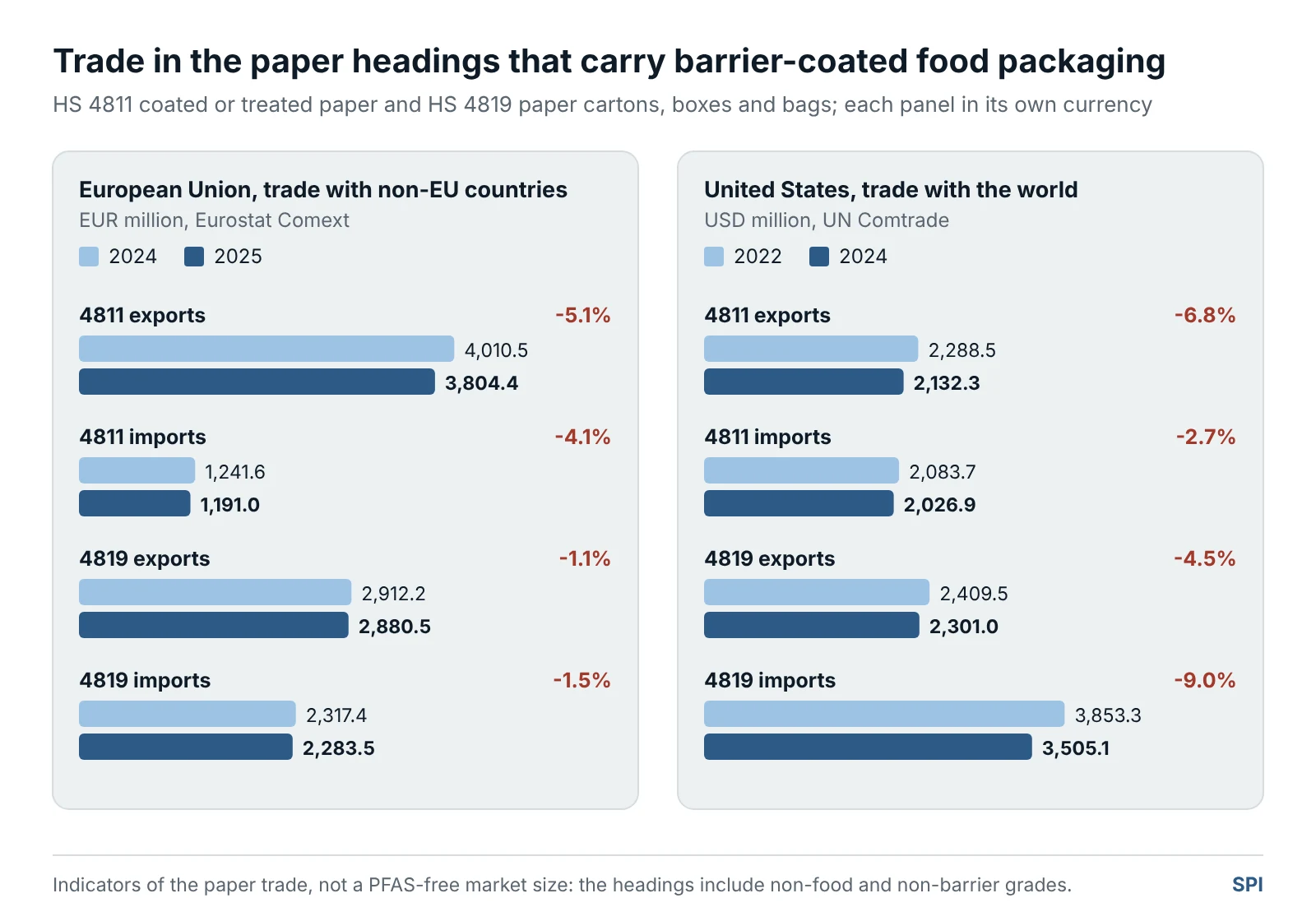
| Series | Currency | Earlier year | Value | Later year | Value | Change |
|---|---|---|---|---|---|---|
| EU HS 4811 exports, extra-EU | EUR million | 2024 | 4,010.5 | 2025 | 3,804.4 | -5.1% |
| EU HS 4811 imports, extra-EU | EUR million | 2024 | 1,241.6 | 2025 | 1,191.0 | -4.1% |
| EU HS 4819 exports, extra-EU | EUR million | 2024 | 2,912.2 | 2025 | 2,880.5 | -1.1% |
| EU HS 4819 imports, extra-EU | EUR million | 2024 | 2,317.4 | 2025 | 2,283.5 | -1.5% |
| US HS 4811 exports | USD million | 2022 | 2,288.5 | 2024 | 2,132.3 | -6.8% |
| US HS 4811 imports | USD million | 2022 | 2,083.7 | 2024 | 2,026.9 | -2.7% |
| US HS 4819 exports | USD million | 2022 | 2,409.5 | 2024 | 2,301.0 | -4.5% |
| US HS 4819 imports | USD million | 2022 | 3,853.3 | 2024 | 3,505.1 | -9.0% |
Note: Indicators, not a market size: the headings include non-food and non-barrier grades. SPI does not add, convert or rank across currencies. Changes by SPI's calculation.
SPI analysis: the trade data cannot show a shift from fluorinated to PFAS-free grades, because both sit in the same headings. What they do show is the size of the flows that the new limits now reach at the border: food contact packaging among the HS 4819 imports has had to meet the Article 5(5) numbers at release for free circulation since 12 August 2026, and barrier paper under HS 4811 now has to come with the fluorine evidence that converters pass on to brand owners.
Company reports say less about PFAS-free lines than the regulation does. Exhibit 9 sets out what the reports of five packaging companies and one buyer state, each figure in its own currency. SPI has not yet confirmed a company filing that reports revenue from PFAS-free food packaging as a separate line.
Mondi’s sustainable development report for 2025 says its laboratory has developed and validated methods to detect PFAS at trace levels, and that the work supports compliance with emerging rules and the evaluation of alternatives to PFAS. Pactiv Evergreen’s product sheet, which is a company page rather than a filing, describes its EarthChoice moulded fibre containers, tableware and school lunch trays as PFAS-free. On the buyer side, McDonald’s reports that at the end of 2025, 99.9% of its primary guest packaging did not contain intentionally added fluorinated compounds, against its goal of all primary guest packaging free from intentionally added fluorinated compounds by the end of 2025, which it rates as substantially achieved.
| Company | Document | Figure, own currency | What it states on PFAS |
|---|---|---|---|
| Huhtamaki | Annual Report 2025 | Net sales EUR 3,960.2 million; Foodservice Packaging EUR 936.2 million | SPI has not yet confirmed a named PFAS-free line in the report |
| Stora Enso | Annual Report 2025 | Sales EUR 9,326 million (2024: EUR 9,049 million) | Describes packaging materials built on base boards and barrier coatings; SPI has not yet confirmed a PFAS reference |
| Mondi | Sustainable development report 2025 | 88% of packaging and paper revenue from reusable, recyclable or compostable products | Trace-level PFAS testing methods; evaluating alternatives to PFAS |
| Graphic Packaging | Form 10-K, 2025 | Net sales USD 8,617 million (2024: USD 8,807 million) | SPI has not yet confirmed a PFAS reference |
| Pactiv Evergreen | Product sheet, not a filing | No figure | EarthChoice moulded fibre lines described as PFAS-free |
| McDonald's (buyer) | Goal performance page | 99.9% of primary guest packaging, end 2025 | No intentionally added fluorinated compounds |
Note: Each figure in its own currency and year. SPI does not add, convert or rank across currencies, and makes no market-position claim.
Source: Huhtamaki Annual Report 2025; Stora Enso Annual Report 2025; Mondi Group sustainable development report 2025; Graphic Packaging Holding Company Form 10-K for 2025; Pactiv Evergreen PFAS-free solutions sheet; McDonald's goal performance page (SPI summary)
SPI publishes no price for PFAS-free packaging, and none of the official sources on this page states the price of a substitute barrier or its premium over the fluorinated grades it replaces. What the sources do state is the cost of being out of line: in the UK, an automatic red rating under RAM 2027; in the EU, removal from the market; in Denmark, an inspection finding. Costs of testing, of certificates of compliance and of barrier coatings are not published by any source cited here, and SPI has not yet confirmed them.
The rule dates for PFAS in food packaging are now mostly in the past. The next fixed points are fewer.
| Date | Jurisdiction | What happens |
|---|---|---|
| 1 Jan 2027 | United Kingdom | RAM 2027 reporting year starts; packaging above the PFAS thresholds is rated red automatically |
| 12 Feb 2030 | European Union | Review of the Article 5(5) PFAS restriction, Commission timeline |
Note: Dates as stated in the sources. The review date is from the Commission timeline.
Source: GOV.UK RAM 2027 materials assessment guidance; Commission Green Forum PPWR implementation timeline; Commission Notice C/2026/3084 (SPI summary)
Two open variables will shape the market after 2026. The first is enforcement in the EU, where the Danish campaign suggests that missing supplier evidence, rather than treated paper, is the more common finding. The second is the 2030 EU review, which recital 21 of Regulation (EU) 2025/40 frames as an evaluation of whether the restriction should be amended or repealed so that it does not duplicate other Union acts.
This report was written on 29 November 2026 from regulators’ texts, statutes and official statistics. Limits and dates come from the EUR-Lex text of Commission Notice C/2026/3084, the GOV.UK RAM 2027 guidance, the Danish Veterinary and Food Administration’s fact sheet and campaign report, US FDA pages and the pages of state agencies and legislatures listed under Sources. Trade figures come from Eurostat Comext dataset ds-045409 (EU27 with extra-EU partners, annual, value in euros) and from UN Comtrade (United States with world, annual, primary value in US dollars); quantities are net weight. Percentage changes and shares are SPI’s calculations. Each figure stays in its own currency; SPI never adds, converts or ranks amounts across currencies. No third-party market size, growth rate or share is used, because no official statistic measures PFAS-free food contact packaging on its own.
Get sample pages with the market model, segment tables and the full table of contents.
What is moving demand for pfas-free food contact packaging market up or down over , with the expected impact on growth.
Article 5(5) of Regulation (EU) 2025/40 has applied to food contact packaging of every material since 12 August 2026, with no exception for recycled material.
Nine states restrict PFAS in food packaging, most on an intentionally added test, from 31 December 2022 to 25 May 2026.
The FDA reported in February 2024 that PFAS grease-proofing substances are no longer sold for US food contact use.
RAM 2027 rates packaging red automatically above 1 ppm of total PFAS, or 25 ppb in food packaging, from 1 January 2027.
Thresholds run from 25 ppb in the EU to 100 ppm of total organic fluorine in California, on different measures.
In Denmark's 2024 campaign, 9 of 48 companies could not document PFAS compliance.
Washington Ecology identified up to seven safer options per product type, including clay, wax and PLA coatings and densified paper.
McDonald's reports 99.9% of primary guest packaging free of intentionally added fluorinated compounds at the end of 2025.
The Commission states there are no exceptions for packaging containing recycled material under Article 5(5).
The Commission timeline lists a review of the Article 5(5) restriction by 12 February 2030.
The rules that change material choice, design and cost for this market. Each one is covered in depth in the report.
| Rule | Jurisdiction | Status | What it means |
|---|---|---|---|
| Regulation (EU) 2025/40, Article 5(5) | European Union | Applies since 12 Aug 2026 | Food contact packaging barred at or above 25 ppb any PFAS, 250 ppb sum or 50 ppm total PFAS |
| Danish ban on PFAS in paper and board food contact materials | Denmark | In force since 1 Jul 2020 | Indicator value of 20 micrograms organic fluorine per gram of paper |
| RAM 2027 PFAS criterion | United Kingdom | Applies to the 2027 reporting year | Automatic red above 1 ppm total PFAS, or 25 ppb in food packaging |
| FDA market phase-out of PFAS grease-proofing | United States | 35 FCNs no longer effective from 6 Jan 2025 | Stock compliance date 30 Jun 2025 |
| New York ECL Article 37, Title 2 | United States, New York | In force since 31 Dec 2022 | Plant fibre food packaging with intentionally added PFAS |
| California AB 1200 | United States, California | In force since 1 Jan 2023 | Plant fibre food packaging with intentionally added PFAS or 100 ppm total organic fluorine |
| Washington PFAS in food packaging restriction | United States, Washington | In force from 1 Feb 2023 and 1 May 2024 | Nine fibre food packaging types with intentionally added PFAS |
| Vermont 9 V.S.A. 2494x, formerly 18 V.S.A. chapter 33A | United States, Vermont | In force since 1 Jul 2023 | Food packages with intentionally added PFAS in any amount |
| Minnesota 325F.075 | United States, Minnesota | In force since 1 Jan 2024 | Food packages with intentionally added PFAS |
| Maine Chapter 80, section 5 | United States, Maine | Applies from 25 May 2026 | Nine fibre packaging types with intentionally added PFAS |
Maker of foodservice, flexible and fiber packaging; reported Foodservice Packaging net sales of EUR 936.2 million in 2025.
Maker of renewable packaging materials, base boards and barrier-coated boards; reported 2025 sales of EUR 9,326 million.
Paper and packaging company; reports trace-level PFAS testing methods and evaluation of alternatives to PFAS.
Maker of paperboard packaging for food and foodservice; reported 2025 net sales of USD 8,617 million.
Maker of foodservice and food packaging; describes its EarthChoice moulded fibre lines as PFAS-free.
Article 5(5) PFAS limits of Regulation (EU) 2025/40 began to apply to food contact packaging on 12 August.
Commission Notice C/2026/3084 set out a three-step test for the Article 5(5) limits.
Maine's rule on PFAS in nine fibre food packaging types applied from 25 May.
Denmark reported 12 of 51 paper and board samples above its organic fluorine indicator.
The FDA found 35 PFAS grease-proofing notifications no longer effective from 6 January.
Oregon's ban on foodware with intentionally added PFAS took effect on 1 January.
The FDA said PFAS grease-proofing substances are no longer sold for US food contact use.
| Base year | 2025 |
|---|---|
| Units | Value (USD Billion), volume (kilotonnes) |
| Regions covered | North America, Europe, Asia Pacific, Latin America, Middle East & Africa |
| Companies profiled | Huhtamaki, Stora Enso, Mondi, Graphic Packaging, Pactiv Evergreen |
| Report coverage | Market size and forecast, segment and country analysis, packaging regulation, pricing, value chain, competitive landscape, company profiles |
| Customisation | Up to 10% additional scope free of charge before delivery |
Chapters are built from this report’s segmentation, regions and company list. Open a chapter to see every section.
Includes the list of tables and figures with sample data pages.
How Strategic Packaging Insights builds and checks the numbers in this report.
We fix the formats, substrates and end uses in scope, the unit of measure (USD and tonnes) and the base year (2025), so every number in the report counts the same thing.
Regulator texts (EU PPWR, national EPR schemes, plastic packaging taxes), customs and trade statistics for packaging HS codes, company annual reports and investor filings, trade association data and patent records.
Structured interviews with converters, resin and paper suppliers, brand-owner packaging and procurement teams, machinery suppliers and recyclers, used to test volumes, prices and adoption timing.
Demand in tonnes by substrate and end use, multiplied by regional average selling price per kilogram, built country by country.
Cross-check against end-use output (food, beverage, pharma, personal care, e-commerce shipments) and the reported packaging revenue of the leading companies.
The two views are reconciled, then forecast to 0 with drivers for demand, resin and fibre prices, and regulatory scenarios (recyclability grades, recycled-content targets, EPR fees).
Every figure is checked for arithmetic consistency (segments add to the total, shares add to 100%), every regulatory statement is checked against the official text, and a senior analyst signs off the release.
Single user, team and company-wide licences are available. Tell us who will use the report and we will send the licence options and pricing by email.
The EU sets a measured test. Since 12 August 2026, food contact packaging may not contain 25 ppb or more of any single PFAS, 250 ppb or more of their sum, or 50 ppm or more of total PFAS. A total fluorine result below 50 mg/kg counts as compliant, and recycled material has no exception.
Nine states have dated laws: New York from 31 December 2022, California from 1 January 2023, Washington in two phases from 2023, Vermont from 1 July 2023, Connecticut, Minnesota and Colorado by early 2024, Oregon from 2025, and Maine from 25 May 2026. Most target intentionally added PFAS, mainly in paper and plant fibre packaging.
On 28 February 2024 the FDA said grease-proofing substances containing PFAS are no longer sold for food contact use in the US. It then found that 35 food contact notifications for paper and paperboard grease-proofing were no longer effective from 6 January 2025, and set a compliance date of 30 June 2025 for existing packaging stock.
Washington's Department of Ecology named clay, wax and PLA coatings, densified paper, PLA foam, aluminium and reusable options, by product type, in its May 2022 report, and did not find two polyethylene types safer. Denmark requires a functional barrier where PFAS are found. California requires the least toxic alternative. The EU and UK texts name no substitute.
No official statistic measures it on its own, and SPI uses no third-party estimate. As indicators, EU exports to non-EU countries of HS 4811 coated paper were EUR 3,804.4 million in 2025, and US imports of HS 4819 paper containers were USD 3,505.1 million in 2024. Both headings include non-food goods.
Public sources used alongside primary interviews and company filings.