
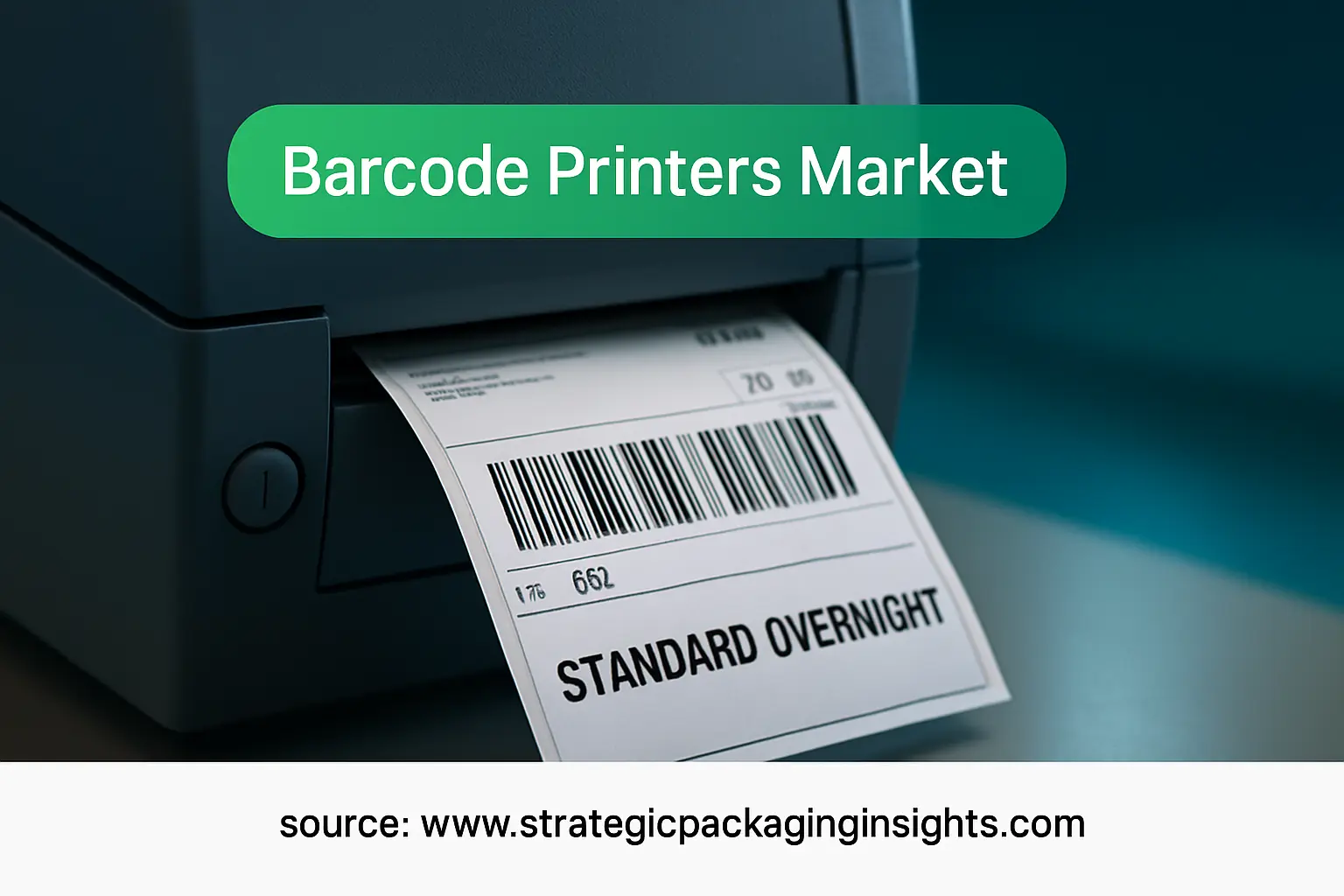
Explore the dynamic growth of the Barcode Printers Market, driven by technological advancements and increasing demand across various sectors. Discover market forecasts, segment analysis, and strategic insights for 2025-2034.
In the rapidly evolving landscape of global commerce, the Barcode Printers Market stands as a beacon of innovation, driving efficiency and accuracy across industries. As businesses strive to streamline operations and enhance customer experiences, the demand for advanced barcode printing solutions has surged, setting the stage for significant market growth.
https://www.strategicpackaginginsights.com/report/barcode-printers-market
Market Context & Industry Relevance
The Barcode Printers Market has become integral to modern supply chain management, retail operations, and healthcare logistics. With the proliferation of e-commerce and the need for precise inventory tracking, barcode printers have transitioned from being a mere operational tool to a strategic asset. This market's relevance is underscored by its ability to enhance data accuracy, reduce human error, and improve operational efficiency across various sectors.
Demand Drivers Across Packaging
Several factors are propelling the demand for barcode printers. The rise of omnichannel retailing requires seamless integration of online and offline inventory systems, necessitating reliable barcode solutions. Additionally, the healthcare sector's emphasis on patient safety and regulatory compliance has increased the adoption of barcode technology for tracking medical supplies and patient information. Furthermore, the logistics industry's focus on real-time tracking and efficient supply chain management continues to drive market growth.
Market Valuation & Forecast
In 2025, the Barcode Printers Market was valued at $4.67 billion. By 2034, it is projected to reach $9.60 billion, growing at a robust CAGR of 8.3%. This growth trajectory is fueled by technological advancements, increased automation, and the expanding application of barcode technology across diverse industries. The market's expansion reflects a broader trend towards digital transformation and the adoption of smart technologies in business operations.
Segment Breakdown
| Segment | Description |
|---|---|
| By Printer Type | Desktop Printers, Industrial Printers, Mobile Printers |
| By Technology | Thermal Transfer, Direct Thermal, Inkjet Barcode |
| By Application | Labels, Shipping, Inventory, Healthcare Tracking |
| By End Use | Retail, Logistics, Manufacturing, Healthcare |
| Region | Asia Pacific, North America, Latin America, Europe, Middle East & Africa |
The market is segmented by printer type, technology, application, end use, and region. Desktop printers are favored for their compact size and ease of use, while industrial printers are preferred for high-volume printing needs. Mobile printers are gaining traction due to their portability and convenience. Thermal transfer and direct thermal technologies dominate the market, offering durability and cost-effectiveness. Applications span across labels, shipping, inventory management, and healthcare tracking, with retail and logistics being the primary end-use sectors.
Application-Led Impact
The impact of barcode printers is most pronounced in applications requiring precision and efficiency. In retail, barcode printers facilitate quick checkouts and accurate inventory management. In logistics, they enable real-time tracking and efficient supply chain operations. The healthcare sector benefits from improved patient safety and compliance through accurate tracking of medical supplies and patient information. These application-led impacts underscore the critical role of barcode printers in enhancing operational efficiency and customer satisfaction.
Risks, Barriers & Mitigation
Despite the promising growth prospects, the Barcode Printers Market faces several challenges. Technological obsolescence, high initial investment costs, and data security concerns are significant barriers. To mitigate these risks, companies are investing in R&D to develop innovative solutions that offer enhanced security features and cost-effective pricing models. Additionally, strategic partnerships and collaborations are being pursued to leverage technological advancements and expand market reach.
Concise SWOT Snapshot
| Strengths | Weaknesses | Opportunities | Threats |
|---|---|---|---|
| Technological advancements, Wide application range | High initial costs, Technological obsolescence | Growing e-commerce, Expansion in emerging markets | Data security concerns, Intense competition |
Technology & Sustainability Influence
Technological innovation is a key driver of the Barcode Printers Market. The integration of IoT and AI in barcode printing solutions is enhancing functionality and efficiency. Sustainability is also becoming a focal point, with companies developing eco-friendly printing technologies and materials to reduce environmental impact. These advancements are not only meeting regulatory requirements but also aligning with consumer preferences for sustainable business practices.
Strategic Takeaways for 2025–2034
As we look towards 2025 and beyond, the Barcode Printers Market is poised for significant transformation. Companies should focus on leveraging technological advancements to enhance product offerings and address emerging customer needs. Strategic investments in R&D, coupled with a focus on sustainability, will be crucial in maintaining competitive advantage. Additionally, expanding into emerging markets and forming strategic partnerships will be key strategies for capturing new growth opportunities. By aligning with these strategic imperatives, businesses can position themselves for success in the evolving barcode printers landscape.