


Tabbing Tapes Market Outlook
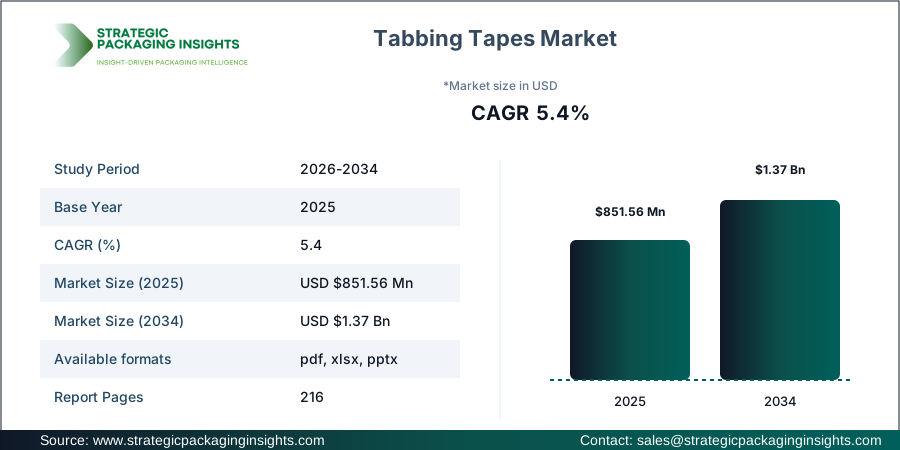
The Tabbing Tapes market size was valued at USD 851.56 million in 2025 and is anticipated to reach USD 1.37 billion by 2034, growing at a CAGR of 5.4% during the forecast period according to Strategic Packaging Insights. The market is witnessing significant growth due to the increasing demand for efficient and reliable packaging solutions across various industries. Companies like 3M and Tesa are leading the charge by innovating new products that cater to the evolving needs of the packaging and electronics sectors. The rise in e-commerce and the need for secure packaging solutions have further fueled the demand for tabbing tapes, making them an essential component in the packaging industry.
One of the most impactful drivers of the tabbing tapes market is the growing emphasis on sustainable and eco-friendly packaging solutions. Governments worldwide are implementing stringent regulations to reduce plastic waste, which has led to an increased demand for paper and silicone-based tabbing tapes. These tapes are not only environmentally friendly but also offer superior performance in terms of adhesion and durability. Companies like Avery Dennison and Nitto Denko are investing heavily in research and development to create innovative products that meet these regulatory requirements while providing high-quality solutions to their customers.
Report Scope
| Attributes | Details |
| Report Title | Tabbing Tapes Market Size, Future Growth and Forecast 2034 |
| Product Type | Film Tabbing Tapes, Paper Tabbing Tapes, Silicone Tabbing Tapes |
| Adhesive Type | Acrylic, Rubber-Based, Silicone-Based |
| Application | Battery Manufacturing, Labeling, Packaging, Electronics |
| End Use | Energy Storage, Electronics, Packaging, Industrial |
| Region | Asia Pacific, North America, Latin America, Europe, Middle East & Africa |
| Base Year | 2025 |
| Historic Period | 2018-2024 |
| Forecast Period | 2026-2034 |
| Number of Pages | 216 |
| Customization Available | Yes* |
Opportunities & Threats
The tabbing tapes market presents numerous opportunities, particularly in the realm of technological advancements and product innovations. As industries such as electronics and energy storage continue to evolve, there is a growing need for specialized tapes that can withstand extreme conditions and provide reliable performance. Companies like Saint-Gobain and Scapa are at the forefront of developing high-performance tabbing tapes that cater to these specific needs, thereby opening up new avenues for growth and expansion in the market.
Another significant opportunity lies in the expanding applications of tabbing tapes in emerging markets. With the rapid industrialization and urbanization in regions like Asia Pacific and Latin America, there is an increasing demand for efficient packaging and labeling solutions. This trend is expected to drive the growth of the tabbing tapes market, as companies look to capitalize on the untapped potential in these regions. Intertape Polymer Group and Shurtape are strategically positioning themselves to capture a significant share of this growing market by expanding their product offerings and strengthening their distribution networks.
However, the market also faces certain restraints, primarily in the form of fluctuating raw material prices. The cost of raw materials such as adhesives and films can significantly impact the overall production costs, thereby affecting the profitability of manufacturers. Additionally, the presence of stringent environmental regulations regarding the use of certain chemicals in adhesive formulations poses a challenge for companies in the market. To mitigate these challenges, companies are focusing on developing cost-effective and sustainable alternatives that comply with regulatory standards while maintaining product quality.
Drivers & Challenges
The primary driver of the tabbing tapes market is the increasing demand for efficient and reliable packaging solutions across various industries. With the rise of e-commerce and the need for secure packaging, tabbing tapes have become an essential component in ensuring the safe transportation of goods. Companies like Berry Global and Lohmann are investing in advanced manufacturing technologies to produce high-quality tapes that meet the stringent requirements of the packaging industry. Additionally, the growing emphasis on sustainability and eco-friendly packaging solutions is driving the demand for paper and silicone-based tabbing tapes, which offer superior performance and environmental benefits.
Another significant driver is the rapid growth of the electronics industry, which requires specialized tapes for various applications such as battery manufacturing and labeling. The increasing adoption of electronic devices and the need for efficient energy storage solutions have led to a surge in demand for high-performance tabbing tapes. Companies like 3M and Nitto Denko are focusing on developing innovative products that cater to the specific needs of the electronics industry, thereby driving the growth of the market.
Despite the positive growth prospects, the tabbing tapes market faces several challenges, including the fluctuating prices of raw materials and the presence of stringent environmental regulations. The cost of raw materials such as adhesives and films can significantly impact the overall production costs, thereby affecting the profitability of manufacturers. Additionally, the presence of stringent environmental regulations regarding the use of certain chemicals in adhesive formulations poses a challenge for companies in the market. To overcome these challenges, companies are focusing on developing cost-effective and sustainable alternatives that comply with regulatory standards while maintaining product quality.
Market Growth Factors
- U.S. trade and industrial policy is reinforcing domestic solar manufacturing. The Department of Energy says tariffs, duties, tax credits, and loans are being used to help domestic solar manufacturers compete and grow the U.S. supply chain, which supports demand for tabbing and related assembly tapes used in module production.
- The U.S. Treasury's January 2025 domestic content bonus guidance for clean energy credits increases incentives to use American-made manufactured products in solar and wind projects, improving the business case for local sourcing of specialty adhesive and tabbing tape solutions used in clean-energy assemblies. [U.S. Department of the Treasury ]
- Final IRS regulations for the Section 45Y clean electricity production credit and Section 48E clean electricity investment credit took effect on January 15, 2025, providing post-2024 policy certainty for clean electricity and energy storage projects and supporting continued procurement of tape-based bonding, insulation, and tabbing materials used across those build-outs.
- Battery manufacturing is a current growth engine for specialty tape demand. In March 2026, DOE announced up to 0 million to expand U.S. critical mineral processing and derivative battery manufacturing and recycling, which supports higher use of functional tapes in cell connection, insulation, venting, and module assembly.
- Federal EV charging policy is sustaining downstream demand for industrial tapes. FHWA said in February 2026 that updated Buy America requirements will apply to federally funded EV charger projects once the waiver is finalized, increasing domestic sourcing needs for adhesive and electrical assembly materials used in charging equipment. [Federal Highway Administration ]
- Manufacturing capacity for industrial adhesive tapes is being expanded in response to end-market demand. tesa said its Offenburg expansion is aimed at higher demand for high-performance industrial adhesive tape solutions from automotive, electronics, and printing and paper industries, improving supply availability for tabbing-tape-adjacent applications.
- Automated, debondable adhesive technologies are broadening the performance profile of advanced tapes. In April 2026, tesa and AUMOVIO introduced a robotically applied adhesive-tape solution for automotive displays that is load-bearing immediately yet detachable for repair and recycling, underscoring a shift toward tapes that support automation, rework, and circular manufacturing.
Recent Developments
- In April 2025, Avery Dennison Performance Tapes introduced a Solar Panel Bonding Portfolio of pressure-sensitive adhesive tapes for solar panel manufacturing applications, including cell fixation, dielectric insulation, edge protection, busbar bonding, panel stiffener mounting, junction-box mounting, and cable fixation. [Avery Dennison Performance Tapes ]
- In June 2025, tesa opened a Debonding on Demand development laboratory in Singapore and partnered with A*STAR to develop and scale removable adhesive solutions for automotive and electronics applications, with the lab beginning operations on July 1, 2025.
- In April 2026, Avery Dennison introduced a new pressure-sensitive adhesive tape portfolio for EV battery cell connection systems, with products engineered for dielectric protection, thermal-barrier bonding, flame-retardant performance, and vibration absorption in battery assemblies. [Avery Dennison Performance Tapes ]
- In May 2026, tesa announced the topping-out milestone for the expansion of its Offenburg plant, a double-digit million investment that adds a 4,500-square-meter production building with adhesive compound manufacturing, a coating line, and storage to increase industrial adhesive tape capacity.
Market Share Analysis
The competitive landscape of the tabbing tapes market is characterized by the presence of several key players who are actively engaged in product innovation and strategic partnerships to strengthen their market position. Companies like 3M, Tesa, and Nitto Denko hold a significant share of the market, owing to their extensive product portfolios and strong distribution networks. These companies are continuously investing in research and development to introduce new and advanced products that cater to the evolving needs of the packaging and electronics industries.
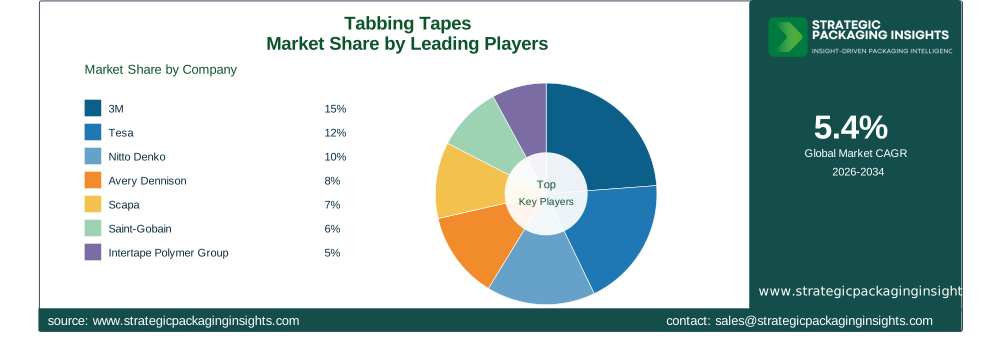
Avery Dennison and Scapa are also prominent players in the market, known for their innovative solutions and commitment to sustainability. These companies are focusing on developing eco-friendly products that comply with environmental regulations while providing superior performance. Saint-Gobain and Intertape Polymer Group are leveraging their expertise in materials science to create high-performance tabbing tapes that meet the specific requirements of various applications, such as battery manufacturing and labeling.
Shurtape and Berry Global are expanding their market presence by strengthening their distribution networks and enhancing their product offerings. These companies are strategically positioning themselves to capture a significant share of the growing market by focusing on emerging regions like Asia Pacific and Latin America. Lohmann, with its strong focus on innovation and customer-centric approach, is also gaining traction in the market by offering customized solutions that cater to the unique needs of its clients.
Overall, the tabbing tapes market is highly competitive, with companies constantly striving to gain a competitive edge through product innovation, strategic partnerships, and expansion into new markets. The presence of several key players and the continuous advancements in technology are expected to drive the growth of the market in the coming years.
Key Highlights
- The tabbing tapes market is projected to grow from USD 851.56 million in 2025 to USD 1.37 billion by 2034, at a CAGR of 5.4%.
- Key players in the market include 3M, Tesa, Nitto Denko, Avery Dennison, and Scapa.
- Increasing demand for eco-friendly packaging solutions is driving the growth of the market.
- Technological advancements and product innovations present significant opportunities for market expansion.
- Fluctuating raw material prices pose a challenge for manufacturers in the market.
- The electronics industry is a major driver of demand for high-performance tabbing tapes.
- Companies are focusing on developing sustainable alternatives to comply with environmental regulations.
Tabbing Tapes Market Segments Insights

Product Type Analysis
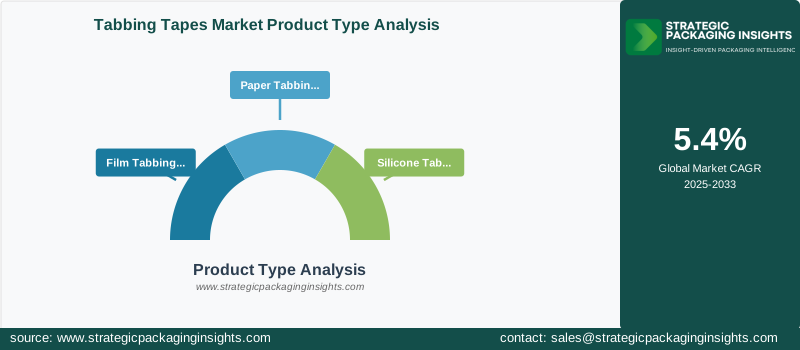
The tabbing tapes market is segmented by product type into film tabbing tapes, paper tabbing tapes, and silicone tabbing tapes. Film tabbing tapes are widely used due to their excellent durability and resistance to environmental factors, making them ideal for applications in electronics and packaging. Companies like 3M and Tesa are leading the market with their innovative film-based products that offer superior adhesion and performance. Paper tabbing tapes, on the other hand, are gaining popularity due to their eco-friendly nature and cost-effectiveness. These tapes are primarily used in applications where sustainability is a key consideration, such as packaging and labeling. Silicone tabbing tapes are known for their high-temperature resistance and are extensively used in industrial applications where extreme conditions are prevalent.
The demand for these products is driven by the increasing need for reliable and efficient packaging solutions across various industries. As companies continue to focus on sustainability and environmental compliance, the demand for paper and silicone-based tabbing tapes is expected to rise significantly. Additionally, the growing electronics industry is driving the demand for film tabbing tapes, as they provide the necessary durability and performance required for electronic applications.
Adhesive Type Analysis
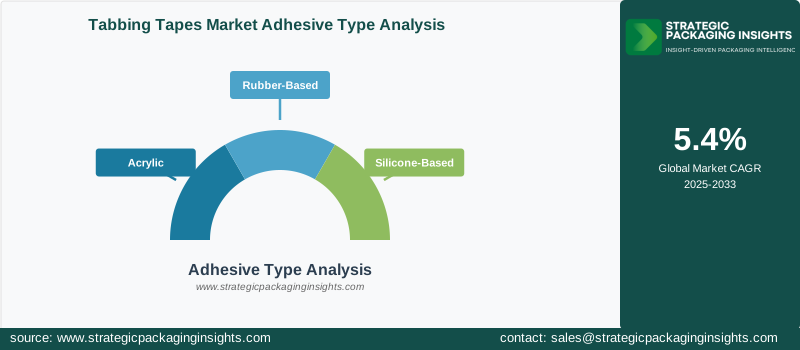
Based on adhesive type, the tabbing tapes market is segmented into acrylic, rubber-based, and silicone-based adhesives. Acrylic adhesives are widely used due to their excellent adhesion properties and versatility, making them suitable for a wide range of applications. Companies like Avery Dennison and Nitto Denko are focusing on developing advanced acrylic adhesives that offer superior performance and environmental benefits. Rubber-based adhesives are known for their strong bonding capabilities and are primarily used in applications where high adhesion strength is required, such as industrial and packaging applications.
Silicone-based adhesives are gaining traction due to their high-temperature resistance and flexibility, making them ideal for applications in electronics and energy storage. The demand for these adhesives is driven by the increasing need for specialized tapes that can withstand extreme conditions and provide reliable performance. As industries continue to evolve and demand for high-performance adhesives increases, companies are investing in research and development to create innovative products that cater to the specific needs of their customers.
Application Analysis
The tabbing tapes market is segmented by application into battery manufacturing, labeling, packaging, and electronics. Battery manufacturing is a significant application area for tabbing tapes, as they provide the necessary insulation and protection required for efficient energy storage. Companies like Saint-Gobain and Scapa are developing high-performance tapes that cater to the specific needs of the battery manufacturing industry, thereby driving the growth of the market.
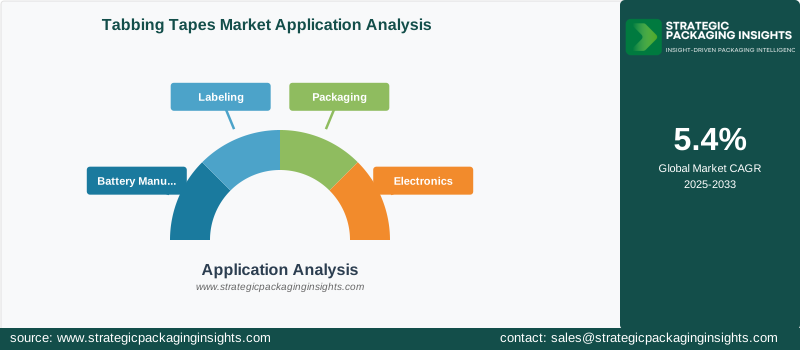
Labeling and packaging are also major application areas for tabbing tapes, as they provide the necessary adhesion and durability required for secure packaging solutions. The rise of e-commerce and the increasing demand for efficient packaging solutions are driving the growth of the market in these application areas. Additionally, the electronics industry is a major driver of demand for tabbing tapes, as they provide the necessary performance and reliability required for electronic applications.
End Use Analysis
The tabbing tapes market is segmented by end use into energy storage, electronics, packaging, and industrial applications. Energy storage is a significant end-use segment for tabbing tapes, as they provide the necessary insulation and protection required for efficient energy storage solutions. Companies like Intertape Polymer Group and Shurtape are focusing on developing high-performance tapes that cater to the specific needs of the energy storage industry, thereby driving the growth of the market.
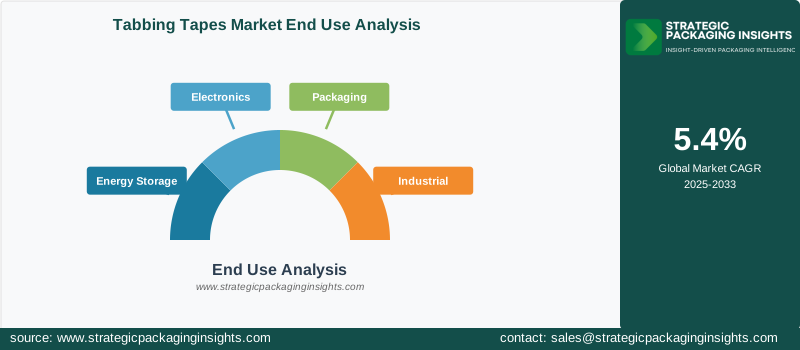
Electronics is another major end-use segment for tabbing tapes, as they provide the necessary performance and reliability required for electronic applications. The increasing adoption of electronic devices and the need for efficient energy storage solutions are driving the demand for high-performance tabbing tapes in this segment. Additionally, the packaging and industrial segments are also significant end-use areas for tabbing tapes, as they provide the necessary adhesion and durability required for secure packaging and industrial applications.
Tabbing Tapes Market Segments
The Tabbing Tapes market has been segmented on the basis ofProduct Type
- Film Tabbing Tapes
- Paper Tabbing Tapes
- Silicone Tabbing Tapes
Adhesive Type
- Acrylic
- Rubber-Based
- Silicone-Based
Application
- Battery Manufacturing
- Labeling
- Packaging
- Electronics
End Use
- Energy Storage
- Electronics
- Packaging
- Industrial
Region
- Asia Pacific
- North America
- Latin America
- Europe
- Middle East & Africa




