


Conductive Inks Market Outlook
The Conductive Inks market size was valued at USD 3.80 billion in 2025 and is anticipated to reach USD 7.86 billion by 2034, growing at a CAGR of 8.4% during the forecast period according to Strategic Packaging Insights. The market is witnessing significant growth due to the increasing demand for printed electronics and the rising adoption of conductive inks in various applications such as RFID, sensors, and solar cells. Companies like DuPont and Henkel are at the forefront, driving innovation and expanding their product portfolios to cater to the growing needs of the electronics and automotive industries. The integration of conductive inks in flexible and wearable electronics is further propelling market growth, offering lucrative opportunities for manufacturers and suppliers.

One of the most impactful drivers of the Conductive Inks market is the growing emphasis on sustainability and eco-friendly solutions. Governments and regulatory bodies worldwide are increasingly focusing on reducing carbon footprints and promoting the use of environmentally friendly materials. This trend is encouraging companies like Sun Chemical and NovaCentrix to develop inks that are not only efficient but also sustainable. The push towards renewable energy sources, such as solar power, is also boosting the demand for conductive inks, as they play a crucial role in the manufacturing of solar cells. This shift towards sustainable practices is expected to drive the market further, as companies strive to meet regulatory standards and consumer expectations.
Report Scope
| Attributes | Details |
| Report Title | Conductive Inks Market Size, Future Growth and Forecast 2034 |
| By Material Type | Silver Inks, Copper Inks, Carbon Inks, Graphene Inks |
| By Technology | Screen Printing, Inkjet Printing, Flexographic Printing |
| By Application | RFID, Printed Electronics, Sensors, Solar Cells |
| By End Use | Electronics, Automotive, Healthcare, Packaging |
| Region | Asia Pacific, North America, Latin America, Europe, Middle East & Africa |
| Base Year | 2025 |
| Historic Period | 2018-2024 |
| Forecast Period | 2026-2034 |
| Number of Pages | 106 |
| Customization Available | Yes* |
Sustainability & Circular Economy Analysis
Sustainability initiatives are significantly influencing the Conductive Inks market, as companies strive to reduce their environmental impact and align with circular economy principles. The use of recyclable materials and eco-friendly innovations in conductive inks is becoming increasingly important. Companies are investing in research and development to create inks that minimize waste and reduce carbon footprints. This focus on sustainability is not only driven by regulatory compliance but also by consumer preferences for environmentally responsible products. As a result, manufacturers are adopting lightweight packaging and reusable solutions to enhance their market competitiveness.
The integration of circular economy practices is reshaping the packaging design and manufacturing processes within the conductive inks industry. Companies are exploring ways to extend the lifecycle of their products through recycling and reusability. This approach not only reduces waste but also optimizes resource utilization, leading to cost savings and improved efficiency. The emphasis on ESG (Environmental, Social, and Governance) initiatives is further encouraging companies to adopt sustainable practices, which in turn influences investment decisions and supply chain strategies. By prioritizing sustainability, companies can enhance their brand reputation and gain a competitive edge in the market.
Regulatory compliance and extended producer responsibility (EPR) are key factors driving the adoption of sustainable practices in the Conductive Inks market. Governments are implementing stringent regulations to ensure that companies adhere to environmental standards and reduce their carbon emissions. This regulatory landscape is prompting companies to innovate and develop eco-friendly materials that meet these requirements. By aligning with sustainability trends, companies can not only comply with regulations but also tap into new market opportunities and cater to the growing demand for sustainable products. This focus on sustainability is expected to drive long-term market growth and competitiveness.
Packaging Value Chain & Supply Chain Analysis
The packaging value chain in the Conductive Inks market is complex, involving multiple stakeholders from raw material sourcing to end-user delivery. Raw material availability plays a crucial role in determining the efficiency and cost-effectiveness of the supply chain. Companies like DuPont and Henkel are focusing on securing reliable sources of raw materials to ensure uninterrupted production and meet the growing demand for conductive inks. Packaging converters and manufacturers are also key players in the value chain, as they transform raw materials into finished products that meet specific customer requirements.
Supply chain efficiency is critical for maintaining competitiveness in the Conductive Inks market. Companies are investing in advanced packaging machinery and logistics solutions to streamline their operations and reduce lead times. Strategic partnerships with logistics providers and distributors are essential for ensuring timely delivery and expanding market reach. Inventory management and procurement strategies are also crucial for optimizing supply chain performance and minimizing costs. By enhancing supply chain resilience and adopting localization strategies, companies can mitigate risks associated with global sourcing and improve their overall market performance.
Recycling networks and extended producer responsibility (EPR) initiatives are becoming increasingly important in the Conductive Inks market. Companies are exploring ways to integrate recycling into their supply chain strategies to reduce waste and enhance sustainability. By collaborating with recycling networks, companies can ensure that their products are disposed of responsibly and contribute to a circular economy. This approach not only aligns with regulatory requirements but also enhances brand reputation and customer loyalty. As the market continues to evolve, companies that prioritize supply chain efficiency and sustainability will be better positioned to capitalize on emerging opportunities and drive long-term growth.
Opportunities & Threats
The Conductive Inks market presents numerous opportunities for growth, driven by technological advancements and increasing demand for innovative applications. The rise of printed electronics and the growing adoption of flexible and wearable devices are creating new avenues for market expansion. Companies can capitalize on these opportunities by developing advanced conductive inks that offer superior performance and compatibility with emerging technologies. The integration of conductive inks in smart packaging solutions is also gaining traction, providing companies with the chance to differentiate their products and enhance customer engagement.
Another significant opportunity lies in the expanding renewable energy sector, particularly in the production of solar cells. Conductive inks play a vital role in the manufacturing of solar panels, and the increasing focus on sustainable energy sources is driving demand for these inks. Companies can leverage this trend by investing in research and development to create inks that enhance the efficiency and durability of solar cells. Additionally, the growing emphasis on sustainability and eco-friendly solutions presents opportunities for companies to develop inks that align with environmental standards and consumer preferences.
Despite the promising opportunities, the Conductive Inks market faces several threats that could hinder its growth. One of the primary challenges is the volatility in raw material prices, which can impact production costs and profit margins. Companies need to adopt effective procurement strategies and establish strong relationships with suppliers to mitigate this risk. Additionally, the market is subject to stringent regulatory requirements, which can pose compliance challenges for manufacturers. Companies must stay abreast of evolving regulations and invest in technologies that ensure compliance while maintaining product quality and performance.
Drivers & Challenges
The Conductive Inks market is driven by several key factors, including the increasing demand for printed electronics and the growing adoption of smart devices. The rise of the Internet of Things (IoT) and the proliferation of connected devices are fueling the demand for conductive inks, as they enable the integration of electronic components into various applications. Companies are investing in research and development to create inks that offer enhanced conductivity and compatibility with emerging technologies. This focus on innovation is driving market growth and creating new opportunities for manufacturers and suppliers.
Another significant driver is the growing emphasis on sustainability and eco-friendly solutions. Consumers and regulatory bodies are increasingly demanding products that minimize environmental impact and reduce carbon footprints. This trend is encouraging companies to develop conductive inks that are not only efficient but also sustainable. The push towards renewable energy sources, such as solar power, is also boosting the demand for conductive inks, as they play a crucial role in the manufacturing of solar cells. By aligning with sustainability trends, companies can enhance their market competitiveness and tap into new growth opportunities.
Despite the positive drivers, the Conductive Inks market faces several challenges that could impede its growth. One of the primary challenges is the high cost of raw materials, which can impact production costs and profit margins. Companies need to adopt effective procurement strategies and establish strong relationships with suppliers to mitigate this risk. Additionally, the market is subject to stringent regulatory requirements, which can pose compliance challenges for manufacturers. Companies must stay abreast of evolving regulations and invest in technologies that ensure compliance while maintaining product quality and performance.
Market Share Analysis
The Conductive Inks market is characterized by intense competition, with several key players vying for market share. Companies like DuPont, Henkel, and Sun Chemical are leading the market, leveraging their extensive product portfolios and strong distribution networks to maintain their competitive edge. These companies are investing in research and development to create innovative products that meet the evolving needs of customers. The market is also witnessing the entry of new players, such as NovaCentrix and Heraeus, who are focusing on niche applications and offering specialized solutions to gain a foothold in the market.

DuPont is a major player in the Conductive Inks market, known for its high-performance products and commitment to sustainability. The company offers a wide range of conductive inks for various applications, including printed electronics and solar cells. Henkel is another leading player, with a strong focus on innovation and customer-centric solutions. The company's conductive inks are used in a variety of industries, including automotive and healthcare, and are recognized for their reliability and performance.
Sun Chemical is a prominent player in the market, offering a diverse portfolio of conductive inks for different applications. The company is known for its advanced technologies and commitment to sustainability, which have helped it maintain a strong market position. NovaCentrix is a key player in the market, specializing in conductive inks for printed electronics and flexible devices. The company's innovative solutions and focus on customer satisfaction have contributed to its success in the market.
Heraeus is a leading provider of conductive inks, known for its high-quality products and strong customer relationships. The company's inks are used in a variety of applications, including sensors and RFID, and are recognized for their performance and reliability. PV Nano Cell is another important player in the market, offering conductive inks for printed electronics and solar cells. The company's focus on innovation and sustainability has helped it gain a competitive edge in the market.
Key Highlights
- The Conductive Inks market is projected to reach USD 7.86 billion by 2034, growing at a CAGR of 8.4%.
- Silver inks dominate the market due to their superior conductivity and wide application range.
- Screen printing technology is widely used, offering cost-effective and scalable solutions.
- Asia Pacific is the fastest-growing region, driven by the electronics and automotive industries.
- Increasing demand for printed electronics and flexible devices is driving market growth.
- Companies are focusing on sustainability and eco-friendly solutions to meet regulatory standards.
- Technological advancements in ink formulations are enhancing product performance and compatibility.
Conductive Inks Market Segments Insights

By Material Type Analysis
The Conductive Inks market is segmented by material type into Silver Inks, Copper Inks, Carbon Inks, and Graphene Inks. Silver inks hold a significant share due to their excellent conductivity and versatility in various applications. They are widely used in printed electronics, RFID, and solar cells, offering superior performance and reliability. Copper inks are gaining traction as a cost-effective alternative to silver inks, particularly in applications where cost is a critical factor. The development of advanced copper ink formulations is enhancing their conductivity and expanding their application range.
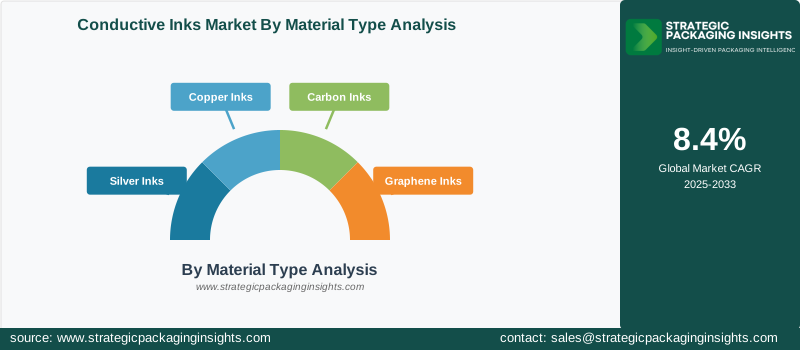
Carbon inks are primarily used in applications requiring moderate conductivity and cost-effectiveness. They are commonly used in sensors and printed electronics, offering a balance between performance and affordability. Graphene inks are emerging as a promising material due to their exceptional electrical properties and flexibility. They are being explored for use in advanced applications such as flexible electronics and wearable devices. The growing demand for innovative and high-performance materials is driving the development of new ink formulations and expanding the market for conductive inks.
By Technology Analysis
The Conductive Inks market is segmented by technology into Screen Printing, Inkjet Printing, and Flexographic Printing. Screen printing is the most widely used technology, offering cost-effective and scalable solutions for mass production. It is commonly used in the manufacturing of printed electronics, sensors, and solar cells, providing high precision and reliability. Inkjet printing is gaining popularity due to its ability to produce complex patterns and fine details, making it suitable for applications requiring high resolution and customization.

Flexographic printing is primarily used in packaging applications, offering fast production speeds and cost-effectiveness. It is commonly used in the production of RFID tags and smart packaging solutions, providing a balance between performance and affordability. The growing demand for advanced printing technologies is driving the development of new ink formulations and expanding the market for conductive inks. Companies are investing in research and development to create inks that offer enhanced performance and compatibility with emerging technologies.
By Application Analysis
The Conductive Inks market is segmented by application into RFID, Printed Electronics, Sensors, and Solar Cells. Printed electronics hold a significant share of the market, driven by the increasing demand for flexible and wearable devices. Conductive inks are used in the manufacturing of various electronic components, offering superior performance and reliability. RFID is another key application, with conductive inks used in the production of RFID tags and smart labels, providing cost-effective and scalable solutions.

Sensors are a growing application area, with conductive inks used in the production of various types of sensors, including pressure, temperature, and humidity sensors. The increasing demand for smart and connected devices is driving the growth of this segment. Solar cells are another important application, with conductive inks used in the manufacturing of solar panels, enhancing their efficiency and durability. The growing focus on renewable energy sources is driving the demand for conductive inks in this application.
By End Use Analysis
The Conductive Inks market is segmented by end use into Electronics, Automotive, Healthcare, and Packaging. The electronics industry holds a significant share of the market, driven by the increasing demand for printed electronics and flexible devices. Conductive inks are used in the manufacturing of various electronic components, offering superior performance and reliability. The automotive industry is another key end-use sector, with conductive inks used in the production of various automotive components, including sensors and displays.

The healthcare industry is a growing end-use sector, with conductive inks used in the production of medical devices and wearable health monitors. The increasing demand for smart and connected healthcare solutions is driving the growth of this segment. The packaging industry is also a key end-use sector, with conductive inks used in the production of smart packaging solutions, offering enhanced functionality and consumer engagement. The growing demand for innovative and high-performance materials is driving the development of new ink formulations and expanding the market for conductive inks.
Conductive Inks Market Segments
The Conductive Inks market has been segmented on the basis ofBy Material Type
- Silver Inks
- Copper Inks
- Carbon Inks
- Graphene Inks
By Technology
- Screen Printing
- Inkjet Printing
- Flexographic Printing
By Application
- RFID
- Printed Electronics
- Sensors
- Solar Cells
By End Use
- Electronics
- Automotive
- Healthcare
- Packaging
Region
- Asia Pacific
- North America
- Latin America
- Europe
- Middle East & Africa




