
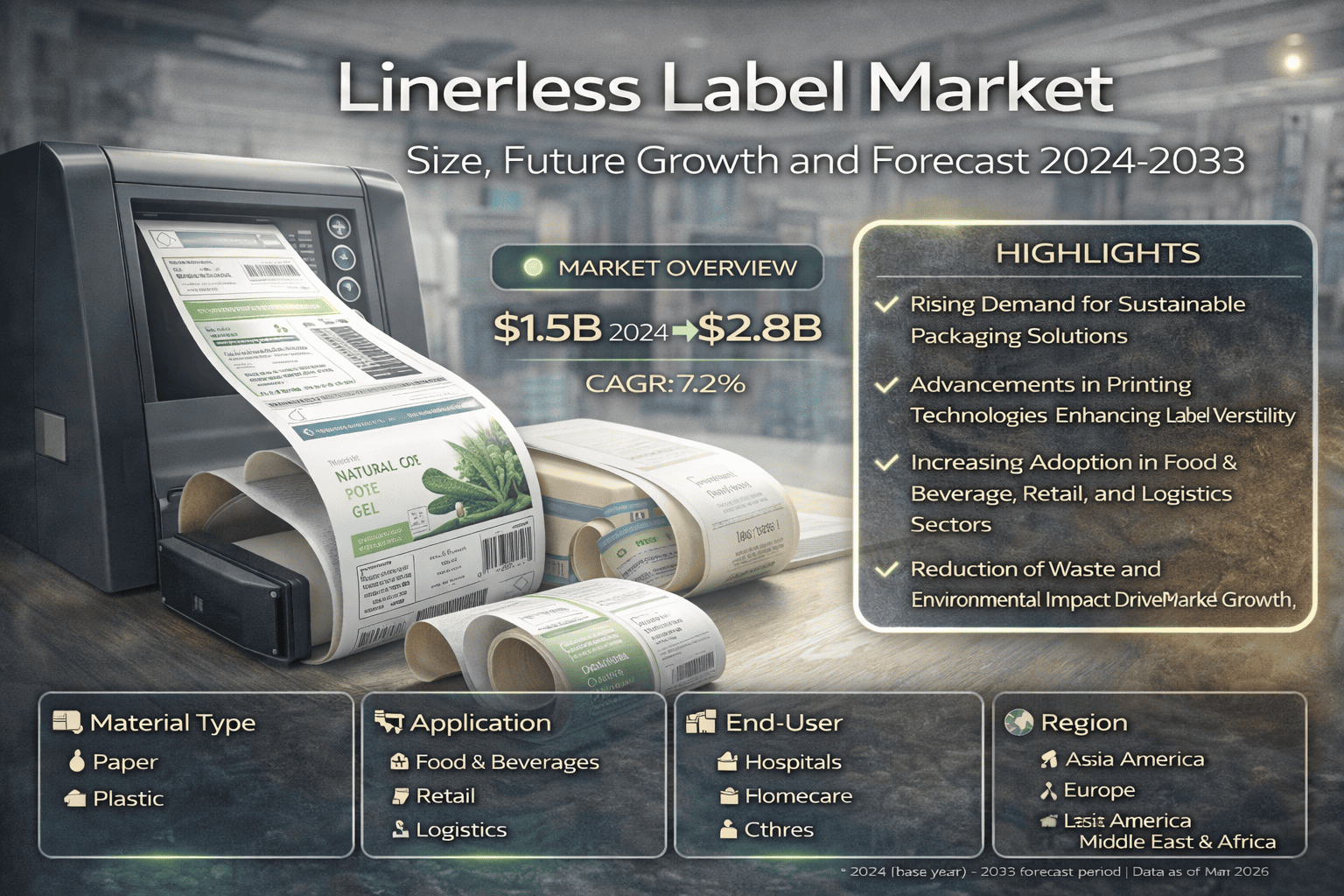
The linerless label market was valued at $1.5 billion in 2024 and is projected to reach $2.8 billion by 2033, growing at a CAGR of 7.2% during the forecast period 2025-2033.
The linerless label market is undergoing a significant transformation, driven by the global shift toward sustainable packaging, advances in printing technology, and the expanding demands of e-commerce and logistics. Valued at $1.5 billion in 2024, the market is projected to reach $2.8 billion by 2033, growing at a compound annual growth rate of 7.2% during the forecast period from 2025 to 2033. This impressive growth reflects how linerless labels are increasingly being recognized as both a practical and environmentally responsible labeling solution across a wide range of industries.
https://www.strategicpackaginginsights.com/report/linerless-label-market
What Are Linerless Labels and Why Do They Matter?
Traditional labels come attached to a release liner, which is a backing sheet that is peeled away and discarded during application. Linerless labels, by contrast, eliminate this liner entirely. This seemingly simple design change has far-reaching implications. Without the liner, manufacturers generate less waste, use fewer raw materials, and reduce the weight of label rolls, which in turn lowers transportation costs and carbon emissions. For companies striving to meet sustainability targets, linerless labels offer a tangible path toward reducing their environmental footprint without sacrificing labeling quality or functionality.
Beyond environmental benefits, linerless labels also deliver operational efficiencies. Rolls of linerless labels contain significantly more labels per roll compared to lined alternatives, meaning fewer roll changes and less downtime in high-volume production environments. These advantages are making linerless labels increasingly attractive to businesses across food and beverages, retail, logistics, pharmaceuticals, and personal care.
Key Market Drivers Fueling Growth
Sustainability is the single most powerful force driving the linerless label market forward. Consumers, advocacy groups, and regulatory bodies worldwide are pushing businesses to adopt greener packaging practices. As organizations face mounting pressure to demonstrate environmental responsibility, linerless labels have emerged as a straightforward and effective solution. The elimination of the release liner alone reduces total label waste considerably, and when paired with recyclable paper-based materials, the overall environmental impact is substantially lower than traditional labeling systems.
The rapid expansion of e-commerce has also created a strong demand for efficient, scalable labeling solutions. As online retailers and third-party logistics providers process increasingly large volumes of shipments, the ability to label goods quickly, accurately, and cost-effectively has become a critical operational priority. Linerless labels fit naturally into this environment, offering versatility and adaptability that keep pace with the demands of modern supply chains.
Advancements in printing technologies are another key driver. Both digital and flexographic printing have evolved to support higher-quality, more customizable linerless label output. Digital printing, in particular, enables short-run production with variable data, making it ideal for brands that require personalization or frequent label changes. These technological improvements are expanding the application range of linerless labels and making them accessible to a broader range of industries and business sizes.
Challenges and Barriers to Adoption
Despite the market's strong growth prospects, certain challenges continue to slow adoption, particularly among smaller businesses. The transition from traditional labels to linerless labels requires investment in new machinery and processes, and this upfront capital expenditure can be a significant deterrent. Small and medium enterprises, which often operate on tighter margins, may find it difficult to justify these costs even when the long-term savings are apparent.
Another barrier is a general lack of awareness about linerless labels among potential end-users. Many businesses remain unfamiliar with the full range of benefits linerless labels offer, from cost savings to waste reduction. Educating the market and demonstrating the return on investment through pilot programs and case studies will be essential to accelerating broader adoption. Additionally, ongoing innovation in adhesive and material technologies remains necessary to ensure that linerless labels perform reliably across the diverse environments and surfaces encountered in different industries.
Material Types: Paper, Plastic, and Beyond
The linerless label market is segmented by material type into paper, plastic, and other emerging materials. Paper-based linerless labels are gaining significant traction, largely because of their recyclability and alignment with sustainability goals. They are especially popular in the food and beverage sector, where eco-conscious branding and regulatory requirements around packaging waste are particularly strong.
Plastic linerless labels, while less eco-friendly in terms of recyclability, offer practical advantages in certain applications. Their durability and resistance to moisture make them well-suited for use in logistics, cold storage, and pharmaceutical settings where labels must withstand challenging conditions. Ongoing research and development in material science is also producing hybrid materials that combine the environmental benefits of paper with the performance characteristics of plastic, expanding the options available to manufacturers and end-users alike.
Application Sectors: Where Linerless Labels Are Making an Impact
The food and beverage industry represents one of the largest application segments for linerless labels. With growing consumer interest in sustainable packaging and strict regulations around food labeling, producers in this sector are turning to linerless solutions that reduce waste while maintaining clear, attractive product labeling. The retail sector is similarly enthusiastic, drawn by the cost-effectiveness and flexibility of linerless labels for price tags, promotional labels, and product identification.
In logistics and supply chain management, linerless labels are valued for their efficiency and adaptability. The ability to print variable data on demand and apply labels quickly to diverse package shapes and sizes makes them a strong fit for fast-moving distribution environments. Pharmaceutical companies use linerless labels for their durability and ability to carry detailed, compliant labeling information under demanding conditions. The personal care sector also utilizes linerless labels for their visual appeal and the customization possibilities they offer for premium product presentation.
Printing Technologies Shaping the Market
Printing technology plays a central role in determining the quality, versatility, and cost of linerless labels. Digital printing has gained considerable momentum in recent years due to its capacity for producing high-resolution, fully customizable labels with rapid turnaround. It is particularly well-suited to industries like food and beverage and personal care, where brand differentiation and frequent product line changes are common.
Flexographic printing, on the other hand, is valued for its cost-effectiveness in large-volume runs. It remains a dominant technology for logistics and industrial labeling applications where straightforward, consistent output is more important than customization. The broader category of other printing technologies includes innovations that continue to push the boundaries of what linerless labels can achieve in terms of quality, speed, and material compatibility.
Regional Landscape: Where Growth Is Happening
North America holds a significant share of the global linerless label market, with the United States contributing approximately $450 million and growing at a CAGR of 6%. The country's advanced manufacturing infrastructure, focus on sustainability, and supportive regulatory environment all contribute to robust market demand. Europe, led by Germany with a market size of around $300 million and a CAGR of 5%, also represents a mature and environmentally driven market with strong industrial demand.
Asia Pacific is the fastest-growing region, with China posting a CAGR of 8% and a market size of $350 million. China's booming e-commerce sector, combined with government-backed initiatives to reduce packaging waste, is accelerating adoption of linerless labels at an impressive pace. Japan, with $250 million in market size, brings its advanced manufacturing capabilities and quality-first mindset to the sector, while the United Kingdom continues to see steady growth driven by its strong retail sector and sustainability commitments.
Competitive Landscape and Key Players
The linerless label market is competitive, with a handful of major players setting the tone through product innovation, strategic partnerships, and acquisitions. Avery Dennison Corporation leads the market with a strong global presence and a comprehensive portfolio of sustainable labeling solutions. 3M Company brings its expertise in adhesive technologies to bear on the linerless segment, while CCL Industries Inc. combines scale with a commitment to innovation and environmental responsibility.
Coveris Holdings S.A. and SATO Holdings Corporation round out the top tier of market participants, each bringing specialized expertise in packaging and labeling solutions. These companies are investing heavily in research and development to stay ahead of evolving customer needs and regulatory demands. Meanwhile, a vibrant ecosystem of smaller and mid-sized companies adds diversity and innovation to the market, ensuring a dynamic and competitive landscape that benefits end-users with a growing range of options.
Looking Ahead: The Future of the Linerless Label Market
The linerless label market is on a clear upward trajectory, underpinned by powerful structural trends including sustainability mandates, e-commerce growth, and continuous technological advancement. As businesses across industries continue to prioritize environmental responsibility and operational efficiency, demand for linerless labels is set to grow steadily through 2033 and beyond. Companies that invest in awareness-building, technological innovation, and accessible pricing models will be best positioned to capture the significant opportunities this expanding market offers.
For businesses still on the fence about switching to linerless labels, the evidence is compelling. The combination of reduced waste, lower long-term costs, improved operational efficiency, and strong alignment with sustainability goals makes linerless labels one of the most forward-looking packaging solutions available today. The market's continued growth from $1.5 billion in 2024 to a projected $2.8 billion in 2033 is a strong signal that the industry has reached a tipping point, and adoption will only accelerate from here.