
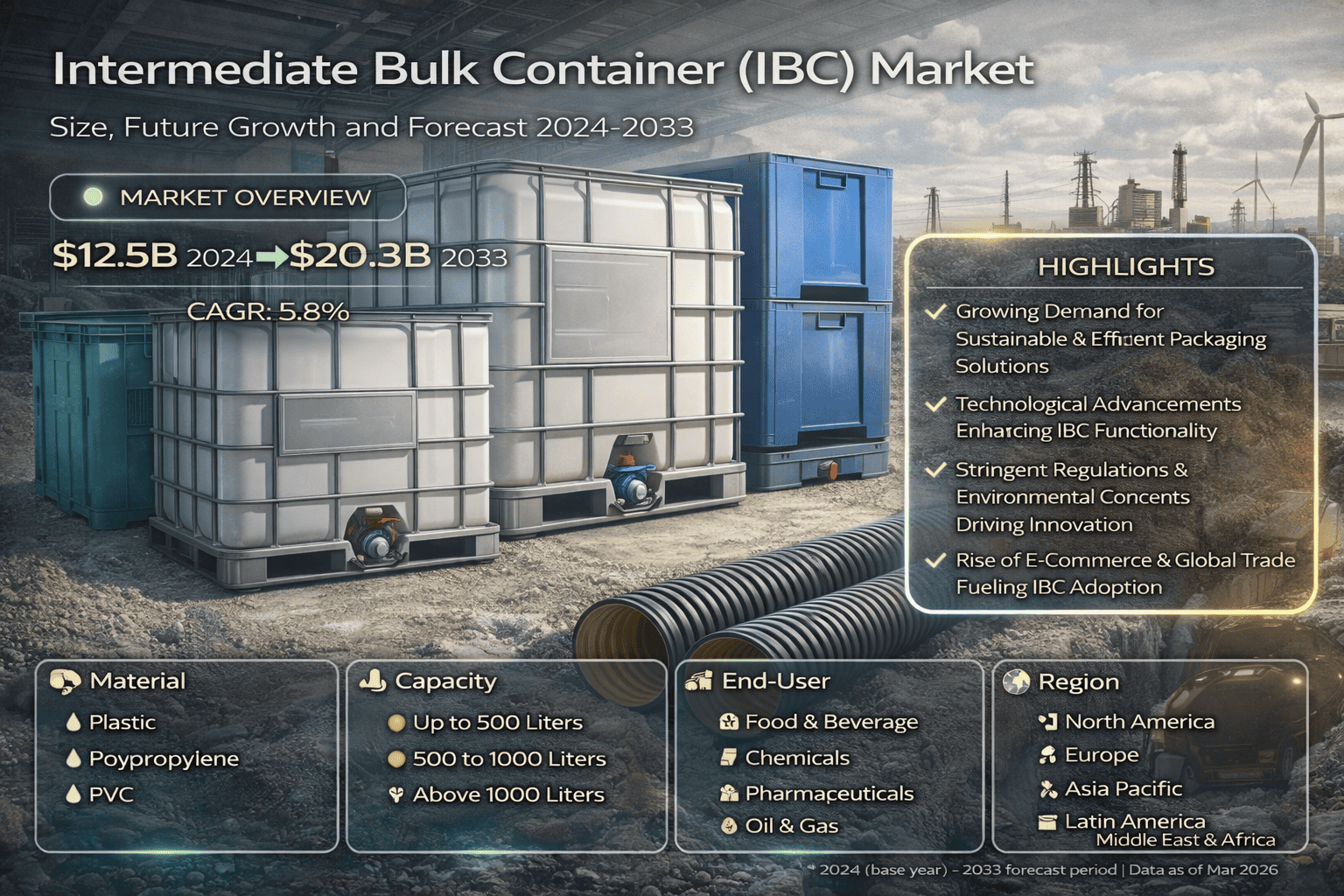
The Intermediate Bulk Container (IBC) market was valued at $12.5 billion in 2024 and is projected to reach $20.3 billion by 2033, growing at a CAGR of 5.8% during the forecast period 2025-2033.
The global Intermediate Bulk Container (IBC) market is on a strong upward trajectory, valued at $12.5 billion in 2024 and projected to reach $20.3 billion by 2033. This expansion, at a compound annual growth rate (CAGR) of 5.8%, reflects a sweeping transformation in how industries approach the transportation and storage of bulk materials. From food and beverage companies to chemical manufacturers and pharmaceutical giants, IBCs have become an indispensable part of modern supply chain infrastructure. As the world accelerates its shift toward sustainable, efficient, and technology-driven packaging, the IBC market stands at the center of a dynamic convergence of industrial demand and environmental responsibility.
https://www.strategicpackaginginsights.com/report/intermediate-bulk-container-ibc-market
What Is Driving the IBC Market Forward
Several powerful forces are pushing the IBC market to new heights. At the core of this growth is the rising global demand for bulk packaging solutions that are both cost-effective and reliable. Industries dealing with large-scale movement of liquids, semi-solids, and solids are turning to IBCs because they streamline logistics, reduce material waste, and lower transportation costs when compared to traditional packaging formats such as drums and barrels.
The surge in global trade is another major catalyst. As international supply chains grow more complex, businesses require packaging that can survive long-haul shipping under varying climatic conditions. IBCs, with their robust construction and stackable design, are ideally suited for this purpose. Additionally, advancements in material science are making IBCs more durable, lightweight, and longer-lasting, further adding to their appeal. The integration of smart technologies, including IoT-enabled tracking systems, is also reshaping the IBC landscape. These systems allow for real-time monitoring of product conditions during transit, which is especially valuable for industries transporting hazardous or temperature-sensitive materials.
Sustainability as a Core Growth Driver
One of the most significant themes shaping the IBC market today is the global push for sustainability. As regulatory bodies and consumers alike demand greener practices, companies across industries are rethinking their packaging strategies. IBCs made from recyclable materials, including high-density polyethylene and composite blends, are gaining traction as businesses look to reduce their environmental footprint. The development of biodegradable IBCs presents a particularly exciting frontier for manufacturers who want to differentiate themselves and comply with evolving environmental regulations.
The food and beverage sector is a leading example of this trend. Companies in this space are prioritizing packaging that not only preserves product quality but also aligns with their corporate sustainability goals. Regulatory pressure surrounding plastic waste disposal is compelling manufacturers to invest in eco-friendly alternatives, and those who move quickly stand to gain a meaningful competitive advantage in the marketplace.
Challenges Facing the IBC Industry
Despite strong growth momentum, the IBC market is not without its obstacles. Stringent regulations governing the use of plastics and the disposal of packaging waste are compelling manufacturers to invest in sustainable alternatives, which can significantly increase production costs. For small and medium enterprises, the high initial cost of IBCs compared to conventional packaging remains a tangible barrier to adoption. These businesses may find it difficult to justify the upfront investment, even when long-term cost savings and efficiency gains are factored in.
Volatility in raw material prices adds another layer of complexity. Fluctuations in the cost of steel, plastic resins, and composite materials can squeeze margins for IBC manufacturers and make long-term pricing strategies difficult to maintain. Companies that develop agile supply chain strategies and invest in alternative materials research will be better positioned to weather these pressures.
A Closer Look at Market Segments
By Material
The IBC market is segmented by material into plastic, metal, and composite categories. Plastic IBCs command the largest share due to their lightweight nature, affordability, and versatility across a wide range of industries. Metal IBCs, while more expensive, are prized for their strength and resistance to harsh conditions, making them the go-to choice for chemical and pharmaceutical applications. Composite IBCs, which combine elements of both plastic and metal, offer a compelling middle ground - delivering strength without excessive weight. The demand for composite solutions is growing as manufacturers develop new material combinations that improve both performance and sustainability.
By Capacity
IBCs in the 500 to 1,000-liter capacity range are the most widely used, striking a balance between handling ease and storage volume. Smaller-capacity IBCs (up to 500 liters) serve niche applications where precision and portability are key, while large-capacity units (above 1,000 liters) are reserved for large-scale industrial operations that deal in high volumes of bulk goods.
By End-User
The food and beverage industry is the dominant end-user of IBCs, leveraging these containers for hygienic, efficient, and scalable storage and transport. The chemical industry is the second-largest adopter, given its need for safe and reliable hazardous materials handling. Pharmaceuticals, oil and gas, and other industrial sectors round out the end-user landscape, each with specific requirements around product integrity, regulatory compliance, and durability.
Regional Market Performance
The IBC market shows strong regional variation in terms of growth pace and driving factors. The United States leads with a market size of $3.5 billion and a CAGR of 6%, supported by a robust industrial base, rising sustainability mandates, and the presence of major market players investing in packaging innovation. Germany holds a $2.1 billion market, driven by its strong manufacturing culture and an intense national focus on reducing carbon emissions.
China is the fastest-growing major market, with a projected CAGR of 8% and a current market size of $1.8 billion. Government-backed environmental initiatives and a rapidly expanding industrial sector are accelerating adoption. India is emerging as a key market with a CAGR of 7% and a $1.2 billion valuation, driven by industrialization and growing demand for efficient supply chain solutions. Brazil, at $900 million with a 6% CAGR, is another market to watch as it expands its industrial capacity and focuses on reducing its environmental impact. The Asia Pacific region as a whole leads all regions with a CAGR of 15%, reflecting its role as the world's manufacturing engine.
Competitive Landscape and Key Players
The IBC market is highly fragmented, with a mix of global corporations and regional specialists vying for market share. Leading players include Greif Inc., Mauser Group B.V., SCHÜTZ GmbH and Co. KGaA, and Berry Global Inc. These companies have established strong footholds through expansive product portfolios, global manufacturing footprints, and a consistent emphasis on product innovation.
Greif Inc. is recognized for its commitment to sustainable packaging and its ability to bring innovative solutions to market quickly. Mauser Group B.V. differentiates itself through customer-centric approaches and a comprehensive range of IBC offerings. SCHÜTZ GmbH and Co. KGaA operates across multiple continents, providing reliable, high-quality products to a broad industrial base. Berry Global Inc. has built a reputation for combining functional packaging design with sustainability-oriented thinking. Other notable competitors such as Time Technoplast Ltd., Snyder Industries, and Hoover Ferguson Group are also investing heavily in R and D to capture emerging opportunities.
Opportunities on the Horizon
Looking ahead, several exciting opportunities are positioned to reshape the IBC market. The rise of e-commerce and direct-to-consumer fulfillment networks is creating new demand for reliable bulk packaging in distribution-intensive environments. Customization is increasingly becoming a competitive differentiator, as manufacturers offer tailor-made IBC solutions designed to meet the unique dimensional, material, and regulatory requirements of specific industries.
The integration of smart technology into IBC design represents perhaps the most transformative opportunity. IoT-enabled IBCs equipped with sensors can provide continuous data on temperature, pressure, and fill levels, delivering actionable insights that improve supply chain decision-making. As industries such as pharmaceuticals and specialty chemicals grow more demanding in their quality control requirements, this kind of intelligent packaging will become increasingly standard. Manufacturers who invest early in these capabilities and in the development of compliant, eco-friendly materials will be best placed to lead the market through 2033 and beyond.
Conclusion
The IBC market is entering a period of sustained and diversified growth, anchored by industrial demand, sustainability imperatives, and technological advancement. From the expanding Asia Pacific region to the innovation-driven markets of North America and Europe, the appetite for efficient and responsible bulk packaging is clear and growing. While challenges around regulatory compliance and raw material costs remain real, the overall outlook is one of resilience and opportunity. Companies that align their strategies with the dual demands of performance and sustainability will find themselves well-positioned to capture the considerable value this market has to offer over the coming decade.