
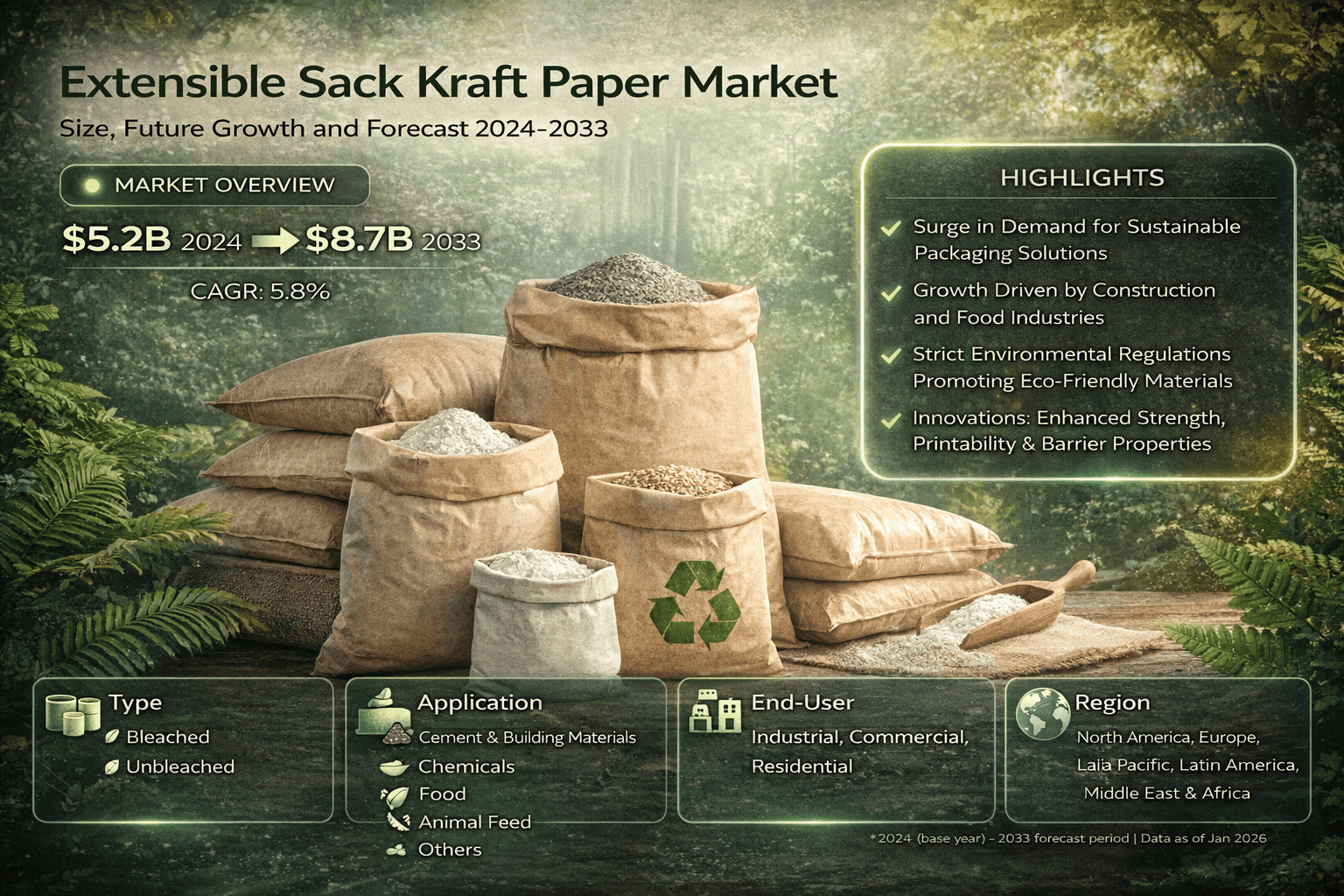
The Extensible Sack Kraft Paper market was valued at $5.2 billion in 2024 and is projected to reach $8.7 billion by 2033, growing at a CAGR of 5.8% during the forecast period 2025-2033.
The packaging industry is undergoing a significant transformation as businesses and consumers alike push for more sustainable, durable, and eco-friendly solutions. At the heart of this shift lies the extensible sack kraft paper market, a segment that has been gaining remarkable momentum across industries ranging from construction to food processing. Valued at $5.2 billion in 2024, the market is projected to reach $8.7 billion by 2033, growing at a compound annual growth rate (CAGR) of 5.8% during the forecast period from 2025 to 2033. This growth trajectory reflects the broader global pivot toward packaging materials that balance performance with environmental responsibility.
https://www.strategicpackaginginsights.com/report/extensible-sack-kraft-paper-market
What Is Extensible Sack Kraft Paper and Why Does It Matter?
Extensible sack kraft paper is a high-strength, flexible packaging material designed to withstand the demands of heavy-duty applications. Its unique extensibility allows it to absorb impact and stress without tearing, making it particularly well-suited for packaging materials like cement, fertilizers, chemicals, and bulk food products. Unlike conventional paper, extensible sack kraft paper offers superior elongation properties, which means sacks made from it can be filled at high speeds on automated packing lines without compromising structural integrity.
The material comes in two primary variants: bleached and unbleached. Bleached kraft paper offers a cleaner, white appearance with better printability, which makes it popular in the food and consumer goods sectors where branding plays a crucial role. Unbleached kraft paper, by contrast, retains its natural brown tone and requires fewer chemical treatments during production, giving it a stronger sustainability profile. As the global appetite for greener packaging grows, unbleached variants are expected to see accelerating demand, even as both segments continue to find robust markets across multiple industries.
Key Drivers Fueling Market Growth
Several powerful forces are driving the expansion of this market. The most prominent is the global surge in demand for sustainable packaging. With governments worldwide tightening environmental regulations and consumers becoming increasingly conscious of their ecological footprint, industries are under pressure to move away from plastic-based packaging. Extensible sack kraft paper, being biodegradable and largely recyclable, fits neatly into this green packaging narrative.
The construction industry is another major growth engine. Rapid urbanization, especially in emerging economies across Asia, Africa, and Latin America, has created enormous demand for cement and building materials. Since extensible sack kraft paper is the go-to packaging solution for cement bags, the construction boom translates directly into stronger demand for this material. Countries like India and China, which are experiencing some of the fastest urbanization rates globally, are leading this charge.
The food and beverage industry also contributes significantly to market growth. Flour, sugar, grains, starch, and pet food are just a few of the commodities commonly packaged using sack kraft paper. As global food production scales up and supply chains grow more complex, the need for reliable, food-safe packaging becomes ever more critical. Extensible sack kraft paper meets these needs effectively while aligning with food safety standards.
Furthermore, the rise of e-commerce has amplified the need for packaging that is both protective and lightweight. As more goods are shipped directly to consumers, packaging must perform under varied conditions of transportation and handling. Extensible sack kraft paper's strength and flexibility make it a capable contender in this evolving logistics environment.
Market Segmentation: A Closer Look
The extensible sack kraft paper market is segmented across several dimensions including type, application, end-user, and geography. On the application front, cement and building materials command the largest share, reflecting the material's dominant role in the construction supply chain. Chemicals follow closely, as sack kraft paper offers adequate protection against moisture and contamination. The food segment, covering products like flour, animal feed, and grains, rounds out the top three application areas.
From an end-user perspective, the industrial sector leads the market by a wide margin. Industrial operations rely on large volumes of durable packaging for bulk materials, and extensible sack kraft paper fulfills this need efficiently. The commercial sector, which includes retailers and distributors of consumer goods, also contributes substantially. Even the residential sector is witnessing a slow but steady uptick in demand, largely driven by the DIY and home renovation trend that has gained popularity in recent years.
Regional Highlights: Asia Pacific Leads the Charge
Geographically, Asia Pacific stands out as the fastest-growing region in the extensible sack kraft paper market, with a 2024 market size of $1.8 billion and strong growth momentum fueled by industrialization and urban development in China and India. China alone holds a market size of $1.2 billion with a projected CAGR of 6%, while India is expected to grow even faster at 7%, driven by large-scale infrastructure projects and agricultural packaging needs.
Europe, with a market size of $1.5 billion, remains a significant player due to its stringent environmental policies and deep-rooted emphasis on sustainable packaging. Germany, one of Europe's manufacturing powerhouses, has a market valued at $0.8 billion, supported by regulatory frameworks that favor eco-friendly materials over plastics.
North America, valued at approximately $1.2 billion, maintains steady growth anchored by the United States, which leads with $1.0 billion in market size. The region's established construction and food industries continue to generate consistent demand. Latin America and the Middle East and Africa, while smaller in absolute terms, are gaining ground due to expanding agricultural activity and growing adoption of sustainable packaging practices.
Competitive Landscape
The extensible sack kraft paper market is home to several global heavyweights. Mondi Group, BillerudKorsnäs AB, Smurfit Kappa Group, and WestRock Company are among the leading players, each leveraging extensive distribution networks and strong R and D capabilities to maintain competitive positions. Mondi Group is particularly recognized for its innovative approach to packaging design, with a strong footprint in Europe and North America. BillerudKorsnäs AB has been strategic in expanding into Asia Pacific to capture the region's rapid growth. Smurfit Kappa continues to invest heavily in research to differentiate its product offerings, while WestRock relies on partnerships and acquisitions to broaden its market reach. Other notable companies such as Georgia-Pacific LLC, Canfor Corporation, and KapStone Paper and Packaging Corporation also contribute to the competitive dynamics of this market.
Challenges and Opportunities Ahead
Despite its strong outlook, the market is not without hurdles. High raw material costs remain a persistent concern, as wood pulp prices can be volatile and subject to supply chain disruptions. Competition from alternative packaging solutions such as plastic woven sacks and flexible intermediate bulk containers also poses a challenge, particularly in price-sensitive markets.
However, these challenges are offset by compelling opportunities. Innovations in product development, including moisture-resistant coatings and improved printability, are expanding the functional range of extensible sack kraft paper. Additionally, as more brands commit to sustainability targets, demand for certified and responsibly sourced paper packaging is set to grow. The convergence of regulatory pressure, consumer preference, and industry innovation creates a fertile environment for long-term market expansion.
The extensible sack kraft paper market is clearly on a robust upward trajectory, underpinned by its versatility, sustainability credentials, and alignment with global megatrends in construction, food production, and eco-conscious commerce.