
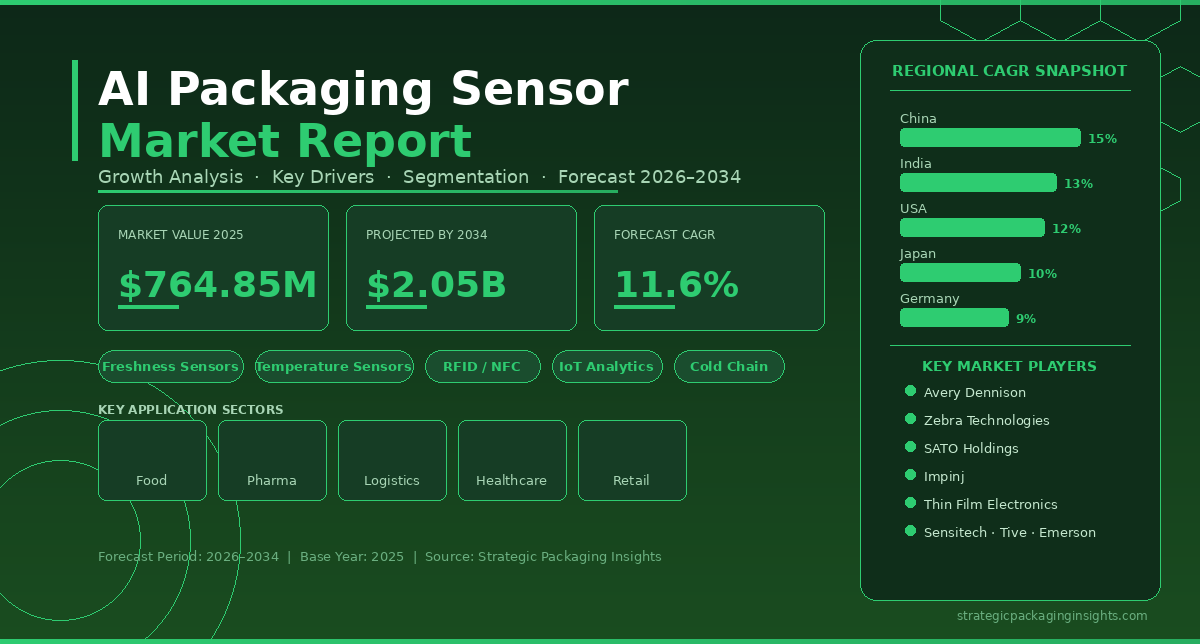
The AI Packaging Sensor market was valued at $764.85 million in 2025 and is projected to reach $2.05 billion by 2034, growing at a CAGR of 11.6% during the forecast period 2026-2034.
The AI Packaging Sensor market was valued at $764.85 million in 2025 and is projected to reach $2.05 billion by 2034, growing at a CAGR of 11.6% during the forecast period 2026 to 2034. This growth reflects the accelerating adoption of smart packaging technologies across food, pharmaceutical, logistics, and industrial sectors.
AI-enabled packaging sensors are transforming supply chain management by providing real-time monitoring, predictive analytics, and automated quality assurance. As industries pursue digital transformation, these sensors have become essential tools for ensuring product safety, reducing waste, and optimizing logistics performance.
https://www.strategicpackaginginsights.com/report/ai-packaging-sensor-market
Key Growth Drivers of the AI Packaging Sensor Market
Rising Demand for Smart Packaging Solutions
The primary driver of market growth is the increasing need for intelligent packaging across multiple industries. Food manufacturers, pharmaceutical companies, and cold chain operators are deploying AI sensors to monitor product conditions continuously. Real-time data on freshness, temperature, shock exposure, and leakage enables proactive decision-making, reduces spoilage, and supports regulatory compliance. This demand is especially strong in markets with strict product safety standards.
Advancements in Sensor Technology and AI Analytics
Sophisticated sensor development is accelerating market adoption. Modern AI packaging sensors can detect subtle changes in product conditions with high accuracy and relay that data through integrated AI analytics platforms. These platforms process large volumes of sensor data to deliver actionable insights for supply chain optimization. Companies such as Avery Dennison, Zebra Technologies, and Thin Film Electronics are investing heavily in next-generation sensor capabilities to meet evolving industry needs.
Integration with IoT and Digital Supply Chain Infrastructure
The convergence of AI sensors with IoT and RFID/NFC technologies is a significant growth catalyst. Connected packaging solutions allow seamless, end-to-end visibility across complex supply chains. Businesses can track products from manufacturing to retail in real time, enabling faster response to quality issues and reducing operational costs. The integration of printed electronics further expands the scope of affordable, scalable smart packaging deployments.
AI Packaging Sensor Market Segmentation Analysis
Sensor Type Analysis
The market is segmented into freshness sensors, temperature sensors, shock sensors, and leakage sensors. Temperature sensors dominate usage in pharmaceutical and cold chain applications where product integrity depends on controlled thermal environments. Freshness sensors are gaining rapid traction in the food industry. Shock sensors serve logistics and industrial packaging, while leakage sensors are critical for liquid product containment and contamination prevention.
Technology Analysis
Key technologies driving the market include AI analytics, IoT, RFID/NFC, and printed electronics. AI analytics provides the data processing backbone that converts raw sensor inputs into meaningful insights. IoT infrastructure enables connectivity and remote monitoring across distributed supply chains. RFID and NFC technologies support accurate product identification and traceability. Printed electronics represents an emerging and cost-effective approach to embedding sensor functionality directly into packaging materials.
Application Analysis
The food industry represents one of the largest application areas, driven by strict freshness and safety standards. Pharmaceutical packaging demands precise temperature monitoring and tamper detection. Logistics applications benefit from real-time location and condition tracking, while industrial packaging uses AI sensors to monitor goods throughout manufacturing and distribution. Each application area is increasingly prioritizing data-driven quality assurance.
End Use Analysis
End users include brand owners, cold chain operators, retailers, and healthcare organizations. Cold chain operators represent a critical segment, as temperature-sensitive products require continuous monitoring from production to delivery. Retailers are leveraging AI sensors to deliver interactive and informative packaging experiences. Healthcare organizations depend on sensor technologies for managing sensitive medical products and maintaining compliance with safety protocols.
Market Challenges and Industry Barriers
Despite strong growth potential, the AI Packaging Sensor market faces notable barriers. High initial investment costs remain a significant obstacle, particularly for small and medium-sized enterprises that may lack resources to deploy advanced AI-enabled systems at scale.
Integration complexity is another challenge. Incorporating AI sensors into legacy packaging and supply chain systems requires significant technical expertise and infrastructure upgrades. The shortage of skilled professionals capable of managing AI sensor deployments adds further friction.
Data privacy and cybersecurity concerns are increasingly prominent as sensor networks generate large volumes of sensitive operational data. Companies must navigate evolving regulatory frameworks and protect their systems from potential breaches, adding compliance costs and complexity.
Regional Outlook of the AI Packaging Sensor Market
The United States leads the global market, supported by strong technological infrastructure, a robust presence of key industry players, and rapid digital adoption in supply chain management. The U.S. market is growing at a CAGR of approximately 12%.
China is among the fastest-growing markets, with a projected CAGR of 15%, fueled by expanding food safety regulations and strong government support for sustainable and smart packaging initiatives.
Germany leads the European segment, growing at a CAGR of 9%, driven by industrial packaging innovation and regulatory compliance demands. Japan holds a strong position in quality-sensitive sectors such as food and pharmaceuticals, growing at 10% CAGR. India is an emerging market expanding at 13% CAGR, supported by growing logistics infrastructure and increasing digital transformation in manufacturing.
Competitive Landscape of the AI Packaging Sensor Market
The market features a mix of established technology companies and specialized innovators. Key players include Avery Dennison, Zebra Technologies, SATO Holdings, Impinj, Thin Film Electronics, Timestrip, Insignia Technologies, Emerson, Sensitech, and Tive. These companies compete through product innovation, strategic partnerships, and expanded sensor capabilities. Impinj leads in RFID-based tracking, while Insignia Technologies and Timestrip focus on freshness and time-temperature monitoring for food and pharma sectors.
Future Outlook of the AI Packaging Sensor Market
The AI Packaging Sensor market is positioned for strong, sustained growth through 2034. Continued investment in IoT infrastructure, printed electronics, and AI-driven analytics will expand the capabilities and reduce the costs of smart packaging solutions. Sustainability mandates will further accelerate adoption as companies seek sensors that can simultaneously monitor environmental impact and product conditions. As global supply chains grow more complex, AI packaging sensors will become foundational to quality assurance, regulatory compliance, and operational efficiency across industries.