


Stretch Wrapper Market Outlook
The Stretch Wrapper market size was valued at USD 4.29 billion in 2025 and is anticipated to reach USD 7.44 billion by 2034, growing at a CAGR of 6.3% during the forecast period according to Strategic Packaging Insights. The market is witnessing significant growth due to the increasing demand for efficient packaging solutions across various industries. Companies like Lantech and Signode are leading the charge by innovating new technologies that enhance the speed and efficiency of stretch wrapping processes. The rise in e-commerce and the need for secure packaging solutions are further propelling the market's expansion. As businesses strive to optimize their supply chains, the adoption of advanced stretch wrapping machines is becoming more prevalent, driving the market forward.
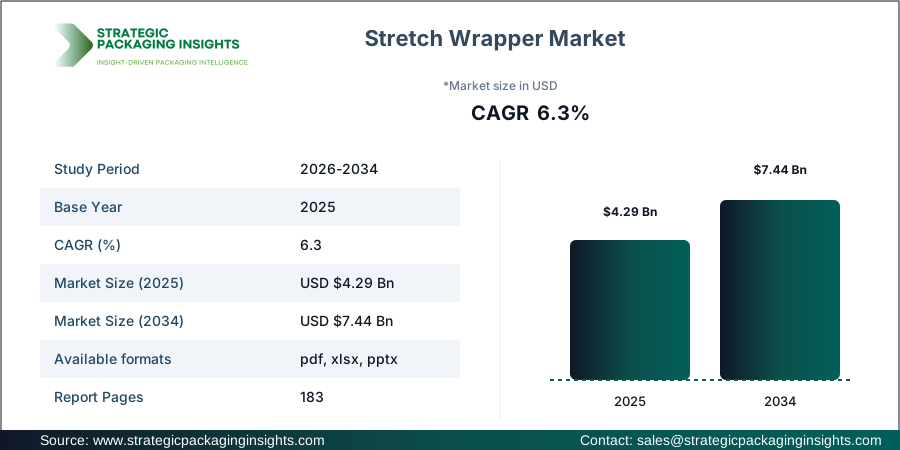
One of the most impactful drivers of the Stretch Wrapper market is the growing emphasis on reducing packaging waste and improving sustainability. Governments worldwide are implementing stringent regulations to minimize environmental impact, which is encouraging companies to adopt eco-friendly packaging solutions. According to a report by the Environmental Protection Agency, reducing packaging waste is a critical component of sustainable business practices. This regulatory push is compelling companies to invest in advanced stretch wrapping technologies that not only enhance operational efficiency but also align with environmental goals. As a result, companies like Robopac and FROMM Group are focusing on developing sustainable stretch wrapping solutions that cater to the evolving needs of the market.
Report Scope
| Attributes | Details |
| Report Title | Stretch Wrapper Market Size, Future Growth and Forecast 2034 |
| Machine Type | Turntable Stretch Wrappers, Rotary Arm Wrappers, Ring Wrappers, Robotic Wrappers |
| Automation Level | Semi-Automatic, Automatic, Fully Automatic |
| Application | Pallet Wrapping, Carton Wrapping, Industrial Packaging |
| End Use | Food & Beverage, Logistics, Manufacturing, Retail |
| Region | Asia Pacific, North America, Latin America, Europe, Middle East & Africa |
| Base Year | 2025 |
| Historic Period | 2018-2024 |
| Forecast Period | 2026-2034 |
| Number of Pages | 183 |
| Customization Available | Yes* |
Opportunities & Threats
The Stretch Wrapper market presents numerous opportunities, particularly in the realm of technological advancements. The integration of IoT and automation in stretch wrapping machines is a significant opportunity for market players. These technologies enable real-time monitoring and control, enhancing operational efficiency and reducing downtime. Companies like Orion Packaging and Wulftec are investing heavily in R&D to develop smart stretch wrapping solutions that cater to the needs of modern supply chains. The growing demand for customized packaging solutions is another opportunity, as businesses seek to differentiate their products in a competitive market. This trend is driving the development of versatile stretch wrapping machines that can handle a variety of packaging requirements.
Another opportunity lies in the expanding e-commerce sector, which is driving the demand for efficient and reliable packaging solutions. As online shopping continues to grow, the need for secure and tamper-proof packaging is becoming increasingly important. Stretch wrappers play a crucial role in ensuring that products are securely packaged and protected during transit. Companies like Cousins Packaging and Muller LCS are capitalizing on this trend by offering innovative stretch wrapping solutions that cater to the unique needs of the e-commerce industry. The increasing focus on sustainability is also creating opportunities for market players to develop eco-friendly stretch wrapping solutions that align with the environmental goals of businesses.
Despite the opportunities, the Stretch Wrapper market faces several threats, including the high initial cost of advanced stretch wrapping machines. Small and medium-sized enterprises may find it challenging to invest in these technologies due to budget constraints. Additionally, the market is highly competitive, with numerous players vying for market share. This intense competition can lead to price wars, which may impact the profitability of market players. Furthermore, the ongoing supply chain disruptions caused by global events such as the COVID-19 pandemic pose a threat to the market's growth. Companies need to navigate these challenges by adopting flexible business strategies and investing in resilient supply chain solutions.
Drivers & Challenges
The primary driver of the Stretch Wrapper market is the increasing demand for efficient and reliable packaging solutions across various industries. As businesses strive to optimize their supply chains, the adoption of advanced stretch wrapping machines is becoming more prevalent. Companies like Phoenix Wrappers and SIAT are leading the charge by developing innovative technologies that enhance the speed and efficiency of stretch wrapping processes. The rise in e-commerce and the need for secure packaging solutions are further propelling the market's expansion. Additionally, the growing emphasis on reducing packaging waste and improving sustainability is driving the adoption of eco-friendly stretch wrapping solutions.
Another significant driver is the technological advancements in stretch wrapping machines. The integration of IoT and automation in these machines is enhancing operational efficiency and reducing downtime. Companies like Lantech and Signode are investing heavily in R&D to develop smart stretch wrapping solutions that cater to the needs of modern supply chains. The increasing focus on sustainability is also driving the development of eco-friendly stretch wrapping solutions that align with the environmental goals of businesses. As a result, the market is witnessing significant growth, with companies striving to differentiate their products in a competitive market.
However, the Stretch Wrapper market faces several challenges, including the high initial cost of advanced stretch wrapping machines. Small and medium-sized enterprises may find it challenging to invest in these technologies due to budget constraints. Additionally, the market is highly competitive, with numerous players vying for market share. This intense competition can lead to price wars, which may impact the profitability of market players. Furthermore, the ongoing supply chain disruptions caused by global events such as the COVID-19 pandemic pose a threat to the market's growth. Companies need to navigate these challenges by adopting flexible business strategies and investing in resilient supply chain solutions.
Market Growth Factors
- Persistent labor shortages in packaging and processing operations are accelerating end-of-line automation. PMMI reported in 2025 that many CPG companies are struggling to hire skilled operators and technicians, increasing interest in targeted automation, machine-embedded HMIs, predictive maintenance, and remote OEM support that favor automatic and semi-automatic stretch wrappers over manual pallet wrapping.
- Warehouse robotics and AMR adoption are creating direct demand for stretch wrappers that can integrate with automated pallet movement. Lantech formally launched AMR-integrated stretch wrapping solutions in 2026, reflecting a broader shift toward robotic pallet flow in distribution and manufacturing sites.
- The EU Packaging and Packaging Waste Regulation entered into force on February 11, 2025 and will generally apply from August 12, 2026, introducing packaging minimization and recyclability requirements across the packaging life cycle. This is pushing shippers and manufacturers to adopt more film-efficient and better-controlled wrapping systems. [European Commission ]
- California’s packaging producer responsibility rules took effect on May 1, 2026 and require producers to reduce single-use plastic by 25% and ensure all packaging is recyclable or compostable. These source-reduction requirements support demand for stretch wrappers that lower film consumption and can work with alternative wrapping materials.
- Sustainability requirements from brand owners, retailers, and regulators are reshaping OEM specifications. PMMI’s 2026 sustainability report highlights material transitions, modular upgrade paths, embedded monitoring, and reporting readiness as rising equipment requirements, supporting retrofit and replacement demand in the stretch wrapper installed base.
- Buyers are increasingly prioritizing domestic sourcing and supply-chain resilience for packaging machinery. Orion’s 2026 launch of a fully U.S.-built entry-level stretch wrapper explicitly ties customer demand to predictable lead times, reduced exposure to overseas disruptions, and tighter control over components and pricing.
- AI and digitalization are becoming more practical in packaging equipment. PMMI reported in 2026 that AI applications in packaging machinery have expanded and become more affordable, supporting market demand for connected stretch wrappers with remote diagnostics, optimization, and predictive maintenance capabilities. [PMMI ]
Recent Developments
- In February 2025, Mosca introduced its Digital Load Pass at LogiMAT 2025, a QR-based cloud system for secured load units that stores safety- and sustainability-relevant data on the packaging solution used, including wrapping, and presented it alongside its Saturn S6 stretch wrapping platform. [Mosca ]
- In December 2025, Lantech detailed the launch of its next-generation SL400 and SL400LT semi-automatic stretch wrappers, adding lower-touch operation and new automation features intended to reduce labor dependence, downtime, and shipping damage.
- In February 2026, Orion Packaging Systems launched the U.S.-built Flex Legion semi-automatic stretch wrapper, replacing its imported entry-level model and emphasizing domestic manufacturing, shorter lead times, and stronger supply-chain control. [Orion Packaging Systems ]
- In March 2026, Lantech upgraded and streamlined its automatic stretch wrapper line, adding next-generation Metered Film Delivery to QL, SL, and SL High Speed LeanWrap machines while upgrading the Q Automatic with Power Roller Stretch Plus and Pallet Grip.
Market Share Analysis
The Stretch Wrapper market is characterized by a highly competitive landscape, with several key players dominating the market. Companies like Lantech, Signode, and Robopac hold significant market shares due to their extensive product portfolios and strong distribution networks. These companies are continuously innovating to maintain their competitive edge, investing in research and development to introduce advanced stretch wrapping solutions. The market is also witnessing the entry of new players, which is intensifying the competition and driving companies to adopt aggressive marketing strategies to capture market share.
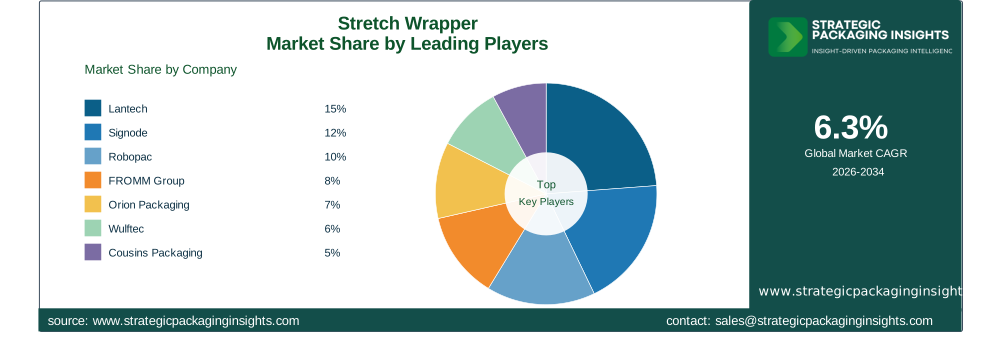
Lantech is a leading player in the Stretch Wrapper market, known for its innovative solutions and strong customer base. The company offers a wide range of stretch wrapping machines, catering to various industries such as food and beverage, logistics, and manufacturing. Signode, another major player, is renowned for its high-quality packaging solutions and extensive global presence. The company focuses on developing sustainable stretch wrapping solutions that align with the environmental goals of businesses. Robopac is also a key player, offering advanced stretch wrapping machines that integrate IoT and automation technologies to enhance operational efficiency.
FROMM Group and Orion Packaging are other notable players in the market, known for their innovative products and strong distribution networks. FROMM Group specializes in developing customized stretch wrapping solutions that cater to the unique needs of its clients. Orion Packaging, on the other hand, focuses on developing smart stretch wrapping solutions that enhance operational efficiency and reduce downtime. Wulftec and Cousins Packaging are also prominent players, offering a wide range of stretch wrapping machines that cater to various industries.
Muller LCS and Phoenix Wrappers are key players in the market, known for their innovative solutions and strong customer base. Muller LCS focuses on developing sustainable stretch wrapping solutions that align with the environmental goals of businesses. Phoenix Wrappers, on the other hand, offers advanced stretch wrapping machines that integrate IoT and automation technologies to enhance operational efficiency. SIAT is another notable player, known for its high-quality packaging solutions and extensive global presence. The company focuses on developing customized stretch wrapping solutions that cater to the unique needs of its clients.
Key Highlights
- The Stretch Wrapper market is projected to grow from USD 4.29 billion in 2025 to USD 7.44 billion by 2034, at a CAGR of 6.3%.
- Key players in the market include Lantech, Signode, Robopac, FROMM Group, and Orion Packaging.
- Technological advancements, such as IoT and automation, are driving the market's growth.
- The increasing demand for eco-friendly packaging solutions is a significant market driver.
- The e-commerce sector is a major growth opportunity for the Stretch Wrapper market.
- High initial costs of advanced machines pose a challenge for small and medium-sized enterprises.
- The market is highly competitive, with numerous players vying for market share.
- Government regulations on packaging waste are encouraging the adoption of sustainable solutions.
- Companies are focusing on developing customized stretch wrapping solutions to cater to diverse industry needs.
Stretch Wrapper Market Segments Insights

Machine Type Analysis
The Stretch Wrapper market is segmented by machine type into Turntable Stretch Wrappers, Rotary Arm Wrappers, Ring Wrappers, and Robotic Wrappers. Turntable Stretch Wrappers are widely used due to their cost-effectiveness and ease of use, making them a popular choice among small and medium-sized enterprises. Rotary Arm Wrappers, on the other hand, are preferred for their ability to handle heavy and unstable loads, making them ideal for industrial applications. Ring Wrappers are gaining traction due to their high-speed capabilities, which enhance operational efficiency. Robotic Wrappers are the latest innovation in the market, offering advanced automation features that reduce labor costs and improve packaging precision.
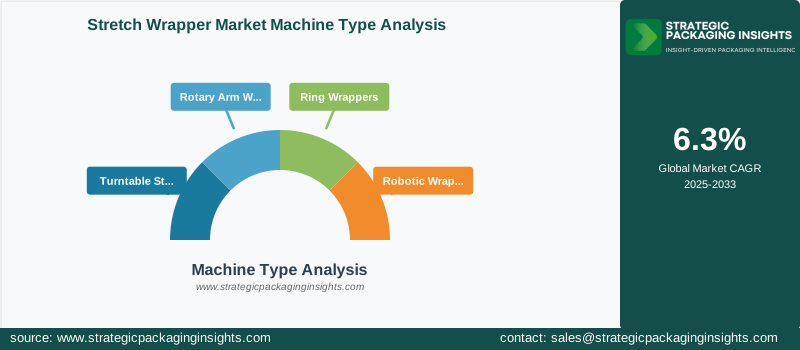
Companies like Lantech and Signode are leading the development of innovative machine types that cater to the evolving needs of the market. The demand for Robotic Wrappers is expected to grow significantly due to the increasing focus on automation and efficiency in packaging processes. These machines offer real-time monitoring and control, enhancing operational efficiency and reducing downtime. The integration of IoT and automation technologies in stretch wrapping machines is a significant trend, enabling companies to optimize their packaging operations and improve supply chain efficiency.
Automation Level Analysis
The Stretch Wrapper market is segmented by automation level into Semi-Automatic, Automatic, and Fully Automatic machines. Semi-Automatic machines are popular among small and medium-sized enterprises due to their affordability and ease of use. Automatic machines are widely used in industries that require high-speed packaging solutions, offering enhanced operational efficiency and reduced labor costs. Fully Automatic machines are the most advanced, offering complete automation of the packaging process, which significantly reduces human intervention and improves packaging precision.
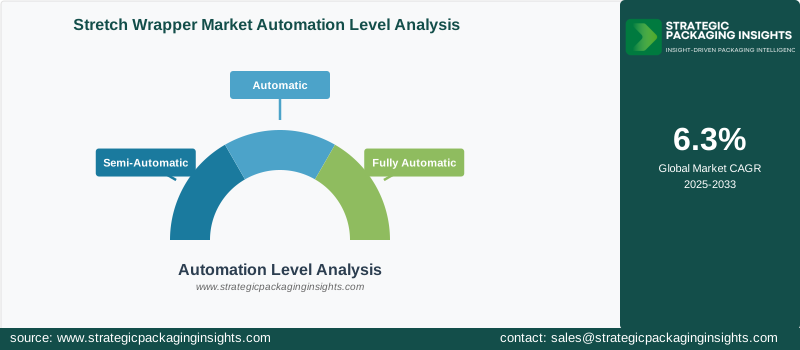
Companies like Robopac and FROMM Group are investing heavily in the development of fully automatic stretch wrapping machines that cater to the needs of modern supply chains. The demand for fully automatic machines is expected to grow significantly due to the increasing focus on automation and efficiency in packaging processes. These machines offer real-time monitoring and control, enhancing operational efficiency and reducing downtime. The integration of IoT and automation technologies in stretch wrapping machines is a significant trend, enabling companies to optimize their packaging operations and improve supply chain efficiency.
Application Analysis
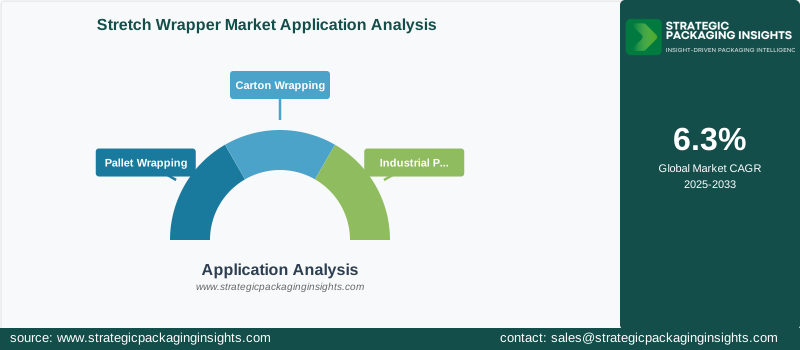
The Stretch Wrapper market is segmented by application into Pallet Wrapping, Carton Wrapping, and Industrial Packaging. Pallet Wrapping is the most common application, as it ensures the secure packaging of goods for transportation and storage. Carton Wrapping is gaining popularity due to the increasing demand for customized packaging solutions that cater to the unique needs of businesses. Industrial Packaging is a significant segment, driven by the need for efficient and reliable packaging solutions in various industries such as food and beverage, logistics, and manufacturing.
Companies like Orion Packaging and Wulftec are leading the development of innovative application-specific solutions that cater to the evolving needs of the market. The demand for customized packaging solutions is expected to grow significantly due to the increasing focus on product differentiation and branding. The integration of IoT and automation technologies in stretch wrapping machines is a significant trend, enabling companies to optimize their packaging operations and improve supply chain efficiency. The growing emphasis on sustainability is also driving the development of eco-friendly packaging solutions that align with the environmental goals of businesses.
End Use Analysis
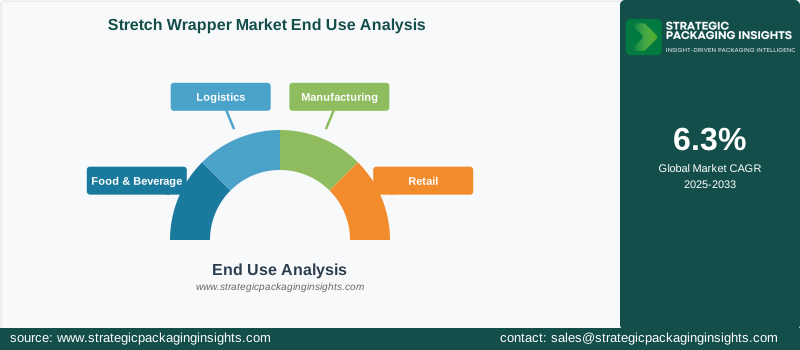
The Stretch Wrapper market is segmented by end use into Food & Beverage, Logistics, Manufacturing, and Retail. The Food & Beverage industry is a major end-user of stretch wrapping machines, as it requires efficient and reliable packaging solutions to ensure the safe transportation and storage of products. The Logistics industry is another significant end-user, driven by the need for secure and tamper-proof packaging solutions. The Manufacturing industry is also a key end-user, as it requires efficient packaging solutions to optimize supply chain operations.
Companies like Cousins Packaging and Muller LCS are leading the development of innovative end-use-specific solutions that cater to the evolving needs of the market. The demand for customized packaging solutions is expected to grow significantly due to the increasing focus on product differentiation and branding. The integration of IoT and automation technologies in stretch wrapping machines is a significant trend, enabling companies to optimize their packaging operations and improve supply chain efficiency. The growing emphasis on sustainability is also driving the development of eco-friendly packaging solutions that align with the environmental goals of businesses.
Stretch Wrapper Market Segments
The Stretch Wrapper market has been segmented on the basis ofMachine Type
- Turntable Stretch Wrappers
- Rotary Arm Wrappers
- Ring Wrappers
- Robotic Wrappers
Automation Level
- Semi-Automatic
- Automatic
- Fully Automatic
Application
- Pallet Wrapping
- Carton Wrapping
- Industrial Packaging
End Use
- Food & Beverage
- Logistics
- Manufacturing
- Retail
Region
- Asia Pacific
- North America
- Latin America
- Europe
- Middle East & Africa




