


Polymer Plastics Market Outlook
The Polymer Plastics market size was valued at USD $712.48 Billion in 2025 and is anticipated to reach USD $1, 028.36 Billion by 2035, growing at a CAGR of 3.7% during the forecast period according to Strategic Packaging Insights.
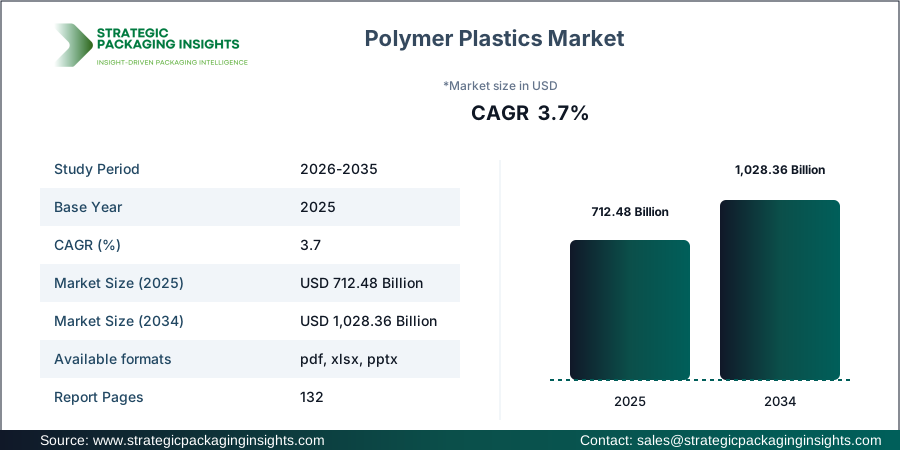
The increasing demand for lightweight and durable materials in the automotive and packaging industries is a significant driver for the Polymer Plastics market. The automotive sector's shift towards fuel efficiency and emission reduction has led to increased use of polymer plastics for vehicle components. Additionally, the packaging industry's need for sustainable and cost-effective solutions is propelling the demand for bioplastics and engineering plastics.
Report Scope
| Attributes | Details |
| Report Title | Polymer Plastics Market Projected to Scale to 1,028.36 Billion by 2035, Assesses Strategic Packaging Insights |
| By polymer type | Polyethylene, Polypropylene, Polyvinyl Chloride, Polyethylene Terephthalate, Polystyrene, Engineering Plastics, Bioplastics, Polyurethane, Polyamide, Polycarbonate |
| By processing technology | Injection Molding, Blow Molding, Extrusion, Thermoforming, Rotational Molding, Compression Molding |
| By form | Film and Sheet, Fibers, Foam, Pellets, Resins, Compounds |
| By application | Packaging, Automotive, Construction, Electrical and Electronics, Consumer Goods, Healthcare, Agriculture, Industrial Products |
| By region | North America, Europe, Asia Pacific, Latin America, Middle East and Africa |
| Base Year | 2025 |
| Historic Period | 2018-2024 |
| Forecast Period | 2026-2035 |
| Number of Pages | 132 |
| Customization Available | Yes* |
Market Trends Analysis
Polymer Plastics are witnessing a shift towards sustainable materials, with bioplastics gaining traction due to environmental concerns and regulatory pressures. The adoption of bioplastics is driven by consumer demand for eco-friendly products and government initiatives promoting sustainability. This trend is influencing manufacturers to invest in research and development for biodegradable and recyclable plastics, impacting market growth positively.
Technological advancements in processing technologies such as injection molding and extrusion are enhancing production efficiency and reducing costs. Automation and digital transformation in manufacturing processes are enabling companies to optimize operations and improve product quality. These advancements are crucial for maintaining competitive positioning and meeting the evolving demands of end-users across various industries, including automotive, packaging, and electronics.
Industry Transformation Analysis
The Polymer Plastics industry is undergoing significant transformation with increased focus on sustainability and circular economy principles. Companies are investing in recycling technologies and infrastructure to enhance the recyclability of plastics and reduce environmental impact. This shift is driven by regulatory mandates and consumer expectations for sustainable products, leading to changes in procurement and production strategies.
Globalization and localization dynamics are influencing the industry's value chain, with companies expanding their presence in emerging markets to capitalize on growing demand. Capacity expansions and strategic partnerships are being pursued to strengthen supply chains and ensure consistent material availability. These structural changes are expected to enhance operational efficiency and support long-term growth in the Polymer Plastics market.
Trends & Disruptions Impacting Customers' Customers
Downstream customers, particularly in the packaging and automotive sectors, are increasingly prioritizing sustainability and cost-efficiency. The demand for lightweight, durable, and recyclable materials is driving innovation in polymer plastics. Regulatory pressures and consumer preferences for eco-friendly products are compelling companies to adopt sustainable practices and materials, influencing the entire supply chain.
These changes are impacting product demand and purchasing decisions, with companies seeking suppliers that offer sustainable and innovative solutions. The focus on sustainability is creating opportunities for new product development and market expansion, while also posing challenges for traditional plastic manufacturers. Suppliers need to adapt to these evolving requirements to remain competitive and capitalize on emerging market opportunities.
Polymer Plastics Market Ecosystem
The Polymer Plastics market ecosystem involves a complex interplay of raw material suppliers, resin producers, and processing technology providers. The procurement of petrochemical feedstocks and bio-based materials is critical for resin production, which forms the backbone of the industry. Processing technologies such as injection molding and extrusion are essential for converting resins into finished products, catering to diverse end-use applications.
Value creation in the ecosystem is driven by innovation and efficiency in production processes, with companies focusing on sustainability and cost-effectiveness. Supply-chain dependencies are evident in the reliance on raw material availability and technological advancements. Changes in the ecosystem, such as shifts towards bioplastics and recycling, are influencing market dynamics and creating new opportunities for growth.
Analyst Perspective
Analyst Perspective: The Polymer Plastics market is poised for growth driven by sustainability trends and technological advancements.
The industry's shift towards eco-friendly materials and efficient processing technologies is reshaping market dynamics. Companies investing in bioplastics and recycling infrastructure are likely to gain a competitive edge, while those lagging in sustainability may face challenges.
Market participants should monitor regulatory developments and consumer preferences closely, as these factors will significantly impact demand and innovation. Strategic investments in technology and capacity expansion will be crucial for capturing market opportunities and ensuring long-term success.
Opportunities & Threats
The Polymer Plastics market presents significant opportunities in the development of sustainable materials and recycling technologies. The growing demand for bioplastics and eco-friendly solutions is driving innovation and investment in research and development. Companies that can offer cost-effective and sustainable products are well-positioned to capture market share and meet evolving consumer expectations.
Technological advancements in processing technologies such as injection molding and extrusion are enhancing production efficiency and reducing costs. Automation and digital transformation in manufacturing processes are enabling companies to optimize operations and improve product quality. These advancements are crucial for maintaining competitive positioning and meeting the evolving demands of end-users across various industries, including automotive, packaging, and electronics.
However, the market faces threats from raw material volatility and regulatory uncertainty. Fluctuations in petrochemical prices can impact production costs and profitability, while stringent regulations on plastic usage and waste management pose compliance challenges. Companies must navigate these uncertainties by diversifying supply sources and investing in sustainable practices.
Competition from alternative materials and recycling constraints also present challenges for the Polymer Plastics market. The rise of biodegradable and compostable materials is increasing competition, while limitations in recycling infrastructure can hinder the adoption of sustainable practices. Companies need to innovate and adapt to these challenges to remain competitive and capitalize on emerging market opportunities.
Drivers & Challenges
The Polymer Plastics market is driven by the increasing demand for lightweight and durable materials in the automotive and packaging industries. The automotive sector's shift towards fuel efficiency and emission reduction has led to increased use of polymer plastics for vehicle components. Additionally, the packaging industry's need for sustainable and cost-effective solutions is propelling the demand for bioplastics and engineering plastics.
Technological advancements in processing technologies such as injection molding and extrusion are enhancing production efficiency and reducing costs. Automation and digital transformation in manufacturing processes are enabling companies to optimize operations and improve product quality. These advancements are crucial for maintaining competitive positioning and meeting the evolving demands of end-users across various industries, including automotive, packaging, and electronics.
However, the market faces challenges from raw material volatility and regulatory uncertainty. Fluctuations in petrochemical prices can impact production costs and profitability, while stringent regulations on plastic usage and waste management pose compliance challenges. Companies must navigate these uncertainties by diversifying supply sources and investing in sustainable practices.
Packaging Market Economics
The economics of the Polymer Plastics market are influenced by raw material costs, resin pricing, and conversion costs. The price of petrochemical feedstocks and bio-based materials impacts resin production costs, while processing technologies such as injection molding and extrusion determine conversion costs. Energy costs, labor, and logistics also play a role in the overall economics of the market.
Companies must optimize their operations to manage costs effectively and maintain profitability. This includes investing in efficient processing technologies, reducing waste, and improving supply-chain logistics. The focus on sustainability and recyclability is also driving changes in procurement and production strategies, with companies seeking to minimize environmental impact and meet regulatory requirements.
Packaging Value Chain & Cost Analysis
The Polymer Plastics value chain involves multiple tiers, from resin synthesis and processing to end-use applications. Tier-3 includes resin synthesis and additives, while Tier-2 involves film extrusion and substrate production. Tier-1 focuses on converting, printing, and lamination, with downstream activities including co-packing, distribution, and recycling.
Substrate lead times, capacity utilization, and resin supply are critical factors influencing the value chain. Companies must manage these elements effectively to ensure consistent material availability and meet customer demand. The focus on sustainability and recyclability is also driving changes in procurement and production strategies, with companies seeking to minimize environmental impact and meet regulatory requirements.
Unit Economics & Substrate Cost Analysis
The unit economics of Polymer Plastics are influenced by raw material costs, resin/feedstock pricing, and processing costs. Energy, labor, and logistics also play a role in the overall cost structure. Companies must optimize their operations to manage costs effectively and maintain profitability.
Investments in efficient processing technologies, waste reduction, and supply-chain logistics are crucial for maintaining competitive positioning. The focus on sustainability and recyclability is also driving changes in procurement and production strategies, with companies seeking to minimize environmental impact and meet regulatory requirements.
Packaging Regulatory & Sustainability Analysis
The Polymer Plastics market is subject to various regulatory and sustainability requirements, including packaging regulations, EPR, and recycling targets. Regulatory bodies such as the European Commission and U.S. EPA are implementing measures to reduce plastic waste and promote sustainability.
Companies must comply with these regulations and invest in sustainable practices to remain competitive. This includes adopting eco-friendly materials, improving recyclability, and reducing environmental impact. The focus on sustainability is also driving innovation and investment in research and development for biodegradable and recyclable plastics.
Strategic Mergers, Acquisitions & Capacity Expansions
Recent strategic developments in the Polymer Plastics market include mergers, acquisitions, and capacity expansions. Companies are investing in new plants and recycling facilities to enhance production capacity and meet growing demand. Strategic partnerships and technology investments are also being pursued to strengthen supply chains and improve operational efficiency.
These developments are driven by the need to meet regulatory requirements and consumer expectations for sustainable products. Companies that can offer cost-effective and sustainable solutions are well-positioned to capture market share and capitalize on emerging opportunities.
Strategic Action Directives
Brand Packaging Engineers & Sustainability Directors should focus on material selection, mono-material qualification, and recyclability to meet regulatory requirements and consumer expectations. PCR integration and barrier performance are also critical considerations for sustainable packaging solutions.
Converter Operations & Extrusion Leads should optimize line speed, tooling, and changeover processes to improve efficiency and reduce costs. Managing PCR variability and capacity utilization are also important for maintaining competitive positioning.
Procurement & Material Sourcing Managers should diversify resin contracts, price indexing, and PCR contracts to manage supply-chain risks and ensure consistent material availability. Supplier diversification and EPR exposure are also important considerations for sustainable procurement strategies.
Investors should focus on capacity, margin structure, and M&A opportunities to capitalize on market growth and emerging trends. Technology investments and market concentration are also important factors for long-term success in the Polymer Plastics market.
Market Share Analysis
The Polymer Plastics market is characterized by a competitive landscape with several key players, including Dow, SABIC, ExxonMobil, LyondellBasell, INEOS, BASF, Borealis, Formosa Plastics, Braskem, Reliance Industries, Covestro, and LG Chem. These companies are actively involved in the production and distribution of polymer plastics, catering to diverse end-use industries such as packaging, automotive, and electronics.
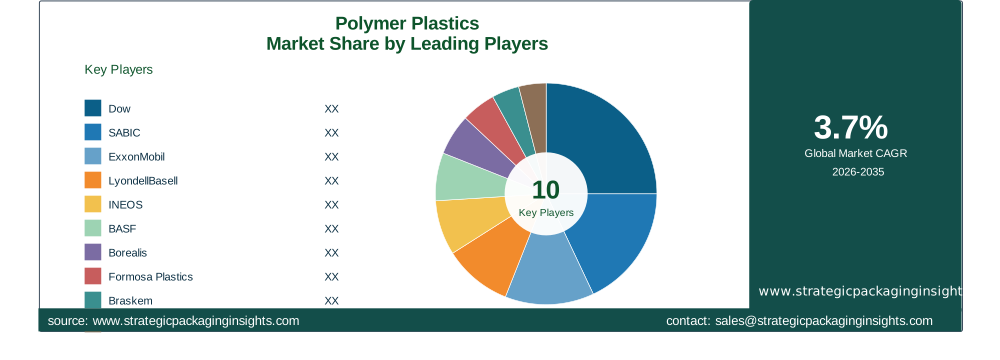
Dow and SABIC are prominent players with a strong presence in the global market, offering a wide range of polymer products and technologies. ExxonMobil and LyondellBasell are also key competitors, focusing on innovation and sustainability to meet evolving customer demands. BASF and INEOS are known for their extensive product portfolios and strategic partnerships, enhancing their competitive positioning.
Borealis and Formosa Plastics are expanding their production capacities and investing in new technologies to strengthen their market presence. Braskem and Reliance Industries are focusing on sustainability and recycling initiatives to align with regulatory requirements and consumer expectations. Covestro and LG Chem are leveraging their expertise in engineering plastics and bioplastics to capture emerging market opportunities.
The competitive landscape is influenced by factors such as product innovation, sustainability initiatives, and strategic partnerships. Companies are investing in research and development to enhance product offerings and meet the growing demand for eco-friendly solutions. The focus on sustainability and recyclability is driving changes in procurement and production strategies, with companies seeking to minimize environmental impact and meet regulatory requirements.
Key Highlights
- Largest Region: Asia Pacific
- Fastest-Growing Region: Asia Pacific
- Largest Segment: Packaging
- Fastest-Growing Segment: Bioplastics
- Base-year market size: $712.48 Billion
- Forecast-year market size: $1, 028.36 Billion
- CAGR: 3.7%
- Important application: Automotive
- Major end-use industry: Packaging
- Major market driver: Sustainability and eco-friendly materials
Regional Insights
The global Polymer Plastics market is dominated by major regions such as Asia Pacific, North America, Europe, Latin America, and the Middle East & Africa. Asia Pacific is the largest and fastest-growing region, driven by increasing demand from the packaging and automotive industries. The region's rapid industrialization and urbanization are contributing to the growth of the Polymer Plastics market.
North America
North America is a significant market for Polymer Plastics, with strong demand from the automotive and packaging industries. The region's focus on sustainability and recycling is driving innovation and investment in eco-friendly materials. Regulatory initiatives promoting sustainability are influencing market dynamics and creating opportunities for growth.
The presence of major players such as Dow and ExxonMobil is contributing to the region's competitive landscape. These companies are investing in research and development to enhance product offerings and meet evolving customer demands. The focus on sustainability and recyclability is driving changes in procurement and production strategies, with companies seeking to minimize environmental impact and meet regulatory requirements.
Europe
Europe is a mature market for Polymer Plastics, with a strong focus on sustainability and circular economy principles. The region's regulatory environment is driving the adoption of eco-friendly materials and recycling initiatives. Companies are investing in research and development to enhance product offerings and meet evolving customer demands.
The presence of major players such as BASF and INEOS is contributing to the region's competitive landscape. These companies are investing in research and development to enhance product offerings and meet evolving customer demands. The focus on sustainability and recyclability is driving changes in procurement and production strategies, with companies seeking to minimize environmental impact and meet regulatory requirements.
Asia Pacific
Asia Pacific is the largest and fastest-growing region for Polymer Plastics, driven by increasing demand from the packaging and automotive industries. The region's rapid industrialization and urbanization are contributing to the growth of the Polymer Plastics market. The presence of major players such as SABIC and LG Chem is contributing to the region's competitive landscape.
The focus on sustainability and recyclability is driving changes in procurement and production strategies, with companies seeking to minimize environmental impact and meet regulatory requirements. The region's regulatory environment is driving the adoption of eco-friendly materials and recycling initiatives. Companies are investing in research and development to enhance product offerings and meet evolving customer demands.
Latin America
Latin America is an emerging market for Polymer Plastics, with increasing demand from the packaging and automotive industries. The region's focus on sustainability and recycling is driving innovation and investment in eco-friendly materials. Regulatory initiatives promoting sustainability are influencing market dynamics and creating opportunities for growth.
The presence of major players such as Braskem and Reliance Industries is contributing to the region's competitive landscape. These companies are investing in research and development to enhance product offerings and meet evolving customer demands. The focus on sustainability and recyclability is driving changes in procurement and production strategies, with companies seeking to minimize environmental impact and meet regulatory requirements.
Middle East & Africa
The Middle East & Africa is a growing market for Polymer Plastics, with increasing demand from the packaging and automotive industries. The region's focus on sustainability and recycling is driving innovation and investment in eco-friendly materials. Regulatory initiatives promoting sustainability are influencing market dynamics and creating opportunities for growth.
The presence of major players such as SABIC and Borealis is contributing to the region's competitive landscape. These companies are investing in research and development to enhance product offerings and meet evolving customer demands. The focus on sustainability and recyclability is driving changes in procurement and production strategies, with companies seeking to minimize environmental impact and meet regulatory requirements.
Polymer Plastics Market Segments Insights

By Polymer Type Analysis
The Polymer Plastics market is segmented by polymer type, including polyethylene, polypropylene, polyvinyl chloride, polyethylene terephthalate, polystyrene, engineering plastics, bioplastics, polyurethane, polyamide, and polycarbonate. Polyethylene and polypropylene are the most widely used polymers, driven by their versatility and cost-effectiveness. Bioplastics are gaining traction due to environmental concerns and regulatory pressures, influencing market dynamics positively.
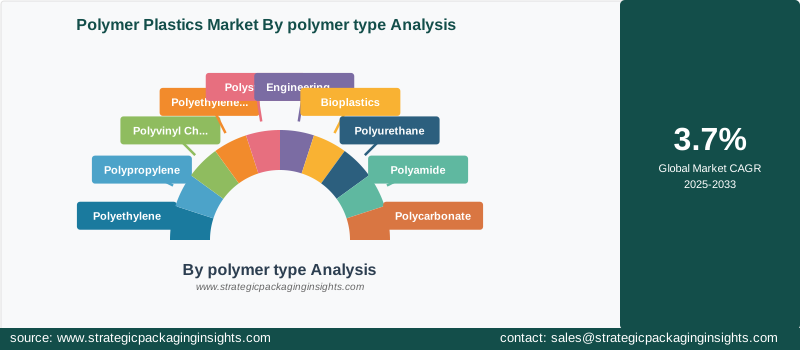
Technological advancements in polymer production and processing are enhancing product quality and expanding application areas. The focus on sustainability and recyclability is driving innovation in bioplastics and engineering plastics, creating new opportunities for growth. Companies are investing in research and development to enhance product offerings and meet evolving customer demands.
By Processing Technology Analysis
The Polymer Plastics market is segmented by processing technology, including injection molding, blow molding, extrusion, thermoforming, rotational molding, and compression molding. Injection molding and extrusion are the most widely used technologies, driven by their efficiency and cost-effectiveness. Technological advancements in processing technologies are enhancing production efficiency and reducing costs, influencing market dynamics positively.
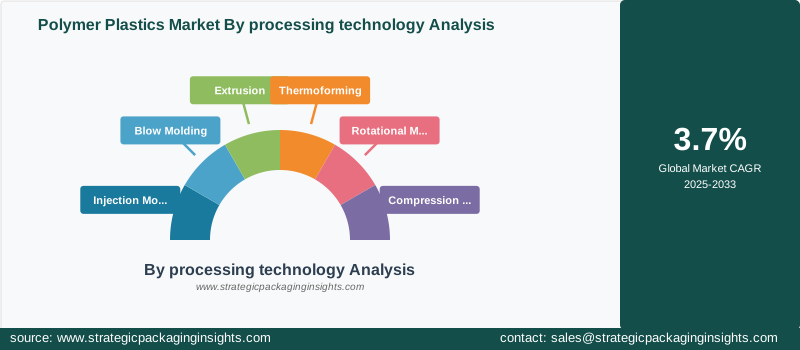
Automation and digital transformation in manufacturing processes are enabling companies to optimize operations and improve product quality. These advancements are crucial for maintaining competitive positioning and meeting the evolving demands of end-users across various industries, including automotive, packaging, and electronics. Companies are investing in research and development to enhance product offerings and meet evolving customer demands.
By Form Analysis
The Polymer Plastics market is segmented by form, including film and sheet, fibers, foam, pellets, resins, and compounds. Film and sheet are the most widely used forms, driven by their versatility and cost-effectiveness. Technological advancements in polymer production and processing are enhancing product quality and expanding application areas, influencing market dynamics positively.
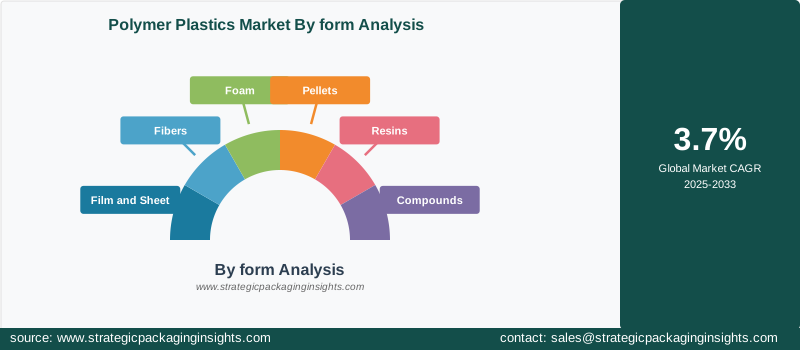
The focus on sustainability and recyclability is driving innovation in bioplastics and engineering plastics, creating new opportunities for growth. Companies are investing in research and development to enhance product offerings and meet evolving customer demands. The focus on sustainability and recyclability is driving changes in procurement and production strategies, with companies seeking to minimize environmental impact and meet regulatory requirements.
By Application Analysis
The Polymer Plastics market is segmented by application, including packaging, automotive, construction, electrical and electronics, consumer goods, healthcare, agriculture, and industrial products. Packaging is the largest application segment, driven by the demand for lightweight and durable materials. The automotive sector's shift towards fuel efficiency and emission reduction is also driving demand for polymer plastics.
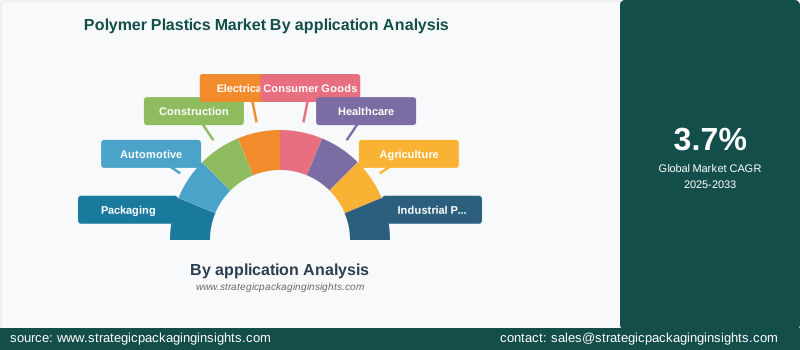
The focus on sustainability and recyclability is driving innovation in bioplastics and engineering plastics, creating new opportunities for growth. Companies are investing in research and development to enhance product offerings and meet evolving customer demands. The focus on sustainability and recyclability is driving changes in procurement and production strategies, with companies seeking to minimize environmental impact and meet regulatory requirements.
By Region Analysis
The Polymer Plastics market is segmented by region, including North America, Europe, Asia Pacific, Latin America, and the Middle East & Africa. Asia Pacific is the largest and fastest-growing region, driven by increasing demand from the packaging and automotive industries. The region's rapid industrialization and urbanization are contributing to the growth of the Polymer Plastics market.
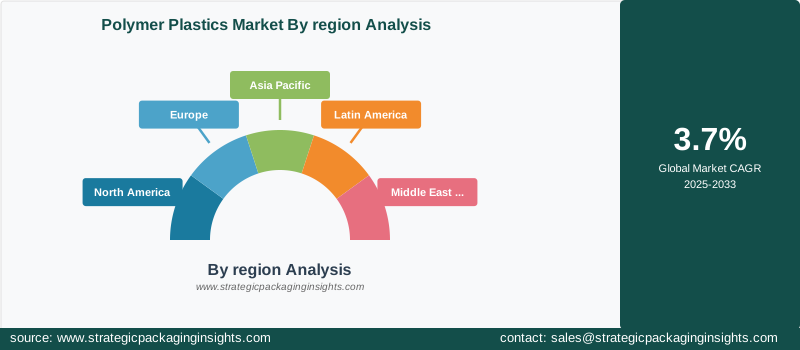
The focus on sustainability and recyclability is driving changes in procurement and production strategies, with companies seeking to minimize environmental impact and meet regulatory requirements. The region's regulatory environment is driving the adoption of eco-friendly materials and recycling initiatives. Companies are investing in research and development to enhance product offerings and meet evolving customer demands.
Polymer Plastics Market Segments
The Polymer Plastics market has been segmented on the basis ofBy polymer type
- Polyethylene
- Polypropylene
- Polyvinyl Chloride
- Polyethylene Terephthalate
- Polystyrene
- Engineering Plastics
- Bioplastics
- Polyurethane
- Polyamide
- Polycarbonate
By processing technology
- Injection Molding
- Blow Molding
- Extrusion
- Thermoforming
- Rotational Molding
- Compression Molding
By form
- Film and Sheet
- Fibers
- Foam
- Pellets
- Resins
- Compounds
By application
- Packaging
- Automotive
- Construction
- Electrical and Electronics
- Consumer Goods
- Healthcare
- Agriculture
- Industrial Products
By region
- North America
- Europe
- Asia Pacific
- Latin America
- Middle East and Africa




