


Pilot Scale Solvent Recycling Plants for Food-Grade HDPE Market Outlook
The Pilot Scale Solvent Recycling Plants for Food-Grade HDPE market was valued at $2.06 billion in 2025 and is projected to reach $4.56 billion by 2034, growing at a CAGR of 9.2% during the forecast period 2026-2034. This market is witnessing significant growth due to the increasing demand for sustainable packaging solutions and the rising awareness about environmental conservation. The shift towards circular economy practices is driving the adoption of solvent recycling technologies, particularly in the food-grade HDPE sector. The market is also benefiting from technological advancements that enhance the efficiency and effectiveness of recycling processes, making them more viable for large-scale applications.
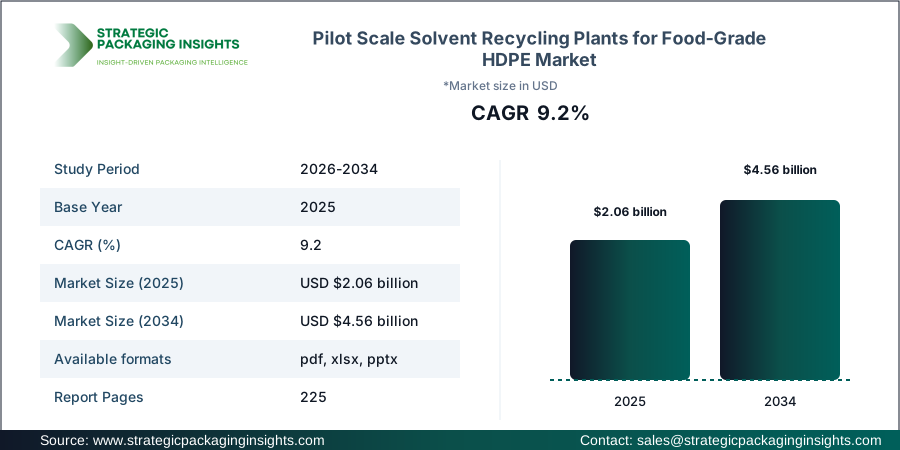
Despite the promising growth prospects, the market faces certain challenges, including stringent regulatory frameworks and high initial investment costs. Regulatory bodies across various regions are imposing strict guidelines to ensure the safety and quality of recycled materials, which can pose hurdles for new entrants. However, the potential for cost savings and the growing consumer preference for eco-friendly products present substantial opportunities for market players. The increasing collaboration between recyclers and FMCG brands to develop innovative recycling solutions is expected to further propel market growth.
Report Scope
| Attributes | Details |
| Report Title | Pilot Scale Solvent Recycling Plants for Food-Grade HDPE Market Size, Future Growth and Forecast 2034 |
| By Process Type | Solvent Purification, Polymer Dissolution, Decontamination, Extrusion |
| By Output Type | Food-Grade rHDPE, High-Purity Flakes, Recycled Pellets |
| By Application | Bottles, Caps, Food-Contact Containers |
| By End Use | Recyclers, FMCG Brands, Packaging Converters |
| Region | Asia Pacific, North America, Latin America, Europe, Middle East & Africa |
| Base Year | 2025 |
| Historic Period | 2018-2024 |
| Forecast Period | 2026-2034 |
| Number of Pages | 225 |
| Customization Available | Yes* |
Opportunities & Threats
The Pilot Scale Solvent Recycling Plants for Food-Grade HDPE market presents numerous opportunities, particularly in the realm of technological innovation. Companies are investing heavily in research and development to enhance the efficiency of solvent recycling processes, which can significantly reduce operational costs and improve output quality. The growing emphasis on sustainability and the circular economy is encouraging businesses to adopt advanced recycling technologies, thereby creating a fertile ground for market expansion. Additionally, the increasing demand for food-grade recycled HDPE in packaging applications offers lucrative opportunities for market players to diversify their product offerings and capture a larger market share.
Another significant opportunity lies in the expanding consumer base for eco-friendly products. As consumers become more environmentally conscious, there is a rising demand for sustainable packaging solutions, including food-grade recycled HDPE. This trend is prompting FMCG brands and packaging converters to collaborate with recycling companies to develop innovative and sustainable packaging solutions. The integration of digital technologies, such as IoT and AI, in recycling processes is also opening new avenues for market growth by enhancing process efficiency and traceability.
However, the market is not without its threats. One of the primary challenges is the stringent regulatory landscape governing the use of recycled materials in food-contact applications. Regulatory bodies impose rigorous testing and certification requirements to ensure the safety and quality of recycled HDPE, which can be a significant barrier for market entry. Additionally, the high initial investment required for setting up solvent recycling plants can deter small and medium-sized enterprises from entering the market. The volatility in raw material prices and the availability of cheaper alternatives also pose threats to market growth.
Drivers & Challenges
The Pilot Scale Solvent Recycling Plants for Food-Grade HDPE market is driven by several key factors, including the increasing demand for sustainable packaging solutions and the growing emphasis on environmental conservation. The shift towards a circular economy is encouraging businesses to adopt solvent recycling technologies, which offer a viable solution for reducing plastic waste and conserving resources. Technological advancements in recycling processes are also playing a crucial role in driving market growth by enhancing the efficiency and effectiveness of recycling operations. The collaboration between recyclers and FMCG brands to develop innovative recycling solutions is further propelling market expansion.
Another significant driver is the rising consumer awareness about the environmental impact of plastic waste. As consumers become more environmentally conscious, there is a growing demand for eco-friendly packaging solutions, including food-grade recycled HDPE. This trend is prompting FMCG brands and packaging converters to collaborate with recycling companies to develop sustainable packaging solutions. The increasing government support for recycling initiatives and the implementation of favorable policies are also contributing to market growth by encouraging businesses to invest in recycling technologies.
Despite the promising growth prospects, the market faces several challenges, including stringent regulatory frameworks and high initial investment costs. Regulatory bodies across various regions impose strict guidelines to ensure the safety and quality of recycled materials, which can pose hurdles for new entrants. The high cost of setting up solvent recycling plants can also deter small and medium-sized enterprises from entering the market. Additionally, the volatility in raw material prices and the availability of cheaper alternatives can impact market growth. Companies need to navigate these challenges by investing in research and development to enhance the efficiency of recycling processes and reduce operational costs.
Market Share Analysis
The competitive landscape of the Pilot Scale Solvent Recycling Plants for Food-Grade HDPE market is characterized by the presence of several key players, each striving to enhance their market position through strategic initiatives such as mergers and acquisitions, partnerships, and product innovations. Companies like PureCycle Technologies, APK AG, and Polystyvert are at the forefront of the market, leveraging their technological expertise and extensive industry experience to offer innovative recycling solutions. These companies are focusing on expanding their production capacities and enhancing their product portfolios to cater to the growing demand for food-grade recycled HDPE.
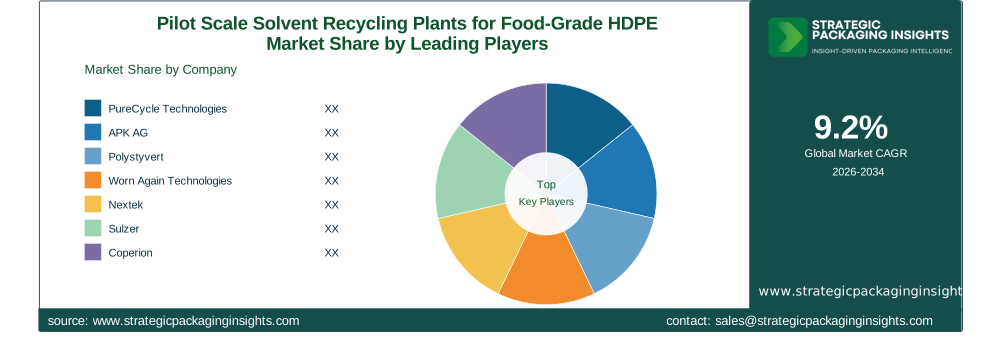
PureCycle Technologies is a leading player in the market, known for its proprietary recycling technology that purifies recycled polypropylene to near-virgin quality. The company is actively expanding its production facilities to meet the increasing demand for sustainable packaging solutions. APK AG is another prominent player, specializing in the production of high-quality recycled polymers through its unique solvent-based recycling process. The company is focusing on strengthening its market presence by collaborating with FMCG brands and packaging converters to develop innovative recycling solutions.
Polystyvert is a key player in the market, renowned for its advanced dissolution technology that enables the recycling of polystyrene into high-purity recycled pellets. The company is investing in research and development to enhance the efficiency of its recycling processes and expand its product offerings. Worn Again Technologies is also making significant strides in the market, with its innovative polymer recycling technology that converts textile waste into high-quality recycled polymers. The company is focusing on expanding its production capacities and establishing strategic partnerships to strengthen its market position.
Other notable players in the market include Nextek, Sulzer, Coperion, EREMA, Starlinger, and KraussMaffei. These companies are actively investing in research and development to enhance their recycling technologies and expand their product portfolios. They are also focusing on strategic collaborations and partnerships to strengthen their market presence and capture a larger market share. The competitive landscape of the market is expected to intensify in the coming years, with companies striving to differentiate themselves through innovative product offerings and strategic initiatives.
Key Highlights
- The market is projected to grow at a CAGR of 9.2% from 2026 to 2034, driven by the increasing demand for sustainable packaging solutions.
- Technological advancements in recycling processes are enhancing the efficiency and effectiveness of solvent recycling plants.
- Stringent regulatory frameworks and high initial investment costs pose challenges for market entry.
- The growing emphasis on the circular economy is encouraging businesses to adopt solvent recycling technologies.
- Collaboration between recyclers and FMCG brands is driving the development of innovative recycling solutions.
- The rising consumer awareness about environmental conservation is boosting the demand for eco-friendly packaging solutions.
- Government support for recycling initiatives is contributing to market growth by encouraging businesses to invest in recycling technologies.
- The competitive landscape is characterized by the presence of several key players, each striving to enhance their market position through strategic initiatives.
- Companies are focusing on expanding their production capacities and enhancing their product portfolios to cater to the growing demand for food-grade recycled HDPE.
- The integration of digital technologies in recycling processes is opening new avenues for market growth by enhancing process efficiency and traceability.
Top Countries Insights
In the Pilot Scale Solvent Recycling Plants for Food-Grade HDPE market, the United States stands out as a key player, with a market size of approximately $1.2 billion and a CAGR of 8%. The country's strong regulatory framework supporting recycling initiatives and the presence of major FMCG brands driving demand for sustainable packaging solutions are significant growth drivers. Additionally, technological advancements and government incentives for recycling projects further bolster market expansion.
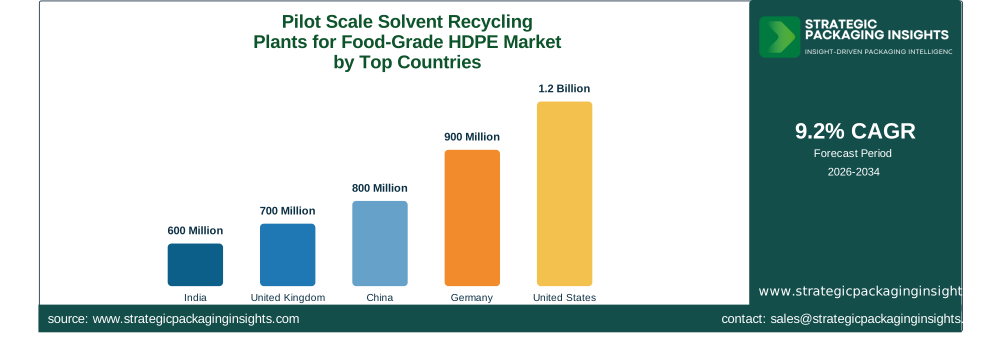
Germany is another prominent market, valued at around $900 million, with a CAGR of 7%. The country's robust recycling infrastructure and stringent environmental regulations are key factors driving market growth. The collaboration between recyclers and packaging converters to develop innovative recycling solutions is also contributing to market expansion. However, the high cost of recycling technologies and the availability of cheaper alternatives pose challenges to market growth.
China, with a market size of approximately $800 million and a CAGR of 10%, is witnessing rapid growth in the Pilot Scale Solvent Recycling Plants for Food-Grade HDPE market. The country's increasing focus on environmental conservation and the implementation of favorable policies to promote recycling initiatives are significant growth drivers. The rising demand for sustainable packaging solutions from the FMCG sector is also contributing to market expansion.
In the United Kingdom, the market is valued at around $700 million, with a CAGR of 6%. The country's strong regulatory framework supporting recycling initiatives and the growing consumer awareness about environmental conservation are key factors driving market growth. The collaboration between recyclers and FMCG brands to develop innovative recycling solutions is also contributing to market expansion. However, the high cost of recycling technologies and the availability of cheaper alternatives pose challenges to market growth.
India, with a market size of approximately $600 million and a CAGR of 12%, is emerging as a significant player in the Pilot Scale Solvent Recycling Plants for Food-Grade HDPE market. The country's increasing focus on sustainability and the implementation of favorable policies to promote recycling initiatives are significant growth drivers. The rising demand for eco-friendly packaging solutions from the FMCG sector is also contributing to market expansion. However, the lack of adequate recycling infrastructure and the high cost of recycling technologies pose challenges to market growth.
Pilot Scale Solvent Recycling Plants for Food-Grade HDPE Market Segments Insights

Process Type Analysis
The process type segment in the Pilot Scale Solvent Recycling Plants for Food-Grade HDPE market is categorized into solvent purification, polymer dissolution, decontamination, and extrusion. Solvent purification is gaining traction due to its ability to produce high-quality recycled materials with minimal impurities. This process is particularly favored by recyclers and FMCG brands aiming to meet stringent regulatory standards for food-grade applications. Polymer dissolution, on the other hand, is witnessing increased adoption due to its efficiency in breaking down complex polymer structures, making it ideal for recycling diverse HDPE waste streams.
Decontamination processes are crucial for ensuring the safety and quality of recycled HDPE, especially for food-contact applications. This segment is driven by the growing emphasis on meeting regulatory requirements and consumer demand for safe, sustainable packaging solutions. Extrusion, a widely used process in the recycling industry, is favored for its ability to produce high-purity recycled pellets suitable for various applications. The increasing demand for recycled pellets in the packaging industry is expected to drive the growth of this segment.
Output Type Analysis
The output type segment in the Pilot Scale Solvent Recycling Plants for Food-Grade HDPE market includes food-grade rHDPE, high-purity flakes, and recycled pellets. Food-grade rHDPE is witnessing significant demand due to the growing emphasis on sustainable packaging solutions in the FMCG sector. The ability of food-grade rHDPE to meet stringent regulatory standards for food-contact applications is a key driver for this segment. High-purity flakes are also gaining popularity due to their versatility and ease of integration into various manufacturing processes.
Recycled pellets, a staple in the recycling industry, are favored for their high purity and consistency, making them suitable for a wide range of applications. The increasing demand for recycled pellets in the packaging industry is expected to drive the growth of this segment. Companies are focusing on enhancing the quality and consistency of recycled pellets to meet the evolving needs of the market. The integration of advanced technologies in recycling processes is also contributing to the growth of this segment by improving the quality and efficiency of recycled outputs.
Application Analysis
The application segment in the Pilot Scale Solvent Recycling Plants for Food-Grade HDPE market is divided into bottles, caps, and food-contact containers. Bottles represent a significant portion of the market, driven by the increasing demand for sustainable packaging solutions in the beverage industry. The ability of recycled HDPE to meet regulatory standards for food-contact applications is a key driver for this segment. Caps, another important application, are witnessing increased demand due to the growing emphasis on sustainability and the circular economy.
Food-contact containers, a critical application in the FMCG sector, are experiencing significant growth due to the rising consumer demand for eco-friendly packaging solutions. The ability of recycled HDPE to meet stringent regulatory standards for food-contact applications is a key driver for this segment. Companies are focusing on developing innovative recycling solutions to enhance the quality and safety of recycled HDPE for food-contact applications. The collaboration between recyclers and FMCG brands is also contributing to the growth of this segment by driving the development of sustainable packaging solutions.
End Use Analysis
The end-use segment in the Pilot Scale Solvent Recycling Plants for Food-Grade HDPE market includes recyclers, FMCG brands, and packaging converters. Recyclers play a crucial role in the market, driven by the increasing demand for sustainable packaging solutions and the growing emphasis on the circular economy. The ability of recyclers to produce high-quality recycled HDPE that meets regulatory standards for food-contact applications is a key driver for this segment. FMCG brands, another important end-use segment, are focusing on developing innovative recycling solutions to meet the rising consumer demand for eco-friendly packaging.
Packaging converters, a critical end-use segment, are witnessing increased demand due to the growing emphasis on sustainability and the circular economy. The ability of packaging converters to integrate recycled HDPE into their manufacturing processes is a key driver for this segment. Companies are focusing on developing innovative recycling solutions to enhance the quality and consistency of recycled HDPE for packaging applications. The collaboration between recyclers and packaging converters is also contributing to the growth of this segment by driving the development of sustainable packaging solutions.
Pilot Scale Solvent Recycling Plants for Food-Grade HDPE Market Segments
The Pilot Scale Solvent Recycling Plants for Food-Grade HDPE market has been segmented on the basis ofBy Process Type
- Solvent Purification
- Polymer Dissolution
- Decontamination
- Extrusion
By Output Type
- Food-Grade rHDPE
- High-Purity Flakes
- Recycled Pellets
By Application
- Bottles
- Caps
- Food-Contact Containers
By End Use
- Recyclers
- FMCG Brands
- Packaging Converters
Region
- Asia Pacific
- North America
- Latin America
- Europe
- Middle East & Africa




