


Pellet Machine Market Outlook
The pellet machine market was valued at $2.45 billion in 2025 and is projected to reach $4.17 billion by 2034, growing at a CAGR of 6.1% during the forecast period 2026-2034. This growth is driven by increasing demand for sustainable and efficient energy solutions, particularly in the biomass sector. The rising awareness of renewable energy sources and the need for efficient waste management solutions are propelling the adoption of pellet machines globally. Additionally, the agricultural sector's demand for animal feed production is significantly contributing to market expansion. The versatility of pellet machines in processing various materials such as wood, biomass, and feed is further enhancing their market appeal.

Despite the promising growth prospects, the pellet machine market faces certain challenges. Regulatory constraints related to emissions and environmental impact are significant barriers that manufacturers must navigate. Moreover, the high initial investment required for setting up pellet production facilities can deter small and medium enterprises from entering the market. However, advancements in technology and the development of cost-effective solutions are expected to mitigate these challenges over time. The market's potential for growth is further bolstered by increasing government incentives and subsidies for renewable energy projects, which are likely to encourage more investments in pellet machine technologies.
Report Scope
| Attributes | Details |
| Report Title | Pellet Machine Market Size, Future Growth and Forecast 2034 |
| Machine Type | Flat Die Pellet Machines, Ring Die Pellet Machines, Biomass Pellet Machines, Feed Pellet Machines |
| Capacity | Small Capacity, Medium Capacity, Large Capacity |
| Application | Animal Feed, Biomass Fuel, Fertilizer Pellets, Wood Pellets |
| End Use | Agriculture, Energy, Feed Mills, Industrial |
| Region | Asia Pacific, North America, Latin America, Europe, Middle East & Africa |
| Base Year | 2025 |
| Historic Period | 2018-2024 |
| Forecast Period | 2026-2034 |
| Number of Pages | 140 |
| Customization Available | Yes* |
Opportunities & Threats
The pellet machine market presents numerous opportunities, particularly in the realm of renewable energy. As global energy demands continue to rise, there is a growing shift towards sustainable and eco-friendly energy sources. Pellet machines play a crucial role in this transition by enabling the efficient conversion of biomass into energy. This not only helps in reducing carbon footprints but also provides a reliable alternative to fossil fuels. Additionally, the agricultural sector's increasing focus on sustainable practices is driving the demand for pellet machines for animal feed production. The ability to produce high-quality feed pellets that enhance livestock nutrition and growth is a significant advantage for farmers and feed producers.
Another opportunity lies in the technological advancements in pellet machine design and functionality. Innovations such as automated control systems, enhanced durability, and energy-efficient operations are making pellet machines more attractive to a broader range of industries. These advancements are not only improving the efficiency of pellet production but also reducing operational costs, thereby increasing the return on investment for businesses. Furthermore, the expansion of the pellet machine market into emerging economies presents a lucrative opportunity for manufacturers. As these regions continue to industrialize and urbanize, the demand for efficient energy solutions and agricultural productivity tools is expected to rise significantly.
However, the market is not without its threats. One of the primary challenges is the volatility in raw material prices, which can impact the cost-effectiveness of pellet production. Additionally, the market faces competition from alternative energy sources such as solar and wind, which are also gaining traction as sustainable energy solutions. The need for continuous innovation and adaptation to changing market dynamics is crucial for companies to maintain their competitive edge. Moreover, stringent environmental regulations and the need for compliance with international standards can pose significant hurdles for market players, particularly in regions with strict environmental policies.
Drivers & Challenges
The pellet machine market is driven by several key factors, including the increasing demand for renewable energy and sustainable agricultural practices. The global push towards reducing carbon emissions and reliance on fossil fuels is a major driver for the adoption of pellet machines. These machines enable the efficient conversion of biomass into energy, providing a sustainable alternative to traditional energy sources. Additionally, the agricultural sector's need for high-quality animal feed is driving the demand for pellet machines. The ability to produce nutrient-rich feed pellets that enhance livestock growth and productivity is a significant advantage for farmers and feed producers.
Technological advancements in pellet machine design and functionality are also driving market growth. Innovations such as automated control systems, enhanced durability, and energy-efficient operations are making pellet machines more attractive to a broader range of industries. These advancements are not only improving the efficiency of pellet production but also reducing operational costs, thereby increasing the return on investment for businesses. Furthermore, the expansion of the pellet machine market into emerging economies presents a lucrative opportunity for manufacturers. As these regions continue to industrialize and urbanize, the demand for efficient energy solutions and agricultural productivity tools is expected to rise significantly.
Despite these drivers, the pellet machine market faces several challenges. One of the primary challenges is the volatility in raw material prices, which can impact the cost-effectiveness of pellet production. Additionally, the market faces competition from alternative energy sources such as solar and wind, which are also gaining traction as sustainable energy solutions. The need for continuous innovation and adaptation to changing market dynamics is crucial for companies to maintain their competitive edge. Moreover, stringent environmental regulations and the need for compliance with international standards can pose significant hurdles for market players, particularly in regions with strict environmental policies.
Market Share Analysis
The pellet machine market is characterized by a competitive landscape with several key players dominating the industry. Companies such as CPM, Andritz, and Bühler hold significant market shares due to their extensive product portfolios and strong global presence. These companies have established themselves as leaders in the pellet machine market by consistently delivering high-quality and innovative products that meet the evolving needs of their customers. Their ability to leverage advanced technologies and maintain strong customer relationships has enabled them to maintain a competitive edge in the market.
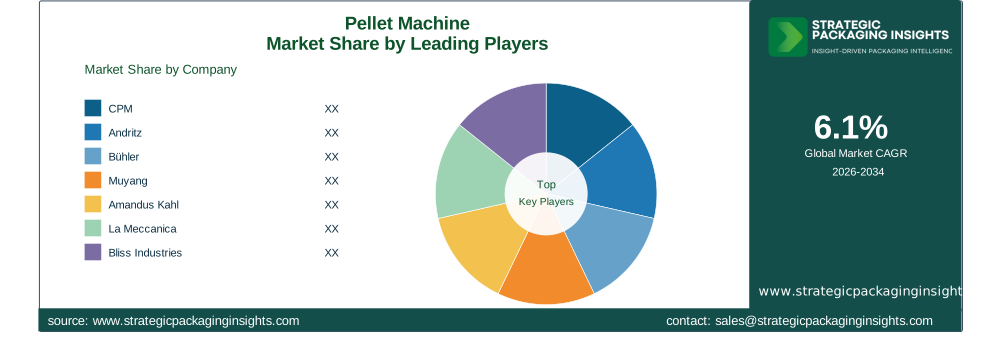
Andritz, for instance, is renowned for its comprehensive range of pellet machines that cater to various applications, including biomass, feed, and wood pellets. The company's focus on research and development has resulted in the introduction of cutting-edge technologies that enhance the efficiency and performance of their machines. Similarly, Bühler has established itself as a key player in the market by offering a diverse range of pellet machines that are designed to meet the specific needs of different industries. The company's commitment to sustainability and innovation has positioned it as a leader in the pellet machine market.
Other notable players in the market include Muyang, Amandus Kahl, and La Meccanica, each of which has carved out a niche in the industry through their specialized product offerings and strong customer focus. Muyang, for example, is known for its advanced feed pellet machines that are widely used in the agricultural sector. The company's emphasis on quality and customer satisfaction has earned it a loyal customer base and a strong market position. Amandus Kahl, on the other hand, is recognized for its innovative biomass pellet machines that are designed to maximize energy efficiency and minimize environmental impact.
Bliss Industries, Zhengchang, RICHI Machinery, and GEMCO are also key players in the pellet machine market, each contributing to the industry's growth through their unique product offerings and strategic market initiatives. Bliss Industries, for example, is known for its robust and reliable pellet machines that are widely used in industrial applications. The company's focus on durability and performance has made it a preferred choice for many businesses. Similarly, Zhengchang and RICHI Machinery have established themselves as leaders in the market by offering a wide range of pellet machines that cater to various applications and industries.
Key Highlights
- The pellet machine market is projected to grow at a CAGR of 6.1% from 2026 to 2034.
- Increasing demand for renewable energy solutions is a major driver for market growth.
- Technological advancements in pellet machine design are enhancing efficiency and reducing costs.
- Regulatory constraints related to emissions pose challenges for market players.
- Emerging economies present significant growth opportunities for manufacturers.
- Key players include CPM, Andritz, Bühler, Muyang, and Amandus Kahl.
- Volatility in raw material prices can impact the cost-effectiveness of pellet production.
- Competition from alternative energy sources such as solar and wind is a potential threat.
- Government incentives for renewable energy projects are encouraging investments in pellet machine technologies.
Top Countries Insights
In the pellet machine market, the United States stands out as a key player with a market size of approximately $1.2 billion and a CAGR of 5%. The country's focus on renewable energy and sustainable agricultural practices is driving the demand for pellet machines. Government incentives and subsidies for renewable energy projects are further boosting market growth. However, regulatory constraints related to emissions and environmental impact pose challenges for manufacturers operating in the region.

China is another significant market for pellet machines, with a market size of around $1 billion and a CAGR of 7%. The country's rapid industrialization and urbanization are driving the demand for efficient energy solutions and agricultural productivity tools. The Chinese government's focus on reducing carbon emissions and promoting renewable energy sources is also contributing to market growth. However, the market faces challenges related to raw material availability and price volatility.
Germany, with a market size of approximately $800 million and a CAGR of 6%, is a key player in the European pellet machine market. The country's strong focus on sustainability and renewable energy is driving the demand for pellet machines. Government policies and incentives for renewable energy projects are further supporting market growth. However, stringent environmental regulations and the need for compliance with international standards pose challenges for market players.
India, with a market size of around $600 million and a CAGR of 8%, is an emerging market for pellet machines. The country's growing focus on renewable energy and sustainable agricultural practices is driving the demand for pellet machines. Government initiatives to promote renewable energy projects and reduce carbon emissions are further boosting market growth. However, the market faces challenges related to infrastructure development and technological advancements.
Brazil, with a market size of approximately $500 million and a CAGR of 6%, is a key player in the Latin American pellet machine market. The country's focus on renewable energy and sustainable agricultural practices is driving the demand for pellet machines. Government incentives and subsidies for renewable energy projects are further supporting market growth. However, the market faces challenges related to economic instability and regulatory constraints.
Pellet Machine Market Segments Insights

Machine Type Analysis
The pellet machine market is segmented by machine type into flat die pellet machines, ring die pellet machines, biomass pellet machines, and feed pellet machines. Flat die pellet machines are popular for small-scale operations due to their simplicity and cost-effectiveness. They are widely used in the production of animal feed and small-scale biomass pellets. Ring die pellet machines, on the other hand, are preferred for large-scale operations due to their high efficiency and durability. These machines are commonly used in industrial applications and large-scale biomass pellet production. Biomass pellet machines are gaining traction due to the increasing demand for renewable energy sources. These machines are designed to process various types of biomass materials, including wood, agricultural residues, and energy crops. Feed pellet machines are essential in the agricultural sector for producing high-quality animal feed pellets that enhance livestock nutrition and growth.

The demand for different types of pellet machines is driven by various factors, including the scale of operations, material type, and end-use application. Flat die pellet machines are ideal for small-scale farmers and businesses looking to produce pellets for personal use or local distribution. Ring die pellet machines, with their higher capacity and efficiency, are suitable for large-scale commercial operations. Biomass pellet machines are increasingly being adopted by energy companies and industrial players looking to capitalize on the growing demand for renewable energy. Feed pellet machines are essential for feed mills and agricultural businesses aiming to improve livestock productivity and reduce feed costs.
Capacity Analysis
The pellet machine market is segmented by capacity into small capacity, medium capacity, and large capacity machines. Small capacity pellet machines are designed for small-scale operations and are ideal for farmers and small businesses looking to produce pellets for personal use or local distribution. These machines are cost-effective and easy to operate, making them a popular choice for small-scale producers. Medium capacity pellet machines are suitable for mid-sized operations and are commonly used in feed mills and small industrial applications. These machines offer a balance between cost and efficiency, making them an attractive option for businesses looking to expand their production capabilities.

Large capacity pellet machines are designed for large-scale industrial operations and are capable of producing high volumes of pellets. These machines are commonly used in biomass energy production and large-scale feed production. The demand for large capacity pellet machines is driven by the increasing need for efficient and sustainable energy solutions, as well as the growing demand for high-quality animal feed. The choice of pellet machine capacity is influenced by factors such as production volume, material type, and end-use application. Small and medium capacity machines are ideal for businesses looking to produce pellets for local distribution or personal use, while large capacity machines are suitable for commercial operations and large-scale production.
Application Analysis
The pellet machine market is segmented by application into animal feed, biomass fuel, fertilizer pellets, and wood pellets. Animal feed is one of the largest applications for pellet machines, driven by the growing demand for high-quality feed that enhances livestock nutrition and growth. Pellet machines are essential for producing feed pellets that are easy to store, transport, and distribute. Biomass fuel is another significant application for pellet machines, driven by the increasing demand for renewable energy sources. Biomass pellets are used as a sustainable alternative to fossil fuels in energy production, providing a reliable and eco-friendly energy source.

Fertilizer pellets are gaining popularity due to the growing focus on sustainable agricultural practices. Pellet machines are used to produce fertilizer pellets that are easy to apply and provide essential nutrients to crops. Wood pellets are widely used in residential and commercial heating applications, driven by the increasing demand for sustainable and efficient heating solutions. The demand for pellet machines in different applications is influenced by factors such as material type, production volume, and end-use requirements. Animal feed and biomass fuel are the largest applications for pellet machines, driven by the growing demand for sustainable energy and agricultural solutions.
End Use Analysis
The pellet machine market is segmented by end use into agriculture, energy, feed mills, and industrial applications. The agricultural sector is one of the largest end users of pellet machines, driven by the growing demand for high-quality animal feed and sustainable agricultural practices. Pellet machines are essential for producing feed pellets that enhance livestock nutrition and growth. The energy sector is another significant end user of pellet machines, driven by the increasing demand for renewable energy sources. Biomass pellets are used as a sustainable alternative to fossil fuels in energy production, providing a reliable and eco-friendly energy source.

Feed mills are a key end user of pellet machines, driven by the growing demand for high-quality feed that enhances livestock nutrition and growth. Pellet machines are essential for producing feed pellets that are easy to store, transport, and distribute. The industrial sector is also a significant end user of pellet machines, driven by the increasing demand for efficient and sustainable energy solutions. Pellet machines are used in various industrial applications, including biomass energy production and large-scale feed production. The demand for pellet machines in different end-use applications is influenced by factors such as production volume, material type, and end-use requirements.
Pellet Machine Market Segments
The Pellet Machine market has been segmented on the basis ofMachine Type
- Flat Die Pellet Machines
- Ring Die Pellet Machines
- Biomass Pellet Machines
- Feed Pellet Machines
Capacity
- Small Capacity
- Medium Capacity
- Large Capacity
Application
- Animal Feed
- Biomass Fuel
- Fertilizer Pellets
- Wood Pellets
End Use
- Agriculture
- Energy
- Feed Mills
- Industrial
Region
- Asia Pacific
- North America
- Latin America
- Europe
- Middle East & Africa




