
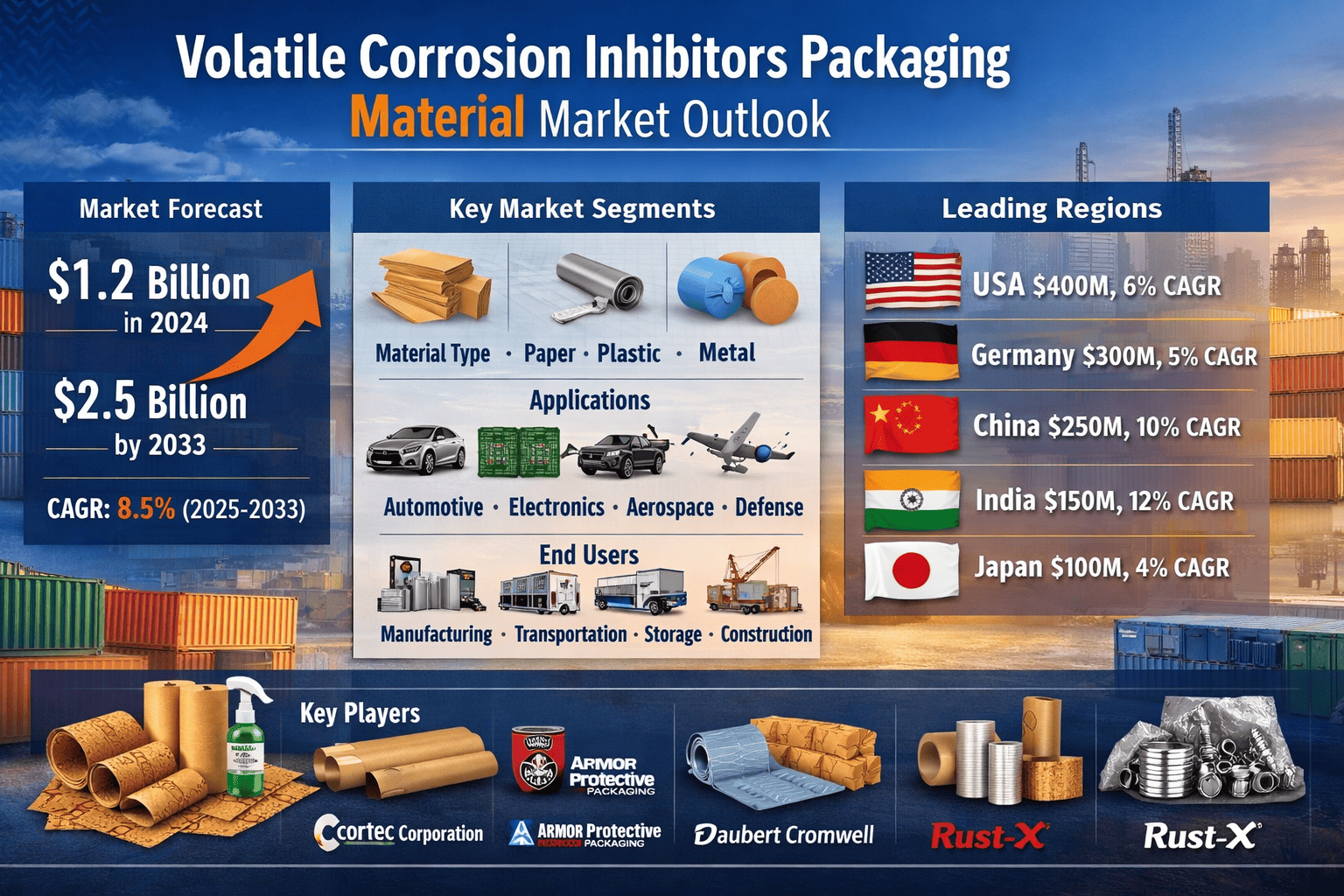
The Volatile Corrosion Inhibitors (VCI) Packaging Material market was valued at $1.2 billion in 2024 and is projected to reach $2.5 billion by 2033, growing at a CAGR of 8.5% during the forecast period 2025-2033.
Corrosion is one of the most persistent and costly challenges facing industries that work with metal components. From automotive parts sitting in transit to aerospace hardware stored for months before deployment, the threat of rust and oxidation can compromise product integrity, inflate replacement costs, and disrupt supply chains. The Volatile Corrosion Inhibitors (VCI) Packaging Material market has emerged as a powerful solution to this challenge, and the numbers tell a compelling story of sustained growth.
Market Overview and Valuation
The Volatile Corrosion Inhibitors Packaging Material market was valued at $1.2 billion in 2024 and is projected to reach $2.5 billion by 2033, expanding at a compound annual growth rate (CAGR) of 8.5% during the forecast period from 2025 to 2033. This robust growth trajectory reflects the rising global demand for packaging solutions that actively protect metal products during storage and transportation.
The fundamental appeal of VCI packaging lies in its mechanism. VCI materials release chemical compounds that form a protective molecular layer on metal surfaces, preventing oxidative reactions without the need for direct contact or messy coatings. This passive protection makes VCI packaging highly practical for industries that handle large volumes of metal components across long supply chains.
Key Market Drivers
Several converging forces are accelerating the growth of the VCI packaging material market. The expansion of global trade volumes has increased the distances and durations over which metal products must travel, raising the stakes for effective corrosion protection. Industries such as automotive, electronics, and aerospace are growing rapidly, particularly in emerging economies, and each of these sectors depends on reliable corrosion prevention to safeguard sensitive and expensive components.
The automotive industry stands out as one of the most significant consumers of VCI packaging. Vehicle manufacturers and suppliers routinely ship engine components, gears, bearings, and structural parts across international borders. Electronics manufacturers face similar challenges with circuit boards, connectors, and metallic housings that are vulnerable to moisture and oxidation. The defense and aerospace sectors add another layer of demand, requiring VCI materials capable of protecting mission-critical equipment under demanding conditions.
Beyond industry growth, rising awareness about the long-term cost benefits of VCI packaging is bringing more buyers into the market. Companies are beginning to recognize that the upfront investment in quality VCI packaging materials pays dividends by reducing product failures, warranty claims, and replacement costs over time.
Material Type Segmentation
The market is segmented by material type into paper, plastic, and metal, each serving distinct use cases. Paper-based VCI materials are gaining traction thanks to their eco-friendly profile and biodegradable nature. These products are particularly popular in the automotive and electronics sectors, where sustainability credentials are becoming part of procurement criteria.
Plastic-based VCI materials continue to dominate the overall market due to their superior moisture resistance and structural durability. They are especially suited for long-term storage applications where metal products may be held in warehouses for extended periods. However, the environmental footprint of plastic packaging remains a concern, prompting manufacturers to invest in recycling-compatible formulations and alternative materials.
Metal-based VCI packaging serves a niche but important role in specialized applications that require extremely high levels of corrosion protection, such as heavy industrial components and precision engineering parts.
Application Segments in Focus
The application landscape of the VCI packaging material market spans automotive, electronics, aerospace, metalworks, and defense. The automotive and electronics industries collectively represent the largest consumption base, driven by the sheer volume of metal components moving through their global supply chains.
Aerospace and defense applications, while smaller in volume, are high-value segments where the quality requirements for corrosion protection are exceptionally rigorous. A corroded aerospace component can have serious safety implications, making premium VCI solutions a non-negotiable investment for players in those industries. Metalworks, covering everything from fabrication shops to heavy machinery manufacturers, also represents a steady and growing source of demand.
End-User Analysis
From an end-user perspective, the manufacturing sector leads consumption of VCI packaging materials, using them to protect components throughout the production and assembly process. The transportation segment relies on VCI packaging to safeguard metal goods during shipping, particularly over long hauls or in environments with high humidity.
Storage facilities and distribution centers represent another key end-user category, using VCI solutions for inventory held over extended durations. The construction sector, while less prominent, uses VCI materials to protect steel structures, rebar, and hardware from corrosion during both the build phase and ongoing maintenance.
Challenges and Restraints
The market is not without headwinds. Environmental regulations governing the use of certain chemical compounds in packaging materials pose ongoing compliance challenges for manufacturers. These regulations are tightening in key markets such as Europe and North America, forcing companies to reformulate products and invest in greener alternatives. While this creates short-term disruption, it is also spurring innovation in bio-based VCI materials that could redefine the competitive landscape.
Cost remains another barrier, particularly for small and medium-sized enterprises that may struggle to justify the price premium of VCI packaging over conventional alternatives. Awareness gaps in certain developing markets also constrain growth, underscoring the need for education-focused marketing strategies.
Opportunities and Innovation Trends
The opportunity horizon for VCI packaging material providers is broad and promising. The development of biodegradable and recyclable VCI materials opens the door to buyers with strong sustainability mandates, including large multinational corporations with net-zero commitments. Bio-based VCI materials, derived from renewable raw materials, represent one of the most exciting frontiers in this space.
Smart packaging integration is another major emerging theme. VCI materials embedded with IoT-enabled sensors can monitor temperature, humidity, and corrosion indicators in real time, providing end-users with actionable data about the condition of their packaged goods. This convergence of material science and digital technology adds significant value beyond basic corrosion prevention and is expected to attract premium pricing and new market segments.
Competitive Landscape and Leading Players
The market features several well-established players commanding strong positions. Cortec Corporation leads with a diverse product range spanning films, papers, and liquids, backed by a strong commitment to sustainability. Armor Protective Packaging is recognized for product quality and an extensive distribution network. Daubert Cromwell distinguishes itself through active research and development investment. Other notable participants include Northern Technologies International Corporation, Branopac GmbH, and Rust-X, all competing on product performance, service quality, and geographic reach.
Regional Highlights
Geographically, the United States leads with a market size of $400 million and a CAGR of 6%, supported by large automotive and aerospace sectors. Germany follows at $300 million with a 5% CAGR, reflecting its manufacturing depth and engineering culture. China is the fastest-growing major market among established players, valued at $250 million with a 10% CAGR, fueled by its massive industrial base. India is emerging as a high-growth market with a CAGR of 12%, driven by its expanding manufacturing sector and government-backed sustainability initiatives. Japan, at $100 million with a 4% CAGR, represents a mature market anchored by precision electronics and automotive companies.
Conclusion
The Volatile Corrosion Inhibitors Packaging Material market is at a pivotal juncture, balancing strong industrial demand with the imperatives of environmental responsibility and technological innovation. With a projected valuation of $2.5 billion by 2033, the market offers substantial opportunities for manufacturers, investors, and end-users willing to adapt to evolving demands. Companies that prioritize eco-friendly formulations, smart packaging integration, and expanding distribution into emerging markets will be best positioned to capture long-term value in this growing sector.