
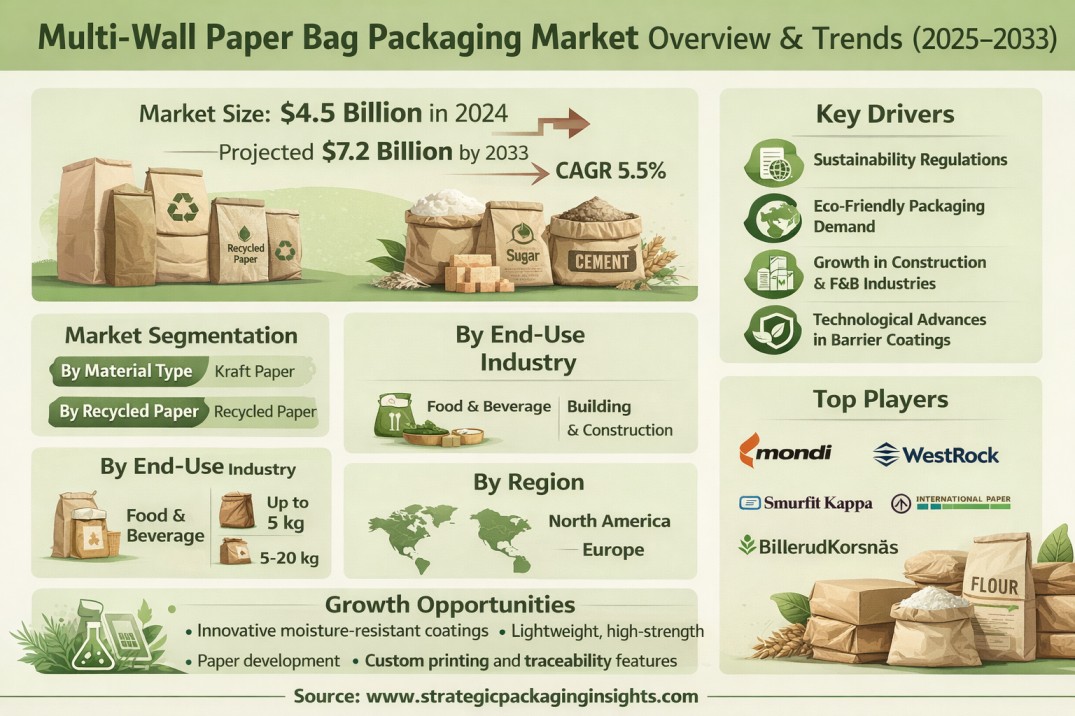
The global Multi-Wall Paper Bag Packaging market was valued at USD 4.5 billion in 2024 and is projected to reach USD 7.2 billion by 2033, growing at a steady CAGR of 5.5% during the forecast period 2025–2033.
Multi-Wall Paper Bag Packaging Market: Industry Outlook, Sustainability Trends and Forecast to 2033
Multi-wall paper bag packaging plays a vital role in safely transporting and storing bulk products across food, construction, chemical, and agricultural industries. These bags are manufactured using multiple layers of kraft or recycled paper to deliver superior strength, puncture resistance, and moisture protection while maintaining high recyclability and environmental compliance.
Read Full Report : https://www.strategicpackaginginsights.com/report/multi-wall-paper-bag-packaging-market
Market Overview
The global Multi-Wall Paper Bag Packaging market was valued at USD 4.5 billion in 2024 and is projected to reach USD 7.2 billion by 2033, growing at a steady CAGR of 5.5% during the forecast period 2025–2033. This growth is driven by increasing demand for eco-friendly packaging alternatives and rising consumption of bulk packaged goods in construction materials, food ingredients, and industrial chemicals.
Governments and regulatory bodies across regions are tightening plastic usage regulations, accelerating the shift toward paper-based and biodegradable packaging solutions. As a result, multi-wall paper bags are becoming a preferred option for manufacturers seeking compliance, brand sustainability positioning, and cost-effective bulk packaging.
Why Multi-Wall Paper Bags Are Gaining Industry Preference
- High load-bearing capacity for heavy and granular products
- Excellent breathability for food and agricultural commodities
- Superior print quality for branding and compliance labeling
- High recyclability and reduced carbon footprint
- Customizable barrier coatings for moisture and grease protection
These functional advantages allow manufacturers to replace plastic sacks and woven polypropylene bags while meeting product safety and sustainability requirements.
Market Segmentation Analysis
By Material Type
The market is segmented into Kraft Paper and Recycled Paper. Kraft paper dominates due to its superior tensile strength, tear resistance, and durability in heavy-load applications such as cement, fertilizers, and animal feed. Recycled paper bags are increasingly adopted in retail and secondary packaging where sustainability certifications and lower material costs are key purchasing drivers.
By End-Use Industry
Major end-use sectors include Food & Beverage and Building & Construction. In food applications, these bags are widely used for flour, sugar, grains, starch, and powdered ingredients, offering food-grade safety and breathable structures. In construction, multi-wall paper bags are essential for cement, mortar, plaster, and specialty building chemicals that require high mechanical protection during transport and storage.
By Capacity
Capacity segments include Up to 5 kg and 5–20 kg. Smaller capacities are commonly used in retail-ready packaging and food service distribution, while 5–20 kg bags dominate industrial supply chains where manual handling and stacking efficiency are operational priorities.
By Region
North America and Europe represent major consumption hubs due to strict sustainability regulations, well-established recycling infrastructure, and strong industrial production bases. European markets are particularly advanced in adopting low-carbon packaging materials, while North America shows strong growth in construction-driven packaging demand.
Key Market Drivers
- Rising environmental regulations limiting plastic packaging usage
- Growing construction activity and infrastructure development
- Increased demand for packaged food ingredients and additives
- Corporate sustainability commitments and ESG targets
- Advancements in paper strength and barrier coating technologies
Growth Opportunities and Emerging Trends
Manufacturers are investing in advanced coatings that improve moisture resistance while maintaining recyclability. Development of lightweight high-strength paper grades is enabling material reduction without compromising performance, helping brands lower logistics costs and environmental impact.
Custom printing, digital traceability features, and smart labeling integration are emerging as value-added services, particularly in regulated food and chemical sectors where product traceability and safety compliance are critical.
PESTLE Analysis of the Market
Political: Environmental regulations and packaging waste directives are supporting paper-based alternatives.
Economic: Construction cycles and agricultural output directly influence packaging demand volumes.
Social: Rising consumer preference for sustainable packaging enhances brand adoption of paper bags.
Technological: Innovation in fiber processing and coating chemistry improves performance capabilities.
Legal: Food safety standards and chemical packaging regulations shape material specifications.
Environmental: Carbon footprint reduction targets promote renewable fiber-based packaging solutions.
Competitive Landscape and Market Share Insights
The Multi-Wall Paper Bag Packaging market is moderately fragmented, with both global leaders and strong regional manufacturers contributing to market competition. Companies are actively investing in production capacity expansion, sustainable material sourcing, and product innovation to strengthen customer relationships and long-term contracts.
Leading companies include Mondi Group, WestRock Company, and Smurfit Kappa Group. Mondi Group is recognized for its broad portfolio of sustainable industrial paper packaging and continuous material innovation. WestRock focuses on customer-specific packaging designs and capacity expansion through acquisitions. Smurfit Kappa emphasizes integrated paper production and closed-loop recycling systems.
Other notable players include International Paper Company, BillerudKorsnäs AB, and Georgia-Pacific LLC, all of which invest heavily in renewable fiber sourcing, product development, and high-performance packaging structures. Regional players also play an important role by serving niche markets and localized industrial supply chains.
Future Outlook
Over the forecast period, the Multi-Wall Paper Bag Packaging market is expected to benefit from continuous sustainability-driven substitution of plastic sacks, expansion of infrastructure projects, and rising global demand for packaged food ingredients. Manufacturers that focus on innovation, supply chain integration, and environmentally responsible sourcing will be best positioned to capture emerging opportunities.
Conclusion
Multi-wall paper bag packaging remains a cornerstone of industrial and food-grade bulk packaging due to its strength, flexibility, and environmental advantages. With strong regulatory support and expanding end-use applications, the market is set for stable and sustained growth through 2033. Businesses investing in advanced materials, production efficiency, and sustainable practices will continue to gain competitive advantage in this evolving packaging landscape.