
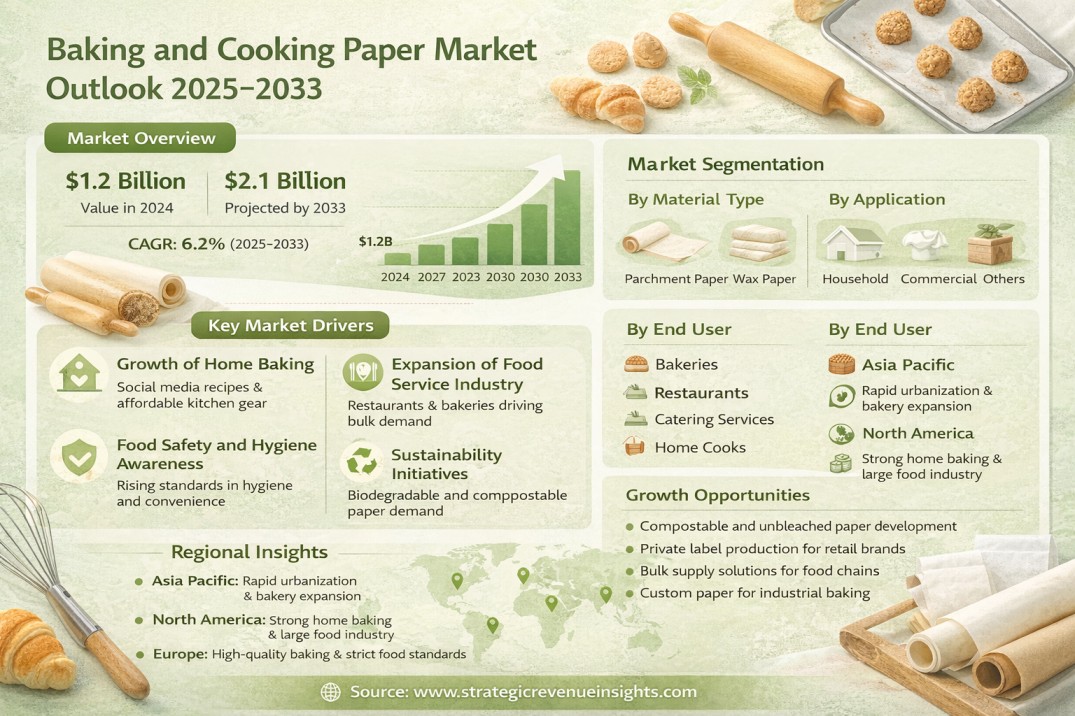
Baking and cooking paper market to grow from $1.2B in 2024 to $2.1B by 2033. Discover key segments, trends, and opportunities.
Baking and Cooking Paper Market Outlook 2025–2033: Growth Trends, Segmentation, and Strategic Insights
The global Baking and Cooking Paper market is witnessing steady growth as both household and commercial food preparation increasingly adopt hygienic, non-stick, and convenient packaging solutions. Valued at USD 1.2 billion in 2024, the market is projected to reach USD 2.1 billion by 2033, expanding at a CAGR of 6.2% during the forecast period 2025–2033.
Rising consumer preference for home baking, growth in food service outlets, and increasing focus on food safety and convenience are driving consistent demand for baking and cooking papers across global markets.
Read More : https://www.strategicpackaginginsights.com/report/baking-and-cooking-paper-market
Understanding Baking and Cooking Paper
Baking and cooking paper refers to specialized paper products used to prevent food from sticking to baking trays, grills, and cookware. These papers improve cooking efficiency, reduce cleaning effort, and support hygienic food handling.
- Heat-resistant and grease-resistant surfaces
- Non-stick properties without added oils
- Improved food presentation and safety
- Time-saving in both home and commercial kitchens
As food consumption habits evolve and convenience becomes a priority, baking and cooking papers are transitioning from optional accessories to essential kitchen supplies.
Market Size and Growth Outlook
The market demonstrates stable and long-term growth potential due to expanding food industries and changing lifestyle patterns. Growth is particularly strong in emerging economies where urbanization and organized food services are expanding rapidly.
| Year | Market Value (USD Billion) |
|---|---|
| 2024 | 1.2 |
| 2027 (Est.) | 1.5 |
| 2030 (Est.) | 1.8 |
| 2033 | 2.1 |
Consistent product replacement cycles and rising usage frequency in food businesses ensure stable revenue streams for manufacturers.
Market Segmentation Analysis
By Material Type
| Material | Characteristics | Market Demand |
|---|---|---|
| Parchment Paper | Silicone-coated, high heat resistance, non-stick | Largest market share |
| Wax Paper | Moisture resistant, low heat tolerance | Used for food wrapping and preparation |
| Others | Compostable and specialty coated papers | Fast-growing niche segment |
Parchment paper dominates due to its superior performance in baking and roasting applications, while sustainable material innovations are gaining attention in premium segments.
By Application
- Household: Home baking, air fryers, daily cooking convenience
- Commercial: Restaurants, cafés, bakeries, quick-service outlets
- Industrial: Food manufacturing and large-scale processing
Commercial kitchens generate higher volume consumption, while household demand benefits from increasing home cooking trends and baking as a hobby.
By End User
| End User | Usage Pattern |
|---|---|
| Bakeries | Continuous daily usage in production cycles |
| Restaurants | Used for grilling, baking, and food presentation |
| Catering Services | High-volume event-based consumption |
| Home Cooks | Convenience-driven occasional use |
Regional Market Outlook
The baking and cooking paper market shows strong regional diversity, influenced by culinary habits, disposable income, and food service infrastructure.
- Asia Pacific: Rapid urbanization, bakery chain expansion, growing packaged food sector
- North America: Strong home baking culture and large food service industry
- Europe: High-quality baking traditions and strict food safety standards
- Latin America: Expanding restaurant industry and retail food chains
- Middle East & Africa: Hospitality growth and tourism-driven food services
Asia Pacific is expected to witness the fastest growth, supported by increasing disposable income and rising adoption of modern cooking practices.
Key Market Drivers
1. Growth of Home Baking and Cooking
Social media influence, recipe platforms, and affordable kitchen appliances are encouraging consumers to cook and bake at home, driving household demand.
2. Expansion of Food Service Industry
Restaurants, cafés, and bakery chains rely on cooking paper for operational efficiency, hygiene, and consistent product quality.
3. Food Safety and Hygiene Awareness
Rising regulatory standards and consumer awareness are increasing demand for clean and disposable cooking surfaces.
4. Sustainability Initiatives
Manufacturers are investing in biodegradable and compostable papers to meet environmental compliance and eco-conscious consumer demand.
Growth Opportunities and Strategic Developments
- Development of compostable and unbleached paper variants
- Private label manufacturing for retail brands
- Bulk packaging solutions for food service chains
- Customization for industrial baking processes
Companies that align product innovation with sustainability and cost efficiency are expected to gain long-term competitive advantages.
PESTLE Analysis
| Factor | Market Impact |
|---|---|
| Political | Food packaging regulations and import/export policies |
| Economic | Food service growth and household spending trends |
| Social | Preference for convenience cooking and hygiene |
| Technological | Advanced coatings and heat-resistant paper development |
| Legal | Compliance with food contact material standards |
| Environmental | Demand for recyclable and biodegradable packaging |
Competitive Landscape and Industry Focus
Market competition centers around product quality, coating technology, sustainability credentials, and pricing strategies. Manufacturers are focusing on:
- Material innovation and coating efficiency
- Long-term supply contracts with food chains
- Retail brand partnerships
- Regional production expansion to reduce logistics costs
Brand recognition and regulatory certifications play an important role in supplier selection, especially among large food service operators.
Conclusion: Stable Growth with Sustainability at the Core
The Baking and Cooking Paper market offers consistent growth opportunities supported by evolving cooking habits, expanding food service sectors, and increasing emphasis on hygiene and convenience. With steady CAGR and growing applications across households and commercial kitchens, demand is expected to remain resilient through 2033.
Future market success will depend on sustainable material innovation, operational efficiency, and strong distribution partnerships. Companies that invest in eco-friendly product development while maintaining competitive pricing are well-positioned to benefit from the next phase of market expansion.