
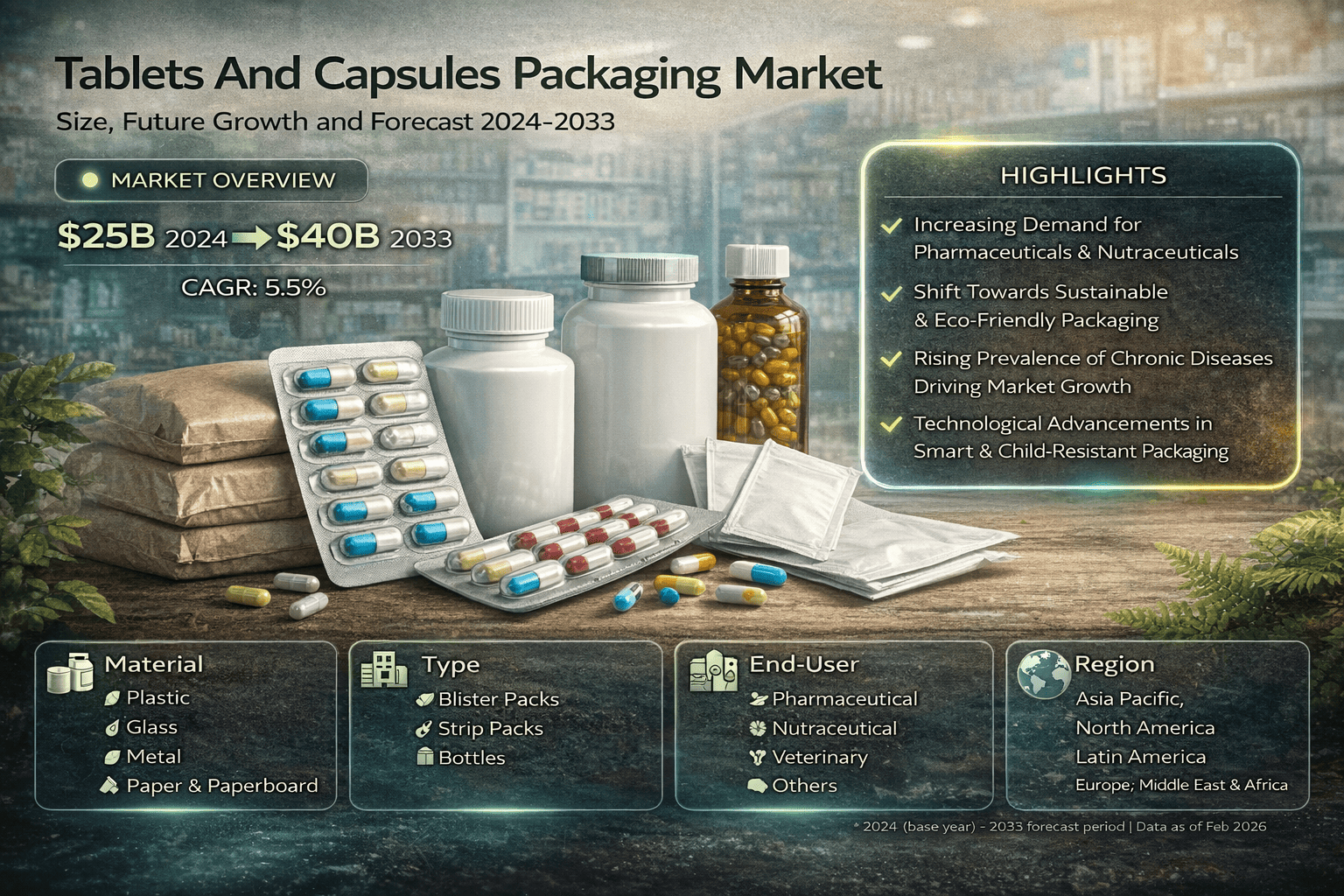
The Tablets and Capsules Packaging market was valued at $25 billion in 2024 and is projected to reach $40 billion by 2033, growing at a CAGR of 5.5% during the forecast period 2025-2033.
The global tablets and capsules packaging market is undergoing a significant transformation, driven by a combination of demographic shifts, technological innovation, and evolving consumer expectations. Valued at $25 billion in 2024, this market is projected to reach $40 billion by 2033, growing at a compound annual growth rate (CAGR) of 5.5% during the forecast period. As pharmaceutical companies race to meet the demands of an aging global population and rising chronic disease prevalence, packaging has emerged as a critical element in ensuring product safety, efficacy, and patient compliance.
https://www.strategicpackaginginsights.com/report/tablets-and-capsules-packaging-market
The Core Forces Driving Market Growth
At the heart of this market's expansion lies a simple but powerful reality: more people are taking more medications than ever before. Chronic conditions such as diabetes, cardiovascular disease, and respiratory disorders require ongoing medication regimens, creating consistent and growing demand for tablets and capsules, and by extension, for the packaging that protects them. The aging population worldwide amplifies this trend considerably, as older adults typically manage multiple prescriptions simultaneously.
Beyond prescription drugs, the surge in self-medication and over-the-counter pharmaceutical products has opened a parallel avenue for market growth. Consumers today are more proactive about managing their health, turning to vitamins, dietary supplements, and nutraceuticals in record numbers. This behavioral shift has created substantial demand not just from traditional pharmaceutical companies, but also from nutraceutical brands that need packaging solutions capable of maintaining product integrity while appealing to health-conscious shoppers.
Technological advancement is another major growth engine. The development of high-barrier packaging materials that shield products from moisture, oxygen, and UV light has been particularly impactful. These materials help maintain the chemical stability and potency of sensitive formulations over longer shelf periods, which is especially critical for markets where supply chains span vast distances and face variable storage conditions. In parallel, smart packaging innovations incorporating RFID tags, NFC chips, QR codes, and IoT-enabled tracking systems are redefining how pharmaceutical products are monitored and how patients interact with their medications.
Packaging Types and Materials Shaping the Landscape
The market encompasses several distinct packaging formats, each serving specific functional needs. Blister packs remain the dominant packaging type, favored for their ability to protect individual doses, provide tamper evidence, and support patient compliance. Their unit-dose structure makes it easier for patients to track medication schedules, and manufacturers appreciate the compatibility with high-speed production lines.
Strip packs offer a cost-effective alternative for high-volume production scenarios, while bottles remain the standard for bulk packaging and liquid-adjacent formulations. Sachets, although a smaller segment, are gaining ground in single-dose applications and sample distribution, particularly as personalized medicine and direct-to-consumer models expand their reach.
On the materials side, plastic continues to dominate due to its flexibility, cost advantages, and barrier performance. However, mounting environmental pressure is reshaping material preferences across the industry. Glass maintains a loyal following for its chemically inert properties, making it ideal for sensitive formulations where packaging-drug interaction must be minimized. Metal sees limited but consistent application where durability is paramount. Most notably, paper and paperboard are gaining momentum as sustainable secondary packaging alternatives, reflecting the industry's broader pivot toward eco-conscious practices.
Sustainability as a Strategic Imperative
The packaging industry's sustainability journey is accelerating rapidly, and the tablets and capsules packaging sector is no exception. As consumers increasingly evaluate brands through an environmental lens, pharmaceutical and nutraceutical companies are responding by demanding greener packaging solutions from their suppliers.
The shift toward biodegradable plastics, recycled content, and mono-material packaging designs represents more than just a compliance exercise. It is a genuine business opportunity for packaging innovators who can deliver solutions that maintain regulatory compliance, preserve product integrity, and reduce environmental footprint simultaneously. Companies that successfully navigate this triple mandate are positioning themselves ahead of competitors still reliant on conventional materials.
Regulatory bodies across North America, Europe, and increasingly Asia are tightening environmental packaging standards, adding urgency to this transition. Packaging manufacturers investing now in sustainable material research and circular economy-aligned product lines are likely to find themselves in a strong competitive position as these regulations become more widespread.
Regional Dynamics and Emerging Market Opportunities
Geography plays a defining role in this market's growth story. North America, led by the United States with a market size of approximately $8 billion, remains the single largest regional market. The country's advanced healthcare infrastructure, robust FDA regulatory framework, and high pharmaceutical consumption make it a benchmark market for packaging innovation.
Europe represents another mature and sophisticated market, with Germany contributing around $3 billion and a CAGR of 5%. German pharmaceutical manufacturing's global reputation for precision and quality extends naturally into its packaging sector, with strong regulatory oversight supporting consistent standards.
The most exciting growth, however, is unfolding across Asia Pacific and Latin America. China's tablets and capsules packaging market, currently valued at $5 billion, is growing at an impressive 7% CAGR. Government investment in healthcare infrastructure and expanding middle-class access to medical care are creating enormous demand for pharmaceutical products and their packaging. India's market, valued at $4 billion and growing at 6%, is similarly buoyed by its massive population base, rising healthcare spending, and the proliferation of e-commerce pharmacies that require secure, tamper-evident packaging for safe delivery.
Brazil anchors the Latin American segment with a $2 billion market and 5% CAGR, where improving healthcare access and a maturing pharmaceutical manufacturing base are supporting steady growth.
Competitive Landscape and Key Industry Players
The competitive environment is dynamic, featuring a blend of global giants and agile regional players. Amcor Limited maintains a leading position through its broad portfolio and strong sustainability commitments. Gerresheimer AG distinguishes itself through specialized glass and plastic solutions for healthcare applications. Berry Global brings scale and advanced plastic manufacturing expertise, while West Pharmaceutical Services has carved a niche around patient safety-focused packaging components.
Other significant contributors include AptarGroup with its dispensing and active packaging systems, Schott AG in premium glass solutions, and Catalent along with Becton, Dickinson and Company rounding out a diverse competitive field. Strategic moves like mergers, acquisitions, product launches, and sustainability partnerships are continuously reshaping the market's competitive hierarchy.
Challenges the Industry Must Address
Despite the promising outlook, the tablets and capsules packaging market faces real headwinds. Regulatory compliance across multiple jurisdictions demands significant investment and expertise, raising barriers particularly for smaller enterprises. Volatility in raw material prices, especially plastics and metals, can compress margins unpredictably and disrupt supply chain planning. The capital intensity of adopting advanced smart packaging or sustainable material technologies puts meaningful pressure on small and medium-sized businesses competing against well-resourced global players.
Companies that will thrive through 2033 are those investing strategically in research and development, building flexible supply chains, and forging partnerships that allow them to share both the risks and rewards of innovation in this rapidly evolving market.