
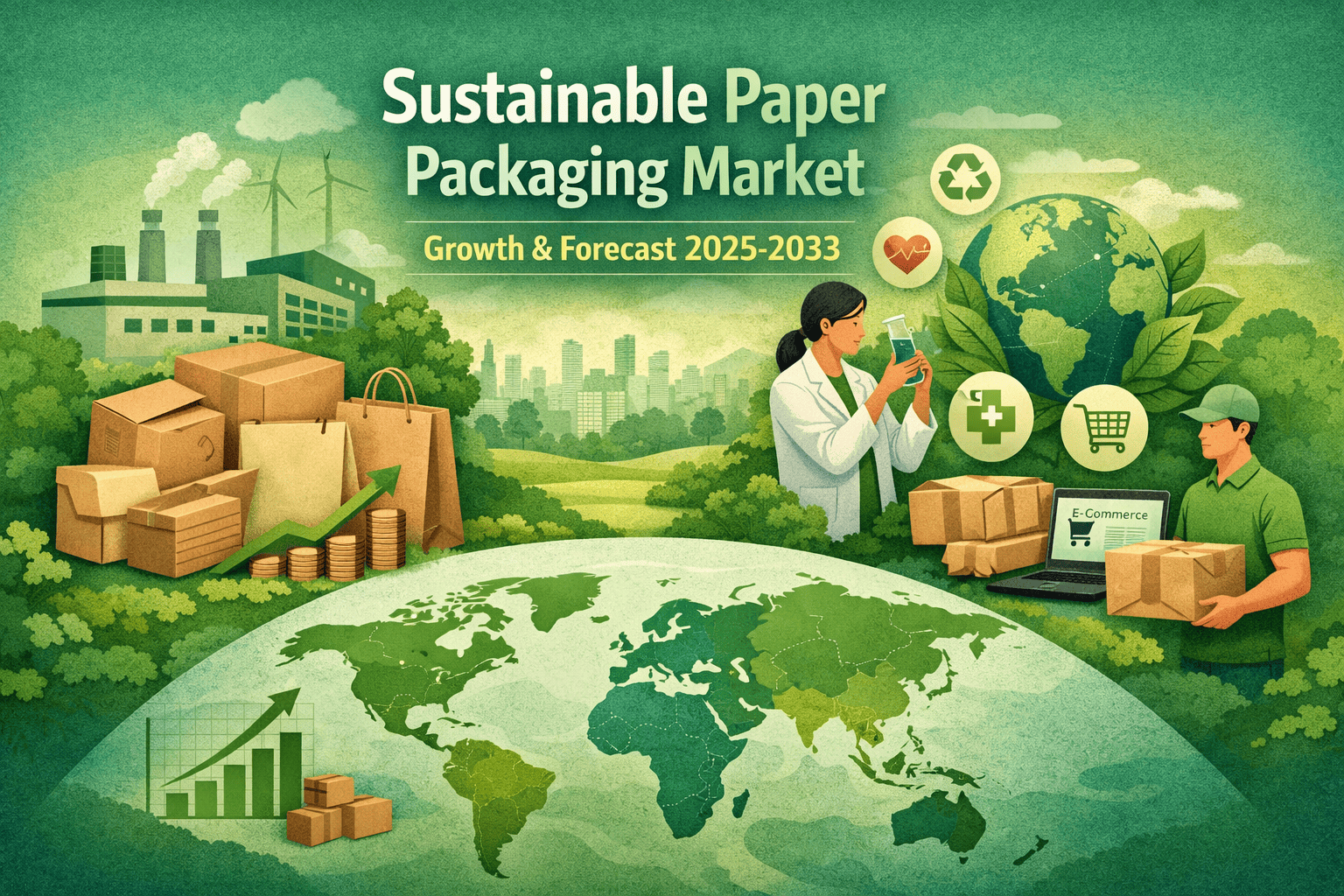
The sustainable paper packaging market was valued at $256 billion in 2024 and is projected to reach $412 billion by 2033, growing at a CAGR of 5.4% during the forecast period 2025-2033.
The sustainable paper packaging market was valued at $256 billion in 2024 and is projected to reach $412 billion by 2033, growing at a CAGR of 5.4% during the forecast period 2025 to 2033.
This market is gaining strong momentum as businesses across industries transition away from conventional plastic packaging toward renewable, recyclable alternatives. Regulatory mandates, shifting consumer expectations, and rapid innovation in paper-based materials are collectively reshaping the global packaging landscape.
Sustainable paper packaging encompasses corrugated board, boxboard, paper bags, and related formats used across food and beverage, healthcare, personal care, electronics, and retail sectors.
https://www.strategicpackaginginsights.com/report/sustainable-paper-packaging-market
Key Growth Drivers of the Sustainable Paper Packaging Market
Rising Consumer Demand for Eco-Friendly Packaging
Consumer behavior is one of the most powerful forces driving this market. Buyers across developed and emerging economies are actively seeking products packaged in environmentally responsible materials. This preference is pushing brands to replace plastic with paper-based alternatives to protect both their reputation and market share.
Retail chains, food companies, and e-commerce platforms are accelerating their sustainability commitments, directly expanding demand for certified paper packaging formats.
Regulatory Push Against Plastic Waste
Governments worldwide are implementing strict regulations to reduce plastic packaging waste. These include bans on single-use plastics, mandatory recycled content requirements, and extended producer responsibility frameworks.
Such policies are creating a structural shift in procurement decisions across industries. Manufacturers and brands are compelled to comply, making sustainable paper packaging not just a preference but a regulatory necessity in many markets.
Technological Advancements in Packaging Materials
Innovation is making sustainable paper packaging more competitive. Advances in biodegradable coatings, water-resistant inks, and barrier adhesives are enhancing the functional performance of paper-based formats.
These technologies allow paper packaging to replace plastic in applications that previously required moisture or grease resistance, such as food service packaging and personal care containers. This expands the addressable market significantly and improves adoption rates across high-performance use cases.
Sustainable Paper Packaging Market Segmentation Analysis
Material Type Analysis
Corrugated board dominates the material type segment due to its high strength, structural versatility, and recyclability. It is extensively used in e-commerce shipping, food packaging, and consumer electronics protection.
Boxboard holds a strong position in premium packaging for personal care, pharmaceutical, and luxury goods applications. Paper bags represent the fastest-growing format, driven by retail and grocery sector demand for compostable carry solutions.
Technology Analysis
Biodegradable coatings and barrier technologies are at the forefront of product innovation in this market. Companies are developing fiber-based trays, molded pulp inserts, and coated boards that replicate the protection of plastic while remaining fully recyclable.
Investment in digital printing technologies is also expanding, enabling shorter print runs, faster customization, and reduced material waste in packaging production.
Application Analysis
Food and beverage is the largest application segment, driven by both consumer preference and food safety regulations that favor recyclable materials. Healthcare packaging is a fast-growing application, with sustainable paper solutions being adopted for pharmaceutical boxes, inserts, and secondary packaging.
Personal care and cosmetics brands are also transitioning to paper-based packaging to align with sustainability branding strategies and respond to eco-conscious consumer demand.
Distribution Channel Analysis
The retail sector accounts for the largest share of end-user demand, reflecting the high volume of paper packaging used in consumer goods distribution. Industrial users represent a significant secondary segment, particularly in machinery, components, and export packaging. Institutional demand is also rising as public sector and corporate sustainability mandates expand procurement of eco-certified packaging.
Market Challenges and Industry Barriers
Despite strong growth, the sustainable paper packaging market faces real constraints. The cost of producing sustainable paper packaging remains higher than conventional plastic alternatives, creating pricing pressure particularly in cost-sensitive markets.
Variability in regional regulations and the absence of globally standardized certifications for sustainable packaging create compliance complexity for multinational manufacturers. Raw material price fluctuations, particularly in wood pulp and recycled fiber, can compress margins and affect supply chain stability.
Competition from flexible plastics and metal packaging, which offer superior barrier performance at lower cost, continues to challenge full-scale adoption in certain categories.
Regional Outlook of the Sustainable Paper Packaging Market
The United States market is valued at approximately $65 billion, growing at a CAGR of 6%. Strong regulatory frameworks, high consumer awareness, and the presence of major market players including International Paper Company and Packaging Corporation of America drive consistent growth.
Germany's market stands at around $48 billion, growing at 5% CAGR, supported by the country's advanced environmental policies and robust packaging technology ecosystem.
China represents a $30 billion market growing at 7% CAGR, accelerated by e-commerce expansion and government-led sustainability initiatives targeting urban consumption patterns.
India is among the fastest-growing markets at 8% CAGR, with a current valuation of $15 billion. Retail sector expansion and rising urban consumer awareness are key demand catalysts.
Japan, valued at $22 billion and growing at 4% CAGR, benefits from a cultural emphasis on minimal and responsible packaging, supported by strong corporate sustainability commitments.
Competitive Landscape of the Sustainable Paper Packaging Market
The market features a mix of global leaders and regional specialists. Major companies include International Paper Company, WestRock Company, Smurfit Kappa Group, Mondi Group, DS Smith Plc, Stora Enso Oyj, Oji Holdings Corporation, Nine Dragons Paper Holdings Limited, Packaging Corporation of America, and Pratt Industries, Inc.
These players are investing in R&D, strategic acquisitions, and production capacity expansion to maintain competitive positioning in an increasingly sustainability-driven procurement environment.
Future Outlook of the Sustainable Paper Packaging Market
The sustainable paper packaging market is on a clear upward trajectory, expected to grow from $256 billion in 2024 to $412 billion by 2033. The next growth phase will be characterized by wider adoption in healthcare and personal care, deeper e-commerce integration, and the commercial scaling of next-generation biodegradable barrier materials.
Companies that invest in material innovation, regulatory alignment, and transparent sustainability credentials will be best positioned to capture share in this high-potential market through 2033 and beyond.