
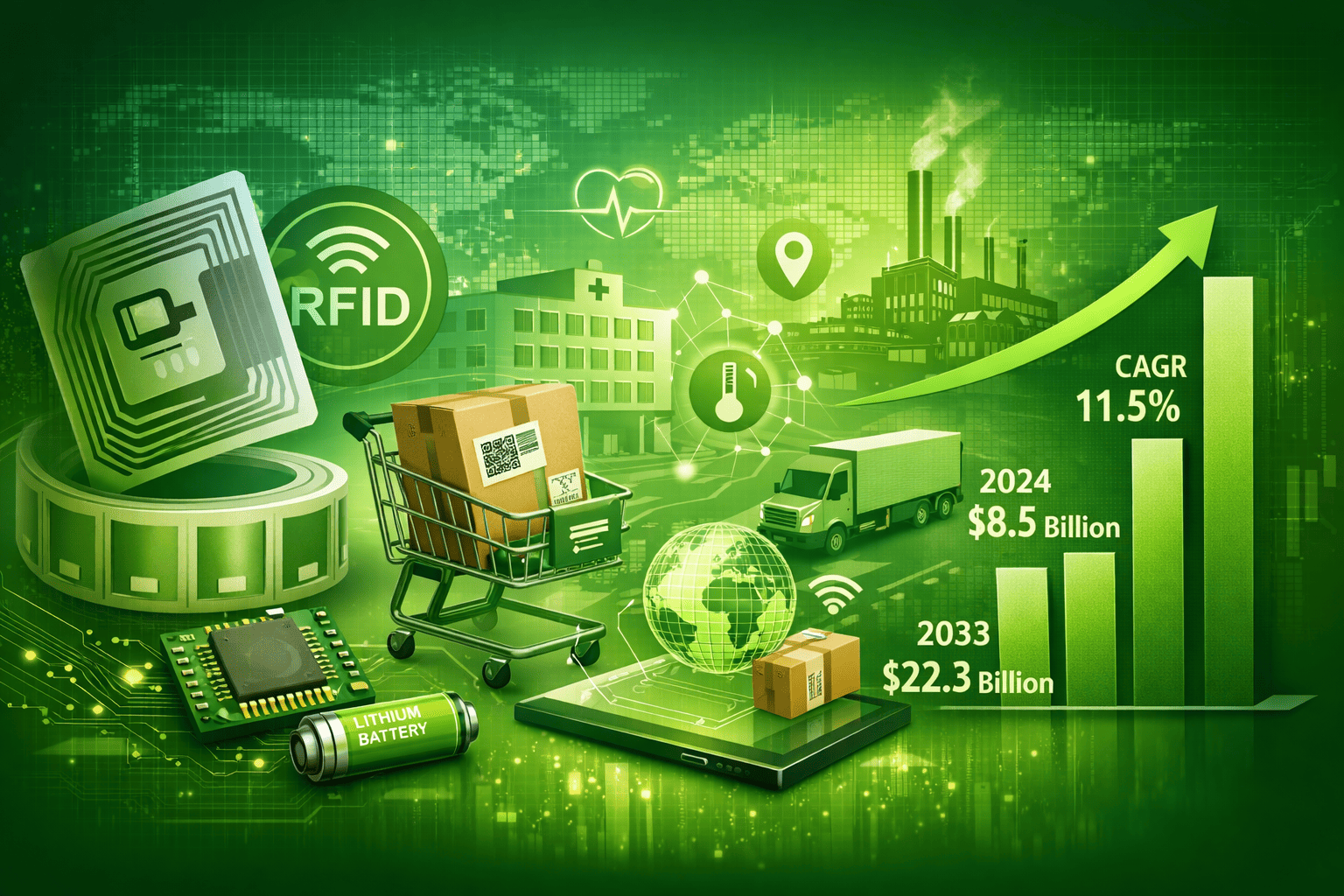
The Smart Label market was valued at $8.5 billion in 2024 and is projected to reach $22.3 billion by 2033, growing at a CAGR of 11.5% during the forecast period 2025-2033.
The smart label market is undergoing a period of exceptional growth, cementing its role as a foundational technology across retail, healthcare, logistics, and manufacturing. Valued at $8.5 billion in 2024, the market is projected to reach $22.3 billion by 2033, expanding at a compound annual growth rate (CAGR) of 11.5% during the forecast period 2025-2033. This trajectory reflects a fundamental shift in how businesses manage inventory, authenticate products, and build transparency across complex supply chains.
https://www.strategicpackaginginsights.com/report/smart-label-market
What Is Driving This Explosive Growth?
At the heart of the smart label market's expansion is the surging demand for efficient inventory management. Traditional barcode systems, while functional, fall short in environments that require real-time, high-volume tracking. Smart labels bridge this gap by combining technologies like Radio Frequency Identification (RFID) and Near Field Communication (NFC) into compact, data-rich identifiers that communicate automatically with readers and digital systems.
The retail and logistics sectors have emerged as the primary adopters of this technology, and for good reason. As e-commerce reshapes consumer expectations around speed and accuracy, retailers need smarter tools to manage warehouse operations, reduce shrinkage, and enhance the customer experience. Smart labels deliver on all fronts, offering real-time stock visibility, theft deterrence through Electronic Article Surveillance (EAS), and enriched product information accessible to shoppers via smartphone.
Beyond retail, the accelerating digitalization of global supply chains is a powerful tailwind. Businesses are investing in automation and connected infrastructure to reduce operational costs, and smart labels fit seamlessly into these modernization efforts. Sensing labels that can monitor temperature, humidity, and other environmental variables are particularly transformative in cold-chain logistics and pharmaceutical distribution, where product integrity is non-negotiable.
Technology Breakdown: RFID Leads, NFC Gains Ground
RFID dominates the technology landscape of the smart label market. Its capacity to read multiple tags simultaneously over greater distances without line-of-sight requirements makes it the backbone of large-scale inventory operations. Both passive RFID, which draws power from reader signals, and active RFID, which carries its own power source, are finding expanding roles in retail stores, distribution centers, and manufacturing facilities. The ongoing development of next-generation RFID chips is pushing down costs while increasing data capacity, making the technology accessible to a broader range of enterprises.
NFC technology is carving out its own significant niche, particularly in consumer-facing applications. The contactless communication standard enables tap-to-read interactions between smart labels and smartphones, unlocking new possibilities in product authentication, loyalty programs, and interactive marketing. In the healthcare sector, NFC-enabled labels are being used to verify the authenticity of medications and medical devices, directly addressing concerns around counterfeit products.
Electronic Article Surveillance and sensing labels round out the technology segment. Sensing labels, in particular, represent one of the most exciting frontiers in the market. Their ability to detect and transmit environmental conditions in real time is reshaping how perishable goods, biological samples, and temperature-sensitive products are tracked throughout the supply chain.
Application Segments: Retail and Healthcare Lead the Charge
The retail sector accounts for the largest share of smart label applications, driven by the twin imperatives of inventory efficiency and customer engagement. Smart labels give retailers granular, real-time visibility into stock levels, enabling automatic replenishment triggers and reducing the risk of out-of-stock scenarios. At the same time, consumer-facing NFC labels are enhancing in-store experiences by delivering product stories, usage guides, and sustainability credentials directly to shoppers' devices.
Healthcare is the most rapidly advancing application segment, driven by mounting pressure to ensure patient safety and operational efficiency. Smart labels are being deployed to track medical equipment, pharmaceuticals, and consumables throughout hospital and clinic environments. Sensing labels capable of monitoring storage conditions are proving particularly valuable for vaccines and biologics, where temperature excursions can render products ineffective. The ability to provide full chain-of-custody documentation through smart label data is also helping healthcare providers meet increasingly stringent regulatory requirements.
The logistics and food and beverage industries are also significant adopters. In logistics, smart labels enable automated sorting, real-time shipment tracking, and faster customs clearance. In food and beverage, the technology is helping producers and retailers demonstrate product provenance, extend shelf life management, and comply with food safety regulations by maintaining detailed temperature and handling records.
Component Insights: Batteries and Transceivers Power the Ecosystem
Two component categories define the hardware architecture of smart labels: batteries and transceivers. Batteries are critical for active and semi-passive smart labels that must transmit data independently of reader proximity. Advances in lithium-ion and emerging solid-state battery technologies are extending the operational life of smart labels while reducing their physical footprint. Eco-friendly battery formulations are also gaining traction as manufacturers respond to sustainability expectations from brand owners and regulators alike.
Transceivers handle the communication layer, enabling smart labels to both receive and transmit signals. The push toward low-power transceiver designs is particularly significant for large-scale deployments where energy consumption and battery replacement costs are key operational considerations. High-frequency transceiver innovations are simultaneously boosting read ranges and data throughput, making smart labels more capable in demanding industrial environments.
Regional Dynamics: A Truly Global Market
North America holds a dominant regional position, underpinned by robust retail and logistics infrastructure, high technology adoption rates, and the presence of major market players. The United States alone accounts for a $2.5 billion share, growing at a 10% CAGR, supported by continued investment in supply chain modernization and sustainability initiatives.
China is emerging as the fastest-growing market, with a $1.8 billion valuation and a 12% CAGR. The country's massive e-commerce ecosystem, government-backed digitalization programs, and expanding manufacturing sector create an exceptionally fertile environment for smart label adoption.
Germany and Japan are maintaining strong positions within Europe and Asia Pacific respectively, driven by advanced manufacturing sectors and deep commitments to industrial automation. The United Kingdom, backed by a sophisticated retail industry, is also contributing meaningfully to global market expansion.
Challenges on the Path Forward
Despite its robust growth outlook, the smart label market faces real obstacles. The upfront cost of implementing smart label infrastructure remains a significant barrier for small and medium-sized enterprises. Integrating smart label systems with legacy enterprise software adds further complexity and cost. The absence of universal standards and protocols creates interoperability challenges across global supply chains, slowing adoption in some sectors.
Addressing these challenges will require collaboration between technology providers, industry bodies, and regulators to establish clearer standards and more accessible implementation pathways. Investment in training and support ecosystems will also be essential for broadening the market beyond large enterprise deployments.
The Road to 2033
The smart label market is not merely a technology trend. It is a structural shift in how physical goods are identified, tracked, and authenticated across the global economy. With sustainability pressures mounting, automation accelerating, and consumer expectations rising, the case for smart labels grows stronger with each passing year. Companies that invest early in smart label capabilities will be well-positioned to lead in an era defined by supply chain intelligence, real-time visibility, and data-driven decision-making.