
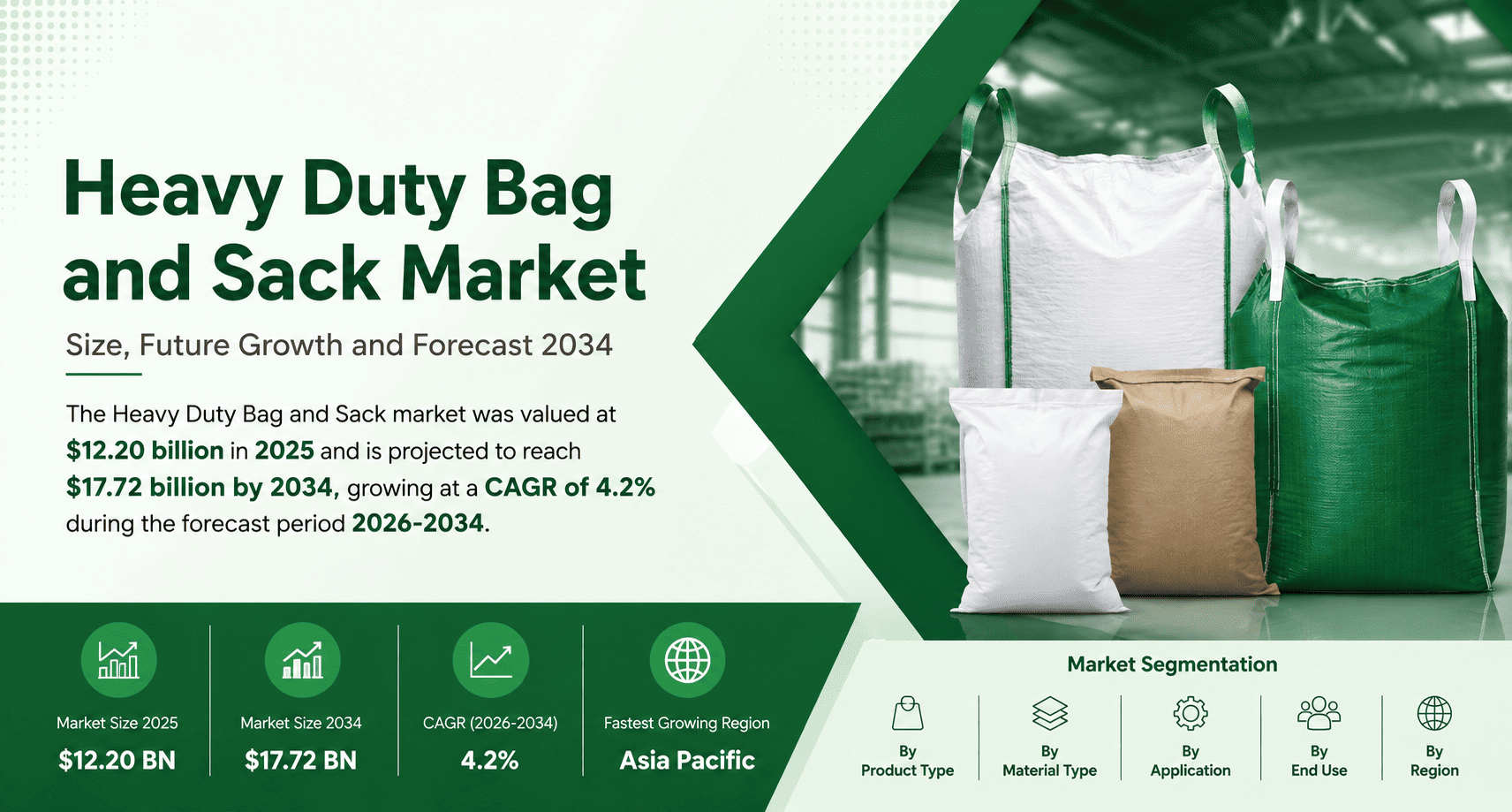
The Heavy Duty Bag and Sack market was valued at $12.20 billion in 2025 and is projected to reach $17.72 billion by 2034, growing at a CAGR of 4.2% during the forecast period 2026-2034.
The Heavy Duty Bag and Sack Market was valued at $12.20 billion in 2025 and is projected to reach $17.72 billion by 2034, growing at a CAGR of 4.2% during the forecast period 2026-2034. This market serves as a critical component of global industrial supply chains, providing durable packaging solutions across construction, agriculture, chemicals, and logistics sectors.
Heavy-duty bags and sacks are engineered to withstand demanding physical conditions, including extreme temperatures, heavy loads, and prolonged transit. Their relevance continues to expand as industrialization accelerates across emerging and developed economies alike.
https://www.strategicpackaginginsights.com/report/heavy-duty-bag-and-sack-market
Key Growth Drivers of the Heavy Duty Bag and Sack Market
Urbanization and Industrial Sector Expansion
Rapid urbanization, particularly across Asia Pacific, Latin America, and Africa, is one of the strongest demand catalysts in this market. Large-scale infrastructure projects are generating consistent demand for cement packaging, aggregates transport, and construction material handling, all of which rely heavily on durable bag and sack solutions. Government investments in roads, housing, and industrial parks are further reinforcing this trend through 2034.
Sustainability and Eco-Friendly Material Innovation
Environmental responsibility is reshaping material preferences across the packaging industry. Manufacturers are transitioning from conventional polypropylene and polyethylene toward paper-based and composite materials that offer reduced environmental impact. Regulatory restrictions on single-use plastics in the European Union, North America, and parts of Asia are accelerating this shift. Companies investing in biodegradable and recyclable heavy-duty packaging stand to gain meaningful competitive advantages as compliance requirements tighten.
E-Commerce and Logistics Growth
The global expansion of e-commerce has created new demand channels for heavy-duty packaging. Online retail requires robust, reliable packaging that protects goods through complex multi-step logistics networks. Heavy-duty sacks and industrial bags are increasingly adopted by fulfillment centers and third-party logistics operators to ensure product integrity from warehouse to last-mile delivery. This trend is expected to sustain demand growth well beyond 2030.
Heavy Duty Bag and Sack Market Segmentation Analysis
Product Type Analysis
The market is segmented into heavy-duty sacks, industrial bags, and woven sacks. Heavy-duty sacks dominate due to their widespread application in construction and agriculture. Industrial bags are favored in the chemicals and waste management sectors for their specialized containment properties. Woven sacks are gaining traction in logistics and agriculture owing to their strength-to-weight ratio and cost-effectiveness.
Material Type Analysis
Polypropylene (PP) and polyethylene (PE) remain the most widely used materials due to their superior tensile strength and moisture resistance. However, paper and composite materials are gaining market share as sustainability considerations become central to procurement decisions. Composite materials, in particular, are being adopted for applications requiring a combination of strength and environmental compliance.
Application Analysis
Key application segments include cement, chemicals, agriculture, and waste management. The cement industry is the largest single application, driven by ongoing construction activity globally. The agriculture segment is expanding rapidly, particularly in India and Brazil, where packaging of seeds, fertilizers, and harvested produce requires high-performance sack solutions. Waste management represents an emerging growth area, with municipalities and industrial operators seeking durable containment options.
End Use Analysis
Construction remains the dominant end-use sector, followed by industrial, agriculture, and logistics applications. The logistics sector is witnessing accelerated adoption as global trade volumes increase and supply chain resilience becomes a strategic priority for businesses.
Market Challenges and Industry Barriers
The Heavy Duty Bag and Sack Market faces notable headwinds that market participants must actively manage. Raw material price volatility is a primary challenge, as polypropylene and polyethylene prices are closely linked to petrochemical market fluctuations. Sudden input cost increases can compress manufacturer margins and disrupt pricing strategies.
Regulatory pressure surrounding plastic-based packaging is another significant barrier. Governments in multiple regions are implementing bans and restrictions on certain packaging materials, forcing manufacturers to reformulate product lines and invest in alternative solutions.
Competition from flexible packaging and rigid containers presents ongoing pressure. As these alternative formats improve in performance and cost-efficiency, heavy-duty bag and sack manufacturers must innovate continuously to retain market relevance.
Regional Outlook of the Heavy Duty Bag and Sack Market
The United States holds a market size of approximately $3.5 billion, growing at a CAGR of 3%. Industrial strength, sustainability initiatives, and robust e-commerce infrastructure underpin steady demand growth.
China represents a $2.8 billion market expanding at a CAGR of 5%, driven by infrastructure investment and an ongoing commitment to urbanization and industrial output expansion.
Germany, the leading European market at $1.9 billion and a CAGR of 4%, is shaped by stringent environmental regulations and strong manufacturing sector demand for high-performance industrial packaging.
India is one of the fastest-growing markets globally, valued at $1.5 billion with a CAGR of 6%. Infrastructure development programs and agricultural sector growth are the primary demand drivers.
Brazil leads Latin America with a $1.2 billion market at a CAGR of 4%, supported by industrial expansion and government sustainability programs.
Competitive Landscape of the Heavy Duty Bag and Sack Market
The competitive landscape includes established global players such as Mondi, Berry Global, LC Packaging, Novolex, Greif, Hood Packaging, Smurfit Kappa, International Paper, ProAmpac, and NNZ Group. Mondi leads with a strong focus on sustainable packaging innovation. Berry Global leverages strategic acquisitions and advanced manufacturing to broaden its industrial packaging portfolio. Smurfit Kappa and International Paper are prominent in fiber-based heavy-duty solutions, aligning with global sustainability mandates. These companies collectively drive product development, capacity expansion, and regulatory compliance across the market.
Future Outlook of the Heavy Duty Bag and Sack Market
The Heavy Duty Bag and Sack Market is on a steady growth trajectory through 2034, supported by construction activity, agricultural modernization, and logistics sector expansion. Innovation in sustainable materials, digital printing for branding, and advanced manufacturing processes will define competitive differentiation. Asia Pacific is expected to register the highest regional growth rate, making it the primary geography for market investment and expansion over the coming decade.