
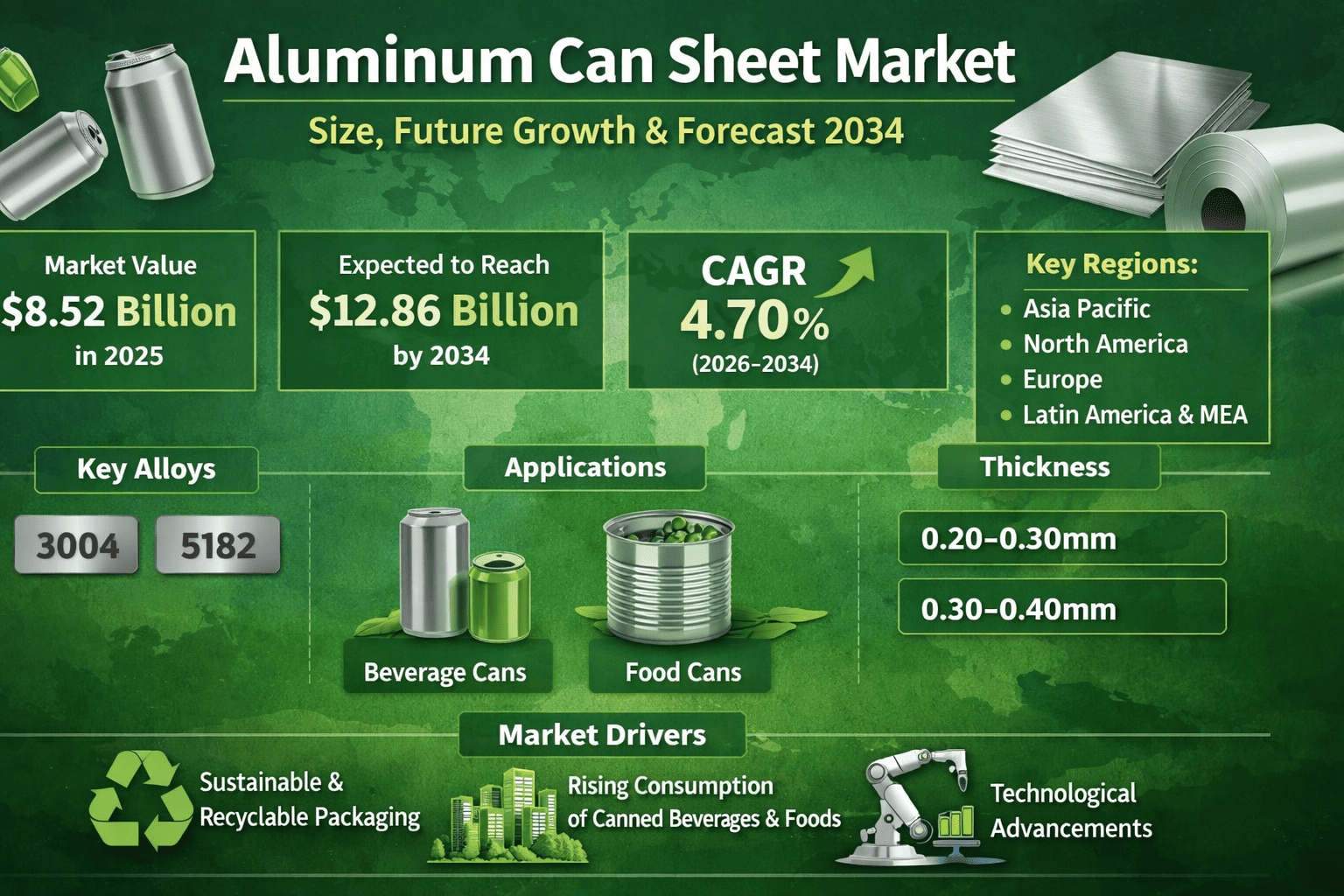
The Aluminum Can Sheet market was valued at $8.52 billion in 2025 and is projected to reach $12.86 billion by 2034, growing at a CAGR of 4.70% during the forecast period 2026-2034.
Introduction to the Aluminum Can Sheet Market
The Aluminum Can Sheet market was valued at $8.52 billion in 2025 and is projected to reach $12.86 billion by 2034, growing at a compound annual growth rate of 4.70% during the forecast period from 2026 to 2034.
Aluminum can sheets are thin, rolled aluminum products used primarily in the manufacture of beverage and food cans. Their lightweight nature, corrosion resistance, and infinite recyclability make them a preferred packaging material across multiple industries. Rising environmental awareness and increasing demand for sustainable packaging continue to accelerate adoption across both mature and emerging markets.
https://www.strategicpackaginginsights.com/report/aluminum-can-sheet-market
Key Growth Drivers of the Aluminum Can Sheet Market
Urbanization and Rising Consumption of Canned Products
Rapid urbanization, especially across Asia Pacific and Latin America, is reshaping consumer lifestyles and purchasing habits. Urban populations increasingly prefer convenient, ready-to-drink beverages and ready-to-eat meals, which are predominantly packaged in aluminum cans. This behavioral shift is directly translating into stronger demand for aluminum can sheets across the supply chain.
Sustainability and Recyclability as Competitive Advantages
Aluminum is 100% recyclable without any loss of material quality, making aluminum can sheets a strong fit with evolving environmental regulations and corporate sustainability commitments. Governments across Europe, North America, and Asia are actively promoting recyclable packaging through policy incentives. Manufacturers that align with these standards gain a significant competitive advantage over those relying on plastics or multi-layer materials.
Technological Advancements in Aluminum Sheet Production
Continuous improvements in rolling technology, surface treatment, and alloy development are enhancing the efficiency and performance of aluminum can sheets. Digitalization and automation in production facilities are reducing costs, improving consistency, and enabling faster turnaround. The development of new aluminum alloys with superior strength and formability is opening product differentiation opportunities for leading manufacturers.
Aluminum Can Sheet Market Segmentation Analysis
Alloy Type Analysis
The market is segmented into two primary alloy types: 3004 and 5182. The 3004 alloy dominates the beverage can segment due to its excellent formability and corrosion resistance, making it compatible with high-speed canning lines and a wide range of coatings. The 5182 alloy is preferred for food cans, where higher strength and greater resistance to external stressors are essential. Both alloy types are benefiting from ongoing research into next-generation formulations.
Thickness Analysis
Thickness segmentation covers the 0.20-0.30mm and 0.30-0.40mm ranges. Thinner sheets in the 0.20-0.30mm range are widely adopted for beverage cans, offering an optimal balance of structural integrity and low material weight. The 0.30-0.40mm range is used predominantly in food cans, where additional durability is required to withstand processing, transportation, and storage conditions. Demand across both segments is linked closely to end-use consumption patterns.
Application Analysis
Beverage cans represent the largest application segment, driven by the growing popularity of craft beers, energy drinks, and carbonated soft drinks. Aluminum cans preserve carbonation and protect flavor, making them a preferred format for premium beverage brands. Food cans constitute a growing segment, supported by rising demand for shelf-stable, ready-to-eat products and the global focus on reducing food waste through extended shelf life packaging.
Distribution Channel Analysis
Aluminum can sheet manufacturers primarily serve large-scale can producers through direct supply agreements. Regional distributors and intermediaries play a secondary role in markets with fragmented manufacturing bases. Major beverage and food corporations are increasingly pursuing integrated supply arrangements with sheet producers to ensure consistent quality, material specifications, and supply continuity.
Market Challenges and Industry Barriers
The Aluminum Can Sheet market faces notable headwinds. Aluminum price volatility, driven by geopolitical tensions, trade policy shifts, and supply chain disruptions, poses a persistent challenge for manufacturers in managing their cost structures and maintaining stable margins.
Stringent environmental regulations governing bauxite mining and aluminum smelting add compliance complexity and operational costs. Competition from alternative packaging materials, including PET plastics, glass, and multilayer flexible pouches, remains a constant pressure. Manufacturers must continuously invest in innovation and efficiency to defend market share against lower-cost substitutes.
Regional Outlook of the Aluminum Can Sheet Market
The United States holds a significant market share, supported by high per-capita consumption of canned beverages and robust recycling infrastructure. The U.S. market is growing at a CAGR of approximately 3%, with government policies actively encouraging sustainable packaging.
China is the fastest-growing major economy in this market, expanding at a CAGR of 6%. Rising disposable incomes, urbanization, and government initiatives promoting advanced manufacturing and sustainable packaging are the primary growth enablers.
Germany leads the European market with a CAGR of approximately 4%, underpinned by strong sustainability mandates and a highly developed food and beverage manufacturing sector.
Brazil is growing at a CAGR of 5%, driven by increasing canned beverage consumption and improving economic conditions. India represents an emerging high-growth market with a CAGR of 7%, supported by urbanization, rising incomes, and expanding food processing industries.
Competitive Landscape of the Aluminum Can Sheet Market
Key players operating in the Aluminum Can Sheet market include Novelis, Constellium, Ardagh Metal Packaging, Ball Corporation, Aleris, Norsk Hydro, Amcor, Hindalco Industries, Nampak, and Alcoa. Novelis holds a prominent market position through its diversified portfolio and global manufacturing network. Constellium differentiates through its research-driven approach and advanced aluminum solutions. Companies across the competitive landscape are pursuing mergers, acquisitions, and partnerships to strengthen their positions and broaden their product capabilities.
Future Outlook of the Aluminum Can Sheet Market
The Aluminum Can Sheet market is on a stable upward trajectory through 2034. Growth will be underpinned by sustained demand from the beverage and food packaging sectors, accelerating sustainability mandates, and continued alloy and process innovation. Asia Pacific and Latin America will serve as the primary growth engines, while North America and Europe contribute consistent volume through premium and sustainability-driven applications. Manufacturers that invest in automation, advanced alloy development, and circular economy integration will be best positioned to capture long-term value in this expanding market.